


Generative AI taught software to create. Agentic AI is teaching it to act.
That distinction sounds small, but it’s the difference between a tool that writes you a reply and a system that reads the enquiry, checks your order history, processes the refund and confirms it back to the customer, without a person even touching the enter key on their keyboard.
For brands working with a digital marketing agency, this shift matters for two separate reasons. First, agentic AI is already changing how customer service, sales and marketing operations run day to day. Second, and less talked about, autonomous AI agents are increasingly the ones researching and even purchasing products on a customer’s behalf, which means brands now need to be understood by software, not just by people.
In short: agentic AI refers to autonomous systems that can perceive, reason and take multi-step action toward a goal with limited human oversight, going beyond generative AI’s content creation to actually complete tasks. Brands benefit both by using agentic AI internally, for service, sales and marketing automation, and by optimising their own data so external AI agents can find and recommend them.
Fast facts
| Core distinction | Generative AI creates content; agentic AI plans, reasons and acts autonomously. |
|---|---|
| Enterprise adoption | 35% of organisations had adopted AI agents by 2023, with another 44% planning to (MIT Sloan Management Review and BCG survey). |
| Workforce projection | 15% of day-to-day work decisions are expected to be made autonomously via agentic AI by 2028, up from 0% in 2024 (Gartner). |
| India-specific adoption | 43% of Indian IT security teams already use agents in daily operations, expected to more than double within two years (Salesforce). |
| Agentic commerce opportunity | $3 to $5 trillion globally by 2030 (McKinsey). |
| Live agent-commerce protocols | Agentic Commerce Protocol (Stripe and OpenAI, 2025) and Universal Commerce Protocol (Google, 2026). |
Table of Contents
- What Is Agentic AI?
- What Is the Difference Between Agentic AI and Generative AI?
- How Does Agentic AI Actually Work?
- How Are Brands Already Using Agentic AI?
- What Is B2A Marketing, and Why Should Brands Care?
- How Can Brands Use Agentic AI?
- What Is the Future of Agentic AI?
- What Are the Biggest Challenges of Agentic AI?
- What Should Brands Do to Prepare?
- In Conclusion
- FAQs
What Is Agentic AI?
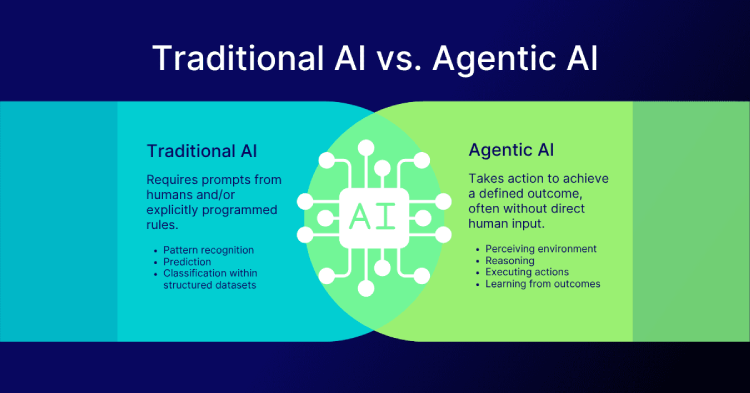
Agentic AI refers to AI systems that can accomplish a specific goal with limited human supervision, using machine learning models that reason through multi-step problems and take real actions, rather than simply generating a response.
The word “agentic” describes agency, the system’s capacity to act independently and purposefully rather than waiting for a new prompt at every step. Unlike earlier AI tools that operate within fixed constraints and need constant human direction, agentic systems can:
- Maintain a goal across multiple steps rather than answering one query at a time
- Call external tools and APIs to actually complete a task, not just describe how to do it
- Adjust their approach based on real-time feedback as a task unfolds
Adoption is already well underway rather than theoretical. A spring 2025 survey by MIT Sloan Management Review and Boston Consulting Group found that 35% of organisations had adopted AI agents by 2023, with a further 44% planning to deploy them shortly after. This isn’t an emerging technology brands can safely ignore for another product cycle; it’s already at the point where most organisations either have a plan or are actively behind one.
What Is the Difference Between Agentic AI and Generative AI?
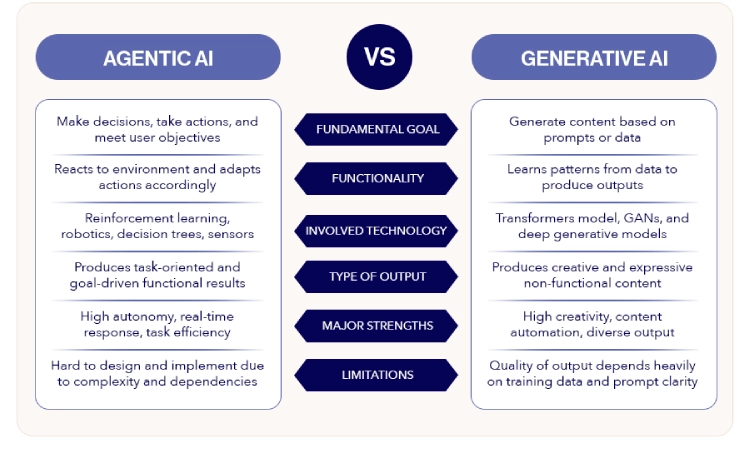
Generative AI creates new content, text, images, code or audio, based on a prompt, while agentic AI goes further by planning, reasoning and autonomously executing multi-step actions to achieve a goal, often using generative AI as one tool within that larger process.
| Generative AI | Agentic AI | |
|---|---|---|
| Core function | Produces content based on a prompt | Plans and executes actions to reach a goal |
| Human involvement | Typically needed at each new prompt | Can operate across multiple steps with limited oversight |
| Example | Writing a product description | Researching competitor prices, updating the listing, and notifying the team unprompted |
| Relationship | A building block that agentic systems can call on | Uses generative AI as one tool among several |
A simple way to hold the difference: a generative AI model can tell you the best time to visit a destination based on your schedule. An agentic AI system can take that same insight and actually book the flight and the hotel for you.
Also Read: Understanding New Era Of AI SEO And What You Need To Know
How Does Agentic AI Actually Work?
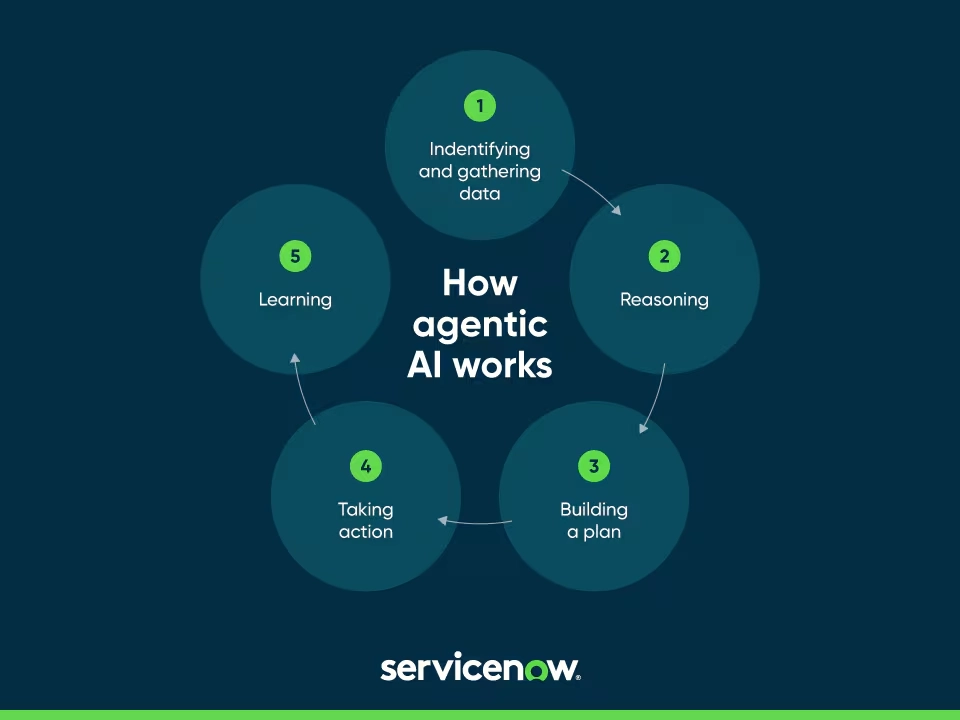
Agentic AI systems generally follow a repeating cycle: perceiving information from their environment, reasoning about what it means, setting or refining a goal, deciding on the best action, executing that action through a connected tool or API, and then learning from the outcome to improve the next cycle.
For a non-technical audience, it’s more useful to think of this as a loop than a single step:
- Perceive: the system gathers relevant data from databases, APIs or user interactions
- Reason: it interprets that data to understand context and what’s actually being asked
- Decide: it chooses the best available action based on the goal it’s been given
- Act: it executes that action through a connected system, rather than just describing it
- Learn: it reviews the outcome and adjusts its approach for next time
This loop is what allows an agent to handle something like an IT support ticket end to end, verifying a user’s identity, resetting a password and confirming the fix, instead of simply telling a human what steps to follow.
How Are Brands Already Using Agentic AI?
Brands across sectors are already deploying agentic AI for customer service, sales pipeline management and marketing campaign execution, using agents that complete entire workflows rather than just assisting a human through them.
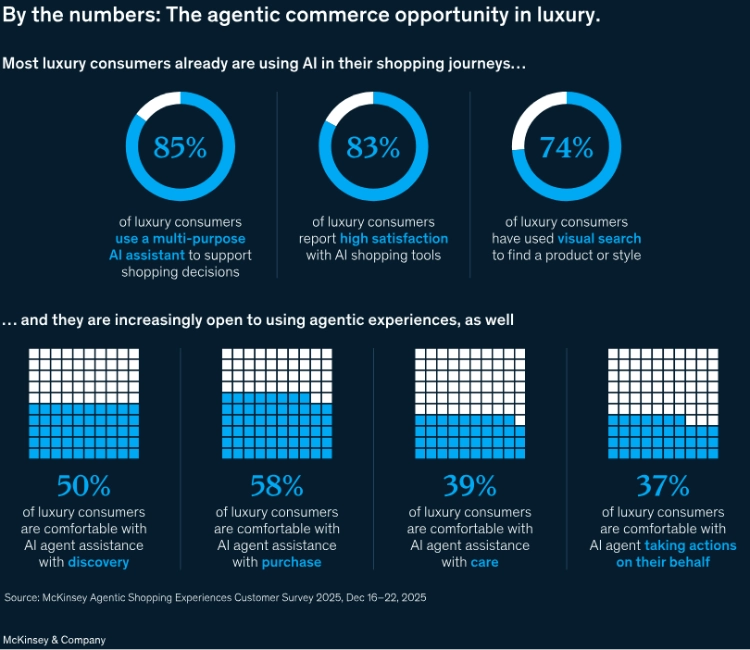
Source / Image Credit: McKinsey & Company, Agentic Shopping Experiences Customer Survey 2025
Agentic AI has evolved past basic chat assistants to run complete, multi-step workflows end-to-end. With employees spending 41% of their time on repetitive tasks, autonomous agents are protecting margins across four core areas:
- Customer Service at Scale: Brands like SharkNinja (across 36 product lines) and Fisher & Paykel deploy agents to resolve complete support tickets, process returns, and update accounts without human intervention.
- Wholesale & Retail Execution: Wholesale distributor RNDC uses conversational agents to let field reps instantly query store compliance in plain language and receive real-time inventory recommendations.
- Luxury Clienteling: ZEGNA (ZEGNA X) provides sales associates with AI copilots to tailor 1-on-1 outreach, while Ralph Lauren (“Ask Ralph”) uses an in-app conversational stylist to curate outfits.
- Upstream Commerce: McKinsey research reveals 85% of shoppers use AI tools (like Perplexity or Gemini) to evaluate products before visiting a store, shifting product discovery upstream.
- Key Impact: McKinsey estimates AI agents could mediate $3T to $5T in global commerce by 2030.
For a smaller brand, the more realistic starting point is usually customer service and campaign management, since these are the workflows where a Performance marketing agency can help implement agentic tools without needing an enterprise-scale IT team behind it.
What Is B2A Marketing, and Why Should Brands Care?
Business-to-Agent (B2A) marketing is the practice of making a brand discoverable and selectable to autonomous AI agents that research, compare and increasingly purchase on a customer’s behalf, sitting alongside traditional marketing to human audiences rather than replacing it.
This is where agentic AI stops being purely an internal efficiency tool and starts becoming a genuine marketing concern. The term itself surfaced through Y Combinator’s own Request for Startups as a category distinct from B2B and B2C, and the scale behind it is real rather than speculative:
- McKinsey projects the global agentic commerce opportunity, the practical output of B2A marketing strategy, could reach $3 to $5 trillion by 2030
- J.P. Morgan estimates up to 25% of US online sales could be agent-mediated by 2030
- Shopify has reported AI-driven traffic to its merchant stores growing 8x year over year in the first quarter of 2026, with 14% higher average order values than organic search
Agentic commerce optimisation is still genuinely early. Brands that treat this as a real workstream now, rather than a future consideration, are positioning themselves ahead of a shift most competitors haven’t started planning for yet.
How Can Brands Use Agentic AI?
Brands become readable to AI agents primarily through structured, machine-readable data, consistent product and pricing information across every channel, and clean crawler access, since agents bypass sites where key information is inconsistent or hidden behind unstructured marketing copy.
A few concrete things this involves:
- Implementing Product, Offer and Review schema markup correctly, so machine-readable brand data actually reflects your live pricing and stock, not a stale snapshot
- Keeping shipping, returns and policy information in a fetchable format rather than only inside a PDF or image, since agents can’t easily parse either
- Allowing legitimate retrieval bots like OAI-SearchBot and PerplexityBot through your robots.txt, even if you separately block AI training crawlers
One nuance worth knowing here, since it’s often misunderstood: this overlaps with, but isn’t identical to, Generative Engine Optimisation, which is about being cited in AI-generated answers rather than being transacted with directly.
A large-scale analysis of AI bot traffic found that major crawlers including GPTBot, ClaudeBot and PerplexityBot largely skip llms.txt files and crawl standard HTML directly instead, so a well-maintained llms.txt matters less for citation than most guides suggest, and more as a machine-readable map for agents actually trying to complete a task on your site.
A proper Technical SEO audit services engagement is usually the fastest way to find out where these gaps actually sit, since most brands only discover inconsistent schema or blocked crawler access once someone audits at that level rather than just checking page rankings.
What Is the Future of Agentic AI?
The future of Agentic AI is autonomous, collaborative and outcome-driven. Unlike traditional AI, which responds to prompts, Agentic AI can plan, reason, make decisions and complete multi-step tasks with minimal human intervention. As large language models become more capable and businesses increasingly adopt AI automation, Agentic AI is set to become the foundation of next-generation digital work.
What can we expect from Agentic AI?
- Autonomous task execution: AI agents will independently manage complex workflows, from research and scheduling to software development and customer support.
- Smarter business operations: Organisations will use AI agents to improve productivity, reduce manual effort and accelerate decision-making.
- Multi-agent collaboration: Specialised AI agents will work together, sharing information and coordinating tasks to solve more sophisticated problems.
- Hyper-personalised experiences: AI will understand user context, preferences and intent to deliver more relevant recommendations and interactions.
- Continuous learning: Future AI agents will adapt through feedback and evolving data, becoming more effective over time.
- Human-AI partnership: Rather than replacing people, Agentic AI will augment human expertise by handling repetitive work and enabling teams to focus on creativity, strategy and innovation.
What Are the Biggest Challenges of Agentic AI?
While the potential is enormous, greater autonomy comes with greater responsibility.
- Accuracy and reliability: AI agents can still make incorrect decisions or confidently produce inaccurate outputs.
- Bias and fairness: Poor-quality or biased training data can lead to unfair or inconsistent outcomes.
- Privacy and security: Autonomous systems often require access to sensitive information, making strong cybersecurity and data governance essential.
- Transparency and accountability: As AI becomes more independent, organisations must be able to explain how decisions were made and determine who is responsible when errors occur.
- Regulation and compliance: Governments worldwide are introducing AI regulations, requiring businesses to balance innovation with legal and ethical standards.
- Workforce transformation: Many routine roles will evolve, increasing the need for reskilling and creating new opportunities centred around AI oversight, governance and collaboration.
The Bottom Line
Agentic AI represents the next evolution of artificial intelligence—moving from systems that simply generate answers to systems that achieve outcomes. The organisations that succeed won’t be those that automate everything. They’ll be the ones that combine autonomous AI with human judgement, ethical governance and clear accountability.
Because even the smartest AI still benefits from a human who knows when to take the wheel.
What Should Brands Do to Prepare?
Brands preparing for agentic AI should start by identifying one internal workflow suited to automation, auditing their external data for consistency across channels, and building conversion paths that can support an agent-completed transaction, rather than trying to overhaul everything at once.
A practical starting sequence:
- Pick one repetitive, well-defined workflow; customer service enquiries are usually the easiest entry point, and pilot an agent there before expanding further
- Audit whether your pricing, availability and product details actually match across your website, marketplace listings and product feeds
- Review whether your checkout or enquiry process could support an agent completing a transaction on a customer’s behalf, which is what ‘how to optimise for AI agents’ actually means in practice
- Treat this as an ongoing part of your Digital marketing strategy rather than a one-off technical project, since agent behaviour and the protocols they use will keep evolving
Brands investing in this early are effectively building the infrastructure that E-commerce growth services will be built on for the next several years, not a short-term optimisation.
You might also like: How to Get Featured in Google AI Mode (Before Everyone Else Does)
In Conclusion
Agentic AI isn’t a single product or trend to watch from the sidelines; it’s a genuine shift in how software completes tasks, and increasingly, in how customers discover and buy from brands at all. The organisations already testing this, inside their own operations and in how they present themselves to external agents, aren’t taking a bet on the future. They’re responding to adoption that’s already well underway.
For most brands, the sensible starting point isn’t a full rebuild. It’s picking one workflow to automate internally, and one honest audit of how readable your brand actually is to the AI systems already researching products on your customers’ behalf.
If you’re figuring out where to start, Flora Fountain works as a SEO agency in Ahmedabad for exactly this kind of transition, helping brands get genuinely ready for both human and AI-driven discovery. Drop us a line at hello@florafountain.com and let’s map out where your brand stands today.
Frequently Asked Questions

The founder and partner of Flora Fountain, Shefali leads the Content and Technology divisions. A one-time engineer who started her career writing front-end code, she took a detour sometime during her 9 years in New York, studied journalism and started writing prose, poetry and sometimes jokes. She now has 15...