


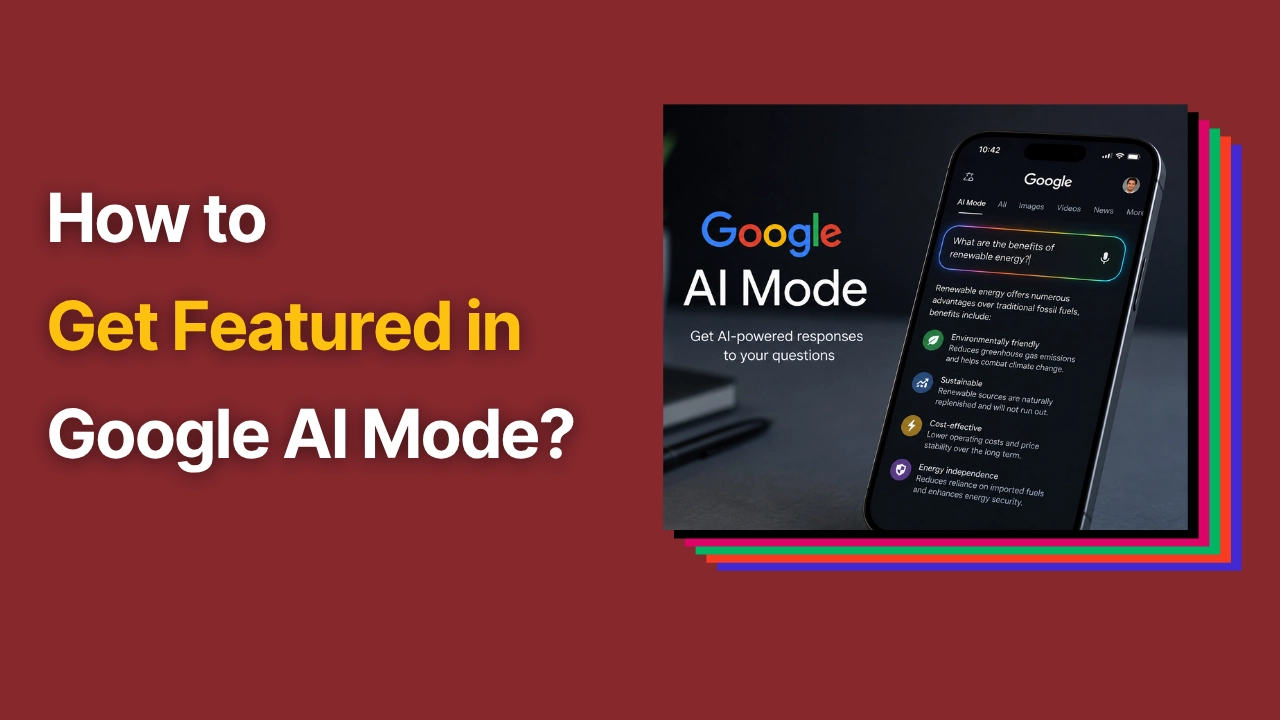
A customer searches for a service exactly like yours. Instead of the usual ten blue links, Google generates a full answer, pulls together information from a handful of sites and cites two or three of them directly. Your competitor’s website is one of them. Yours isn’t anywhere, right?
That’s the reality more business owners are running into as Google AI Mode becomes a normal part of how people search. Ranking on page one is still very important, but it no longer guarantees visibility, since Google AI Mode reads, compares and summarises information from across the web before a user even clicks a link.
If you want your website to be one of the sources Google chooses, it helps to understand exactly how this system decides what to show. This is the practical side of Google AI Mode SEO, and here’s what actually works, based on Google’s own documentation rather than speculation.
Table of Contents
- What Is Google AI Mode?
- Google AI Mode vs AI Overviews
- How Does Google Choose Websites for AI Mode?
- How to Rank in Google AI Mode
- AI Overviews Optimisation Best Practices
- Common Mistakes to Avoid
- Quick Checklist
- Bringing It All Together
- FAQs
What Is Google AI Mode?
Google AI Mode is a conversational search experience built directly into Google Search. Instead of a list of links, it gives you a synthesised answer built from multiple sources, with the option to ask follow-up questions in the same session.
It runs on a technique Google calls query fan-out, where a single question gets broken down into several related sub-queries. Google searches for each one separately, then combines the results into one coherent response. If someone asks about the best air conditioner for a small apartment, AI Mode might search for energy ratings, price comparisons and installation costs behind the scenes before answering.
You’ll find AI Mode as its own tab in Google Search, alongside Images and News. Google has rolled it out to a growing number of countries and languages, and says it plans to keep expanding both its reach and its features.
Google AI Mode vs AI Overviews
AI Overviews are the short AI-generated summaries that sometimes appear at the top of a normal Google Search results page. Google AI Mode is a separate, full-page experience built for more complex questions that would usually take several searches to answer.
You may have also come across the term Search Generative Experience, or SGE. That was Google’s early experimental name for this kind of AI Search, tested through Search Labs before AI Overviews and AI Mode launched under their current names. If you’re still searching for Google SGE ranking advice, treat it as background reading, since SGE has been replaced by these two features.
You may also see the terms Answer Engine Optimisation (AEO) and Generative Engine Optimisation (GEO) used to describe this kind of work, alongside the broader label generative search optimisation. Google draws no real distinction between them, stating plainly that optimising for generative AI search is optimising for the search experience and is therefore still SEO.
| Feature | AI Overviews | AI Mode |
|---|---|---|
| Where it appears | Inside standard search results | Dedicated tab or full-screen view |
| Best suited for | Quick factual questions | Complex, multi-step or comparison queries |
| Follow-up questions | Limited | Built in, with session context |
| Format | Short summary with links | Longer, structured response |
Both features are built on Google’s core Search ranking and quality systems. Neither runs on a separate set of ranking rules.
How Does Google Choose Websites for AI Mode?
Google has confirmed there are no extra technical requirements for appearing in AI Mode or AI Overviews. A page needs to be indexed and eligible to appear in regular Search results with a snippet, the same baseline that applies to standard SEO.
From there, Google’s guidance and search rater documentation point to a consistent set of factors:
- Helpful Content: Pages written to genuinely help a reader, not to rank, tend to perform better across both traditional Search and AI features.
- Topical Authority: Sites that cover a subject in real depth, rather than one shallow post, are more likely to be seen as a reliable source.
- Expertise and experience: Content backed by real, first-hand knowledge aligns with the E-E-A-T framework Google’s search quality raters use, feeding into overall search quality.
- Freshness: Regularly updated pages signal that the information is still accurate.
- Entity SEO: Clear, consistent naming of your business, products and location helps Google connect your content to its Knowledge Graph.
- Trust: Transparent sourcing, accurate claims and a clear byline all matter, especially for topics that affect money, health or safety.
- Crawlability: If Googlebot can’t read your page, it can’t be used to ground an AI answer.
The same fundamentals also help your content surface in other Large Language Models such as ChatGPT, Gemini, Claude and Perplexity, since all of them depend on similar principles of Information Retrieval from crawlable, well-structured content.
Some of this is confirmed by Google guidance. Some of it, like the exact weighting between factors, is informed by best practice rather than an official ranking formula. Google has said no outside tool has access to its internal ranking systems, so treat anyone claiming otherwise with caution.
How to Rank in Google AI Mode
1. Get the SEO fundamentals right first
Make sure your site is crawlable, mobile-friendly and reasonably fast before anything else. Google has stated plainly that AI features are rooted in the same core Search systems as regular ranking, so a page that already performs well in standard Search has a real shot at being cited in AI answers too.
2. Answer one question thoroughly per page
Query fan-out rewards content that answers a specific sub-question well and matches a clear search intent. A page trying to cover ten loosely related topics at once is harder for Google to match to any single query. Structure your content so each section could stand alone if it were the only thing retrieved.
3. Build genuine topical depth
Publishing one strong article rarely establishes authority on its own. Covering a topic from multiple angles through comparisons, guides, FAQs and regular updates builds real Topical Authority, rather than a one-off attempt at ranking.
4. Show real experience, not just expertise
Where you can, include details that only come from actually doing the work: real numbers, real photos, real case examples. This is the experience Google added to its rater guidelines in 2022, and it’s difficult for generic or AI-generated content to fake.
5. Keep your information accurate and current
Google AI Mode uses retrieval-augmented generation, meaning it pulls live information from the web rather than relying purely on stored training data. Outdated pages are less useful for grounding an answer, so review and update key pages on a regular schedule.
Also Read: AI Seo Workflow Step By Step
AI Overviews Optimisation Best Practices
A few practical habits make your content easier for both readers and AI systems to use and form the core of solid AI Overview Optimisation.
- Answer first, explain after: Open each section with a direct answer to the heading’s question, then expand on it.
- Use clear, semantic headings: This is the foundation of Semantic SEO: each heading should reflect one real question a reader is asking.
- Add an FAQ section: Short, specific questions and answers are easy for AI systems to lift and cite, improving your odds of AI Citations.
- Use structured data where relevant: Google has said schema markup isn’t required for AI features, but it still supports rich results in standard Search, so it’s worth keeping as part of your broader AI SEO.
- Link internally to related pages: This helps Google understand the full scope of what your site covers.
- Back up claims with evidence: Data, sources and specifics build trust faster than general statements and support stronger AI Search Results over time.
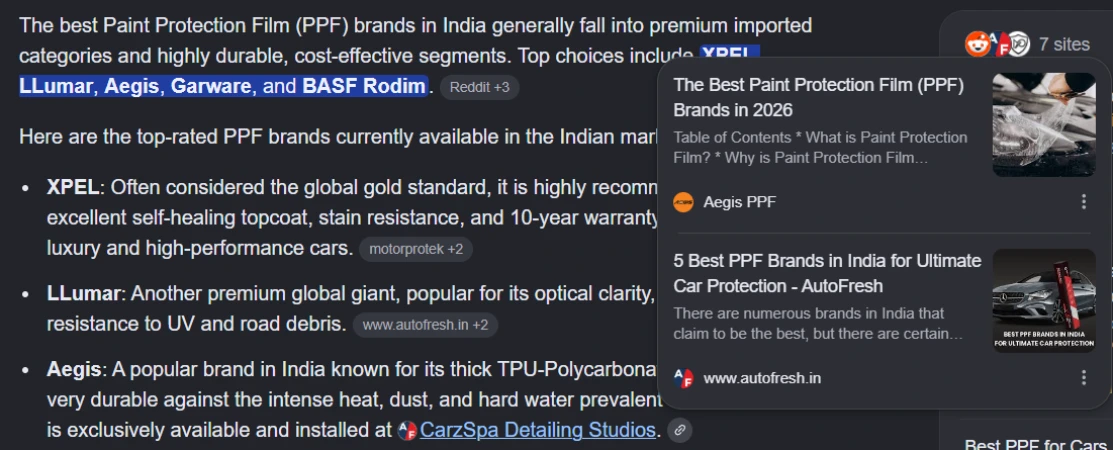
Recently, we implemented this for one of our clients, Aegis Films. We wanted Aegis Films’ name to be shown in the Google AI overview for the keyword “best PPF brand”. We implemented this exact process for the same and now Google’s AI overview suggests our brand when someone searches for “best PPF brand in India”.
Common Mistakes to Avoid
- Chasing AI SEO hacks instead of fundamentals: Google has said directly that optimising for generative AI search is still just SEO. There’s no secret shortcut.
- Publishing thin, generic content: Pages with little original value are less likely to be retrieved or cited.
- Ignoring crawlability. If your site blocks Googlebot or loads slowly, none of your other efforts matter.
- Treating AI Mode and AI Overviews as one thing: They serve different query types, so it pays to write for both short factual questions and longer, comparison-style ones.
- Skipping updates: Old statistics and outdated advice reduce your odds of being used as a grounding source.
You may also like: AI Led Seo Vs Traditional Seo
Quick Checklist
- The page is indexed and shows a snippet in regular Google Search
- Content answers one clear question per section
- Headings reflect real search intent
- FAQ section is written in an answer-first format
- Claims are backed by credible sources
- Author or business expertise is visible on the page
- Content has been reviewed or updated in the last few months
- Internal links connect related pages
- The site is crawlable, mobile-friendly and loads quickly
Bringing It All Together
Google AI Mode hasn’t replaced SEO; rather, it’s built on top of it. The businesses showing up in these new results are the ones already doing the fundamentals well: helpful content, real expertise, clean technical SEO and a site Google can trust.
Keeping up with this shift takes time most business owners don’t have. That’s usually where working with an experienced SEO Company in Ahmedabad or a broader SEO Agency makes a practical difference, not because there’s a shortcut to Google AI Mode visibility, but because getting the fundamentals right consistently, across every page, is genuinely a full-time job.
If you’re not sure where your website currently stands, we can help you. Get in touch with Team Flora today.
Frequently Asked Questions

The founder and partner of Flora Fountain, Shefali leads the Content and Technology divisions. A one-time engineer who started her career writing front-end code, she took a detour sometime during her 9 years in New York, studied journalism and started writing prose, poetry and sometimes jokes. She now has 15...