


In an industry where startups burn through millions in advertising budgets and marketing campaigns, Zoho Corporation did something radical. They built a billion-dollar SaaS empire serving 100 million users across 150 countries without spending a rupee on traditional advertising.
Zero venture capital. Pennies paid for advertising campaigns. Zero expensive Super Bowl commercials or influencer partnerships. Just relentless focus on product excellence, customer satisfaction and strategic organic growth.
As a premier digital marketing agency ourselves, we know the pain other agencies go through while explaining to clients why their competitor’s massive ad spend doesn’t guarantee success, because Zoho’s story provides the perfect counterpoint. This is what happens when a company chooses substance over sizzle, long-term thinking over quarterly targets and customer value over investor expectations.
Let’s examine how Zoho rewrote the marketing playbook and what businesses can learn from their unconventional approach.
Table of Contents:
- The bootstrap mentality that changed everything
- Why Zoho chose product excellence over marketing spend
- Content marketing is the primary growth engine
- Community building and customer advocacy
- The power of integration and ecosystem thinking
- Privacy and trust as competitive advantages
- Rural talent strategy and social responsibility marketing
- What traditional businesses can learn from Zoho
- Conclusion
- Frequently Asked Questions
The bootstrap mentality that changed everything
Zoho’s story begins in 1996 when Sridhar Vembu and Tony Thomas founded AdventNet (later renamed Zoho) in Chennai, India. From day one, they made a decision that would define their trajectory: no external funding.
This wasn’t ideological purity. It was strategic freedom. Without investors demanding quarterly growth and exit strategies, Zoho could invest in R&D, build products that took years to mature and prioritise customer needs over investor expectations.
The bootstrap mentality created discipline. Every rupee spent had to generate value. Marketing budgets that larger competitors threw at billboards and television commercials, Zoho redirected into product development and customer service. This constraint became their greatest advantage.
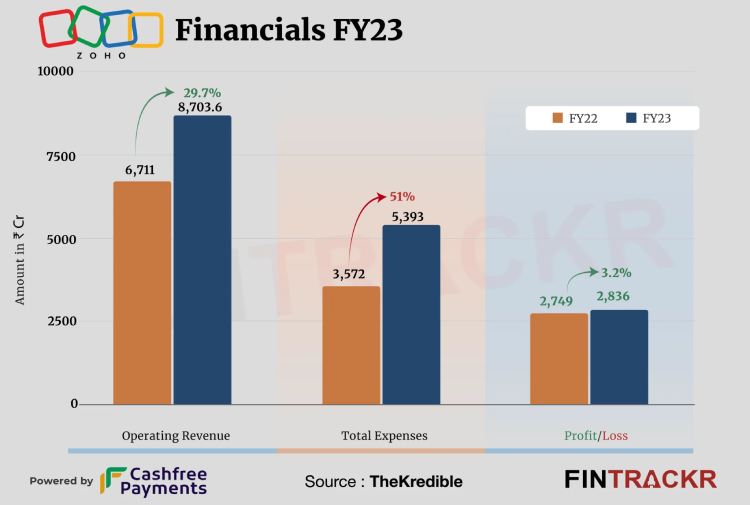
By 2000, Zoho reached $10 million in revenue. By 2022, they crossed $1 billion in annual revenue. Today, they serve over 700,000 customers globally with 55+ integrated business applications, all whilst remaining private, profitable and advertising-free.
Source: Entrackr
Why Zoho chose product excellence over marketing spend
Most SaaS companies follow a familiar pattern: build a minimum viable product, raise funding, spend heavily on customer acquisition and worry about product quality later. Zoho inverted this formula entirely.
Zoho invests 60% of its revenue into research and development, a figure that dwarfs the industry norm of 17%. This extraordinary R&D commitment means Zoho continuously develops new products and improves existing ones rather than spending those resources on marketing campaigns.
The strategy creates compounding advantages. When products genuinely solve customer problems better than alternatives, customers stay longer, spend more and recommend you organically. This reduces customer acquisition costs dramatically whilst increasing lifetime value.
Zoho understood early that in B2B SaaS, your product IS your marketing. Every feature that saves customers time, every integration that simplifies workflows and every improvement that reduces frustration becomes a reason customers tell their networks about you.
This approach requires patience. Product-led growth takes longer than paid acquisition. But it builds sustainable competitive moats that advertising budgets cannot breach. Competitors can outspend you on ads. They cannot easily replicate years of product innovation and customer trust.
Content marketing is the primary growth engine
Without advertising budgets, Zoho needed alternative ways to reach potential customers. They embraced content marketing as a core strategy, establishing a dedicated blog where industry experts and product specialists shared insights, best practices and tutorials related to business productivity, collaboration and digital transformation.
But Zoho’s content marketing wasn’t typical vendor content. They didn’t create thinly disguised product pitches. They created genuinely useful resources addressing real business challenges. Their blog became a destination for business professionals seeking practical advice, not sales material.
This content strategy served multiple purposes. It attracted organic search traffic, established thought leadership, educated potential customers and built trust long before any sales conversation began. When businesses searched for solutions to productivity challenges, Zoho’s content consistently appeared in results.
To maximise reach and impact, Zoho implemented a comprehensive SEO strategy focused on optimising its website and blog for relevant keywords and search queries. They understood that ranking well in search results for high-intent keywords delivers better ROI than paid advertising because the traffic is both free and highly qualified.
For businesses that want to work with a digital marketing agency, you need to understand that Zoho’s approach validates investing in long-form content, SEO and educational resources rather than exclusively focusing on paid channels. Content marketing requires patience but builds assets that appreciate over time rather than expenses that disappear when spending stops.
Community building and customer advocacy
Zoho recognised early that satisfied customers become powerful marketing channels. Rather than paying for advertisements, they invested in customer success, creating advocates who promoted Zoho organically.
This community-building approach manifested in several ways. Zoho created user forums where customers helped each other, reducing support costs whilst building community. They hosted webinars and virtual events where users shared best practices. They featured customer success stories prominently, showing potential buyers real-world results.
The company also developed Zoho University, offering free training and certification programs. This investment educated users, increased product adoption and created a network of Zoho-proficient professionals who naturally recommended the platform when consulting with other businesses.
Customer advocacy marketing works because recommendations from peers carry far more weight than advertising ever could. When a business owner asks their network for software recommendations, a genuine endorsement from someone who actually uses the product daily beats any advertising message.
Zoho understood that customer lifetime value depends not just on retention but on expansion and referral. Happy customers buy more products from your suite, upgrade to higher tiers and recommend you to others. These economics work far better than constantly acquiring new customers through paid channels.
The power of integration and ecosystem thinking
One of Zoho’s most effective marketing strategies wasn’t marketing at all. It was the product strategy that created marketing advantages.
Zoho developed an integrated ecosystem of 55+ applications that work seamlessly together. Once a customer adopts Zoho CRM, they can easily add Zoho Books for accounting, Zoho Desk for customer service, Zoho Social for social media management and dozens of other tools without dealing with complex integrations.
From a marketing perspective, this strategy means every satisfied customer becomes a potential expansion opportunity. Cross-selling and upselling existing customers costs far less than acquiring new ones. The integrated ecosystem also creates natural word-of-mouth as customers discuss how they’ve built their entire tech stack on Zoho.
Competitors offering point solutions struggle to match this advantage. Even if their individual products excel, they cannot match the convenience and cost-effectiveness of an integrated suite. This ecosystem becomes a competitive moat that no advertising budget can overcome.
Privacy and trust as competitive advantages
In an era where tech giants monetise user data and serve targeted advertising, Zoho positioned privacy and trust as core differentiators. Zoho maintains an uncompromising privacy-centred approach where it respects user privacy and does not have an ad-revenue model in any part of its business, including its free products.
This ethical stance isn’t just philosophy. It’s a marketing strategy. Privacy-conscious businesses and government organisations specifically choose Zoho because they trust their data won’t be monetised or sold. This trust becomes a powerful acquisition channel that advertising cannot buy.
The company owns and operates its data centres, ensuring complete oversight of customer data, privacy and security. This infrastructure investment costs significantly more than relying on third-party cloud providers, but it provides marketing advantages through credibility and control.
When competing against giants like Google and Microsoft, privacy positioning helps Zoho differentiate. They cannot outspend these competitors on advertising, but they can outperform them on trustworthiness. For certain customer segments, this trust matters more than any feature comparison or pricing difference.
Rural talent strategy and social responsibility marketing
Zoho’s unconventional approach extends beyond product and marketing into hiring. The company established operations in rural Indian towns, created Zoho Schools of Learning that train high school graduates into engineers and built a workforce in areas typically ignored by tech companies.
This rural talent strategy serves multiple purposes. It reduces costs compared to hiring in expensive urban tech hubs. It taps talent pools that competitors overlook. But it also creates powerful marketing narratives around social responsibility and inclusive growth.
The company’s approach includes investing in local education, targeting rural communities for business opportunities and acknowledging the link between business, social and ecological ecosystems. These initiatives generate significant positive press coverage and brand goodwill that paid advertising cannot replicate.
When journalists write features about Zoho, they don’t just cover the business success. They cover the human interest story of a company bringing high-tech jobs to rural areas and providing opportunities to people typically excluded from the tech economy. This earned media coverage provides marketing value whilst also fulfilling genuine social missions.
What traditional businesses can learn from Zoho
Zoho operates in SaaS, but its marketing principles apply across industries. Here’s what businesses can extract from their approach:
- Product excellence is non-negotiable. Marketing cannot compensate for mediocre products. Quality must come first.
- Customer satisfaction drives organic growth. Happy customers become your sales force; unhappy ones damage your reputation.
- Content marketing builds long-term assets. Valuable content continues to generate trust and traffic over time.
- Integration creates stickiness. Deep integration into customer workflows reduces churn and strengthens relationships.
- Trust and ethics can be competitive advantages. Strong privacy and ethical standards differentiate you in crowded markets.
- Community beats advertising. Building a genuine community fosters loyalty that paid ads cannot replicate.
- Patience enables differentiation. Long-term strategy enables investments that compound over time.
Conclusion
Zoho’s marketing strategy isn’t really about marketing at all. It’s about building products so good that customers willingly market for you. It’s about creating genuine value rather than manufacturing demand through advertising. It’s about playing long-term games that competitors focused on quarterly metrics cannot match.
Yes, advertising works. Yes, paid acquisition has its place. But sustainable competitive advantage comes from being excellent at what you do, treating customers exceptionally well and building genuine relationships rather than buying attention.
If you want to build this kind of long-term momentum for your brand, the right digital marketing agency can help you get there. Start with strategy, refine your story and let your marketing compound instead of disappear.
Zoho proves that you don’t need massive marketing budgets to build global businesses. You need discipline, patience, product excellence, customer obsession and the courage to invest in long-term value creation over short-term metrics.
Frequently Asked Questions

The founder and partner of Flora Fountain, Shefali leads the Content and Technology divisions. A one-time engineer who started her career writing front-end code, she took a detour sometime during her 9 years in New York, studied journalism and started writing prose, poetry and sometimes jokes. She now has 15...