


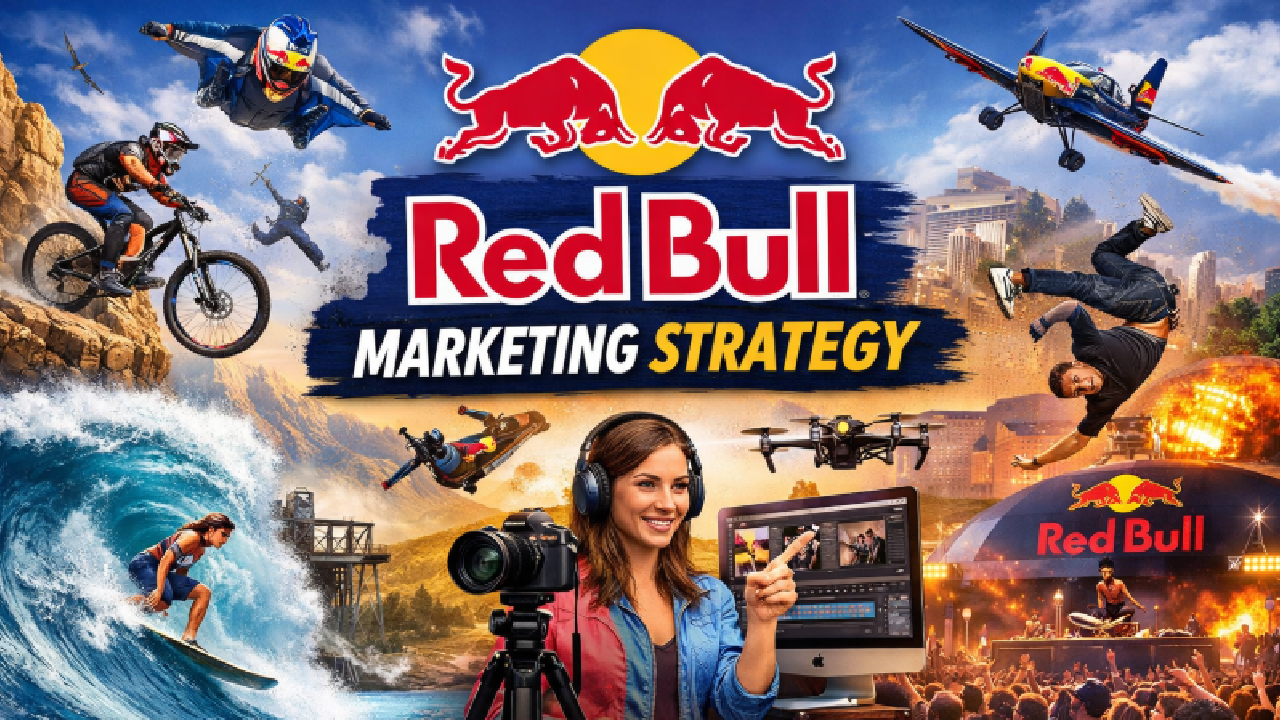
Most beverage brands believe market dominance comes from superior product formulation, aggressive retail distribution or higher advertising spend. Red Bull disproves all three assumptions. Its ascent to a $12.1 billion revenue empire has not been fuelled by traditional beverage marketing playbooks or feature-heavy product communication. Instead, it has been driven by content ownership, cultural positioning and an unusual commitment to becoming a media company that happens to sell energy drinks.
Red Bull does not behave like a conventional beverage brand, nor like a typical consumer packaged goods company. It behaves like a publisher, a sports franchise owner and an event production house simultaneously. For a branding agency studying long-term brand building, this hybrid behaviour offers a sharp contrast to campaign-led thinking.
This dominance is not accidental. It is the outcome of strategic decisions about brand architecture, content investment, audience psychology and vertical integration. Red Bull’s marketing strategy is less about the product and more about the world surrounding it. Less about campaigns and more about infrastructure.
For brands trying to build cultural relevance in commoditised categories, Red Bull’s evolution shows how marketing works when brand strategy, content production and distribution ownership are aligned.
Table of Contents
- What is Red Bull, Really?
- Why Traditional Beverage Marketing Fails Where Red Bull Succeeds
- Red Bull’s Strategic Positioning
- Treating the Brand as a Lifestyle, Not a Product
- Event Creation Over Event Sponsorship
- Internal Systems That Enable External Spectacle
- What Brands Misunderstand When Copying Red Bull
- Measuring Effectiveness Beyond Sales Volume
- Conclusion
- Frequently Asked Questions
What is Red Bull, Really?
View this post on Instagram
Long before Red Bull became synonymous with extreme sports and death-defying stunts, it was built on a sharp structural insight: energy drinks did not exist as a category in Western markets.
When Dietrich Mateschitz encountered Krating Daeng in Thailand and partnered with Chaleo Yoovidhya, they weren’t just entering a market; they were architecting one.
By 2024, Red Bull achieved a record 12.1 billion Euros in revenue, selling over 12.6 billion cans across 175+ countries. Holding approximately 43% of the global energy drink market, Red Bull maintains market leadership despite premium pricing. This pricing power is the ultimate signal of brand strength. They didn’t target mass media early on; they built value through guerrilla distribution at nightclubs and universities, ensuring the brand was discovered through experience rather than persuasion. (Source: Accio)
View this post on Instagram
Why Traditional Beverage Marketing Fails Where Red Bull Succeeds
Beverage brands typically compete on taste, price, availability and mass-market advertising. They buy shelf space, run television campaigns and measure success through retail velocity. Red Bull ignored this entire playbook.
View this post on Instagram
Red Bull assumed consumers need inspiration. Before selling energy, it created cultural moments worth remembering. It did not interrupt entertainment. It produced it.
From the perspective of a modern branding agency, this is the difference between renting attention and owning it. Red Bull does not pay for media placement. It creates the media. That distinction explains why its marketing compounds whilst competitors’ campaigns expire.
Cultural ownership cannot be achieved through advertising frequency. It requires vision, patience and the willingness to invest in brand equity before demanding short-term returns. Most beverage companies lack this discipline.
Red Bull’s Strategic Positioning
Spectacle only works when the underlying brand positioning is stable. Many brands attempt extreme sports marketing and fail because they have not defined what they stand for beyond product attributes. Without strategic clarity, extreme sports partnerships become expensive logo placement.
View this post on Instagram
Red Bull’s marketing strategy centres on a deceptively simple positioning. It gives you wings. Not literally, but conceptually. The brand promise is not framed around caffeine content or flavour profiles. It is about enabling peak performance, pushing boundaries and transcending limitations.
This clarity permits Red Bull to behave unconventionally. When a brand knows exactly who it is, it can enter spaces others cannot. Red Bull can own Formula 1 teams, produce feature films and host cliff diving competitions because all of these express the same core positioning.
An experienced advertising agency in Ahmedabad would recognise that Red Bull’s extreme sports investments are not marketing expenses. They are brand infrastructure. The content produced is not active. It is the product itself.
Brands that skip this foundational positioning work often misread Red Bull’s success. They sponsor an athlete or event and expect transformation. Red Bull built an entire ecosystem before most consumers even understood what it was selling.
Treating the Brand as a Lifestyle, Not a Product
Red Bull’s marketing works because the brand is not positioned around consumption occasions. It is positioned around identity. Consumers do not buy Red Bull for energy. They buy it because of what it signals about who they are or aspire to be.
This identity-led approach creates emotional investment that transcends product satisfaction. Audiences do not evaluate Red Bull based on taste or price. They evaluate it based on alignment with their self-concept.
- Psychological Trigger: While competitors like Monster Energy can match ingredients, they cannot match the cultural infrastructure Red Bull has built.
- Emotional Investment: Audiences align with the brand’s “belief system,” making them less sensitive to price increases or competitor launches.
Event Creation Over Event Sponsorship
Red Bull does not just sponsor events; it creates them. This is a vital distinction that a premier advertising agency in Ahmedabad would understand. Sponsorship is a logo on someone else’s property; creation is owning the intellectual property (IP).
| Owned Property | Key Impact | Viral Reach |
|---|---|---|
| Red Bull Stratos | Worldwide cultural moment | 9.5M+ concurrent live viewers |
| Red Bull Flugtag | Community engagement | Local events in 35+ countries |
| Red Bull Rampage | Extreme sports authority | Hundreds of millions of views |
The Stratos space jump in 2012 is the gold standard. Red Bull conceived, funded, and distributed the project. Over a decade later, that content still generates value. Traditional brands calculate ROI on immediate media value; Red Bull builds permanent brand assets.
Event creation also permits complete creative control. Red Bull designs experiences that express its brand perfectly because it owns every element. Sponsored properties always involve compromise. Owned properties embody vision completely.
Internal Systems That Enable External Spectacle
Red Bull’s apparent chaos is supported by rigorous internal systems. Maintaining brand consistency across 175+ countries requires operational excellence that most organisations lack.
- Red Bull Media House: A dedicated multi-platform media company that provides broadcast-quality content to global networks.
- Operational Capability: Behind every cliff dive is a logistical framework of experts, athlete development programmes, and distribution networks.
- Consistency: Despite operating globally, the visual identity and messaging remain remarkably stable. Order on the inside permits the spectacle on the outside.
What Brands Misunderstand When Copying Red Bull
Most brands copy Red Bull at the tactic level. They sponsor an extreme athlete, host an adrenaline event or produce adventure content. Almost all fail to achieve a similar impact.
Without clear positioning, extreme sports marketing feels opportunistic. Without content ownership, it produces no lasting value. Without operational systems, execution falters. Without long-term commitment, it appears as a campaign rather than a strategy.
Red Bull’s marketing strategy works because every layer supports the next. Positioning enables content choices. Content ownership compounds value. Operational excellence ensures quality. Long-term investment creates cultural presence. Remove any layer, and the strategy collapses.
A responsible branding agency would advise clients to learn from Red Bull’s principles, not its tactics. The lesson is not to sponsor skydivers. It is to build a coherent brand system that compounds value over time.
Brands that skip the foundational work often conclude that Red Bull’s success is unrepeatable. It is not. It simply requires discipline, which most organisations lack. Quarterly earnings pressure, risk aversion and organisational silos prevent most companies from executing long-term brand building at this level.
Measuring Effectiveness Beyond Sales Volume
Red Bull’s effectiveness is found in its pricing power and cultural salience.
- Organic Reach: They generate hundreds of millions in equivalent advertising value through their owned events.
- Asset Building: Content produced years ago continues to act as a funnel for new customers.
- Market Resilience: By behaving like a media company, they have insulated themselves from the volatility of the beverage market
An experienced advertising agency in Ahmedabad globally would evaluate success through brand health indicators, not just campaign metrics. Red Bull’s marketing has built one of the world’s most valuable private companies, not just high engagement rates.
The private ownership structure also permits this long-term perspective. Public beverage companies face quarterly pressure that prevents Red Bull-style investment. Their shareholders demand immediate returns. Red Bull’s structure permits decade-long payback periods on brand investments.
Conclusion
Red Bull’s marketing strategy is effective because it is structural, not superficial. It prioritises ownership over renting, consistency over novelty and infrastructure over campaigns.
The brand behaves like a media company, not a beverage manufacturer. It invests in permanent assets rather than temporary visibility. It builds brand equity through cultural presence rather than advertising frequency.
For businesses looking to apply these principles locally, working with a forward-thinking advertising agency in Ahmedabad can help translate global brand strategies into structured, long-term growth rather than campaign-led visibility.
Frequently Asked Questions

Vasim Samadji is a partner at Flora Fountain, where he leads the Business and Marketing Strategy divisions. In a world where everyone is used to sugarcoating, his directness is often considered rude. But that shouldn't be a problem if you like the no-nonsense approach. Because he is a seasoned professional...