


Search as we know it is fundamentally changing. For two decades, SEO meant optimising to appear in the coveted top 10 results. You created content, built links, improved technical performance and hoped to rank high enough to earn clicks.
That model is breaking down rapidly. Google’s AI Overviews, ChatGPT’s SearchGPT, Perplexity, and other AI-powered search tools are moving towards a different paradigm: one synthesised answer instead of ten competing results. Users ask a question and receive a comprehensive response generated by AI, often without clicking through to any website.
This shift raises urgent questions for businesses investing in SEO. If AI answers questions directly, what happens to website traffic? If users don’t click through, does SEO even matter anymore? And most importantly, is adapting to this new landscape worth the investment?
For an SEO company in Ahmedabad that advises clients on search strategy, understanding this transition isn’t optional anymore. It’s essential for survival.
Table of Contents:
- The New Search Landscape: What is Generative Engine Optimisation?
- The Fundamental Question: Is AI SEO Worth It?
- Building Authority in the AI Era: The E-E-A-T Imperative
- Technical Optimisation for AI Search
- Content Strategy for Generative Engines
- Measuring Success in the AI Search Era
- What’s Next: Continuous Evolution
- Concluding Thoughts
- FAQs
The New Search Landscape: What is Generative Engine Optimisation?
Generative Engine Optimisation (GEO) is the practice of optimising content to be discovered, cited, and synthesised by AI-powered search engines and large language models.
Traditional SEO focused on ranking in search results in clicks. GEO focuses on becoming the authoritative source that AI engines reference when generating answers. Instead of competing for position #1 to get 30% of clicks, you’re competing to be cited as the trusted source within the AI-generated answer itself.
When someone asks ChatGPT or Perplexity a question, the AI synthesises information from multiple sources and ideally cites where specific facts originated. Being that cited source is the new currency of search visibility.
Why This Matters Now
New data from Advanced Web Ranking shows that Google’s AI Overviews now appear for more than half of the searches on the internet. Perplexity handles millions of queries daily. ChatGPT’s search functionality is expanding. Users increasingly prefer getting direct answers over clicking through search results.
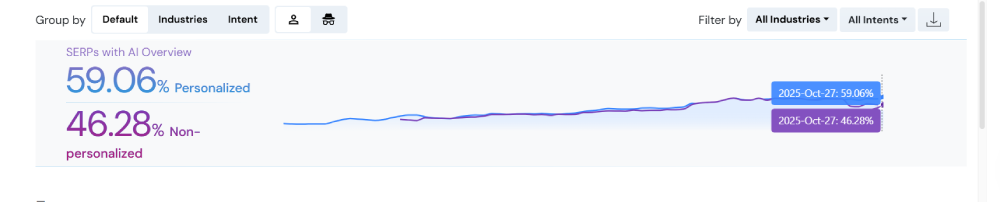
Advanced Web Ranking’s findings on the total number of AI overviews
This isn’t a future possibility. It’s happening now, and businesses that ignore it will find their organic visibility eroding regardless of how well they rank in traditional search.
The Fundamental Question: Is AI SEO Worth It?
Let’s address this directly: yes, AI SEO is worth it, but not in the way traditional SEO was worth it. The value proposition has shifted and understanding that shift determines whether your investment pays off or not becomes critical.
What You Lose
Direct website traffic from informational queries will decline. If AI answers the question completely, users have less reason to click through. For businesses that monetised informational content through ads or relied on blog traffic for brand awareness, this creates real challenges.
Ranking for broad informational keywords becomes less valuable. If the AI answer satisfies the query, your #1 ranking may generate minimal clicks. The economics of content marketing change when traffic potential decreases.
What You Gain
Authority and trust signals that influence purchase decisions. When users see your brand cited as the source in AI-generated answers, you build credibility that drives conversions later in the buying journey.
Visibility for commercial and transactional queries where AI engines still send traffic. When users are ready to buy, compare options or take action, AI search tools still direct them to relevant websites. Being the authoritative source makes you the recommended option.
Competitive positioning in a less crowded space. Most businesses haven’t adapted to GEO yet. Early movers gain disproportionate visibility whilst competitors still optimise only for traditional search.
Future-proofing your search presence. AI search is expanding rapidly. Businesses that build authority now will maintain visibility as traditional search traffic declines. Those who wait will scramble to catch up later.
The Verdict
AI SEO is worth it if your business model doesn’t rely entirely on informational blog traffic for revenue. It’s worth it if you’re positioned for the medium to long-term race rather than just immediate traffic gains. It’s worth it if you’re building a brand that needs authority and trust, not just clicks.
It’s potentially not worth it (yet) if you’re a pure content play monetising through display ads on informational articles with no product or service to sell. Though even then, diversification becomes necessary as AI search grows.
For most businesses working with a digital marketing company, the answer is clear: yes, invest in AI SEO now before your competitors establish themselves as the go-to cited sources in your industry.
Building Authority in the AI Era: The E-E-A-T Imperative
Google’s E-E-A-T framework (Experience, Expertise, Authoritativeness, Trustworthiness) matters more in AI search than it ever did in traditional search. AI models prioritise content from high-confidence sources because generating accurate answers depends on source reliability.
The Role of Experience and Evidence
AI models increasingly evaluate whether content demonstrates genuine experience. A restaurant review written by someone who actually dined there carries more weight than generic promotional content. A software tutorial from someone who uses the tool professionally outranks aggregated information.
How to demonstrate experience:
- Include specific details that only someone with direct experience would know
- Use original images, data or case studies from your work
- Reference specific outcomes, metrics or results from your experience
- Write in first person when sharing direct experiences
- Include timestamps and context showing when the experience occurred
Structured Author Profiles: Verifying Expertise
AI engines can’t evaluate expertise as intuitively as humans can. They rely on structured signals: author bios with credentials, schema markup identifying expertise, consistent authorship across authoritative sites and external validation through citations and references.
Implementing structured expertise signals:
- Add comprehensive author bios to all content with relevant credentials
- Implement Person schema markup with sameAs links to professional profiles
- Link to author profiles on LinkedIn, industry publications or academic sites
- Consistently attribute content to specific authors rather than generic “admin”
- Build topical authority by having authors write exclusively in their areas of expertise
Becoming the “Highest Confidence” Source
AI models assign confidence scores to sources. Sites cited frequently by other authoritative sources gain higher confidence. Content that demonstrates expertise through technical accuracy, specific details and verifiable facts ranks higher in AI synthesis.
Building confidence signals:
- Ensure factual accuracy with proper citations for claims
- Update content regularly to maintain accuracy
- Build relationships with other authoritative sites in your industry
- Get cited and linked by high-authority sources
- Produce original research, data or insights that others reference
Technical Optimisation for AI Search
AI engines process and understand content differently from traditional search crawlers. Technical optimisation for GEO focuses on machine readability and structured information extraction.
Structured Data: Giving AI Definitive Answers
Schema markup has always been important for SEO, but it’s critical for GEO. AI engines rely heavily on structured data to extract factual information with high confidence.
Priority schema types for GEO:
- Article schema with author, datePublished, dateModified
- Person schema for author profiles
- Organisation schema establishing business credentials
- FAQPage schema for direct question-answer content
- HowTo schema for instructional content
- Product schema with aggregateRating for e-commerce
Creating AI-Friendly Answer Blocks
AI models scan content for clear, definitive answers. Structure the content to make extraction easy.
Best practices for answer blocks:
- Lead with direct answers in the first 1-2 sentences of sections
- Use clear heading hierarchy (H2, H3) identifying topics
- Format key facts as concise lists or tables
- Include specific numbers, dates and data points
- Avoid burying answers deep in paragraphs
Example of AI-friendly structure:
Poor: “When considering the various factors that influence customer retention, businesses often discover through analysis that multiple elements play important roles, though timing certainly matters significantly…”
Good: “Customer retention peaks at the 90-day mark. Businesses that engage customers within the first three months see 45% higher lifetime value compared to those with later engagement.”
The second version provides extractable facts AI can cite with confidence.
Content Strategy for Generative Engines
Creating content that AI engines want to cite requires a different strategic approach than traditional SEO content.
The “Answer-First” Approach
Traditional SEO content often buries the answer after lengthy introductions to maximise time on page. GEO content puts the answer first because AI models prioritise clear, immediate responses.
Structure for AI synthesis:
- Open with the direct answer to the primary query
- Expand with supporting details, context and nuance
- Include related questions and answers in subsequent sections
- End with actionable next steps or recommendations
This doesn’t mean dumbing down content. It means frontloading value so AI can extract the answer, whilst users can dive deeper if they want more context.
Anticipating Conversational and Multi-Part Queries
AI search is inherently conversational. Users ask follow-up questions, request clarifications and explore related topics. Content that anticipates this natural flow performs better.
Strategies for conversational content:
- Include FAQ sections addressing obvious follow-up questions
- Link related concepts naturally (what leads to why leads to how)
- Address counterarguments and alternative perspectives
- Provide context for technical terms without assuming prior knowledge
- Structure content to support multi-part queries in a single resource
The Power of Internal Linking for Context
AI models use internal linking to understand topical relationships and authority distribution across your site. Strategic internal linking helps AI engines recognise your comprehensive expertise.
Internal linking best practices for GEO:
- Link to supporting content when making claims that benefit from additional context
- Use descriptive anchor text that clearly indicates destination content
- Create clear topical clusters with pillar content and supporting articles
- Ensure important authoritative content receives links from multiple related pages
- Avoid excessive linking that dilutes topical focus
Measuring Success in the AI Search Era
Traditional SEO metrics (rankings, organic clicks, impressions) don’t fully capture GEO success. New measurement approaches are necessary.
Tracking Citations, Not Just Clicks
The primary GEO KPI is citation frequency: how often AI engines reference your content when generating answers. Tools like SEMrush, Ahrefs, and TapClicks can provide data on how often your content is cited in AI-generated answers, helping you benchmark performance and refine your content strategy.
New KPIs for AI Search:
- Brand mention frequency in AI-generated answers (cited or not)
- Direct traffic increases (users who see citations may visit directly later)
- Conversion rate from organic traffic (fewer but more qualified visitors)
- Assisted conversions (citations influencing later purchases)
- Share of voice in AI responses for your primary topics
What’s Next: Continuous Evolution
AI search technology evolves rapidly. GPT-4 processes information differently from GPT-3.5. Google’s AI Overviews change monthly. Staying ahead requires ongoing adaptation.
Future-focused strategies:
- Monitor AI search tool announcements and updates
- Test content across multiple AI platforms (ChatGPT, Perplexity, Google AI Overviews)
- Engage with SEO communities, tracking GEO developments
- Allocate budget for ongoing content updates and optimisation
- View GEO as continuous improvement rather than one-time implementation
Any SEO company in Ahmedabad that treats AI SEO as a set-and-forget strategy will fall behind quickly.
Concluding Thoughts
Is AI SEO worth it? Absolutely, but with the understanding that the value has shifted from traffic volume to authority positioning. Businesses that adapt to Generative Engine Optimisation now will maintain search visibility as AI-powered search grows.
The fundamentals remain important: create genuinely valuable content, demonstrate expertise and build authority. But the execution must evolve: structure content for AI extraction, implement robust schema markup and prioritise citations over clicks.
Start by auditing your highest-value content against GEO best practices. Implement author schema and improve E-E-A-T signals. Monitor citation frequency in AI search tools. For businesses partnering with an SEO company in Ahmedabad, ensure they understand GEO principles and can adapt strategies accordingly.
The search landscape is changing rapidly. The businesses that thrive will be those that have adapted quickly to AI-powered search, whilst competitors remain focused solely on traditional rankings.
Frequently Asked Questions

The founder and partner of Flora Fountain, Shefali leads the Content and Technology divisions. A one-time engineer who started her career writing front-end code, she took a detour sometime during her 9 years in New York, studied journalism and started writing prose, poetry and sometimes jokes. She now has 15...