


There is a strange paradox sitting at the heart of this war.
Iran has imposed a near-total internet blackout on its own citizens. Ordinary Iranians cannot access X, Instagram, or most international websites. They are cut off from the very platforms their government is using as weapons against the United States on the global stage.
And yet, by almost every analyst’s measure, Iran is winning the narrative war.
Experts say Iran has been fairly successful, certainly more successful than the US and Israel, in reaching a broad audience and gaining more support than they might otherwise have. (Source)
Meanwhile, the White House is mixing real footage of missile strikes with clips from Grand Theft Auto and SpongeBob SquarePants, and calling it a communications strategy.
This is the story of two very different approaches to information warfare. One side has resources, platforms, and the global megaphone it has held for decades. The other has laptops, Telegram, and a very sharp understanding of what makes the internet angry.
Welcome to the most fascinating social media case study of 2026.
Table of Contents
- Why Social Media Became the Second Front for the US-Iran War?
- Iran’s Social Media Strategy
- United States’ Social Media Strategy for War
- The Tactics Compared: A Head-to-Head
- The Disinformation Scoreboard: What Actually Got Believed
- Who Is Winning and Why
- Why a Social Media Strategy Becomes Crucial in War
- Conclusion
- FAQs
Why Social Media Became the Second Front for the US-Iran War?
The war began on 28 February 2026, when the United States and Israel launched coordinated strikes on Iran (Source: Wikipedia) targeting military installations and nuclear facilities. Within hours, the bombs were falling. And within the same hours, so was the content.
View this post on Instagram
Both sides understood immediately that military outcomes alone would not determine who won this conflict in the court of global opinion. The real battle was for the feed. For the share. For the caption that makes someone stop scrolling and decide whose side they are on.
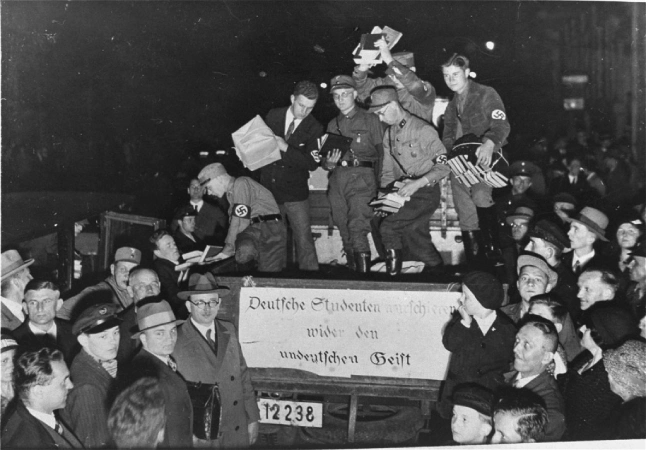
Students and members of the SA unload books deemed “un-German” during the book burning in Berlin. (Source)
This is not a new phenomenon. Information warfare has existed as long as warfare itself.
But in 2026, with younger audiences consuming news almost entirely through short-form social media, governments are capitalising on how audiences, particularly younger ones, get their news from social media and short-form video rather than through traditional outlets.
The result is the first truly AI-native information war, where deepfakes, memes, and algorithmic virality are as strategically significant as any missile.
Iran’s Social Media Strategy
Iran entered this narrative war with a clear disadvantage on paper.
Its military is outgunned. Its economy has been under decades of sanctions. Its own citizens cannot access the internet freely.
And yet its social media strategy has been, by most accounts, remarkably effective.
The Core Strategy
Iran’s approach involves a big information void, filled quickly with synthetic content, propaganda narratives and generally chaotic information.
The goal is not to convince the world that Iran is winning militarily. The goal is to make the American public doubt that the war is worth fighting at all.
As one Cambridge University AI researcher put it, “Their goal is to sow enough discontent with the conflict as to eventually force the West to cave in, so it is massively important to them.” (Source)
AI-Generated Memes and Lego Animations
Pro-Iran groups have used artificial intelligence to create slick internet memes in English to shape the narrative and foster opposition to the war.
View this post on Instagram
The memes are fluent not just in English but in American culture and trolling.
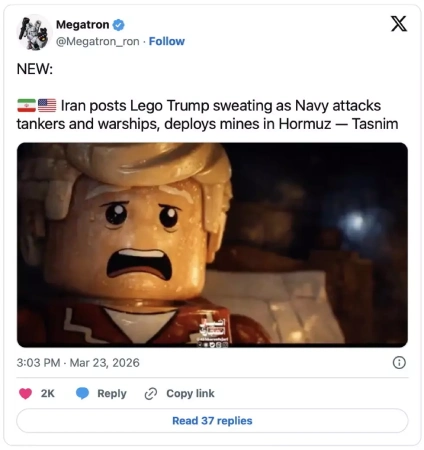
One group, Akhbar Enfejari (meaning “Explosive News”), produces Lego-style animated videos depicting Trump as a stressed, bumbling figurine whilst Iranian forces celebrate. These videos have racked up millions of views across social platforms.
Targeting American Domestic Fault Lines
Iran’s content is not aimed at Iranians. It is aimed at Americans who are already sceptical of the war. Sixty per cent of the most viral posts on X mentioning “Iran” during the first week of the conflict originated from accounts based outside the United States, despite often presenting themselves as American voices.
The recurring narratives pushed by these accounts included claims that the operation was a “betrayal of MAGA” and was carried out “on behalf of Israel.”
The Double Standard Nobody Talks About
Here is the part that deserves more scrutiny. Iran’s officials use X and other social media platforms as weapons in the narrative war, even though the internet remains blocked to ordinary Iranians.
Select “whitelisted” officials post freely on the very platforms their government has banned for its own citizens. (Source: France24)
The regime is using the tools of an open internet to fight for a closed one. That hypocrisy has not gone unnoticed by digital rights activists, but it has done little to slow the content machine down.
United States’ Social Media Strategy for War
If Iran’s strategy is aggressive and psychologically sophisticated, the United States’ approach has been something else entirely.
The Desensitising of War
The White House mixed real footage of military strikes on Iran with clips from video games and Hollywood blockbusters.
L1, R1, SQUARE, R1, LEFT, R2, R1, LEFT, SQUARE, DOWN, L1, L1 https://t.co/Aimj3ZDF0O
— Steven Cheung (@StevenCheung47) March 6, 2026
One video opened with a scene from Grand Theft Auto: San Andreas, quickly transitioning to footage of a US military strike, with the word “Wasted” appearing on screen.
Another stitched together CENTCOM strike footage with clips from SpongeBob SquarePants, Wii Sports and the Mortal Kombat video game soundtrack.
The White House called it a success. Almost everyone else called it deeply disturbing.
Hey White House, please remove the Tropic Thunder clip. We never gave you permission and have no interest in being a part of your propaganda machine. War is not a movie. https://t.co/dMQqRxxVCa
— Ben Stiller (@BenStiller) March 6, 2026
Actor Ben Stiller, whose film Tropic Thunder was used without permission in one montage, tweeted: “Hey White House, please remove the Tropic Thunder clip. We never gave you permission and have no interest in being a part of your propaganda machine. War is not a movie.”
The Audience Problem
The US strategy has a fundamental flaw that no amount of viral content can fix. The White House memes are aimed at a US domestic audience and feature clips from American TV shows and sports. They are not designed to reach or persuade a global audience.
Iran, by contrast, is producing English-language content specifically designed to shape opinion in the West.
One side is playing to its base. The other is trying to convert the opposition. Those are very different games.
The Self-Goal by Voice of America
In what may be the single greatest self-inflicted wound of the entire narrative war, the US government-run Voice of America, which for decades broadcast news in Farsi to Iranian citizens, has been operating with a skeleton staff since Trump ordered it effectively shut down.
The one tool specifically designed to reach ordinary Iranians with an alternative to state propaganda was quietly dismantled by the same administration now spending considerable resources on SpongeBob memes.
The Tactics Compared: A Head-to-Head
| Dimension | Iran | United States |
|---|---|---|
| Primary Platform | X, Telegram, Instagram | X, Truth Social |
| Target Audience | Global, especially anti-war Americans | Domestic US audience |
| Content Format | AI memes, Lego animations, deepfakes | Video game mashups, film clips, CENTCOM updates |
| Tone | Provocative, culturally fluent, anti-Trump | Triumphalist, gamified, base-rallying |
| AI Usage | Sophisticated, high-volume, coordinated | Occasional, reactive |
| Global Reach | Broad, deliberately cross-cultural | Narrow, domestically focused |
| Biggest Own Goal | Internet blackout hypocrisy | Shutting down Voice of America |
The Disinformation Scoreboard: What Actually Got Believed
Numbers tell the clearest story about whose content is landing.
The USS Abraham Lincoln Claim
The most prominent single false claim of the conflict was that Iranian ballistic missiles had sunk or severely damaged the USS Abraham Lincoln aircraft carrier. An X post claiming “Iranian missiles have sunk USS Abraham Lincoln” reached 8 million views. Multiple AI-generated images of the carrier on fire were circulated, with CENTCOM eventually having to explicitly respond: “The Lincoln was not hit.”(Source)
Eight million views before a correction. That is the information war in one data point.
Trump Falsely Claimed Iran Has Tomahawk Missiles
When footage emerged suggesting a US Tomahawk missile may have struck a girls’ school in Iran, Trump claimed at a press conference that Iran possesses Tomahawk cruise missiles, a claim immediately rejected by arms experts. (Source)
“Iran definitely does not, repeat does not, have Tomahawks,” said Jeffrey Lewis, a distinguished scholar of global security at Middlebury College. “Astonishing bald-faced lying,” tweeted retired US Army General Barry McCaffrey in response.
Trump Falsely Claimed the Iranian Military Had Been Destroyed
Donald Trump says “a whole civilisation will die tonight” if Iran doesn’t make a deal with the US. pic.twitter.com/mZGb1sjfu0
— Pop Crave (@PopCrave) April 7, 2026
Trump claimed victory several times during the conflict and falsely claimed the Iranian military had been destroyed.
Even as Iran continued launching missiles at Gulf states, disrupting global shipping, and holding the Strait of Hormuz closed.
Who Is Winning and Why
Both sides declared victory when the ceasefire was announced on 8 April.
Iran claimed victory, asserting that it had forced the US to accept its 10-point plan, which includes lifting all sanctions and withdrawing US combat forces from regional bases. (Source)
Trump posted on Truth Social that the US had “met and exceeded all military objectives.”
But the deeper reality, as most analysts are now pointing out, is more interesting than either claim.
On the narrative front specifically, the verdict is similarly uncomfortable for Washington.
Iran entered this conflict as the militarily weaker party with almost no formal media infrastructure accessible to its own citizens. It turned that constraint into a strategy. By focusing entirely on the global audience, producing culturally fluent content in English, and consistently targeting the cracks in American domestic opinion, Iran’s communications approach evolved from religious-ideological propaganda into operational, multidimensional information warfare.
The US, meanwhile, confused entertainment with persuasion. Gamifying airstrikes might generate clicks from existing supporters. It does not convert sceptics, build international sympathy, or counter Iranian narratives reaching millions of people outside America’s borders.
A professional social media marketing agency’s takeaway: content that only speaks to the people who already agree with you is not a strategy. It is a comfort blanket.
The uncomfortable truth is this. A country that blocked its own citizens from the internet managed to run a more globally effective social media campaign than the country that invented the internet.
That should give every government communications team and every digital marketing agency focusing on narrative strategy something serious to think about.
Why a Social Media Strategy Becomes Crucial in War
The US-Iran conflict did not create information warfare. It just made it impossible to ignore. Every major conflict of the last decade has had a parallel war running on social media, and the side with the clearer strategy has consistently shaped how the world remembers it.
India vs Pakistan: The 87-Minute Gap
After India’s Balakot airstrikes in 2019, exactly 87 minutes after the strikes, Pakistan’s military communications wing ISPR broke the news on Twitter with its own version of events. By the time India issued a formal statement, social media was already flooded with Pakistani narratives, pictures, and counter-claims. (Source)
India had the military action. Pakistan had the story. That 87-minute head start shaped global perception for weeks. Since Balakot, Pakistan institutionalised information warfare as a formal element of its statecraft, whilst India treated it as a reactive media strategy rather than a proactive instrument.
Ukraine vs Russia: The Selfie That Won the Internet
When Russia invaded Ukraine in 2022, Zelensky posted a selfie video from Kyiv saying “I am here” whilst Russia was telling the world he had fled.
It became one of the most shared pieces of conflict content in modern history. It was not an accident. It was a deliberate, real-time content decision made under pressure. Ukraine understood that perceived resilience was as strategically important as actual military resilience.
Russia relied on its traditional state media playbook in an era where younger audiences had already abandoned those channels entirely.
What Every Crisis Teaches Us
- Narrative vacuums fill instantly. Go quiet and your opponent writes the story.
- Speed beats polish. A fast rough response almost always beats a perfectly crafted late one.
- Domestic and global audiences need different content. Conflating the two, as the US did here, is a strategic failure.
- Credibility is built before the crisis, not during it. Every government, brand, or institution that wins the narrative war had already built audience trust long before the conflict began.
Any social media marketing agency worth its value will tell you the same thing: crisis communication is just everyday content strategy under pressure. The principles do not change. Only the consequences of getting it wrong do.
Conclusion
The 2026 US-Iran conflict will be studied for years as a military event. It should be studied just as closely as a communications one.
Iran proved that you do not need the biggest budget, the most powerful platforms, or even a free and open internet to win the narrative war. You need a clear target audience, a disciplined message, culturally fluent content, and the patience to let the algorithm do the rest.
The United States proved the opposite lesson. That institutional power, military dominance, and platform access mean very little if your content strategy is indistinguishable from a teenage gaming channel. That mixing SpongeBob with missile strikes does not inspire confidence. And that shutting down the one tool built to reach Iranian citizens whilst building a meme machine for your own base is not information warfare. It is a theatre.
The bombs may have paused. The narrative war has not.
Read the entire blog? I guess we share common interests.
Let’s connect on a call and see if the stars align. (PS:
Stars are you and me)
Frequently Asked Questions

The founder and partner of Flora Fountain, Shefali leads the Content and Technology divisions. A one-time engineer who started her career writing front-end code, she took a detour sometime during her 9 years in New York, studied journalism and started writing prose, poetry and sometimes jokes. She now has 15...