


Your mother’s Tanishq necklace and your college Fastrack watch were made by the same company.
Let that sink in.
One brand sits inside a velvet box and gets gifted at weddings. The other gets thrown into a college bag next to earphones and deodorant. One speaks to a 45-year-old woman celebrating her daughter’s engagement. The other speaks to a 19-year-old who just posted his first reel.
Same parent. Completely different worlds.
From the viewpoint of a prominent digital marketing agency, Titan Company Limited has quietly pulled off one of the most sophisticated multi-brand marketing strategies in Indian corporate history. While most conglomerates try to stretch one brand across every audience and end up speaking to nobody, Titan did the opposite. They built entirely separate brand universes, each with its own language, attitude, and audience.
Table of Contents
- What is Titan Company?
- The Parent Brand Problem
- Titan Watches: The Emotion Merchants
- Fastrack: When a Sub-Brand Grows Up and Moves Out
- Tanishq: Jewellery as a Cultural Statement
- Titan Eye+: Making Utility Feel Premium
- Skinn: Building Luxury From Scratch
- How Titan Avoids Cannibalising Itself
- What Brands Should Learn From Titan
- Conclusion
- FAQs
What is Titan Company?
Founded in 1984 as a joint venture between the Tata Group and the Tamil Nadu Industrial Development Corporation, Titan started as a watch company. A good one. But they had bigger ambitions. (Source)
Over the next four decades, Titan quietly expanded into jewellery, eyewear, fragrances, accessories, and even wearables. Today, Titan Company Limited is one of India’s largest lifestyle conglomerates, with brands that collectively touch nearly every demographic in the country.
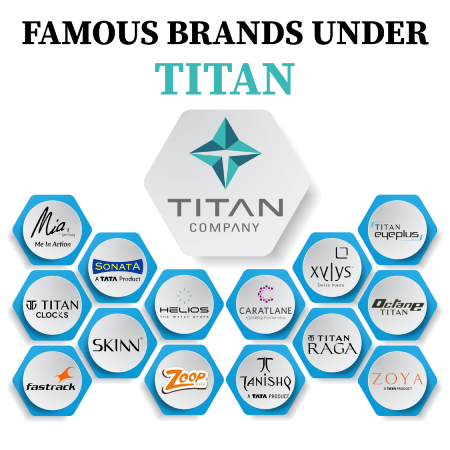
What makes them remarkable is not the number of brands they own. It is how differently each one behaves in the market. Each sub-brand has its own visual identity, its own tone of voice, its own social media personality, and its own emotional universe. For a branding agency that handles multiple sister brands for various clients, Titan is practically a textbook.
The Parent Brand Problem
Here is a challenge most large companies never solve cleanly.
When you own multiple brands across very different categories and audiences, how do you stop them from stepping on each other?
Most companies default to one of two bad options.
Either they plaster the parent brand’s name on everything, which makes nothing feel special, or they let the sub-brands run completely wild with no coherent identity linking them. Both approaches tend to dilute brand equity over time.
Titan figured out a third path.
They let each sub-brand own its audience entirely, with its own creative direction and communication strategy, while maintaining a quiet Tata-backed quality assurance as the invisible backbone. You rarely see “A Titan Company” stamped across a Fastrack ad. But if a consumer digs deep enough, the trust is there.
This sophisticated media presence would be appreciated by even the sharpest social media marketing agency because it means every sub-brand can take creative risks without dragging the parent into controversy.
Titan Watches: The Emotion Merchants
If Fastrack sells attitude, Titan Watches sells feelings.
The watch category itself is a tricky one to market. In an era of smartphones, nobody needs a wristwatch.
So Titan repositioned the watch from a time-telling device into a gifting ritual. Their campaigns rarely talk about features like sapphire glass or Swiss movements. They talk about fathers and daughters. About retirements and milestones. About the moment you hand something precious to someone you love.
Their long-running campaign “The joy of gifting” is a masterclass in occasion-based marketing. It does not sell a product. It sells the feeling of being remembered. And that is an emotion every Indian family understands deeply.
This is the kind of storytelling that a top branding agency would call “owning the occasion” rather than “selling the category.”
Fastrack: When a Sub-Brand Grows Up and Moves Out
Fastrack started as a sub-line within Titan Watches for younger consumers. Then something interesting happened. The audience responded so strongly that Fastrack essentially became its own independent brand with its own stores, its own product lines across watches, bags, belts, and eyewear, and its own very loud personality.
The creative direction was deliberately provocative. “Move On” campaigns. Queer-inclusive imagery long before it was mainstream in Indian advertising. Tongue-in-cheek humour that made parents mildly uncomfortable and made teenagers feel seen.
Notice what is missing from every Fastrack ad. The word “Titan.” That is not an accident. Titan understood that their 19-year-old consumer does not want to wear their parents’ brand. So they gave Fastrack the freedom to exist as if it had nothing to do with a 40-year-old conglomerate.
This kind of deliberate brand separation is a lesson that any digital marketing agency managing multi-product clients should study seriously.
Tanishq: Jewellery as a Cultural Statement
Tanishq is arguably Titan’s most culturally influential brand. And also it’s most controversial.
When they launched in the 1990s, the organised jewellery market in India was dominated by local family jewellers. Tanishq had to convince Indian consumers to trust a corporate brand with their gold. That is no small task in a country where jewellery is inheritance, emotion, and investment all at once.
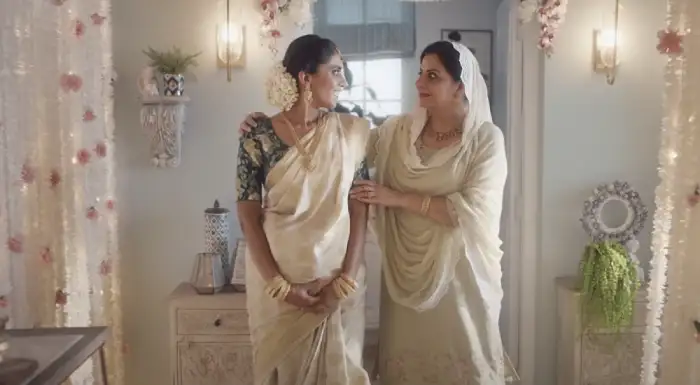
They did it through relentless quality messaging and a retail experience that felt trustworthy and modern. But over time, Tanishq evolved from “quality jewellery” to something far more interesting, a brand willing to make social statements.
Their remarriage campaign, featuring a bride who was a single mother, was a quiet revolution in Indian advertising. The Ekatvam campaign, which showed an interfaith family celebrating a baby shower, sparked national debate and was eventually pulled due to rigorous criticism. Love it or hate it, nobody ignores it.
That is the hallmark of a brand that has truly earned cultural relevance. A skilled social media marketing agency knows that the goal of great content is not universal approval; it is conversation.
Titan Eye+: Making Utility Feel Premium
Not every brand in the Titan family has the luxury of emotional storytelling. Titan Eye+ operates in a largely functional category. People buy glasses because they need them, not because they aspire to them.
[Embed image: Titan Eye+ store interior or campaign] Alt text: Titan Eye+ retail store with clean, white interior and eyewear display
Titan’s answer was to elevate the retail and service experience rather than manufacture artificial emotion. Free eye tests. Transparent pricing. A clean, clinical-yet-warm store design that made spectacle-buying feel less like a chore and more like a considered lifestyle choice.
The marketing stays informational and benefit-led but the brand design ensures it never feels cheap. It sits comfortably in the same family as Tanishq without trying to compete with its drama. Every branding agency worth its salt knows that not every brand needs to be bold. Some just need to be trusted.
Skinn: Building Luxury From Scratch
Of all Titan’s sub-brands, Skinn had the hardest brief. Enter the fragrance category dominated globally by French luxury houses and locally by budget body sprays and find a viable position somewhere in between.
[Embed image: Skinn by Titan product campaign] Alt text: Skinn by Titan perfume bottles arranged on a dark, moody background
Skinn chose “accessible luxury.” Premium enough to feel like a gift. Affordable enough to be a personal treat. The packaging is sleek. The retail placement is careful high-street stores, not discount shelves. The campaigns lean on aspiration without the alienating price tag of a European designer brand.
It is a quieter play than Fastrack or Tanishq, but a smart one and a reminder that building a brand from scratch in a new category requires patience that most digital marketing agency timelines do not account for.
How Titan Avoids Cannibalising Itself
The million-dollar question with so many brands in the portfolio is, why don’t they eat each other?
The answer lies in three things. First, clear audience segmentation. Fastrack’s 19-year-old and Tanishq’s 42-year-old are never shopping in the same mindset, even if they sometimes share a surname. Second, separate creative ecosystems. Each brand has its own agency relationships, its own social media handles, and its own visual world. Third, the Tata Trust is an invisible guarantee that is never advertised loudly, but always quietly reassuring.
This is what portfolio brand strategy looks like when it is done with discipline.
What Brands Should Learn From Titan
The biggest lesson from Titan is this: the same company can speak completely different languages, and that is a strength, not a contradiction.
Most brands try to find one voice and apply it everywhere. Titan built a different voice for every room they walked into. They understood that the audience defines the brand, not the other way around.
For any D2C business, startup, or established player working with a branding agency today, the Titan playbook offers a clear principle: if your product serves different people differently, let your brand reflect that. Do not sand down the edges to find a “universal” message. The edges are where the loyalty lives.
Conclusion
Titan is not just a company that sells watches, jewellery, and eyewear. It is a company that has mastered the art of holding multiple brand truths simultaneously without contradiction, without confusion, and without apology.
From the raw youth energy of Fastrack to the cultural weight of Tanishq, every sub-brand is a complete thought. And the parent company is wise enough to stay out of the way and let each one breathe.
For brands, marketers, and anyone working with a digital marketing agency trying to figure out how to grow without losing focus, Titan is proof that the answer is not one bigger brand. Sometimes, it is several smaller, sharper, braver ones.
Read the entire blog? I guess we share common interests.
Let’s connect on a call and see if the stars align. (PS: Stars are you and me)
Frequently Asked Questions

The founder and partner of Flora Fountain, Shefali leads the Content and Technology divisions. A one-time engineer who started her career writing front-end code, she took a detour sometime during her 9 years in New York, studied journalism and started writing prose, poetry and sometimes jokes. She now has 15...