

As we enter 2026, the dust is finally settling on one of the most consequential algorithm shifts in search history. The Google core update of December 2025, which completed its rollout just days before the new year, has left a transformed digital landscape in its wake. For brand managers and owners, the current volatility isn’t just a minor fluctuation; it is the first major test of the 2026 fiscal year.
This update has intensified the move toward an AI-integrated “Answer Engine,” where traditional ranking signals are being superseded by authentic brand authority. If your organic traffic has dipped in early 2026, it is likely the lingering effect of this December recalibration. Surviving this era requires moving beyond the basic SEO checklists of the past. If you are partnering with a leading SEO company in Ahmedabad, understanding these new mechanics is the only way to safeguard your brand’s visibility and dominance in an increasingly AI-driven marketplace.
Table of Contents
- Has the 2026 Google Core Update Made Your Strategy Useless?
- Why Is Helpful Content No Longer Enough to Rank?
- What Is the Most Important Factor of E-E-A-T in 2026
- The Recovery Framework: A Brand Manager’s Checklist
- The Role of Human Touch in AI-Driven Search
- Conclusion
- FAQs
Has the 2026 Google Core Update Made Your Strategy Useless?
The December 2025 Google core update represents a massive infrastructure change, specifically targeting how Google’s systems evaluate content at scale. Unlike previous years, where updates targeted specific spam tactics, this 18-day rollout focused on “Topical Integrity.” Google is now evaluating how well a brand covers a subject across its entire ecosystem, rather than just on an individual page basis.
For brands, this means that “ranking” for a keyword is now secondary to “owning” a topic. We have observed that websites with fragmented content with articles that don’t link logically or support a central brand mission have seen the sharpest declines following the December rollout. If you are consulting with an SEO company in Ahmedabad, the strategy must now transition from “tracking keywords” to “mapping entities.”
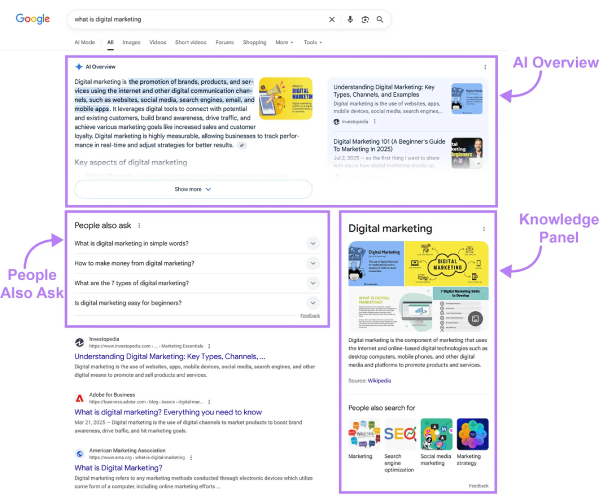
Furthermore, this update marks a leap in how Google interprets “Zero-Click” intent. The algorithm is now prioritising sources that provide modular data that can be synthesised into AI summaries and Overviews.
Intent Purity
Beyond the broad structural changes, the December recalibration introduced a decisive shift toward what we call “Intent-Purity.” Throughout the 18-day rollout, we observed that Google significantly reduced the visibility of “hybrid” pages, those attempting to satisfy both informational and commercial intents simultaneously. For instance, a blog post that mixed a deep educational guide with aggressive product sales pitches often saw its rankings split or suppressed.
The new algorithm logic prefers pages that serve a singular, clear purpose for the user. In 2026, the strategy championed by any leading digital marketing agency must involve auditing content to ensure it matches the “pure intent” of the specific query, separating educational resources from transactional landing pages to maintain a clean, machine-readable signal for the search engine.
Why Is Helpful Content No Longer Enough to Rank?
For years, the mantra was “write helpful content.” In 2026, the Google core update signals that the bar has been raised to “Unique, Verifiable Value.” Google has specifically devalued “AI-Frankenstein” content, i.e blogs that are technically accurate but offer no new perspective, data, or human insight.
The systems refined in December 2025 can now distinguish between a brand that is merely summarising existing search results and a brand that is contributing “Information Gain.” To survive, your content must provide proprietary data points, real-world case studies, or perspectives that aren’t already present in the top 10 results.
If you partner with a specialised SEO company in Ahmedabad, they would be auditing your library for content that lacks this “gain.” In the post-December landscape, having 100 mediocre pages is a liability. This update rewards the “Minimalist Authority”; brands that consolidate thin content into comprehensive power pages. A high-performing digital marketing agency will focus on pruning your site to ensure that every URL provides a “satisfying” experience that prevents the user from bouncing back to the search results, as “bouncing” is now a heavy signal for de-ranking.
What Is the Most Important Factor of E-E-A-T in 2026
The “Experience” pillar of E-E-A-T (Experience, Expertise, Authoritativeness, and Trustworthiness) has transitioned from a creative suggestion to a hard technical requirement following the December 2025 Google core update. In 2026, Google is no longer satisfied with theoretical expertise; it actively searches for “Proof of Life.” This means the algorithm is scanning for evidence that the creator has physically or professionally engaged with the subject matter. For brand managers, this shift necessitates a move away from generic “ghost-written” corporate content toward a “Faces of the Brand” strategy.
To survive this scrutiny, your digital presence must provide verifiable signals that an AI simply cannot replicate:
- Omnichannel Entity Recognition: Google’s Knowledge Graph now cross-references your authors across LinkedIn, industry podcasts, and third-party media mentions. If your “expert” only exists on your blog, they carry zero authority.
- First-Party Visual Evidence: The 2026 update prioritises content that includes original photography, behind-the-scenes video logs, and proprietary data visualisations. Stock imagery is now a “thin content” signal that can trigger a ranking demotion.
- Citations over Backlinks: While traditional links still matter, “unlinked mentions” on high-authority news sites or official government (.gov) and educational (.edu) domains are now weighted more heavily as social proof of your brand’s real-world impact.
The most successful brands are currently treating their website as a “Trust Hub” rather than just a content repository. This involves implementing a “Person Schema” that maps an author’s entire career timeline and professional affiliations directly into the code. By creating this level of transparency, you aren’t just pleasing a search engine; you are building a durable reputation that resists the volatility of future updates. A premier digital marketing agency will focus on this “Social Indexing” shift, ensuring your brand’s story is consistent across social media, community forums like Reddit, and authoritative press outlets to create a 360-degree shield of credibility.
The Recovery Framework: A Brand Manager’s Checklist
If the December Google core update has impacted your visibility, recovery is possible, but it requires a surgical approach rather than a broad overhaul. As we navigate the start of 2026, the first step is to avoid “panic edits” and instead follow a structured audit that prioritises the long-term health of your digital ecosystem over short-term “hacks.”
Step 1: Intent Re-Alignment & Gap Analysis
Analyse the pages that replaced you in January. Did Google shift the intent from “Informational” to “Transactional”? If the top results are now AI summaries or video carousels, a traditional blog post will no longer rank, regardless of quality. We recommend performing an “Information Gain Audit” to identify exactly what unique data or perspectives your competitors are offering that your content lacks.
Step 2: Technical Integrity & Modern Performance
In 2026, Core Web Vitals are a baseline, not a bonus. If your site takes more than 2 seconds to load on a mobile 5G connection, you are likely being filtered out of the “Preferred Source” list for AI Overviews. We focus on “Interaction to Next Paint” (INP) as a primary performance metric, ensuring that your site isn’t just fast, but highly responsive to human behaviour.
Step 3: Signal Strengthening & Entity Mapping
The modern recovery process involves implementing “Entity-Based Schema.” This helps Google understand exactly what your brand is, who your experts are, and what specific problems you solve. This clarity is your best defence against future algorithm volatility, as it ensures your brand is machine-readable for Google’s AI models. By shifting from a “page-first” to a “brand-first” mindset, you can build a search strategy that is both scalable and deeply human.
This is precisely where a premier digital marketing agency adds value, by translating these complex algorithmic shifts into a cohesive, revenue-driving business strategy.
The Role of Human Touch in AI-Driven Search
The irony of the search landscape following the December Google core update is that, while the algorithm is more AI-driven than ever, it is more reliant on human-led signals. By early 2026, it is estimated that over 90% of online content is AI-generated, creating a “sea of sameness” that Google is now aggressively filtering. Brands that automated their entire SEO strategy without a “Human-in-the-Loop” (HITL) framework have seen their traffic vanish as Google’s systems now detect structural predictability; the subtle, probabilistic patterns that generic AI models follow.
The danger of unedited AI content goes beyond mere ranking drops; it introduces significant brand risk through “Textual Hallucinations“: the fabrication of facts, citations, or data points that sound plausible but are entirely false. In a world where 80% of users are sceptical of AI-generated summaries, one hallucinated statistic can permanently damage your brand’s Trust signal. This is why we treat AI as a “Super-Efficient Junior Writer” rather than a solo creator. Our human strategists act as an editorial board, fact-checking every claim, injecting industry-specific anecdotes, and ensuring that every piece of content satisfies the “Needs Met” criteria of the 2026 Quality Rater Guidelines.
A premier digital marketing agency does not just use AI for scale; they use it to handle the grunt work of data organisation so that human creativity can focus on high-stakes strategy. Google’s 2026 documentation explicitly emphasises that “the method of creation is not penalised, but the lack of human-led value is.” By maintaining a hybrid workflow, you ensure your content has the “rhythmic variation” and authentic expertise that automated tools cannot fake. In this post-update environment, human oversight is no longer an optional safety net; it is the ultimate differentiator that tells Google your brand is a credible, living entity in an era of automated noise.
Conclusion
The December 2025 Google core update is a reminder that search is a living ecosystem. For brands that have built their presence on thin tactics or unedited AI output, the start of 2026 is a difficult moment. However, for those willing to invest in deep authority, technical excellence, and genuine human experience, it is an opportunity to outpace the competition.
Navigating these shifts requires a partnership with experts who understand the “why” behind the “what.” The future of search belongs to those who provide the best answers, not just the most content. It’s time to stop chasing the algorithm and start leading it. If your brand is struggling to regain its footing in the new SERP landscape, it may be time to consult with an expert SEO agency in Ahmedabad to audit your entity health and build a resilient recovery roadmap for 2026
Frequently Asked Questions
The founder and partner of Flora Fountain, Shefali leads the Content and Technology divisions. A one-time engineer who started her career writing front-end code, she took a detour sometime during her 9 years in New York, studied journalism and started writing prose, poetry and sometimes jokes. She now has 15...