


Every December, millions of people voluntarily become walking advertisements for Spotify. They share their Wrapped results on Instagram, Twitter and WhatsApp. They compare their top artists with friends. They argue about genre classifications. They screenshot their listening stats and post them like badges of honour.
This isn’t organic enthusiasm for a product. It’s engineered virality built on a simple truth: people love seeing themselves reflected in data form. Spotify understood this years before most brands figured out that personalisation meant more than inserting a first name into an email subject line.
The platform didn’t just personalise recommendations. It personalised identity. It told you who you were based on what you listened to, then made that identity shareable, defensible and weirdly addictive. Your taste became your brand, and Spotify became the platform that validated it.
This is what we, as a data-driven digital marketing agency, preach to brands. Do not be creepy or transactional. Just be eerily accurate in a way that makes you feel understood rather than surveilled.
Table of Contents:
- The Brand That Reflects You to Yourself
- How Spotify Wrapped Became Cultural Currency
- Data as Brand Voice, Not Just a Targeting Tool
- Playlist Culture and the Illusion of Curation
- Why Spotify’s Personalisation Actually Feels Personal
- The Billboard Campaigns That Made Data Human
- What Happens When Your Brand Knows Too Much
- Why This Strategy Is Nearly Impossible to Copy
- What Other Brands Can Learn
- Conclusion
- FAQs
The Brand That Reflects You to Yourself
View this post on Instagram
Most brands try to project an identity onto customers. Spotify does the opposite. It takes your behaviour and mirrors it back as a curated version of yourself. You’re not adopting Spotify’s identity. Spotify is adopting yours.
This is a fundamentally different approach to brand building. Traditional branding says, “This is who we are. Join us if you align.” Data-driven personality branding says, “This is who you are. We’re just the platform that shows you.”
The shift is subtle but powerful. When a brand reflects your identity rather than imposing its own, switching costs become emotional, not functional. Leaving Spotify means leaving the version of yourself the platform has built over years of listening data. It means starting over with an algorithm that doesn’t know you yet.
Any experienced advertising agency pitching a major platform knows this: the strongest moat isn’t features or price. It’s the accumulated understanding of the individual user. Spotify doesn’t compete on catalogue size anymore; Apple Music and YouTube Music have similar libraries. It competes on knowing you better than anyone else.
The product isn’t the music. It’s the personalised lens through which you experience music. And once that lens feels accurate, every other platform feels generic by comparison.
How Spotify Wrapped Became Cultural Currency
View this post on Instagram
Spotify Wrapped launched in 2016 as a year-end summary feature. By 2018, it had become a cultural event. By 2020, it was generating more social media engagement than most Dating app mixer ads do.
The mechanics are simple: Spotify packages your listening data into shareable graphics showing your top artists, songs, genres and total minutes listened. The execution is what makes it brilliant.
First, it’s time-limited. Wrapped only appears once a year, in early December. This creates urgency and FOMO. If you don’t check it immediately, you’re left out of the conversation. The scarcity makes it feel like an event, not a feature.
Second, it’s designed for sharing. Every slide is screenshot-friendly. The colour palette is bold and recognisable. The stats are surprising enough to feel worth posting but not embarrassing enough to hide. Spotify even creates shareable Instagram Story templates, removing every possible friction point between viewing and sharing.
Third, it gamifies identity. Your top 1% listener badge for an artist becomes social proof of your taste. Your genre distribution becomes a personality quiz result. Your total minutes listened becomes a humble-brag about dedication. Wrapped turns passive consumption into active identity performance.
My Wrapped “top artist” is someone I’ve never listened to in a genre I hate – was I hacked or something?
byu/Petkorazzi intruespotify
The result is millions of pieces of user-generated content, all reinforcing the same message: Spotify knows you. And being known feels valuable enough to share publicly.
Data as Brand Voice, Not Just a Targeting Tool
Most brands use data for targeting. Spotify uses it for storytelling. The difference is that targeting feels transactional, showing the right ad to the right person, while storytelling feels relational. It’s not about selling you something. It’s about narrating your experience back to you in a way that feels meaningful.
Spotify’s editorial voice is built entirely on data observations. Their billboard campaigns don’t tell you what to think. They reflect what people actually did. “Dear person who played ‘Sorry’ 42 times on Valentine’s Day, what did you do?” Or: “To the 3,749 people who streamed ‘It’s the End of the World as We Know It’ the day of the Brexit vote, hang in there.”
These aren’t ads. They’re cultural commentary sourced directly from user behaviour. The data becomes the joke, the insight and the brand personality all at once. It’s funny because it’s true. And it’s only possible because Spotify has comprehensive behavioural data on hundreds of millions of users.
The result is a brand that feels self-aware, culturally fluent and oddly human, even though it’s entirely algorithmic. Spotify doesn’t need to tell you what cool is. It shows you what people are actually listening to, and cool emerges from the patterns.
Playlist Culture and the Illusion of Curation
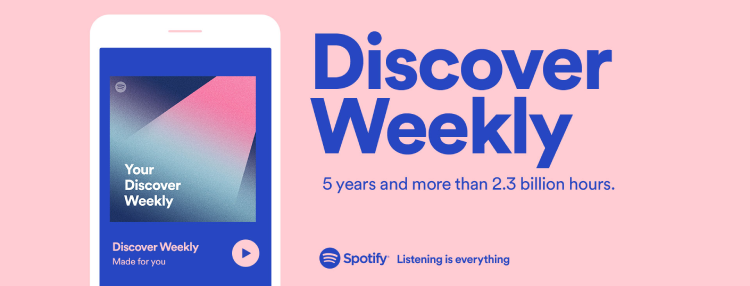
Spotify has over 4 billion playlists. Most are algorithmically generated. But they don’t feel algorithmic. They feel curated, personalised, intentional.
Discover Weekly drops every Monday with 30 songs tailored to your taste. Release Radar surfaces new music from artists you follow. Daily Mixes group your listening into genre-specific collections. Each feels like it was made by someone who knows your taste intimately, even though it’s entirely automated.
This is the illusion Spotify perfected: making scale feel personal. The playlist isn’t generated for millions of users. It’s generated for you, using data only you created. The fact that the process is automated doesn’t make it feel less intimate.
Playlists also solve the paradox of choice. Spotify’s catalogue contains 100 million tracks. That’s paralysing. Playlists reduce infinity to manageability while maintaining the feeling of discovery. You’re not choosing from 100 million songs. You’re choosing from 30 that someone or something, already decided you’d like.
The genius is that Spotify positioned this as curation, not filtering. Curation sounds premium, thoughtful, expert-driven. Filtering sounds restrictive. They’re functionally identical, but the framing changes perception entirely.
Spotify also outsourced playlist curation to users. Anyone can create a public playlist. The best ones, lo-fi study beats, workout bangers, sad girl hours, become cultural artefacts. Users do the work of categorising and contextualising music, and Spotify harvests that labour to improve its own recommendations.
The platform doesn’t just stream music. It creates the social and emotional containers in which music is experienced. That’s brand building through product design.
Why Spotify’s Personalisation Actually Feels Personal
Most personalisation is shallow. “Hi Rohan, we think you’ll like this product you looked at once.” Spotify is structural. It rebuilds the entire interface around your behaviour.
Your homepage isn’t Spotify’s homepage. It’s a dynamic feed of playlists, recommendations, and recently played content shaped entirely by your history. Two users opening Spotify see completely different experiences. The product adapts to the person, not the other way around.
This goes beyond recommendations. Spotify adjusts audio quality based on your connection. It surfaces podcasts based on listening time of day. It even changes its tone depending on context, upbeat suggestions in the morning, mellow ones at night.
The personalisation is also probabilistic, not deterministic. Spotify doesn’t just show you what you already like. It introduces adjacent genres, similar artists and unexpected matches. The algorithm is confident enough to take risks because it knows your taste deeply enough to predict what risks you’ll appreciate. (To read more about the Spotify algorithm, click here)
This is what separates good personalisation from great personalisation. Good personalisation is accurate. Great personalisation is accurate and surprising. It shows you things you didn’t know you wanted but immediately recognise as right.
That framing shift is everything. You’re not using Spotify’s service. Spotify is serving your needs. The brand becomes invisible, and the experience feels bespoke.
The Billboard Campaigns That Made Data Human
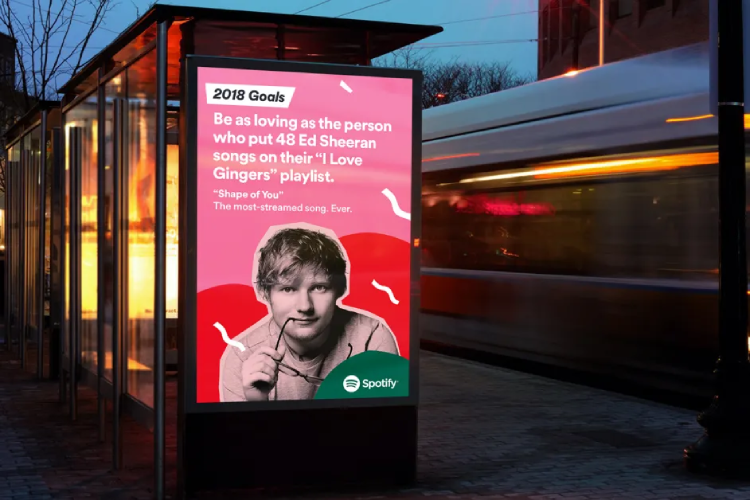
In 2016 and 2017, Spotify ran global outdoor campaigns that turned listening data into witty, humanised observations. Billboards said things like:
- “Dear 3,749 people who streamed ‘It’s the End of the World as We Know It’ the day of the Brexit vote, hang in there.”
- “To the person in Los Angeles who made a playlist called ‘One Night Stand with Jeb Bush,’ we have questions.”
These campaigns worked because they did three things exceptionally well.
First, they proved Spotify was paying attention. The data wasn’t just collected was noticed, interpreted and turned into culture. That made users feel seen, not surveilled.
Second, they made the data funny. Instead of creepy targeting, the campaigns felt like inside jokes. The specificity was absurd enough to be charming rather than invasive.
Third, they positioned Spotify as culturally omniscient. The brand wasn’t commenting on music. It was commenting on human behaviour, using music as the lens. That elevated Spotify from utility to cultural institution.
The campaigns also worked because they didn’t sell anything. There was no CTA, no discount code, no product feature highlight. Just observations. The message was: “We see you. We get you. We’re part of your life.” That’s brand building, not performance marketing.
What Happens When Your Brand Knows Too Much
Spotify’s model depends on comprehensive data collection. It tracks every song you play, skip, save, replay and search for. It knows your listening times, locations and devices. It correlates your behaviour with millions of other users to predict taste.
This raises an obvious question: why doesn’t this feel invasive? Why do people happily share Wrapped results when they’d be horrified if Facebook posted their browsing history?
The answer is value exchange and transparency. Spotify gives you something tangiblebetter recommendations, personalised playlists, and Wrapped return for your data. The value is immediate and obvious. You’re not trading privacy for targeted ads. You’re trading it for a better product experience.
Spotify also frames data collection as a service, not surveillance. The language is always “helping you discover music” or “creating playlists for you,” never “tracking your behaviour.” The framing makes the transaction feel collaborative rather than extractive.
There’s also an opt-in quality to sharing. Wrapped is something you choose to engage with and share. You’re not being advertised you’re being given content about yourself that you find interesting enough to broadcast. That flips the power dynamic entirely.
But the strategy has limits. As privacy concerns grow and regulations tighten, Spotify’s model becomes more fragile. The brand depends on data access remaining socially acceptable. If cultural attitudes shift and data collection becomes stigmatised, the entire moat collapses.
For now, Spotify has threaded the needle: collecting enough data to be valuable without crossing into creepy. But that balance requires constant recalibration as norms evolve.
Why This Strategy Is Nearly Impossible to Copy
Every streaming platform has access to listening data. Few have turned it into a brand personality. The reason isn’t capability, it’s commitment and culture.
Spotify built its entire product around personalisation from the start. The recommendation engine isn’t a feature. It’s the foundation. Competitors like Apple Music and YouTube Music added personalisation later, which means it’s layered on top of existing infrastructure rather than baked into the core.
Spotify also invested in editorial voice and creative campaigns that humanise data. That requires copywriters, designers and marketers who understand how to make numbers feel like stories. Most tech companies don’t hire for that skillset.
The data advantage compounds over time. Spotify has 15+ years of listening history on hundreds of millions of users. A new competitor starting today can’t replicate that depth of understanding, even with better algorithms. The cold-start problem is insurmountable at scale.
Finally, Spotify created cultural rituals like Wrapped, Discover Weekly, and playlist sharing that embed the brand into social behaviour. Competitors can copy the mechanics but not the cultural momentum. Wrapped only works because everyone does it. A similar feature from a smaller platform wouldn’t generate the same social proof.
This is why data-driven brand personality is a durable moat when executed well. It requires product, data, creative and culture to align perfectly over the years. Most brands can’t coordinate that level of long-term, cross-functional commitment.
What Other Brands Can Learn
Spotify proves that data becomes valuable when it enhances experience rather than just targeting efficiency. The lesson isn’t “collect more data.” It’s “use data to make customers feel understood.”
Personalisation must be structural, not cosmetic. Inserting a name into an email isn’t personalisation. Rebuilding the interface around individual behaviour is. Most brands personalise at the edges. Spotify personalises at the core.
Data-driven storytelling works when it reflects rather than targets. Spotify’s campaigns don’t tell you what to buy. They show you what people like you are already doing. That’s cultural observation, not persuasion. And observation feels less intrusive than selling.
Virality happens when sharing feels like self-expression. Wrapped works because posting it says something about your identity. It’s not brand promotion’s personal brand building. Brands that make sharing feel like curation rather than advertising unlock organic reach.
Finally, privacy concerns are managed through value exchange and transparency. People tolerate data collection when they get something meaningful in return and understand how the data is used. Vague promises don’t work. Tangible, immediate benefits do.
Conclusion
Spotify didn’t invent streaming. It didn’t invent playlists or recommendations or social sharing. What it invented was a brand that feels like it knows you personally, at scale.
The platform turned listening data into identity, algorithms into curation and user behaviour into cultural commentary. It made data feel human by using it to tell stories rather than just optimise transactions. And it made personalisation so structural that leaving feels like losing a part of yourself.
That’s where a Digital Marketing Agency like us earns its relevance. Not by chasing reach or clicks, but by translating behaviour into insight, insight into experience and experience into something people would rather stay with than switch from.
The music is the product. The data is the moat. And the feeling that Spotify understands your taste better than you do? That’s the brand. Everything else is just infrastructure.
FAQs

The founder and partner of Flora Fountain, Shefali leads the Content and Technology divisions. A one-time engineer who started her career writing front-end code, she took a detour sometime during her 9 years in New York, studied journalism and started writing prose, poetry and sometimes jokes. She now has 15...