


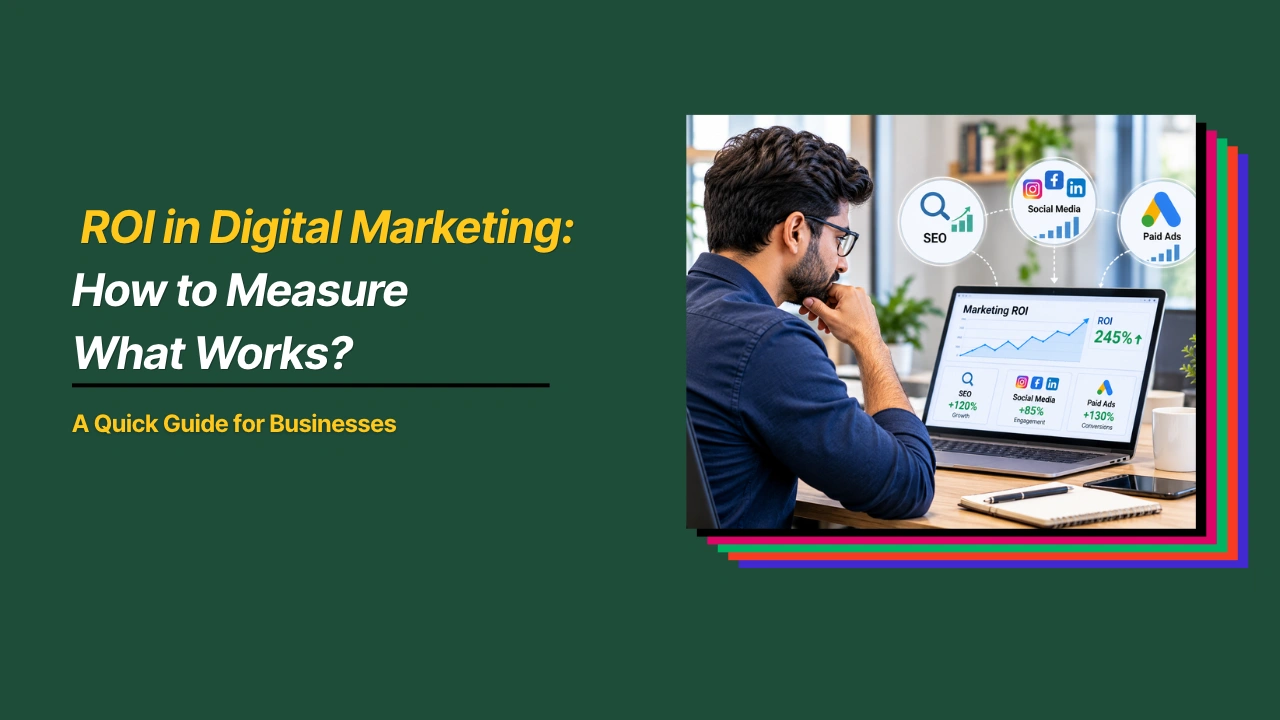
Every business wants its marketing spend to earn its place. You want to know if your SEO brings in profitable customers, if your social media builds an audience worth having and if your ad budget returns more than it costs. That is what ROI in digital marketing tells you.
Return on investment (ROI) compares the value your marketing creates with what you spend to create it. Measuring it takes more than checking sales or website traffic though. Paid ads can bring enquiries this week. SEO builds demand over several months. Social media builds recognition and content shapes decisions along the buying journey. Judge them all by one metric and you will draw the wrong conclusions.
The better approach is simple. Decide what each activity should achieve, pick metrics that match that goal and link the results to business outcomes. In this guide, we show you how to calculate marketing ROI, how to measure returns across each service and how to handle goals like brand awareness that don’t produce instant sales.
Table of Contents
- What Is ROI in Digital Marketing?
- Why Is Measuring Digital Marketing ROI Important?
- How to Calculate ROI in Digital Marketing?
- How to Measure ROI Across Different Digital Marketing Services?
- How to Measure Brand Awareness ROI?
- What Is a Good ROI in Digital Marketing?
- Tools to Help Businesses Measure Digital Marketing ROI
- Common Mistakes Businesses Make While Measuring Marketing ROI
- How Can Businesses Improve Their Digital Marketing ROI?
- Concluding It For You
- FAQs
Quick Summary
Digital marketing ROI shows how much profit your marketing creates compared with what you spend on it. Use the formula [(profit − investment) ÷ investment] × 100, then match the metrics to each service’s goal. Judge SEO, paid ads, content and lead-generation campaigns on enquiries, customers and profit. Judge brand building on awareness signals such as branded search and recall first, then link those signals to future sales.
What Is ROI in Digital Marketing?
ROI in digital marketing is the value your business earns from its marketing compared with what it costs to earn it. It answers one question. Does your marketing earn enough to justify what you spend on it?
Say you spend ₹1,00,000 on a campaign and it brings in ₹3,00,000 in attributable revenue. That looks like a win. But you still need to subtract product costs, operating expenses and other costs before you know how profitable it was.
Revenue and profit are different things. A campaign can bring in strong revenue and still deliver a poor return if each customer costs too much to win. A campaign with fewer immediate sales can still help your growth by building visibility and influencing later purchases. So look at both the financial and non-financial outcomes of your investment.
Why Is Measuring Digital Marketing ROI Important?
Without a clear measurement framework, you can’t tell which activities perform, which need work and where extra spend could do more. Here are five reasons it matters.
1. Understand Which Activities Generate Results
Channels contribute in different ways. Paid search captures people already looking for your service. Social media introduces your brand to people who haven’t started searching yet. Measuring each channel shows you where your audience finds you and which touchpoints lead to conversions.
2. Make Better Budget Decisions
If SEO brings qualified leads at a sustainable cost, you may invest more in content and organic search. If paid campaigns bring traffic but few enquiries, review your targeting, landing pages or ad message before you raise the budget.
3. Spot Problems Early
Tracking the right KPIs shows you where the problem sits. A high cost per lead points to inefficient targeting, while a low lead-to-customer rate points to lead quality, pricing or the sales process.
4. Connect Marketing With Revenue
Customers often touch several channels before they buy. This matters most for businesses with longer buying cycles, such as real estate, B2B services and healthcare.
5. Evaluate Long-Term Value
A visitor might read your blog today, return weeks later through a branded search and then become a customer. If you only measure immediate conversions, you will undervalue SEO, content marketing and brand building.
How to Calculate ROI in Digital Marketing?
The basic formula compares the profit your marketing generates with the total you invest in it.
Marketing ROI Formula:
ROI (%) = [(Marketing-Attributed Profit − Marketing Investment) ÷ Marketing Investment] × 100
Marketing-attributed profit is the profit from customers you can link to the activity. Marketing investment is every cost involved in planning, running and managing the campaign.
Say a company invests ₹2,00,000 in a campaign. It generates ₹6,00,000 in attributable revenue and, after direct fulfilment costs, ₹3,50,000 in attributable profit.
ROI = [(₹3,50,000 − ₹2,00,000) ÷ ₹2,00,000] × 100 = 75%
The business earned ₹75 in profit for every ₹100 it invested. The figures in this guide are illustrative examples that show the maths. They are not industry benchmarks.
ROI vs ROAS: What Is the Difference?
Businesses often use ROI and return on ad spend (ROAS) interchangeably, but they measure different things.
| Parameter | ROI | ROAS |
|---|---|---|
| What it measures | Profit against the overall investment | Revenue against advertising spend |
| Costs considered | All relevant marketing costs | Primarily ad spend |
| Best for | Overall marketing profitability | Paid advertising efficiency |
Say a company spends ₹50,000 on Google Ads and generates ₹2,50,000 in attributed revenue. ROAS is 5, which means ₹5 in revenue for every ₹1 spent. It does not mean ₹5 in profit. You still need to account for product costs, agency fees and staff time.
Remember: ROAS tells you how efficiently your ads work. ROI tells you whether your marketing investment is profitable.
How to Measure ROI Across Different Digital Marketing Services?
Each service has its own goal, audience behaviour and conversion timeline, so the right way to measure its ROI depends on what it should achieve.
1. SEO ROI: Measuring the Value of Organic Search
SEO reaches people who are actively searching for services like yours. The real payoff comes from relevant visitors, qualified enquiries and customers you win over time, not rankings alone.
Key metrics: organic leads, organic conversion rate, keyword visibility for commercial terms, cost per organic lead and revenue from organic search.
Google Search Console shows how often your pages appear and get clicked in Google Search. Google Analytics shows what visitors do next. Together they connect visibility to enquiries. If you want that connection built into your reporting, our SEO team in Ahmedabad works this way.
Example: A company invests ₹60,000 in SEO. Organic search generates 40 enquiries and 8 become customers, each bringing ₹20,000 in gross profit. That is ₹1,60,000 in attributable profit.
SEO ROI = [(₹1,60,000 − ₹60,000) ÷ ₹60,000] × 100 = 166.67%
SEO is a long-term investment, so judge it over a fitting period instead of expecting every month’s spend to produce sales.
2. Social Media ROI: Measuring More Than Likes and Followers
Social media ROI is harder to pin down because social supports several goals, including awareness, engagement and lead generation. To work out how to measure social media ROI, decide what you expect social to achieve first, then pick the KPIs.
Key metrics: reach, engagement rate, profile visits, website visits from social, leads, cost per lead and revenue from social campaigns.
How to Measure Social Media ROI for Lead Generation?
Say a real estate company invests ₹80,000 in social media ads and content. The campaign generates 100 enquiries and 5 buyers bring ₹2,00,000 in gross profit.
ROI = [(₹2,00,000 − ₹80,000) ÷ ₹80,000] × 100 = 150%
Still check enquiry quality, time to convert and whether social influenced customers who later converted through another channel.
How Do You Evaluate Organic Social Media Performance?
Organic social doesn’t always produce instant revenue. Check whether your content reaches the right audience, whether profile visits and branded searches rise and whether posts send visitors to your website or assist conversions. Count the full cost too, including strategy, design, production and management.
Likes and followers show engagement but they aren’t financial returns. Connect results to the goal behind each campaign.
3. PPC and Paid Advertising ROI
Paid campaigns on Google Ads and Meta Ads can produce traffic the moment they go live. More clicks don’t automatically mean better returns though. Measure the quality of the traffic and the value of the conversions.
Key metrics: ad spend, click-through rate, cost per click, conversion rate, cost per lead, cost per acquisition, ROAS and profit.
Example: A business spends ₹1,00,000 on Google Ads and generates 50 enquiries. Ten become customers at ₹15,000 gross profit each, so attributable profit is ₹1,50,000.
Paid Advertising ROI = [(₹1,50,000 − ₹1,00,000) ÷ ₹1,00,000] × 100 = 50%
If you also pay an agency to manage the campaigns, add that fee to the investment.
4. Content Marketing ROI
A well-planned blog can bring organic traffic, answer customer questions, generate enquiries and support buying decisions. Its value reaches beyond the readers of a single piece.
Key metrics: organic traffic to content pages, leads from content, assisted conversions, content-attributed revenue and cost per qualified lead.
Example: A company invests ₹40,000 in industry blogs. They contribute 20 qualified enquiries and four become customers worth ₹1,20,000 in gross profit.
Content Marketing ROI = [(₹1,20,000 − ₹40,000) ÷ ₹40,000] × 100 = 200%
This is why you should judge content by the value it adds across the customer journey and not by page views alone.
5. Email, Website and Influencer Marketing ROI
The same formula works for the rest of your services. Only the metrics change.
- Email marketing: track click-through rate, conversions, revenue per campaign and repeat purchases. Don’t rely on open rates alone. A ₹20,000 campaign that generates ₹80,000 in gross profit returns 300%.
- Website development and CRO: track conversion rate, form abandonment, revenue per visitor and lead quality. A ₹1,50,000 investment that adds ₹3,00,000 in gross profit returns 100%. Compare performance before and after the changes and account for shifts in traffic and campaigns.
- Influencer marketing: track relevant reach, tracked-link visits, discount-code usage and cost per acquisition. A ₹75,000 collaboration that generates ₹1,20,000 in gross profit returns 60%. Also check whether it raised awareness beyond the purchases you tracked directly.
How to Measure Brand Awareness ROI?
Brand awareness is the classic example of activity that isn’t built to produce instant sales. A person might see your Instagram campaign today, find your blog next week and search your name a month later. The campaign helped win that customer even though they didn’t convert on day one. So brand awareness ROI needs a different approach. Check whether your brand building increases recognition, consideration and future demand.
Key Metrics for Measuring Brand Awareness
- Reach and impressions: reach counts unique people who saw your brand. Impressions count total appearances. Neither proves people remember you.
- Branded search volume: rising searches for your company or product name signal growing interest. Track branded impressions and clicks in Google Search Console. Offline marketing, PR and seasonality can also move these numbers.
- Direct website traffic: familiar brands get typed in directly. It isn’t a perfect measure because analytics tools can class some unattributed visits as direct.
- Share of voice: how visible you are compared with competitors across chosen channels and keywords.
- Brand recall and recognition: surveys, brand-lift studies and customer interviews give you more direct insight than follower counts do.
How to Evaluate Brand ROI Beyond Immediate Sales
Link awareness indicators to commercial outcomes wherever you can. Check whether more people search for your brand, whether branded search visitors convert into enquiries, whether customers mention your brand during sales conversations and whether repeat purchases improve.
An important distinction: brand ROI doesn’t always have to appear as a financial percentage. Measure the awareness outcomes first and then look at how they relate to later business results.
What Is a Good ROI in Digital Marketing?
No single percentage guarantees a successful campaign. A good return depends on your industry, profit margins, customer acquisition costs, customer lifetime value, campaign duration and sales cycle. A business with high-value recurring customers may accept a higher acquisition cost. A business selling low-margin products needs a much lower one.
So skip arbitrary industry-wide numbers and set benchmarks from your own economics. Compare actual ROI against your target, current campaigns against previous ones and customer acquisition cost against customer lifetime value.
Tools to Help Businesses Measure Digital Marketing ROI
| Tool | What You Can Measure |
|---|---|
| Google Analytics 4 | Traffic, key events, conversions, revenue and attribution paths |
| Google Search Console | Organic clicks, impressions and search queries |
| Google Ads and Meta Ads Manager | Ad costs, conversions and attributed results |
| CRM platforms | Lead quality, pipeline and closed revenue |
| Email marketing platforms | Engagement, clicks and attributed conversions |
Don’t let one platform drive every decision. Search Console can’t tell you how much profit SEO generated and social analytics can’t link reach to sales without website tracking and CRM data. Google Analytics 4 lets you choose which actions count as key events, so agree on that list before you trust any conversion figure. Our guide on data analytics in digital marketing goes deeper into this.
Common Mistakes Businesses Make While Measuring Marketing ROI
1. Using the Same KPIs for Every Service
A social awareness campaign and a Google Ads lead-generation campaign have different goals. Judge both on sales alone and you undervalue brand building.
2. Ignoring the Complete Cost of Marketing
Ad spend is only one part of your investment. Include agency fees, creative production, software, content development and staff time.
3. Focusing on Vanity Metrics
Likes, impressions and page views give useful clues but they don’t automatically show business value. Tie them to the goal they support.
4. Ignoring the Customer Journey
A customer may find you on social media, research you through organic search and convert after a paid ad. Give all the credit to the last click and earlier channels look less valuable than they are.
5. Expecting Immediate Returns From Long-Term Investments
Judge SEO, content and brand building too early and you may stop strategies that build valuable long-term demand.
How Can Businesses Improve Their Digital Marketing ROI?
1. Set Measurable Objectives Before Launch
Give every activity a clear purpose and set KPIs before the campaign starts.
2. Focus on the Right Audience
Reaching more people isn’t the same as reaching more potential customers. Check audience relevance, search intent and targeting before you place your budget.
3. Improve Conversion Paths
A campaign can attract relevant visitors and still fail if the website experience is weak. Review landing pages, forms, page speed and calls to action.
4. Use Attribution to Understand Channel Contributions
Don’t judge performance on last-click conversions alone. Use attribution reports in Google Analytics to see which channels introduce customers, which assist and which close.
5. Review and Optimise Continuously
See which campaigns generate qualified leads and where costs creep in. Then refine your targeting, creative and budget allocation.
Concluding It For You
Understanding ROI in digital marketing comes down to knowing whether your marketing drives meaningful business results. SEO, paid ads, social media, content marketing and brand building all play different roles, so don’t expect every service to prove its worth through the same metrics or in the same timeframe.
At Flora Fountain, we believe marketing should be judged by the business value it creates and not by the activity it produces. If you want to know whether your current spend delivers, talk to our team about building a digital marketing strategy that connects visibility, engagement and conversions with your business goals.
Frequently Asked Questions

The founder and partner of Flora Fountain, Shefali leads the Content and Technology divisions. A one-time engineer who started her career writing front-end code, she took a detour sometime during her 9 years in New York, studied journalism and started writing prose, poetry and sometimes jokes. She now has 15...