


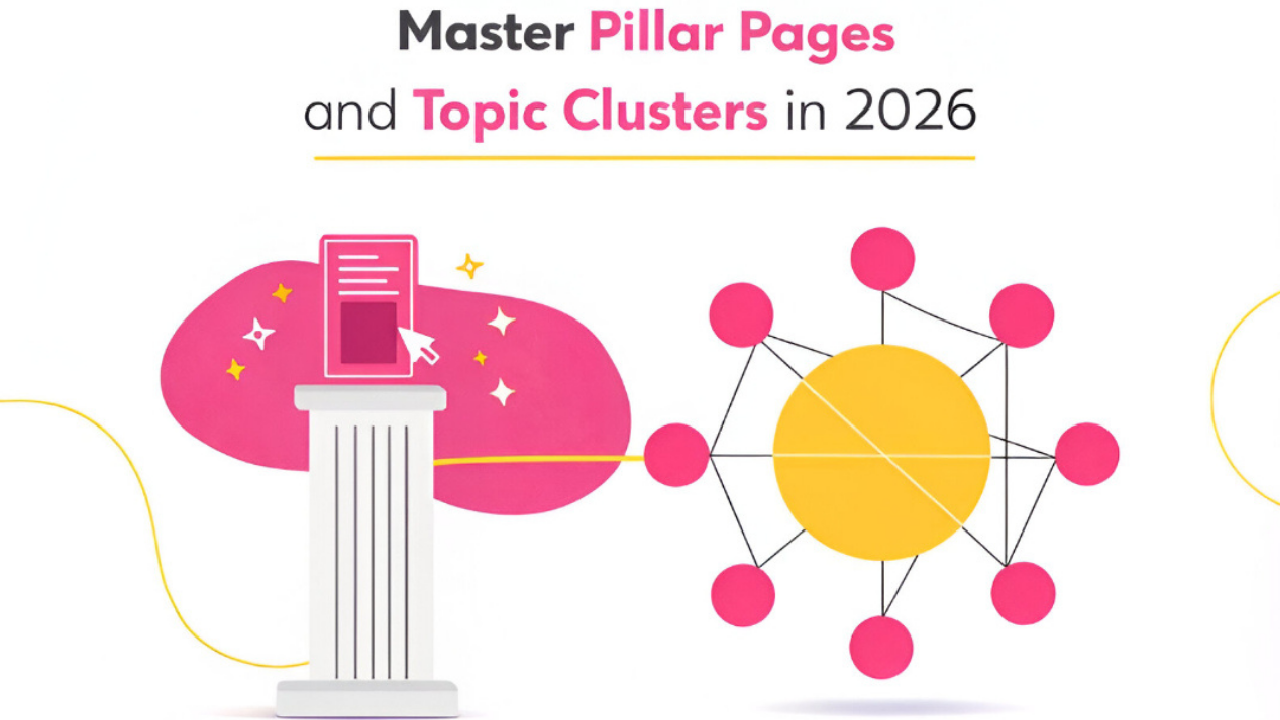
By 2026, the era of the standalone blog post is effectively over. Yet many brands still run their websites like a running journal, publishing isolated ideas that briefly surface, then quietly fade into obscurity. In today’s ecosystem, that’s not content marketing; it’s content disposal.
Search engines no longer reward individual articles for existing. They reward depth, structure, and subject ownership. Visibility now comes from demonstrating expertise across an entire theme, not from chasing keywords one post at a time. To be recognised as a category leader, your website must function like an intelligent framework, not a scattered feed.
This is exactly why pillar pages supported by tightly connected topic clusters have become non-negotiable. In our experience as a Premier digital marketing agency, brands that adopt this structured approach consistently outperform those relying on isolated posts, earning stronger authority signals, sustaining rankings longer, and unlocking up to 30% higher organic growth.
Table of Contents
- What is a Pillar Page?
- How do Pillar Pages and Clusters work?
- The Anatomy of a High-Performing Topic Cluster
- Choosing Your “Win-Ready” Pillar Topics
- Effective Pillar Page Types: Guide vs. “What-Is”
- Strategies to Master Topic Clusters in 2026
- Monitoring Success in the AI Era
- Conclusion
- FAQs
What is a Pillar Page?
In 2026, a pillar page is the central nervous system of a specific subject area. While traditional pillars were often sprawling “ultimate guides” designed for scrolling, the modern version is built for modular extraction. It acts as a high-level hub that provides a comprehensive overview of a broad topic, while intentionally leaving granular details to its supporting cluster content.
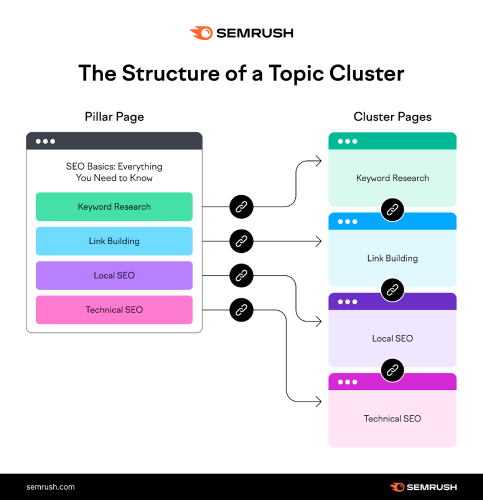
Source: Semrush
A successful pillar page now features anchor-linked navigation, summary boxes, and direct answer modules. This structure caters to both the skimming human reader and the data-hungry AI crawler. By serving as the authoritative anchor, the pillar page establishes your brand’s “entity” status. It is a signal of intent and expertise that a credible SEO Agency uses to anchor a brand’s digital footprint.
How do Pillar Pages and Clusters work?
The topic cluster is the sophisticated system that breathes life into your pillar page. It consists of three core elements: the central pillar (the hub), the cluster content (the spokes), and the strategic internal link web. Think of the pillar as the trunk of a tree and the cluster content as the branches; each branch dives deep into a specific subtopic that relates directly back to the trunk.
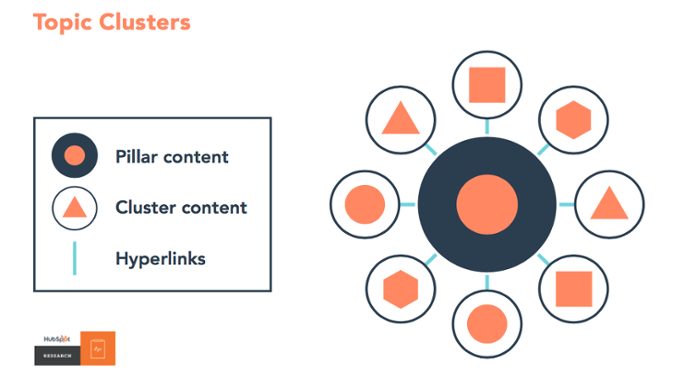
This model is the most effective solution to keyword cannibalisation. Instead of having five different pages competing for the same general keyword, you have one authoritative pillar page and multiple distinct cluster posts targeting high-intent questions. This bidirectional linking tells search engines that your site has the depth of experience and expertise required to satisfy user intent completely.
The Anatomy of a High-Performing Topic Cluster
To function as a semantic ecosystem, your cluster must be architected with precision. In 2026, clusters outperform keywords because they align your content around related entities rather than just exact-match terms.
- The Pillar (Hub): A comprehensive URL that defines the main entity and user intent.
- The Cluster Pages (Spokes): Targeted articles that explore subtopics, FAQs, and niche use cases in exhaustive detail.
- The Connective Tissue: Contextual internal links using descriptive anchor text. Every spoke must link back to the pillar, and the pillar must link to every spoke. This “Topological Webbing” ensures that when one page performs well, the entire cluster gains authority.
Choosing Your “Win-Ready” Pillar Topics
Not every topic deserves a cluster. In 2026, choosing a pillar based solely on high search volume is a strategy for failure. You must identify “Win-Ready” topics that offer high Information Gain.
A premier SEO Agency evaluates potential pillars using a multi-lens approach:
- Strategic Fit: Does this topic align with your core products or revenue-generating services?
- Entity Relevance: Feed your service into an AI engine to see which “Foundational Concepts” it associates with your niche.
- SERP Winability: Is the current competition thin? If top-ranking pages are all major platforms with sky-high authority, look for a more specific “Expert-Led” angle where your unique data can shine.
Effective Pillar Page Types: Guide vs. “What-Is”
In 2026, the format of your pillar should match the user’s intent. Most successful pillars fall into two categories:
- The Guide Pillar Page: A 101-level or advanced resource that provides a 360-degree view of a topic. It often incorporates “How-To” schema and step-by-step guidance to earn rich snippets.
- The “What-Is” Pillar Page: A definitive definition-based hub that explains a complex concept and links to tactical sub-guides. Regardless of the type, the goal is “Task Completeness.” Your pillar should be the last page a user needs to visit to understand the subject.
Strategies to Master Topic Clusters in 2026
To lead the search landscape in 2026, your cluster strategy must transition from a simple internal linking exercise to a sophisticated Node and Network model. The goal is no longer just to “rank” but to become a foundational data source that AI search engines trust and cite.
A premier SEO Agency implements the following advanced strategies to build unshakeable topical dominance:
1. Entity-Based Auditing and Mapping
Traditional keyword research often misses the “conceptual connections” that AI models use to understand a topic. In 2026, we focus on Entity-Based Auditing. This involves identifying the core “nodes”—the nouns, concepts, and authoritative figures—that define your industry.
- The Strategy: Align your pillar pages with the existing knowledge graphs used by models like Gemini and Claude. By using the same conceptual structure that AI has already mapped, you make it significantly easier for the algorithm to “retrieve” your content as a primary source of truth.
- Pro-Tip: Use AI discovery tools to identify “Semantic Gaps” where your competitors are missing key sub-entities. Filling these gaps is the fastest way to achieve 100% topical coverage.
2. The Answer-First (GEO) Structure
Generative Engine Optimisation (GEO) is the technical backbone of 2026 pillar pages. AI search engines prioritised “synthesis-friendly” content that is easy to ingest and summarise.
- The Strategy: Adopt a modular, answer-first structure. Lead every major H2 section with a concise, factual summary (roughly 40 to 60 words) that provides immediate value. This “Bottom Line Up Front” (BLUF) approach hands the answer to generative search engines in a format they can easily extract for AI Overviews.
- Formatting for Bots: Use bulleted lists for technical specifications and tables for data comparisons. These structured formats are high-signal markers that signal “Information Gain” to crawlers.
3. Topological Webbing through Bidirectional Linking
In 2026, internal linking is about more than passing “link juice”; it is about creating a Topological Web. This is the connective tissue that proves your brand has deep, multi-layered expertise.
- The Strategy: Every spoke page must link back to the pillar, but crucially, spokes must also link to their peer “cluster cousins.” This lateral linking signals a dense, interconnected knowledge base.
- Semantic Anchor Text: Avoid generic “click here” anchors. Instead, use semantically varied anchor text that describes the relationship between the two pages. For example, a spoke about “Schema for Local SEO” should link to the “Digital Marketing Strategy” pillar using anchors like “Technical Implementation Blueprint” or “Local Visibility Framework.”
4. Intent-Purity and Task Completeness
Google’s 2026 updates heavily penalise “thin” clusters that only repeat the same information in different ways. To master your niche, you must aim for Task Completeness.
- The Strategy: Ensure your cluster answers every question a user might have along their journey: from “What is it?” (Awareness) to “How do I choose?” (Consideration) to “How do I implement it?” (Action).
- Information Gain: As a leading digital marketing agency, we recommend including proprietary data, unique case studies, or first-hand expert quotes in every spoke. If your content doesn’t add something new to the global index, it will likely be filtered out as “AI-Frankenstein” noise.
Monitoring Success in the AI Era
A common mistake for any Digital Marketing Agency is measuring a pillar page by raw traffic alone. In 2026, success is measured by Share of Voice across traditional search and AI Overviews.
- Answer Inclusion Rate (AIR): How often is your cluster cited as the primary source in an AI summary?
- Engagement Depth: Track scroll depth and internal link CTR to prove that users are actually navigating from your hub to your spokes.
- Assisted Conversions: Use CRM tagging to see how many high-value leads visited a pillar page at the start of their journey, even if they converted weeks later.
Conclusion
The era of random content publication has ended. To thrive in the competitive landscape of 2026, your website must evolve from a collection of pages into an organised, interlinked system of expertise. Pillar pages and topic clusters are the fundamental building blocks of digital brand authority. When you invest in a cluster-based strategy, you are committing to quality over quantity.
From the perspective of a top SEO Agency, this is not optional infrastructure; it is a competitive necessity. The businesses dominating organic visibility are those whose content architecture reflects how modern search systems actually evaluate authority.
Frequently Asked Questions

The founder and partner of Flora Fountain, Shefali leads the Content and Technology divisions. A one-time engineer who started her career writing front-end code, she took a detour sometime during her 9 years in New York, studied journalism and started writing prose, poetry and sometimes jokes. She now has 15...