


In 2026, the traditional search has officially collapsed. Most businesses are still obsessing over "page one" or the SERP of Google, while their customers are getting direct answers from ChatGPT, Perplexity, and Google’s AI Overviews without ever clicking a link. The writer’s spreadsheet is full of keywords, but the organic revenue is vanishing because the machine is not citing the brand.
The problem is not the technology; it is your strategy. AI engines do not "rank" pages; they "retrieve" facts to synthesise answers. From the perspective of a premier digital marketing company, the goal is no longer just traffic. It is becoming the primary source of truth for the algorithm. If you are not optimising for AI Search, you are effectively invisible to the vast majority of the modern shopper's discovery journey.
Table of Contents:
- What is AI search?
- Why Does Your Brand Need To Optimise Content?
- Step #1: Information Density over Word Count
- Step #2: The Rise of the "Answer-First" Structure
- Step #3: Structured Data as your Digital Resume
- Step #4: Building Entity Authority and Trust
- Step #5: Tracking the Answer Inclusion Rate (AIR)
- Conclusion
- FAQs
What is AI search?
AI search is a fundamental shift from a “Library” model to an “Expert” model. For decades, traditional search engines functioned like a librarian. You gave them a keyword, and they gave you a list of books (links) where you might find the answer. The burden of reading, filtering, and synthesising that information was entirely on the user.
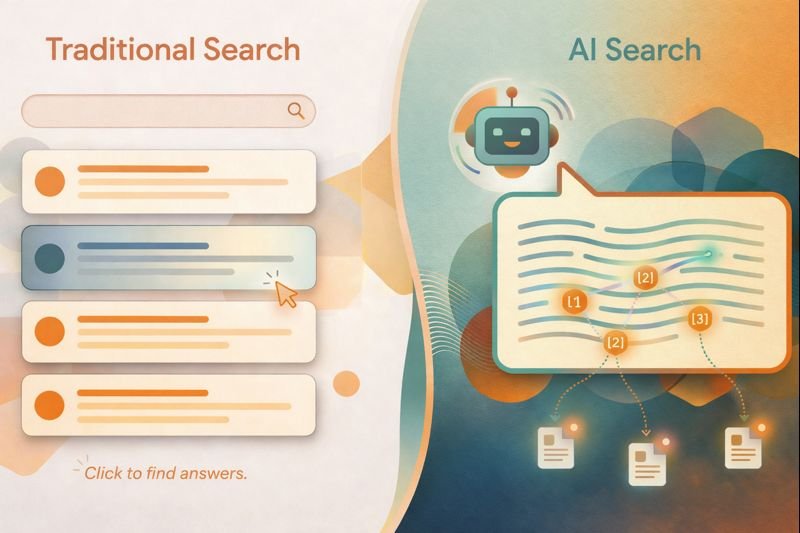
AI search has killed this model by integrating technologies like Natural Language Processing (NLP) and Large Language Models (LLMs) to understand the “why” behind a query, not just the “what.” Instead of a list of blue links, AI search provides a direct, conversational response. It considers your location, history, and the emotional tone of your request to predict exactly what you need.
In 2026, we live in a world of “Zero-Click” dominance. The AI has already read the web for you, meaning the “click” is no longer a mandatory step in the user journey. For a leading SEO agency, we believe the task is no longer getting a user to visit your site, but becoming the authoritative source that the AI “knowledgeable friend” trusts enough to cite.
Why Does Your Brand Need To Optimise Content?
To thrive in this new era, your strategy must evolve from traditional SEO (Search Engine Optimisation) to GEO (Generative Engine Optimisation). While SEO was about convincing an algorithm to rank your URL, GEO is about convincing a generative model to include your brand in its synthesised answer. This shift requires your content to be “machine-readable” so that AI models using Retrieval-Augmented Generation (RAG) can easily pull your data into their responses.
As a strategic digital marketing company, we view the move to GEO as the ultimate competitive advantage. If your content is buried in vague context or heavy jargon, the AI cannot retrieve it, leading to the “Click Collapse”, where your traffic simply vanishes. However, mastering GEO offers several powerful pros for your brand:
- Trust by Association: When an AI engine cites your brand as the “source” for a factual answer, it provides a level of implicit third-party endorsement that traditional ads cannot buy.
- Dominating the “Zero-Click” Space: By being the featured citation in an AI Overview, you stay visible even when the user never clicks through to a website.
- Higher Lead Quality: Users who do click through from an AI citation are often further down the funnel because the AI has already “pre-qualified” your brand as the expert solution.
- Future Proofing: Traditional keyword rankings are volatile, but “Entity Authority” in a generative model is a long-term moat that is much harder for competitors to displace.
Step #1: Information Density over Word Count
By 2026, the “long-form is better” myth will have been completely debunked by the rise of AI-led discovery. Traditional search engines used word count as a proxy for “comprehensiveness,” but AI search models like GPT-4o and Google’s Gemini do not read pages sequentially. Instead, they segment your content into independent blocks of meaning through a process called semantic chunking.
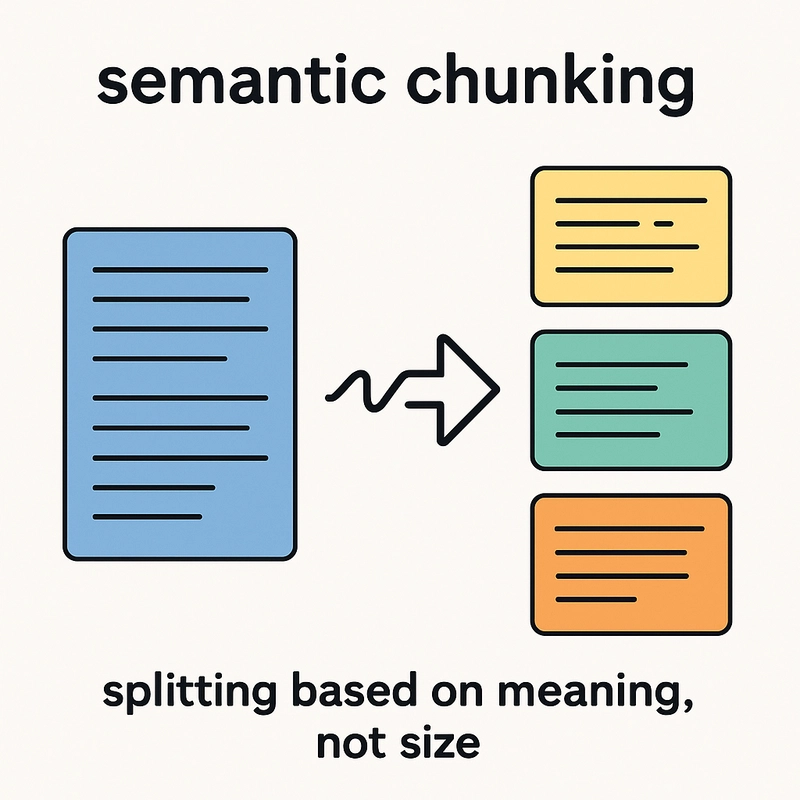
If your 2,000-word blog post is 80% fluff and narrative filler, the AI will ignore it in favour of a 400-word post that is “fact-dense.” In the era of Retrieval-Augmented Generation (RAG), the engine is looking for the highest concentration of unique, verifiable data in the shortest possible space.
An AI-led SEO agency would now focus on “Atomic Claims”. Short, self-contained sentences that state a fact, a statistic, or a proprietary insight clearly. To master information density, you must adopt these three principles:
- Eliminate the “Fluff” Buffer: AI models have limited “context windows.” If you bury your key points under two paragraphs of introductory “In today’s fast-paced world” filler, you waste the model’s processing power. Every sentence must provide a new data point or a distinct perspective.
- Modular Fact-Packing: Treat every paragraph as a standalone “unit of knowledge.” AI often pulls only a 60-word snippet from a massive article. If that snippet relies on the context of the previous five paragraphs to make sense, the AI will deem it “low-confidence” and skip it.
- Use the “Chain of Density” Framework: This involves iteratively refining your summaries to pack in more “salient entities” (specific people, places, metrics, and technical terms) without increasing the word count. The goal is a density of roughly 0.15 unique entities per token, which makes your content highly “extractable” for AI summaries.
As a strategic digital marketing company, we focus on “Information Gain.” AI search engines prioritise content that adds new information to their existing knowledge base. If your content is just a rewrite of what is already on Wikipedia, the AI has no reason to cite you. You must provide original data, first-hand case studies, or distinctive frameworks that the AI cannot find elsewhere.
Step #2: The Rise of the “Answer-First” Structure
In 2026, the traditional way of writing, starting with a long introduction and building up to a conclusion, is a recipe for invisibility. Research shows that opening paragraphs that resolve a query upfront are cited 67% more often by AI overviews. AI engines favour content that delivers a clear, direct answer in the first 40–60 words, as it allows their models to extract and verify information with high confidence.
As a high-performance SEO agency, we recommend adopting the “Inverted Pyramid” framework for every section of your content. This journalistic technique puts the “What, Who, When, Where, and Why” at the very top, followed by supporting evidence and then finer details.
- The BLUF Method: Start your headings with a specific question and provide the Bottom Line Up Front (BLUF). By resolving the user’s intent in the first two sentences, you decrease the “interaction cost” for the AI, making your content the path of least resistance for its summary.
- Semantic Independence: AI often pulls a single paragraph from a 2,000-word article to use as a citation. If that paragraph relies on vague phrases like “as mentioned above” or “this product,” the AI will deem it “low-confidence” and skip it. Each section must be semantically independent, containing all the specific brand names and entities required to stand alone as a complete answer.
- Match the Intent Format: Google’s AI classifies queries into four main formats: definitions, processes, comparisons, or decisions. Your answer-first section should mirror this format. If a user asks “How to…”, start with a numbered step; if they ask “What is…”, start with a concise definition.
Step #3: Structured Data as your Digital Resume
Structured Data (Schema) is the literal language you use to tell the AI exactly what your content is about. In 2026, this is not an “extra” but a core requirement for eligibility in AI results.
| Schema Type | Why it Matters in 2026 |
|---|---|
| FAQPage Schema | Directly feeds conversational AI engines. |
| HowTo Schema | Helps AI extract step-by-step instructions for summaries. |
| Organization Schema | Defines your brand as a “Trusted Entity” in the Knowledge Graph. |
| Author Schema | Links content to a verified human expert, reinforcing trust. |
Step #4: Building Entity Authority and Trust
Google’s AI evaluates your site as a whole “Entity” rather than just a collection of keywords. You must prove to the AI that you are a brand that people actually talk about across the wider internet.
Digital PR, mentions in niche communities like Reddit, and reviews on high-authority sites are now as valuable as traditional backlinks. AI models use these “trust signals” to decide which source is “safe” to recommend to a user. If your brand is mentioned across reputable websites, you become an entity that the AI can confidently cite.
Step #5: Tracking the Answer Inclusion Rate (AIR)
In 2026, “Rankings” are a legacy metric. The only KPI that matters is Answer Inclusion Rate (AIR), how often your brand is cited in an AI-generated answer.
A sophisticated digital marketing company now monitors “Share of Voice” within AI snapshots. We track when an AI engine wants a source but is not citing you yet, allowing us to perform a “GEO Gap Analysis” and fill that content void. Success is measured by citation frequency and branded search growth rather than just raw traffic numbers.
Conclusion
Optimising for AI Search in 2026 is about more than just technical SEO. It is about winning the “Citation War”. By structuring your content for RAG, establishing high E-E-A-T, and focusing on information density, you ensure that your brand is not just indexed but actively used by the machines that now guide consumer discovery.
Partnering with a premier SEO agency allows you to navigate the “Click Collapse” and turn AI Search into your most valuable growth engine. The future of search is conversational, synthesised, and source-based. If you are not the source, you are not in the conversation.
FAQs

The founder and partner of Flora Fountain, Shefali leads the Content and Technology divisions. A one-time engineer who started her career writing front-end code, she took a detour sometime during her 9 years in New York, studied journalism and started writing prose, poetry and sometimes jokes. She now has 15...