


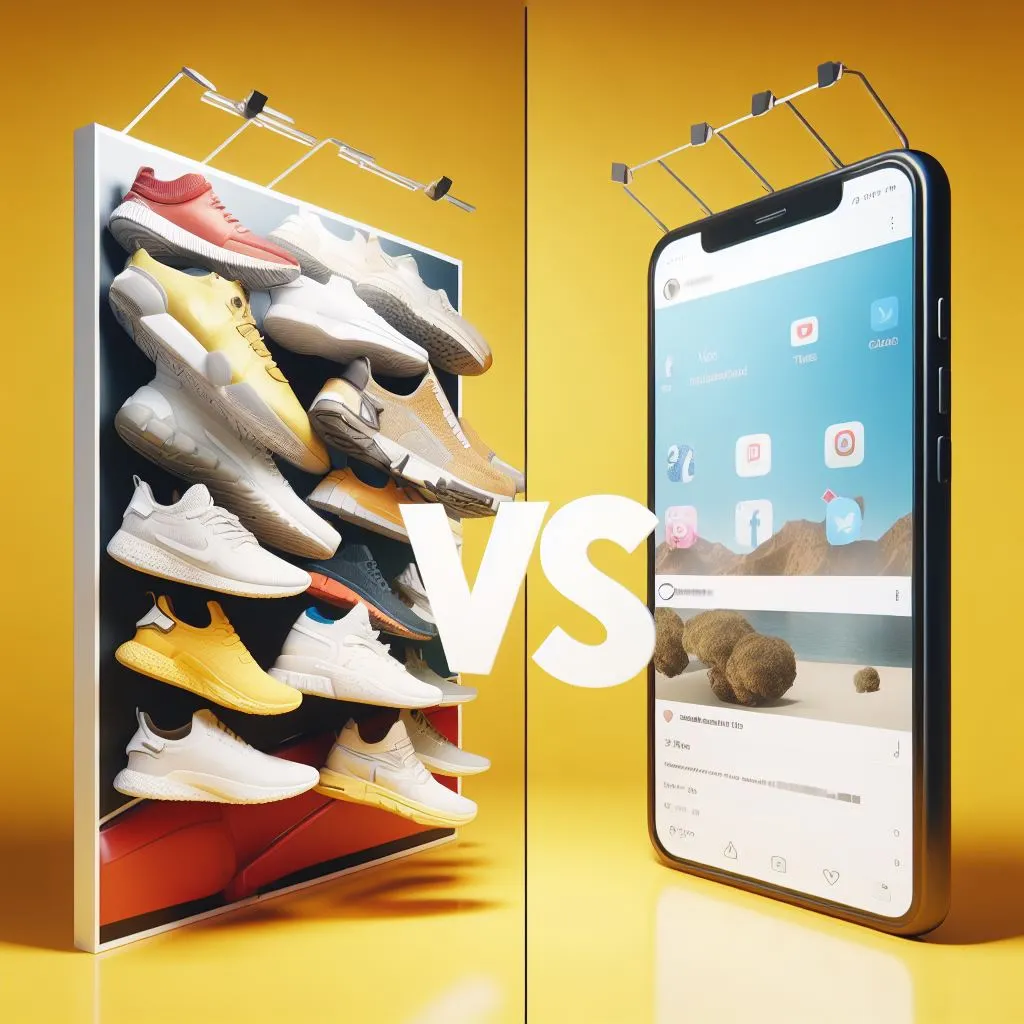
Every business eventually asks the same question. Does hoarding advertising still work, or should the whole budget move to digital? The honest answer is that both are still growing, and both are still earning their place, just for different reasons.
In India, out-of-home advertising is still widely called hoarding advertising. In Australia, the US and most Western markets, the same broad category is called OOH advertising, and the specific roadside format is usually called a billboard. As your trusted advertising agency in Ahmedabad, we at Flora Fountain work across both digital and OOH advertising markets. This guide breaks down what each channel actually does well in 2026, where each one falls short, and how to split your budget between them.
Quick Notes
- Hoarding advertising is any large outdoor display used to reach people in public spaces. It includes billboards, wallscapes, transit media and construction site panels.
- Digital hoardings (also called digital hoarding advertising or DOOH) are now the majority of OOH spend in most mature markets, and a fast-growing share in India.
- India’s OOH industry grew 8.6% in 2026 according to WPP Media’s mid-year TYNY report, making it one of the only traditional formats still expanding while other legacy channels flatten.
- Australia’s OOH industry posted double-digit revenue growth in 2025, with digital formats now making up over three-quarters of total OOH revenue.
- Digital marketing still wins on precise targeting and instant measurement. Hoarding advertising still wins on trust, reach density and cost per impression.
- Run both together as part of an integrated, omnichannel strategy and you typically outperform either channel alone.
Table of Contents
- What Is Hoarding Advertising?
- What Is Digital Marketing?
- Static Hoardings vs Digital Hoardings: What’s Changed in 2026
- Comparing OOH Advertising and Digital Marketing in 2026
- Which One’s the Best Fit for Your Business Type?
- Should You Combine Hoarding Advertising and Digital Marketing?
- Team Flora Fountain Is Always Up for a 1:1 Discussion
- FAQs
What Is Hoarding Advertising?
Hoarding advertising refers to large outdoor ads placed in public spaces to reach people as they move through a city: on roadsides, at bus shelters, on building wallscapes, around construction sites, at metro stations and inside malls. In India this term covers what most of the world calls OOH advertising (out-of-home advertising).
It works on repetition. Someone driving the same route to work sees the same hoarding dozens of times a month without ever choosing to look at it. That passive, repeated exposure builds brand recall in a way a scrollable feed can’t easily replicate. A 2026 India OOH market guide puts a number on this gap: outdoor advertising delivers an 82% recall rate in India compared to 24% for digital display ads, and does it at a fraction of the CPM.
What Is Digital Marketing?
Digital marketing covers every paid or organic effort to reach people online: search ads, social, SEO, email, video and increasingly AI search platforms like ChatGPT and Perplexity. Every click, view and conversion is traceable back to a specific ad, audience and rupee (or dollar) spent.
Global digital ad spend is on track to cross $780 billion in 2026, according to industry compilations of eMarketer, GroupM and Dentsu data, with search still the single largest channel by spend and social growing the fastest. That traceability, more than the scale, is why performance-led businesses default to digital first. You can see within days whether a campaign is working and shift budget before wasting more of it.
Static Hoardings V/S Digital Hoardings: What’s Changed in 2026
Okay, so we are adding this here because we don’t want you to get confused and consider digital hoardings as digital marketing.
Traditional hoarding advertising uses a printed vinyl or flex panel that stays fixed for the length of the booking.
Digital hoardings, also called digital hoarding advertising or DOOH, replace that panel with an LED screen that rotates multiple ads, updates creative remotely and can even change by time of day or audience.
This shift is important because it ends OOH’s oldest weakness: inflexibility. In Australia, DOOH now accounts for 76.6% of total OOH net revenue, up from 74.9% the year before, and the country’s full-year 2025 OOH revenue hit A$1.4495 billion, up 11.43% on 2024. In India, the shift is earlier but accelerating: IMARC Group values India’s digital OOH market at USD 2.43 billion in 2025, projected to grow at an 11.39% CAGR through 2034, driven mostly by metro expansion, airport screens and smart-city infrastructure.
Globally, DOOH is forecast to account for 49% of all OOH spend in 2026, reaching roughly $28 billion and overtaking static formats for the first time, according to the World Out of Home Organisation’s Global Out of Home Expenditure Report.
Comparing OOH Advertising and Digital Marketing in 2026
ROI and cost
Neither channel is universally cheaper, so the real question is cost per outcome, not cost per unit.
Hoarding advertising has a higher upfront cost per site but reaches a large, fixed audience for the length of the booking.
Digital marketing has a lower entry cost but climbs fast in competitive categories, since every business bids for the same keywords or audience. Search advertising alone is projected to hit roughly $390 billion globally in 2026, which tells you how much competition is baked into that channel already.
OOH advertising keeps growing despite this. India’s Pitch Madison Advertising Report 2026 recorded OOH revenue growing 4% year-on-year in 2025, calling it the “traditional survivor” in a media landscape where most legacy formats are flat or shrinking. Australia’s OOH industry has kept growing into 2026 too, with Q1 2026 net media revenue up 7.41% year-on-year and Q2 2026 up a further 5.58%.
Audience targeting: reach vs precision
Digital marketing wins on reach and precision because you can target by age, location, interest, past purchase behaviour and device.
Hoarding advertising wins on reach density. A hoarding at a busy junction reaches everyone who passes, regardless of whether they are searching for anything. OOH also still reaches people where digital marketing increasingly struggles to: the Outdoor Media Association reports OOH reaches 97% of Australians weekly, around 22 million people aged 14 and over, a scale that’s hard to replicate through a screen alone.
Measurement: what’s easier to prove
In digital marketing, you can surely track the measurements in detail. Every impression, click and conversion is logged, so you can prove ROI to a stakeholder within a single reporting cycle.
Hoarding advertising has historically been harder to measure, but that gap is closing fast. Australia rolled out MOVE, a unified audience measurement currency for the entire OOH industry, on 16 March 2026, replacing fragmented, media-owner-specific estimates with one industry-wide standard for planning, buying and reporting. India doesn’t have an equivalent national system yet, but similar footfall-based measurement tools are expanding across metro markets.
Flexibility: how fast you can adapt
Digital marketing can be paused, edited or reallocated within minutes. Traditional hoardings needed weeks to print, install and take down.
Digital hoardings have narrowed that gap significantly. Because DOOH screens are managed remotely, creative can be swapped or paused almost as fast as a social ad, though site availability still needs booking in advance.
Which One’s the Best Fit for Your Business Type?
Startups with tight budgets usually get more from digital marketing first, since it lets you test messaging and offers cheaply before committing to a fixed placement.
Established brands with existing demand tend to benefit more from hoarding advertising, since visibility and recall matter more than direct response once a brand is already known.
Local businesses, particularly retail, real estate, hospitality and healthcare, tend to get the strongest results from both running together. A hoarding near your store builds local trust. Digital marketing captures the person who searches for you after seeing it.
Should You Combine Hoarding Advertising and Digital Marketing?
Yes. Actually running both together as one integrated, omnichannel strategy, rather than two separate budgets, is practically a wise decision.
A well-placed hoarding builds the familiarity that makes someone more likely to click your ad or trust your site when they encounter it later. This is called the search lift effect, where OOH exposure increases branded search volume and improves the performance of digital campaigns running at the same time.
AdQuick’s Search Lift product was built specifically to track this: branded search volume rising after an OOH campaign launches, measured against control markets. YouGov research backs this up from the audience side too: 54% of Gen Z say they search for a product on their phone after seeing it in an OOH ad, and 48% go on to recommend what they saw.
We’ve seen this pattern repeatedly with clients at Flora Fountain. Hoarding campaigns paired with a coordinated digital plan consistently outperform digital running alone.
Team Flora Fountain Is Always Up for a 1:1 Discussion
If you need measurable, budget-controlled results fast, start with digital marketing. If you need broad, unavoidable visibility to build a brand people recognise and trust, OOH advertising still earns its place, and in 2026 it’s earning it with better measurement than ever before.
Most businesses don’t need to choose one permanently. They need the right mix for their stage, category and budget, and that mix should shift as the business grows. If you’d like to talk through what mix makes sense for where your business is right now, get in touch with team Flora Fountain for a direct conversation about what would actually move the needle for you.
Frequently Asked Questions

Vasim Samadji is a partner at Flora Fountain, where he leads the Business and Marketing Strategy divisions. In a world where everyone is used to sugarcoating, his directness is often considered rude. But that shouldn't be a problem if you like the no-nonsense approach. Because he is a seasoned professional...