


When McDonald’s opened its first restaurant in India in October 1996, it had to rethink how a global fast-food model would work in a market with very different food preferences, cultural expectations and price sensitivities.
That decision shaped the brand’s entire India strategy.
McDonald’s marketing strategy in India is built around localisation. The brand adapted its products, pricing, advertising, restaurant experience and distribution to Indian consumer behaviour instead of simply importing its global model. Today, that foundation has expanded into a more digital and omnichannel approach.
This article breaks down how McDonald’s built its position in India, why its localisation strategy worked and how its marketing has evolved.
Table of Contents
- Quick Summary
- What Is McDonald’s Marketing Strategy in India?
- Why McDonald’s Had to Adapt Its Global Strategy for India
- McDonald’s Localisation Strategy in India
- McDonald’s Pricing Strategy in India
- McDonald’s Advertising and Brand Strategy in India
- McDonald’s Digital Marketing Strategy
- How McDonald’s Uses Regional Marketing in India
- How McDonald’s Marketing Strategy Has Evolved
- Why McDonald’s Localisation Strategy Works
- What Indian Brands Can Learn From McDonald’s Marketing Strategy
- Team Flora Fountain Is Just A Call Away
Quick Summary
McDonald’s success in India is not the result of one marketing tactic.
It comes from connecting:
Localisation + Value + Brand + Digital + Regional execution
The brand adapted its product and operations for Indian consumers, used affordability to encourage frequency, built emotional relevance through its campaigns and increasingly connected its customer experience through digital channels.
That combination is what makes McDonald’s India such a useful marketing case study.
What Is McDonald’s Marketing Strategy in India?
At its core, McDonald’s treats India as a distinct market rather than an extension of its global business.
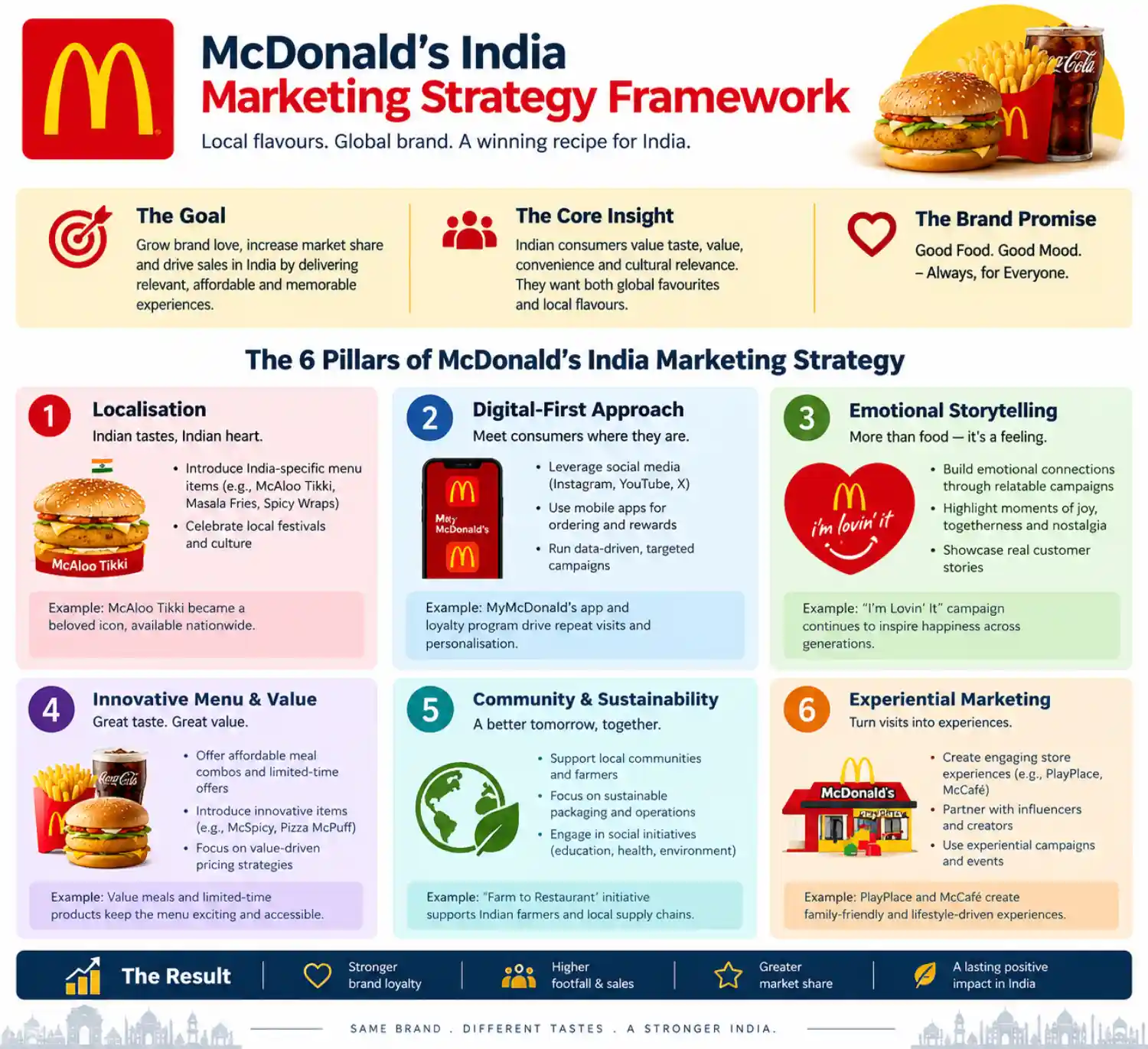
Its strategy combines product localisation, value-led pricing, emotionally driven brand communication, regional execution and an increasingly digital customer journey.
| Strategy | What McDonald’s does | Why it matters |
|---|---|---|
| Product | India-specific products with no beef or pork | Reduces cultural and dietary barriers |
| Pricing | Value-led meals and combos | Makes the brand accessible to price-sensitive consumers |
| Promotion | Campaigns centred on togetherness and cultural relevance | Builds emotional connection |
| Digital | App, website, kiosks and delivery channels | Makes ordering more convenient |
| Localisation | Menu and operational choices adapted for India | Makes a global brand feel locally relevant |
| Regional execution | Different operating structures across regions | Allows local flexibility at scale |
| Customer experience | Vegetarian and non-vegetarian food preparation kept separate | Builds trust and reduces hesitation |
Why McDonald’s Had to Adapt Its Global Strategy for India
India presented McDonald’s with a challenge that could not be solved through advertising alone.
Food preferences vary significantly across the country and religious considerations influence what many consumers are comfortable eating. Vegetarian customers also needed greater clarity and confidence around food preparation.
As a result, McDonald’s had to adapt not just what it sold but how it operated.
The brand introduced India-specific menu items, separated vegetarian and non-vegetarian food preparation and removed beef and pork from its Indian menu. McDonald’s itself has communicated its separate vegetarian and non-vegetarian preparation practices to customers.
The important marketing lesson is that localisation happened at the business level, not just the communication level.
McDonald’s Localisation Strategy in India
👉 Building a localised menu
McDonald’s did not simply take its existing menu and add Indian spices.
One of its most recognisable India-specific products is the McAloo Tikki, which uses a familiar Indian food format and places it within the McDonald’s product system.
That is a much deeper form of localisation. The brand took something consumers already understood and gave it a McDonald’s identity.
McDonald’s India continues to describe menu innovation and culturally relevant food choices as important parts of its proposition.
👉 Keeping vegetarian and non-vegetarian preparation separate
McDonald’s India keeps vegetarian and non-vegetarian food preparation separate within its restaurants.
This decision goes beyond product selection. It addresses a consumer trust issue that could otherwise create friction for vegetarian customers.
That makes operational design part of the marketing strategy.
👉 Adapting flavours and products
The Maharaja Mac is another example of this approach.
Instead of treating the absence of beef as simply a restriction, McDonald’s developed a distinctly Indian alternative and has continued to evolve the product range with both chicken and vegetarian variants.
The broader lesson is simple:
Localisation works better when the product itself feels designed for the market rather than modified for it.
👉 Managing cultural sensitivities
No beef, no pork and separate vegetarian and non-vegetarian preparation all support the same strategic objective: making the brand easier to trust.
For McDonald’s, localisation therefore works as both a relevance strategy and a barrier-reduction strategy.
👉 Building a local supply chain
McDonald’s India has developed a domestic supply chain to support its restaurant network and India-specific products.
This matters strategically because localisation at scale requires more than creative ideas. Products need to be sourced, prepared and delivered consistently across a large restaurant network.
McDonald’s Pricing Strategy in India
McDonald’s has historically positioned affordability as an important part of its Indian proposition.
The logic is not simply “keep prices low”.
An accessible entry point can encourage trial. Combos can increase basket size. Consistent value can then encourage repeat visits.
That creates a value ladder:
Entry price → Trial → Combo → Repeat visit → Habit
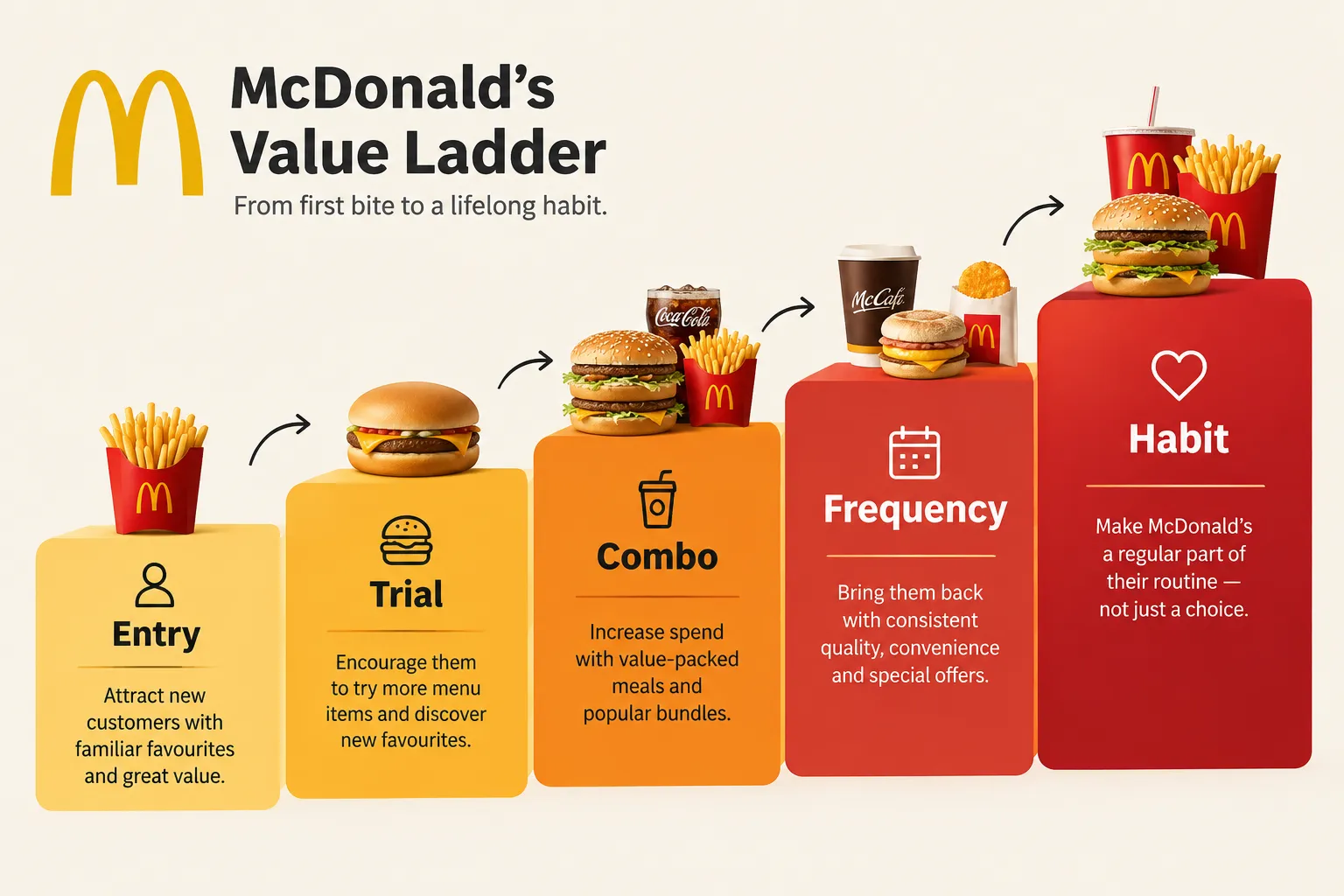
In Westlife Foodworld’s West and South India business, Everyday McSaver Meals and Combos have been a central part of its value strategy. The company’s FY25 annual report says the platform started at ₹99 and ₹149 and helped strengthen affordability perception, footfall and meal frequency.
In 2026, value has become even more important as competition and operating costs have increased. Reuters reported that McDonald’s West and South India operator Westlife Foodworld promoted ₹99 Everyday Value Meals as the business responded to cost-conscious consumers and stronger competition.
The strategic point is that pricing is part of positioning.
McDonald’s is not simply using discounts to drive short-term sales. Its value proposition is being used to support trial, frequency and customer volume.
McDonald’s Advertising and Brand Strategy in India
McDonald’s advertising has consistently built around emotional associations such as family, friendship, togetherness and shared experiences.
The approach has evolved while the underlying brand territory remains familiar.
In 2025, McDonald’s India West & South launched “It’s a McD Thing”, using India’s “Adda” culture and spontaneous social moments to position its restaurants as places where people connect rather than simply places to eat.
In 2026, the “Let’s Family at McD” campaign expanded that idea to include different forms of family and friendship. The campaign also marked McDonald’s 30 years in India.
The strategic pattern is interesting:
Consistent brand idea + changing cultural expression
McDonald’s keeps the emotional territory familiar while adapting the way it expresses that territory for different audiences and moments.
McDonald’s Digital Marketing Strategy
Digital is no longer simply a promotional channel for McDonald’s India. It has become an important part of the customer journey.
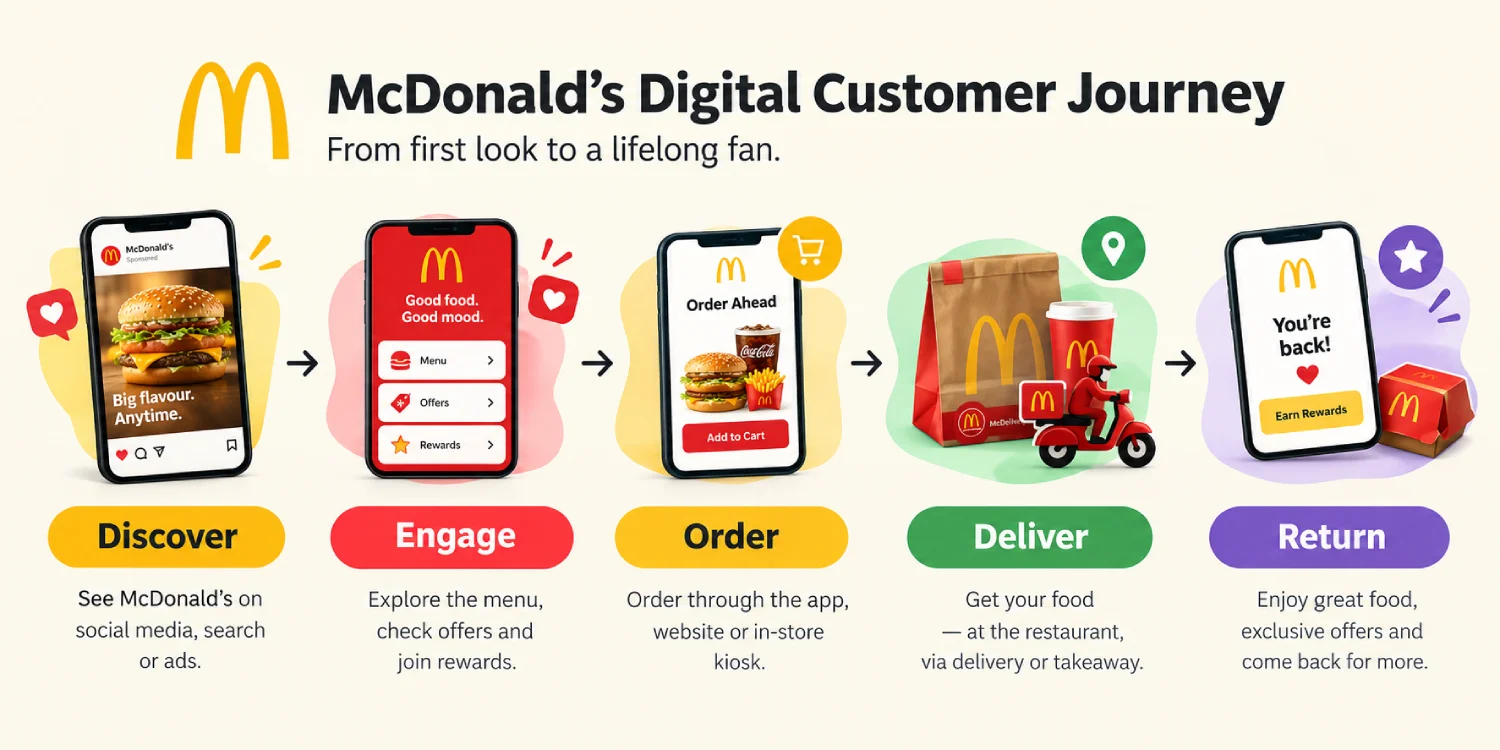
Westlife Foodworld has invested in mobile ordering, self-ordering kiosks, its own digital ecosystem and delivery integration. Its FY25 reporting describes digital channels as a major part of its omnichannel model.
The most important point is not that McDonald’s has an app.
It is that digital connects multiple parts of the experience:
- Discovery
- Offer communication
- Ordering
- Delivery
- Restaurant visits
- Repeat purchases
This figure applies specifically to Westlife’s West and South India business, not to the entire McDonald’s India operation. That distinction should remain explicit.
The marketing lesson is bigger than “McDonald’s does digital marketing”:
Digital works best when it is connected to the entire customer journey.
How McDonald’s Uses Regional Marketing in India
India cannot be treated as one completely uniform consumer market.
McDonald’s India operates through two regional businesses. Westlife Foodworld operates McDonald’s restaurants across West and South India while Connaught Plaza Restaurants operates the North and East business.
This regional structure allows local execution to vary while the overall brand remains consistent.
The strategic principle is important:
A national brand does not always need one identical marketing playbook.
Language, store formats, menu preferences, expansion priorities and consumer behaviour can vary by market.
This is particularly relevant for brands trying to scale across India. National consistency creates recognition but local execution can make the brand more relevant.
How McDonald’s Marketing Strategy Has Evolved
McDonald’s India began with a strong focus on localisation and affordability. The strategy has since developed in three important directions.
👉 Value-led competition
Value remains a major part of the proposition as McDonald’s responds to consumers who are increasingly conscious of prices and to competition from other QSR brands. Reuters reported in July 2026 that Westlife was using ₹99 Everyday Value Meals as part of its response to this environment.
👉 Digital-first customer journeys
Digital ordering and omnichannel infrastructure have moved from supporting the restaurant experience to becoming a major part of it. Westlife’s reporting has consistently highlighted the growing contribution of digital channels.
👉 More relevant brand storytelling
Recent campaigns have focused on cultural behaviour, friendship, family and shared experiences. The 2025 “It’s a McD Thing” campaign and 2026 “Let’s Family at McD” campaign show how McDonald’s is keeping the brand’s emotional territory consistent while updating its expression for contemporary audiences.
Why McDonald’s Localisation Strategy Works
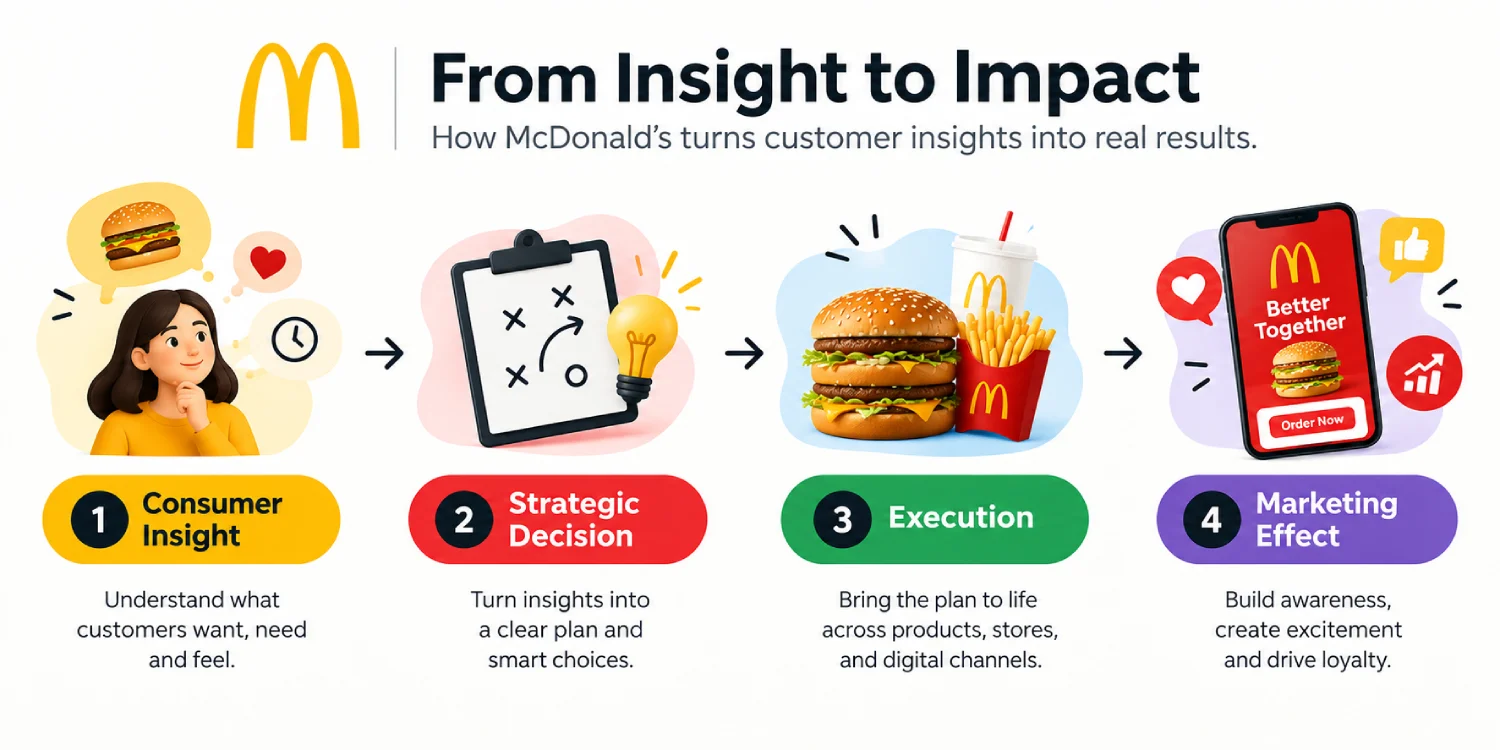
The easiest way to understand McDonald’s India strategy is as a chain of decisions:
Consumer insight
Indian consumers have diverse dietary and cultural preferences.
↓
Strategic decision
Adapt the menu, preparation process and communication.
↓
Execution
Create India-specific products, separate vegetarian and non-vegetarian preparation and build the supporting supply chain.
↓
Marketing effect
Reduce cultural friction and make a global brand feel more familiar.
That is why McDonald’s localisation strategy is more significant than simply adding an Indian burger to the menu.
Localisation changes the experience itself.
A competitor can copy a campaign idea quickly. An operational model built around local sourcing, product development and food preparation is much harder to replicate.
What Indian Brands Can Learn From McDonald’s Marketing Strategy
McDonald’s India offers several lessons that extend beyond the QSR category.
1. Localisation should shape the product or experience
Changing the message is not always enough. The strongest localisation changes what the customer actually experiences.
2. Pricing is part of positioning
Price influences how accessible a brand feels and how often customers are willing to interact with it.
3. Consistent brand codes can coexist with local variation
McDonald’s continues to build around familiar ideas such as family, friendship and togetherness while changing the cultural context around them.
4. Brand building and performance can work together
Brand campaigns create familiarity and demand. Digital ordering, offers and measurable customer journeys help convert that demand.
For Indian businesses, the lesson is broader than McDonald’s. Strong digital marketing increasingly needs to connect brand building, acquisition and conversion rather than treating each as a separate activity.
5. Strong marketing strategies are systems
McDonald’s success does not come from one burger or one advertisement.
Its product decisions, pricing, communication, digital experience and regional execution reinforce one another.
That is the bigger lesson for Indian brands: build a connected marketing system instead of relying on isolated campaigns.
You might also like: Apple’s Secret Marketing Trick Behind the 2026 Launch Event Hype
Team Flora Fountain Is Just A Call Away
McDonald’s success in India shows what happens when marketing decisions are built around a clear understanding of the market, the consumer and the business goal.
At Flora Fountain, we apply the same strategic thinking to the brands we work with. From building stronger brand presence to driving measurable digital growth, our work is shaped by research, consumer insight and the realities of each business. With experience across 150+ brands, we bring together strategy, creativity and digital execution to help brands turn marketing into meaningful business impact.
If your brand is ready to move beyond disconnected campaigns and build a marketing strategy that works as a system, talk to Team Flora Fountain.

Vasim Samadji is a partner at Flora Fountain, where he leads the Business and Marketing Strategy divisions. In a world where everyone is used to sugarcoating, his directness is often considered rude. But that shouldn't be a problem if you like the no-nonsense approach. Because he is a seasoned professional...