


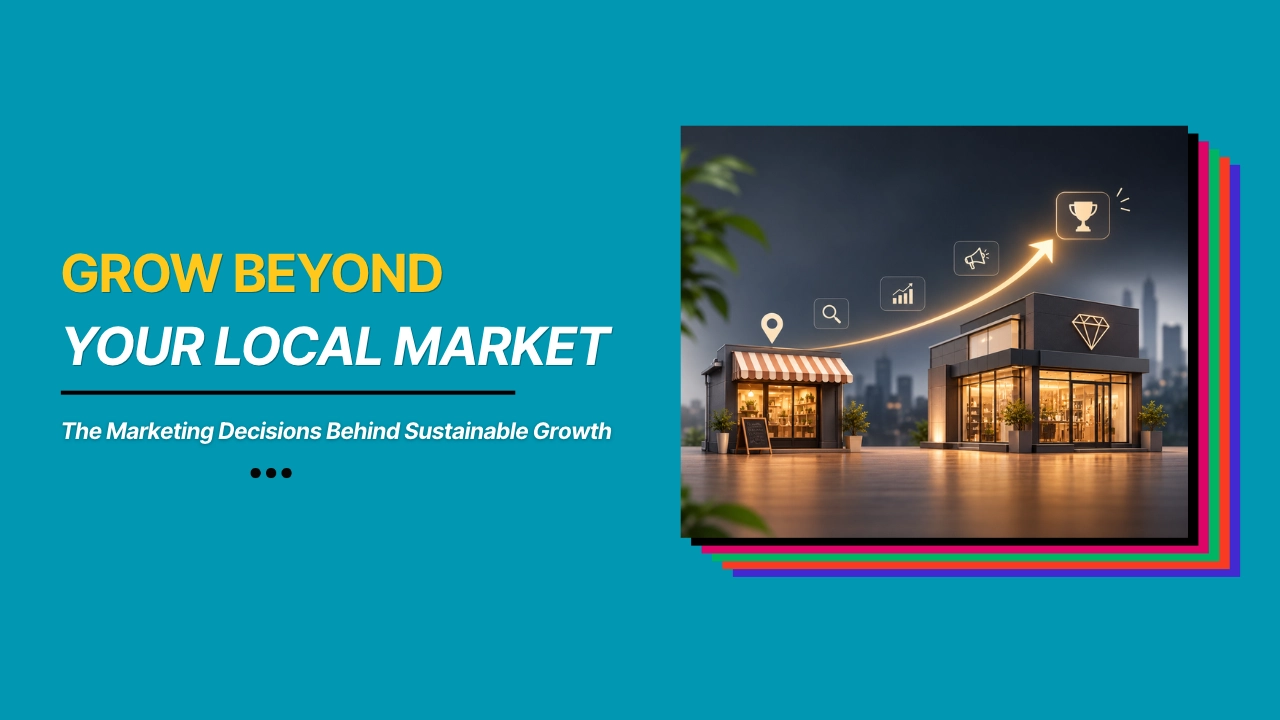
Most recognised brands didn’t start with a big budget or a clever campaign. They started as local businesses that made a series of marketing decisions in the right order.
A neighbourhood café starts with walk-ins and word of mouth. A jewellery store starts with loyal customers and a showroom. Both can have a good product and years of experience, and still struggle to reach beyond their existing network. The problem isn’t always quality. Sometimes the business has simply outgrown the way it markets itself.
That is why digital marketing for local business growth isn’t a checklist. It is a sequence of choices about what to build, what to delay and what to measure.
Here are the decisions behind that move, stage by stage, so you can see what deserves your budget now.
Table of Contents
- Quick Summary
- Why the Decisions Change as the Business Grows
- Decision 1: Build the Digital Foundation
- Decision 2: Turn Visibility Into Consistent Enquiries
- Decision 3: Become a Recognisable Brand
- Decision 4: Scale Beyond the Existing Market
- What the Journey Looks Like in Practice
- How to Decide Which Marketing Services You Need
- Final Thoughts
- Frequently Asked Questions
Quick Summary
Digital marketing for local business growth works when brands choose their investments by stage and not by trend. You don’t need every service at once. Invest in the channel that solves your current business problem.
- Early stage: Build your identity, online presence and basic discovery.
- Consistent enquiries: Improve visibility, trust and lead generation.
- Growing brand: Invest in positioning, content, SEO and performance marketing.
- Established business: Build integrated campaigns, retention and expansion strategies.
Why the Decisions Change as the Business Grows
Take a local jewellery boutique that has traded successfully for several years. Most customers find it through referrals, relationships and its location.
Now the owner wants to attract younger buyers, promote new collections and reach customers in other parts of the city.
More Instagram posts won’t solve that on their own. The brand may need a sharper identity, better product photography, a website that showcases its collections, local SEO and targeted ads.
The marketing requirement changed because the business objective changed. That is the difference between doing marketing activities and making marketing decisions.
A useful way to see it is through four stages.
Decision 1: Build the Digital Foundation
The question to settle: can customers easily find and understand us?
The business works, but its digital presence is thin. Customers arrive through referrals, walk-ins or personal networks. The brands that grow from here don’t launch an elaborate campaign. They build a reliable foundation that tells people who they are, what they offer and how to reach them.
What they invest in:
- A clear brand identity: A recognisable name, visual identity, tone and a clear explanation of what makes the business different. A logo alone isn’t a brand identity. Colours, messaging, packaging and customer communication all need to feel consistent.
- A functional website: It answers basic customer questions without making visitors work. It lists products or services, location, contact details, relevant photographs and a simple enquiry, call or WhatsApp option.
- A Google Business Profile: Correct address, contact details, hours, category and photographs, plus genuine reviews and replies to feedback. Google names relevance, distance and prominence as the main factors behind local results. A complete profile helps Google understand the business, though it can’t guarantee a ranking.
- One or two relevant social platforms: They choose the platforms where their customers spend time. A restaurant may thrive on Instagram food content. A consultancy may find LinkedIn more useful. They don’t open accounts everywhere just because competitors did.
What they delay: large influencer campaigns, multiple paid campaigns and expensive content production. First give customers something useful to find.
Decision 2: Turn Visibility Into Consistent Enquiries
The question to settle: why aren’t visitors turning into customers?
People have started finding the business online, but enquiries are patchy. There are website visits without calls, social engagement without purchases or ad enquiries that rarely become customers. The marketing now has to encourage action and not just create visibility.
What they invest in:
- Local SEO and search visibility: They learn what people search before choosing a business like theirs. A salon may want to appear for service and location searches. A renovation company may need pages that explain its services, projects and areas covered. The focus is on service and location keywords, helpful pages, accurate listings, genuine reviews and clear contact details.
- Consistent social content: They give customers a reason to remember them. That means product demonstrations, customer questions and answers, behind-the-scenes moments, testimonials and useful category tips instead of only promotional graphics.
- Targeted performance marketing: Paid campaigns reach people who actively look for the offering. An interior design studio could run a search campaign for service queries and a separate social campaign that showcases finished projects. They judge it on enquiries, qualified leads and conversions and not only impressions or clicks. Our performance marketing team works this way.
- A better enquiry process: Marketing can’t make up for poor follow-up. They make it easy to call, message or submit an enquiry, and they decide who responds, how quickly and how each lead is tracked. A campaign that gets enquiries but no timely reply won’t deliver its full value.
Decision 3: Become a Recognisable Brand
The question to settle: why should customers choose us over similar businesses?
The business now has a steady customer base and a working digital presence. Enquiries come in, but competition is growing. People know what it sells. They may not know why they should pick it. This is where branding becomes a bigger investment, and where many businesses work with a branding agency in Ahmedabad or in-house to shape it.
What they invest in:
- Brand strategy and positioning: They define what the brand should be known for. That means working out the most valuable customer segment, what makes the offering different, what customers associate with the brand now and what they should remember after dealing with it. Those answers guide messaging, visuals and campaigns.
- Stronger content and storytelling: They go beyond product announcements and show what goes into the offering, the people behind it, the expertise and the problems it solves. A jewellery brand can build content around craftsmanship, design choices and customer experiences instead of relying on discount-led posts.
- Integrated campaigns: Website, social media, advertising and offline communication carry the same message. A new collection launch could combine social storytelling, creator collaborations, targeted ads and a dedicated landing page, with a clear role for each channel.
- Customer retention: New customers aren’t the only route to growth. Email or WhatsApp communication, loyalty initiatives, product updates and personal follow-ups give customers a reason to return and recommend the brand.
Decision 4: Scale Beyond the Existing Market
The question to settle: how do we grow without losing what made us work?
The identity is established, the customer base is growing and the marketing runs consistently. Now the business wants new locations, wider audiences or additional offerings. That takes more than a bigger ad budget. It takes a repeatable system that supports growth without losing the brand and customer experience already built.
What they invest in:
- Market and audience research: Before entering a new location or segment, they study demand, competition and buying behaviour. What works in one city may not work in another, so they validate assumptions first.
- A more complete SEO strategy: Service pages, category content, location landing pages and supporting articles built around real search demand. Each location page gives genuinely useful information. Swapping the city name on duplicate pages isn’t a strong strategy.
- Scalable performance marketing: Once they know which campaigns bring valuable customers, they test new audiences, locations and creative. They track cost per qualified lead, customer acquisition cost and revenue contribution, and raise spend based on performance and operational capacity.
- Better analytics and conversion work: As marketing grows more complex, they track which channels bring qualified enquiries, which landing pages convert, where people drop off, which campaigns bring repeat customers and which segments are most valuable.
- Brand and customer experience management: Expansion shouldn’t make the brand inconsistent. Clear guidelines, communication standards and experience expectations hold across locations and channels.
What the Journey Looks Like in Practice
Consider a hypothetical jewellery boutique that wants to grow beyond its walk-in customers. Its priorities could evolve like this:
| Business stage | Main challenge | What to prioritise |
|---|---|---|
| Starting out | Customers don’t know the brand | Brand identity, website, Google Business Profile |
| Building visibility | Online discovery is inconsistent | Local SEO, social media and useful content |
| Generating enquiries | Customers compare several stores | Product storytelling, reviews, targeted ads and enquiry follow-up |
| Building recognition | The brand needs a distinct identity | Brand positioning, campaigns, creator collaborations and retention |
| Expanding | The business wants to reach new markets | Market research, location SEO, performance marketing and analytics |
Notice that the brand never abandons its earlier investments. Its website still matters. Its identity still guides communication. Its reviews still influence buying decisions. Each new decision builds on the foundation already in place, and that is what digital marketing for local business success looks like in practice.
How to Decide Which Marketing Services You Need
Digital marketing for local business owners works best when you name the problem first. Before you pick a package or hire a partner, identify what you are trying to solve.
| Your current problem | Investment to consider |
|---|---|
| People don’t recognise your business | Branding and social media |
| Customers can’t find you online | SEO and local search |
| Your website gets visits but few enquiries | Website optimisation and conversion improvements |
| You need enquiries within a shorter window | Performance marketing |
| Your content is inconsistent or generic | Content strategy and social media |
| You want to enter a new market | Market research, branding and targeted campaigns |
| Existing customers rarely return | Retention campaigns and customer communication |
When you compare marketing services in Ahmedabad, look beyond the number of deliverables in a proposal. Ask how each service connects with your business objective.
The right investment is the one that solves your actual business problem.
Final Thoughts
Moving from a local business to a recognised brand isn’t about being active on every platform or buying every service. It is about making the right decisions in the right order.
Build a strong foundation before chasing visibility. Improve your enquiry process before raising ad spend. Establish a recognisable brand before expanding into new markets. As your business grows, let your marketing systems grow with it.
At Flora Fountain, we believe strategy should come before execution. Every business has a different starting point, audience and growth goal. The right plan for digital marketing for local business growth starts by understanding those differences and finding what will genuinely move you forward.
Want to know which decision your business faces next? Talk to our team and we’ll work it out with you.
Frequently Asked Questions

The founder and partner of Flora Fountain, Shefali leads the Content and Technology divisions. A one-time engineer who started her career writing front-end code, she took a detour sometime during her 9 years in New York, studied journalism and started writing prose, poetry and sometimes jokes. She now has 15...