


There are brands that advertise. And then there is Heinz.
A 150-year-old condiment company that somehow keeps producing some of the most talked-about, awarded and culturally sharp advertising on the planet. No celebrity deals. No gimmicks. No borrowed equity from a trend cycle.
Just one idea, repeated brilliantly across every campaign for the last decade: It Has To Be Heinz.
This blog breaks down how Heinz thinks about marketing, why their strategy works and the specific campaigns that prove it, including the one that just won the Cannes Grand Prix in 2026.
Table of Contents
- The Evolution of Heinz as a Brand
- The Story of “It has to be Heinz” Narrative
- Pass the Heinz (2017): The Ad That Came From a TV Show
- Draw Ketchup (2021): The Proof That Heinz Is Ketchup
- Ketchup Fraud (2023): Turning a Problem Into a Campaign
- Look Familiar? (2026): The Cannes Grand Prix Winner
- What Heinz’s Marketing Strategy Actually Teaches Us
- In Conclusion
- Frequently Asked Questions
The Evolution of Heinz as a Brand
Heinz was founded in 1869 in Pittsburgh by Henry J. Heinz, who started by selling horseradish from his garden.
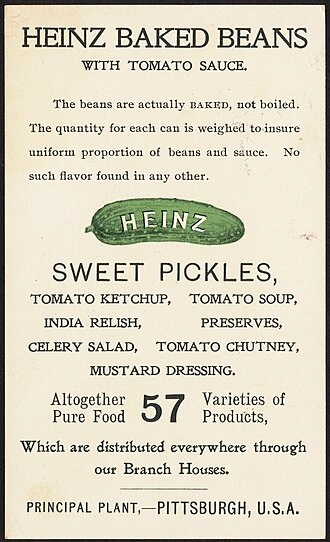
By the time he introduced his now-iconic ketchup in 1876, he had already established the principle the brand still runs on today: quality is non-negotiable and the consumer always knows the difference.
The famous “57 Varieties” tagline, introduced in 1896, was not even accurate at the time, as Heinz already had more than 60 products. Heinz chose it because he liked the number. That willingness to let a strong idea override literal truth is, perhaps, the earliest sign of how this brand would approach creativity forever after.
What makes Heinz worth studying in 2026 is not just its history. It is the fact that a brand which could comfortably coast on its legacy keeps choosing to earn its relevance instead.
The Story of “It has to be Heinz” Narrative
Before getting into individual campaigns, it is worth understanding the single idea that connects all of Heinz’s best modern marketing work.
“It Has To Be Heinz.”
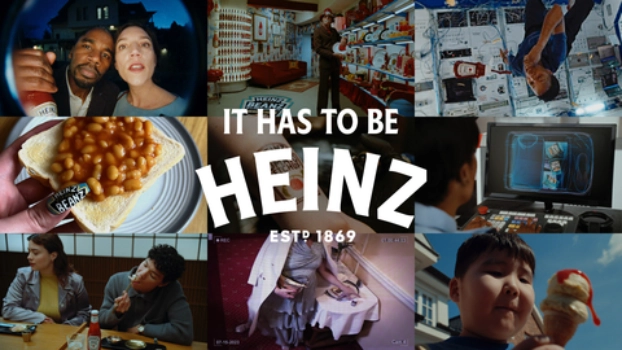
This is not just a tagline. It is a strategic claim that says: when people want ketchup, they do not want a ketchup. They want this ketchup. The brand’s entire creative output since 2017 has been designed to prove that one sentence true.
Every campaign Heinz runs asks a version of the same question: how can we demonstrate that Heinz is irreplaceable, not just popular?
That clarity of purpose is what separates Heinz from brands that produce good individual ads. Good individual ads are a campaign. A single unifying belief executed across a decade is a brand strategy.
| Campaign | Year | Core Proof Point |
|---|---|---|
| Pass the Heinz | 2017 | The absence of Heinz is felt immediately. |
| Draw Ketchup | 2021 | People cannot picture ketchup without picturing Heinz. |
| Ketchup Fraud | 2023 | Even restaurants fake it with Heinz bottles because nothing else will do. |
| Is That Heinz? (Turkey) | 2023 | Consumers can tell the difference and they care. |
| Look Familiar? | 2026 | Every fry box in the world is already a Heinz logo. |
Each campaign is different. The insight behind each one is the same.
Pass the Heinz (2017): The Ad That Came From a TV Show
This is where the modern Heinz creative era begins and it starts with one of the most unusual stories in advertising history.
In Season 6 of Mad Men, fictional advertising executive Don Draper pitches a campaign to Heinz. His idea: show photographs of fries, burgers and steak. Foods that scream out for ketchup, with no ketchup in sight. Just the words “Pass the Heinz.” The fictional Heinz clients reject it. Too daring. Not enough product.
The campaign proposed not showing the product at all, instead showing close-ups of foods that pair perfectly with ketchup french fries, a cheeseburger, and a slice of steak, but without any ketchup in sight. The strategy of creating a craving through the product’s absence was apparently too far ahead of its time.
View this post on Instagram
Fast forward to 2017. Heinz brought the campaign to life, co-crediting it to Mad Men’s Sterling Cooper Draper Pryce alongside their real agency, David Miami. The ads ran in print and on outdoor billboards across New York City.
“Even though Don Draper created the ‘Pass the Heinz’ campaign almost 50 years ago, the communications still really work in today’s world,” said Heinz’s Nicole Kulwicki. “Mr Draper really understood the one thing every Heinz fan knows, which is to never settle for the foods you love without the great taste of Heinz.”
Why it worked: The campaign did two things simultaneously. It proved the brand’s confidence; only a brand that knows it is irreplaceable can run an ad with no product in it. And it generated enormous earned media because the story of a fictional ad becoming real was irresistible to every marketing journalist, blog and podcast on the planet. The PR value dwarfed the media spend.
The lesson: Sometimes the most powerful thing you can show in an ad is what happens without your product.
Draw Ketchup (2021): The Proof That Heinz Is Ketchup
In 2021, Rethink Toronto asked people all over the world to do one simple thing: draw ketchup. They were asked anonymously and Heinz was not mentioned. Yet 97% of them drew Heinz the glass bottle, the Heinz keystone, the tomato on the label, the famous “57”.
View this post on Instagram
The drawings were turned into a global campaign. They were made into stickers that replaced the actual label on Heinz bottles. Some were auctioned as artwork. Together they did something no claim in a television ad could ever do they proved, using the public’s own hand, that Heinz and ketchup are the same thing in the human mind.
The results were extraordinary. The campaign generated over $5.8 million in earned publicity, 127 times the media investment. Social engagement was 1,495% above the industry benchmark. Brand awareness grew to 99% and consideration to 98%. Market share grew from 72.6% to 75.6%. And all of this happened as Heinz simultaneously raised its prices.
(Source: Scribd)
Why it worked: Draw Ketchup did not tell people Heinz was the best. It revealed what people already believed. There is no more powerful form of advertising than handing the audience your brief and letting them write the copy themselves. The campaign won Gold for Creative Effectiveness at Cannes Lions 2023.
The lesson: If your brand recognition is strong enough, your customers will make your best ads for you. The job is to find the insight that unlocks it.
Ketchup Fraud (2023): Turning a Problem Into a Campaign
Someone on Snapchat filmed a restaurant worker refilling a Heinz bottle with generic ketchup. The video went viral. Most brands would have handled this quietly. Heinz turned it into a global creative advertising campaign.
Rethink’s chief creative officer, Mike Dubrick, described the insight: “It’s a real behaviour that we noticed all over the world and wanted to bring to light. It shows just how much weight the Heinz brand carries and how much even just the bottle speaks to quality.”
The campaign, called Ketchup Fraud, ran on billboards in New York and Chicago and across social media. It called out restaurants publicly for the swap and invited consumers to demand the real product. The campaign generated 92% positive sentiment and an engagement rate 128 times above benchmarks, alongside an 8% sales uplift compared to the previous year. (Source: Outfront)
It won Gold at both D&AD 2023 and Cannes Lions 2024.
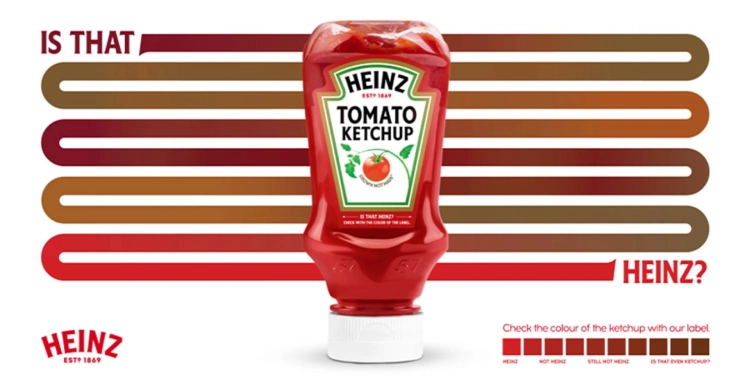
Heinz also took the concept to Turkey with a related execution. They identified the exact Pantone shade of Heinz Tomato Ketchup red and added it as a colour swatch border to their bottle labels, allowing consumers to instantly detect whether a Heinz bottle had been refilled with an imposter. The campaign resulted in a 73% decrease in non-Heinz ketchup refills and a 24% increase in Heinz ketchup usage in street food restaurants.
Why it worked: Heinz flipped a reputational threat into proof of desirability. The fact that restaurants were faking Heinz was reframed not as embarrassing but as flattering and then weaponised to create consumer demand. That is brand confidence operating from a viewpoint of a leading digital marketing agency.
The lesson: A brand secure enough in its identity can turn almost any situation into proof of its own value.
Look Familiar? (2026): The Cannes Grand Prix Winner
This is the most recent entry and, arguably, the most elegant idea Heinz has ever executed.
Facing cheaper rivals and shrinking shopping baskets, Heinz skipped a price war and instead claimed creative ownership of the world’s most popular side dish by pointing out a visual truth hiding in plain sight: the humble fry box is shaped exactly like the 150-year-old Heinz logo.
The campaign, called “Look Familiar?”, was created by Rethink Toronto and built around a single image, a fry box with no words needed. Because the idea required no copy, it could run anywhere in the world without translation.
Heinz placed the campaign in contextual out-of-home locations at the exact moment of consumption, including the Shanghai metro station nearest McDonald’s China’s own office. To close the gap between desire and action, Heinz built a first-of-its-kind Uber Eats integration that added Heinz Ketchup to fry orders, whether or not the restaurant actually stocked it. The campaign achieved 42% reach in the UAE and 33% in Toronto.
It won the Grand Prix at Cannes Lions 2026 in the Print and Publishing Lions category.
Why it worked: Heinz found an insight so simple it almost shouldn’t work: your logo looks like a fry box, and built a global campaign around it. No celebrity. No production budget spectacle. Just a visual truth that had been sitting there for 150 years waiting for someone to notice it.
The lesson: The most powerful brand identity insights are usually already hiding inside the brand. The job is to look hard enough to find them.
What Heinz’s Marketing Strategy Actually Teaches Us
Strip away the specific campaigns and the underlying Heinz playbook looks like this:
- One belief. Every campaign.
“It Has To Be Heinz” is not a tagline. It is a strategic filter. Every campaign they greenlight has to answer yes to the question: Does this prove that Heinz is irreplaceable? If it doesn’t, it doesn’t run. - Confidence is a creative strategy.
Running an ad with no product in it. Turning counterfeiting into a PR campaign. Finding your logo in a fry box. Each of these ideas requires a brand that is completely secure in what it is. Brand confidence is not arrogance. It is the creative freedom that comes from knowing exactly what you stand for. - Insight over execution every time.
None of Heinz’s best campaigns is visually spectacular. They are insightful. Draw Ketchup is just drawings. Pass the Heinz is just food photographs. Look Familiar? is just a fry box. The power is in the idea, not the production value. That is a lesson most brands with large budgets consistently get wrong. - Find what your audience already believes and prove it back to them.
Heinz does not try to change minds. It confirms what its audience already knows, that Heinz is the only ketchup that matters and finds new ways to show them that they are right. That is consumer insight marketing at its most effective. - Stay consistent for long enough to build something.
The same agency, Rethink Toronto, has run Heinz’s creative account for years. The same strategic platform has been held since 2017. That consistency is not laziness. It is discipline. Great brand strategy compounds over time in the same way great investing does.
In Conclusion
Heinz is not a great advertising brand because it has a big budget. It is a great advertising brand because it has a clear belief and the courage to express it consistently, surprisingly and without compromise.
Every campaign on this list was built on the same foundation: we know what this brand means to people and we are going to find the most unexpected, honest way to prove it.
That is a lesson any business can apply, regardless of industry, size or budget. The brands that endure are not the ones that chase every trend. They are the ones who know exactly what they stand for and refuse to let go of it.
If you are working on building that kind of clarity for your own brand, that is precisely the kind of thinking a good branding and advertising agency brings to the table. At Flora Fountain, we help brands find the one thing they stand for and build everything around it. Whether it is strategy, content or creative direction, we are here to help. Write to us at hello@florafountain.com.
Frequently Asked Questions

Vasim Samadji is a partner at Flora Fountain, where he leads the Business and Marketing Strategy divisions. In a world where everyone is used to sugarcoating, his directness is often considered rude. But that shouldn't be a problem if you like the no-nonsense approach. Because he is a seasoned professional...