


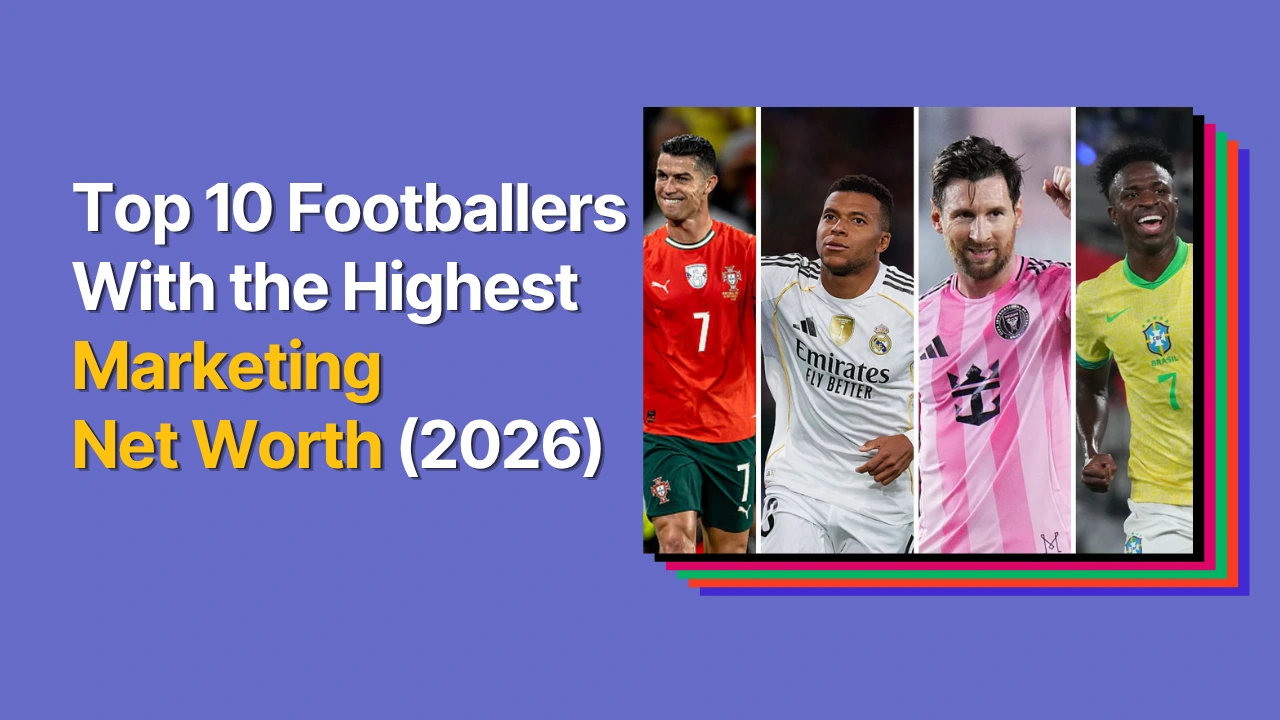
Football’s biggest stars are not just athletes anymore. They are global brands, media companies and investment portfolios wearing boots.
The 2026 FIFA World Cup has put more commercial firepower on a single pitch than any sporting event in history. Between them, the players on this list command billions in brand deals, millions of social media followers and the kind of cultural reach that most companies spend decades trying to build.
This blog ranks the 10 footballers with the highest marketing net worth in 2026, not their total wealth, but specifically their off-field commercial power: sponsorships, endorsements, brand deals and the value they bring to every campaign they front.
Table of Contents
- 10. Karim Benzema (France)
- 9. Lamine Yamal (Spain)
- 8. Jude Bellingham (England)
- 7. Neymar Jr. (Brazil)
- 6. Mohamed Salah (Egypt)
- 5. Vinicius Junior (Brazil)
- 4. Erling Haaland (Norway)
- 3. Kylian Mbappé (France)
- 2. Cristiano Ronaldo (Portugal)
- 1. Lionel Messi (Argentina)
- Summary Table
- How Footballers Became the World’s Most Powerful Marketing Assets
- In Conclusion
- Frequently Asked Questions
10. Karim Benzema ($4 Million)
View this post on Instagram
Karim Benzema spent over a decade as one of Real Madrid’s most decorated forwards before his move to Saudi Arabia’s Al-Ittihad in 2023. His personal brand has always been quieter than the noise around his peers, but no less valuable. Benzema’s associations skew towards luxury and lifestyle, with deals in fashion and tech that reflect his off-pitch persona. His move to the Saudi Pro League opened up a new commercial territory, giving him strong brand relevance across the Gulf region, where football’s financial centre of gravity is rapidly shifting.
With a Ballon d’Or to his name and a career’s worth of Champions League prestige behind him, Benzema remains a credible face for premium brands targeting Middle Eastern and European audiences alike.
Famous sponsorships/brand deals: Adidas, Fendi, Jean Paul Gaultier, and Saudi Tourism Authority.
9. Lamine Yamal ($8 Million)
View this post on Instagram
At 18 years old, Lamine Yamal is already one of the most commercially valuable teenagers in the history of sport. His breakout at Euro 2024 and his continued brilliance at FC Barcelona have made him the face of football’s next generation and brands have moved fast to claim a piece of that.
His primary athlete endorsement partner is Adidas, with whom he fronts the F50 boot campaign alongside a high-profile rivalry with Bellingham. He has also featured centrally in Adidas’s £50 million Backyard Legends World Cup campaign. Visa signed him for their 2026 World Cup “Tap In” campaign, and LEGO featured him alongside Messi, Ronaldo and Mbappé in their global April 2026 film. His commercial ceiling is among the highest on this list precisely because his peak earning years are still entirely ahead of him.
Famous sponsorships/brand deals: Adidas, Lego, Visa, American Eagle
8. Jude Bellingham ($12 Million)
View this post on Instagram
Jude Bellingham has built one of the strongest personal brand identities in European football and he is still only 21. His anchor deal is with Adidas, which runs deep he has his own JB clothing line with the brand, fronted the relaunch of the iconic Predator boot in January 2025 alongside David Beckham and starred in the “Hey Jude” campaign for Euro 2024. He also appeared prominently in the Backyard Legends World Cup campaign. Beyond Adidas, Bellingham has been selective with his commercial partnerships, which has kept his brand feeling premium rather than saturated.
His image rights are managed through his family company Bello&Bello Ltd, signalling a long-term, disciplined approach to athlete brand management that is unusual for someone his age.
Famous sponsorships/brand deals: Adidas, Louis Vuitton, Skims, and Lucozade.
7. Neymar Jr. ($15 Million)
View this post on Instagram
Neymar’s commercial machine has barely slowed down despite a difficult two years with injuries. His off-field earnings are managed through his NR Sports company and supported by approximately 35 active brand partnerships, anchored by a Puma lifetime deal and long-running relationships with Red Bull and Qatar Airways. He has also made a notable move into esports through a stake in Brazilian organisation FURIA. The infrastructure Neymar built around his brand during his peak years at Barcelona and PSG continues to generate income independently of his playing status. His social media following of over 230 million across platforms means brands are still paying for his reach even in the periods he is not on a pitch.
In terms of sports marketing longevity, Neymar is one of the most studied examples of how an athlete can build a commercial operation that outlasts their form.
Famous sponsorships/brand deals: Puma, Red Bull, Superdry, Qatar Airways, and Blaze Betting.
6. Mohamed Salah ($20 Million)
View this post on Instagram
Mohamed Salah is one of the most marketable footballers in the world for a reason that goes beyond the Premier League. He is a cultural icon across North Africa and the Middle East, a region of over 400 million people with rapidly growing purchasing power and deep football loyalty. His brand partnerships reflect this: Adidas, Pepsi, Vodafone and regional deals with Mountain View Egypt and other MENA-facing brands make him the go-to brand ambassador for any company looking to reach Arab-speaking audiences globally.
His April 2025 contract extension at Liverpool, worth £400,000 per week, also reinforced his commercial standing by removing any uncertainty around his club future. Salah’s combination of Premier League brilliance and genuine cross-cultural resonance gives him a commercial reach that most European-based players simply cannot replicate.
Famous sponsorships/brand deals: Adidas, Vodafone Egypt, Pepsi, DHL Express, and AlexBank.
5. Vinícius Júnior ($20 Million)
View this post on Instagram
Vinícius Júnior’s rise from exciting winger to global marketing asset accelerated with his 2024 Ballon d’Or win. His athlete endorsement portfolio is one of the most diverse on this list: Nike, Pepsi, PlayStation, EA Sports, Gatorade, Visa, Marriott and Unilever are among the brands that have signed him for campaigns. He starred alongside Haaland in Visa and Marriott’s “For Fans, Everywhere” World Cup campaign and featured in Nike’s Rip the Script film. Vinícius also carries significant cultural weight in Brazil, where he is the country’s most commercially active footballing export.
His vocal stance against racism has made him a figure of social relevance beyond the sport, giving brand partnership deals with him an added layer of purpose-driven credibility that is increasingly valued by even a leading branding agency.
Famous sponsorships/brand deals: Nike, Pepsi, Gillette, PlayStation, Rhino Shield, and EA Sports.
4. Erling Haaland ($20 Million)
View this post on Instagram
Erling Haaland has assembled a surprisingly eclectic commercial portfolio for someone who only broke into global mainstream consciousness in 2022. His primary deal is with Nike, but his off-field partnerships stretch across categories: Beats by Dre, Breitling, Dolce & Gabbana, Electronic Arts, Marriott, Visa and Unilever all carry his name. He has also taken an equity stake in Scandinavian luggage brand Db, backed by LVMH, and maintains home-market deals with Norwegian brands including Bama Gruppen.
Haaland’s goal-scoring records and Manchester City’s Champions League profile make him one of the most reliable sports marketing assets in the game, a player whose statistical story writes itself into every campaign. At just 25, with potentially another decade at the top, his commercial trajectory is one of the steepest on this list.
Famous sponsorships/brand deals: Nike, Breitling, Prime Hydration, Midea, and Samsung.
3. Kylian Mbappé ($25 Million)
View this post on Instagram
Kylian Mbappé is the most commercially valuable player under 30 in world football. His partnership portfolio includes Nike, Hublot, Oakley, Accor and EA Sports, and his presence in the Adidas Backyard Legends campaign as part of Timothée Chalamet’s assembled team added another major marquee appearance to his 2026 commercial year. His Nike deal is particularly significant given that it was reportedly set to expire in 2026, making the renewal one of the most-watched contract negotiations in athlete endorsement history. Mbappé’s appeal to younger audiences, Gen Z in particular, is unmatched among current players, making him the first choice for brands trying to reach that demographic.
At Real Madrid, the world’s most commercially powerful club, his personal brand has a platform that amplifies every partnership he signs.
Famous sponsorships/brand deals: Nike, Hublot, Oakley, Sorare, and Dior.
2. Cristiano Ronaldo ($65 Million)
View this post on Instagram
Cristiano Ronaldo is the most-followed person on Instagram, with over 660 million followers and he has turned that reach into a commercial operation that rivals mid-sized media companies. His primary athlete endorsement deal is with Nike, a lifetime contract reportedly worth over $1 billion across its duration, with the CR7 signature boot series returning in full force in 2026 after a brief gap. Beyond Nike, he holds deals with Herbalife, TAG Heuer, Armani, Binance and a range of wellness and supplement brands. His own CR7 brand generates around $50 million annually across clothing, fragrances, fitness clubs and a hotel chain with Pestana.
His YouTube channel UR Cristiano, launched in 2024, already has over 78 million subscribers and generates an estimated $10 million in annual revenue on its own. Ronaldo has essentially built a brand identity that operates independently of any club or tournament.
Famous sponsorships/brand deals: Nike (lifetime deal), Binance, Herbalife, Clear Haircare, Whoop, and Erakulis.
1. Lionel Messi ($70 Million)
View this post on Instagram
Lionel Messi sits at number one not just because of what he earns off the pitch but because of how uniquely he earns it. His Inter Miami contract includes a revenue-sharing arrangement with Apple TV+ and a guaranteed Adidas royalty structure a deal structure that an ESPN legal expert described as “unprecedented” and “generational.” His primary partnerships include a lifetime Adidas deal worth approximately $20 million per year, Pepsi, Lay’s, Budweiser, Mastercard, Hard Rock and Apple. He has also built his own business ecosystem: MiM Hotels operates across Spain, his sports drink Más+ by Messi launched in 2024 and The Messi Store runs as a standalone fashion and lifestyle brand.
With 478 million Instagram followers and a net worth estimated between $850 million and $1 billion, Messi is the single most valuable marketing asset in world football. The “Messi Effect” the surge in Inter Miami’s social following, MLS subscriptions and ticket prices that followed his 2023 arrival remains the most documented proof of any athlete’s individual commercial impact in recent sports history.
Famous sponsorships/brand deals: Adidas (lifetime deal), Apple TV, Pepsi, Hard Rock International, Michelob Ultra, and Lays.
Summary Table
| Rank | Footballer | Est. Annual Marketing Earnings |
|---|---|---|
| 1 | Lionel Messi | $70 Million |
| 2 | Cristiano Ronaldo | $65 Million |
| 3 | Kylian Mbappé | $25 Million |
| 4 | Erling Haaland | $20 Million |
| 5 | Vinícius Júnior | $20 Million |
| 6 | Mohamed Salah | $20 Million |
| 7 | Neymar Jr. | $15 Million |
| 8 | Jude Bellingham | $12 Million |
| 9 | Lamine Yamal | $8 Million |
| 10 | Karim Benzema | $4 Million |
How Footballers Became the World’s Most Powerful Marketing Assets
Football’s transformation from sport into a global commercial ecosystem did not happen overnight. It has been decades in the making and the shift has fundamentally changed how brands think about celebrity endorsement and sports marketing.
The Beckham blueprint
David Beckham was the first footballer to be understood explicitly as a brand rather than just a player. His deals with Adidas, Pepsi, Vodafone and Armani in the late 1990s and early 2000s established that a footballer’s image rights could be as commercially valuable as the salary on his contract. Every footballer on this list owes something to that model.
Social media changed the equation
Before Instagram, a footballer’s commercial value was tied to broadcast exposure, how often they appeared on television and in print. Social media removed the intermediary entirely. Ronaldo’s 660 million Instagram followers mean he can deliver a brand message directly to an audience bigger than most countries’ populations, at a cost per impression that no traditional media buy can match. This shift from broadcast to direct reach is why influencer marketing within football has become one of the highest-returning categories in brand spending.
The rise of the footballer-entrepreneur
The most commercially sophisticated players on this list are not just endorsing products. They are building businesses. Messi’s hotel chain. Ronaldo’s fitness clubs. Neymar’s esports investment. Haaland’s equity stake in a luggage brand. Mbappé’s investment portfolio. The modern footballer understands that their name is a depreciating asset on the pitch but a compounding one off it, and the smartest ones have begun treating brand-building like long-term financial planning.
Why brands keep paying
The numbers justify the investment. Studies consistently show that celebrity endorsement in sport delivers higher emotional engagement and purchase intent than virtually any other marketing format. In football specifically, the global fan base, the tribal loyalty and the cultural weight of the sport create a receptiveness to brand association that is almost unique. When Salah wears Adidas or Messi drinks Pepsi, it is not just visibility. It is trust transferred.
The next frontier
The youngest players on this list, Yamal at 18, Bellingham at 21, are already demonstrating a level of commercial sophistication that previous generations developed decades later. They are trademarking names, setting up image rights companies and making equity investments before they have played their peak football. The business of being a footballer has never started earlier or run more deliberately.
In Conclusion
The footballers on this list are not just great players. They are proof that at the highest level, sporting excellence and brand identity have become inseparable. The most commercially valuable athletes in the world are the ones who understood early that the game is only part of the product.
For brands looking to connect with global audiences, football remains one of the highest-returning channels in marketing. And for businesses trying to understand how to build that kind of lasting commercial power, the principles of consistency, cultural relevance and authentic association are the same whether you are Messi or a growing brand in your own market.
At Flora Fountain, a prominent digital marketing agency that works with brands on strategy, content and commercial storytelling, we help businesses build the kind of brand equity that compounds over time. Write to us at hello@florafountain.com.
Frequently Asked Questions
Vasim Samadji is a partner at Flora Fountain, where he leads the Business and Marketing Strategy divisions. In a world where everyone is used to sugarcoating, his directness is often considered rude. But that shouldn't be a problem if you like the no-nonsense approach. Because he is a seasoned professional...