


Every SEO conversation eventually loops back to one number: Domain Authority. Client decks reference it. Outreach targets get filtered by it. Rankings get blamed on it when they slip.
The problem is that most of what gets repeated about domain authority is wrong, starting with the belief that Google uses it to rank websites. It doesn’t, and it never has. Google’s own documentation on ranking helpful content doesn’t mention Domain Authority, Domain Rating, or Authority Score anywhere.
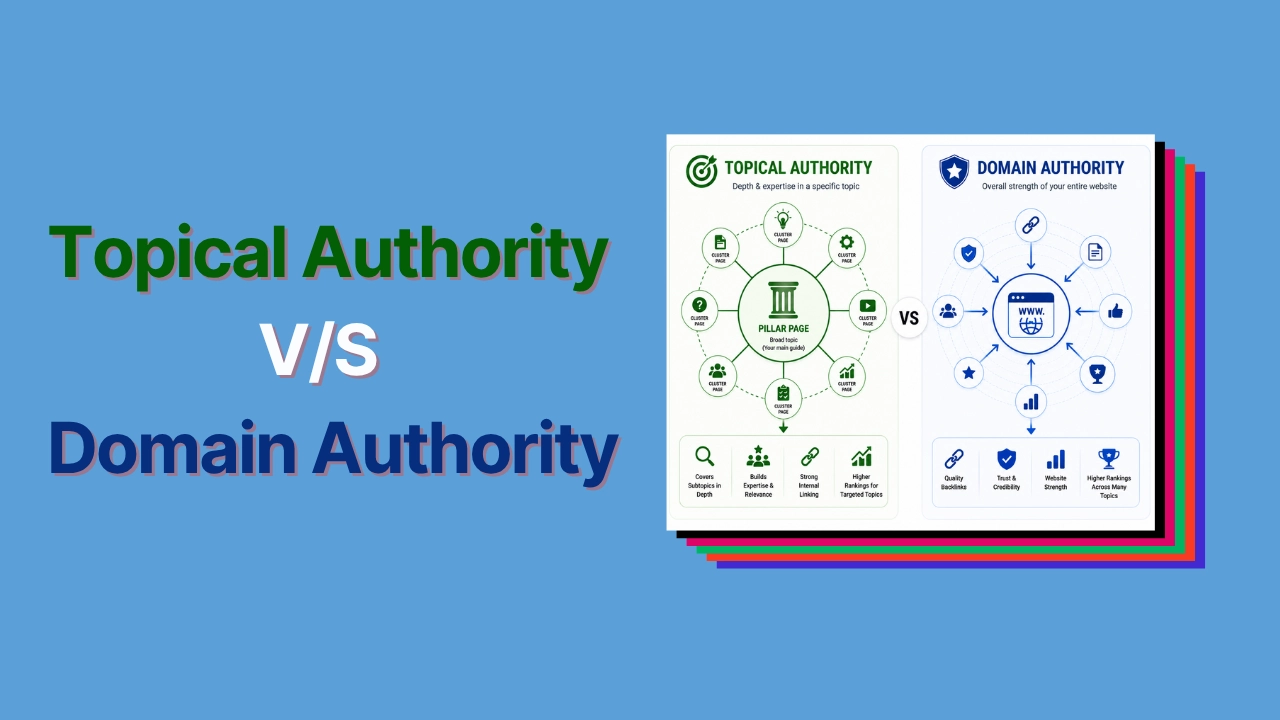
This guide covers what Domain Authority actually measures, how to improve domain authority the right way, how it’s different from Topical Authority, and why the second concept usually matters more for actual rankings.
Table of Contents
- What Is Domain Authority?
- Is Domain Authority a Google Ranking Factor?
- How Is Domain Authority Calculated?
- Domain Authority vs Page Authority vs Domain Rating vs Topical Authority
- What Is a Good Domain Authority Score?
- What Is Topical Authority?
- Domain Authority vs Topical Authority: Which Matters More?
- How to Improve Domain Authority: A Practical Framework
- How to Build Topical Authority: Step by Step
- A Worked Example
- Common Mistakes That Interrupt Domain Authority Growth
- How Long Does This Take, and How Do You Measure It?
- Myths vs Reality
- Where to Start
- FAQs
What Is Domain Authority?
Domain Authority (DA) is a score, from 1 to 100, built by Moz to predict how likely a website is to rank well in Google, based mainly on its backlink profile. It’s a prediction, not a report card. A new blog with a handful of links might sit around DA 5 to 15. An established national publication might sit above 90.
Moz calculates Domain Authority with a machine-learning model trained on its own link index. The model weighs dozens of signals, chiefly the number of linking root domains and total inbound links, and looks for the formula that best predicts how often a domain shows up in Google’s results compared to other sites.
Because the score is model-fitted rather than rule-based, it can shift even when nothing on your site changes. Usually that’s because a competitor picked up a large batch of links, which resets the scale everyone is measured against.
The scale is also logarithmic. Moving from DA 15 to 25 might take a modest push. Moving from DA 70 to 80 can take years, because you’re competing against the internet’s most-linked-to domains for every extra point.
Is Domain Authority a Google Ranking Factor?
No. This is the single most repeated misconception in SEO.
What Google has actually said
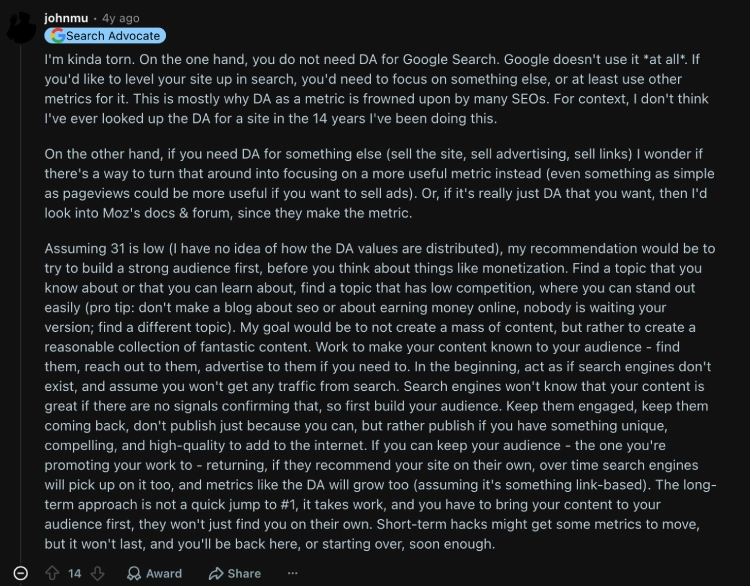
Google’s John Mueller has said that Google doesn’t use Domain Authority in crawling, indexing, or ranking. In a widely cited 2022 Reddit response, he went further and said he’d never once looked up a site’s DA score in over a decade working on Search.
Instead, Google describes E-E-A-T, Experience, Expertise, Authoritativeness, and Trustworthiness, as the framework its human quality raters use to judge content, with trust called out as the most important of the four. E-E-A-T isn’t a direct ranking factor either. It’s an evaluation lens used to train and check the actual ranking systems.
Why High-DA Sites Rank Well Anyway
High-DA sites do tend to rank well. That’s correlation, not causation. Sites build high DA by earning the same things Google’s systems reward: quality backlinks, brand mentions, and content people find worth linking to. DA is a downstream measurement of that activity, not a lever you pull directly. Buying low-quality backlinks can nudge the number up while doing nothing for actual rankings.
How Is Domain Authority Calculated?
Moz doesn’t publish the exact formula, but the model runs primarily on:
- Linking root domains: The number of unique sites linking to you, usually more important than raw link count.
- Total inbound links: including how they’re spread across your pages.
- Link quality: Links from well-linked-to domains carry more weight than links from spammy ones.
- Spam signals: Moz’s Spam Score can suppress DA if a link profile looks manipulated.
Why Ahrefs DR and Semrush Authority Score never match
Ahrefs’ Domain Rating is purely link-based. It counts unique referring domains, weighs them by the linking domain’s own DR, and adjusts for how many other sites each linking domain points to. It explicitly ignores link spam, traffic, and domain age.
Semrush’s Authority Score is broader. It blends backlink signals with estimated organic traffic and spam indicators.
None of these tools crawls the same pages or weighs signals the same way, so a DA of 45 and a DR of 45 aren’t measuring the same thing even though they share a number. Treat each score as useful only within its own tool, never as a cross-tool equivalence.
Domain Authority vs Page Authority vs Domain Rating vs Topical Authority
Moz’s page-level counterpart to Domain Authority. It’s scored 1 to 100 the same way, but it predicts how well a single page, not the whole domain, is likely to rank. A page can carry a high PA on a domain with a modest DA if that page has earned strong links of its own, and the reverse happens just as often: a high-DA domain publishing a brand-new page that has no backlinks yet.
Domain Rating and Authority Score, covered above, sit at the same domain level as DA: DR is purely link-based, Authority Score blends links with traffic and spam signals. All three, DA, PA, and DR, answer the same basic question, how much backlink weight does this domain or page carry, just from different indexes and formulas.
Topical Authority, covered in detail below, isn’t a domain-level or page-level score from any tool. It’s how thoroughly and credibly a site covers a subject. A page can have a modest PA and still belong to a domain building real topical authority, and a high-DA domain can lack topical authority on a given subject if its coverage there is thin or scattered.
- Domain Authority: whole-domain backlink strength (Moz)
- Page Authority: single-page backlink strength (Moz)
- Domain Rating: whole-domain backlink strength (Ahrefs)
- Topical Authority: depth and credibility of subject coverage, not a score from any tool
What Is a Good Domain Authority Score?
There isn’t a fixed range; it depends.
A DA of 35 might lead a local niche and get outmatched instantly in national e-commerce. Compare your score only to the sites currently ranking for your target keywords, not to a fixed number.
- Pull the DA or DR of the top 10 ranking pages for your target keyword.
- Note the range. Competitive SERPs often span widely, since content quality can offset a lower score.
- Recheck quarterly, alongside actual rankings and traffic, not monthly on its own.
What Is Topical Authority?
Topical Authority is how thoroughly and credibly a site covers a specific subject, demonstrated through connected, high-quality content rather than measured by any single tool. There’s no dashboard number for it. It’s a concept, not a metric, but it describes something ranking systems are demonstrably built to reward: sites that have covered a subject thoroughly tend to find it easier to rank new pages in that subject.
Breadth vs Depth
Breadth is how many subtopics you’ve covered.
Depth is how thoroughly you’ve covered each one. Depth usually wins in competitive niches.
Ten thin articles rarely outperform three thorough ones that fully answer the question and link naturally to related coverage.
Common Misconceptions about Topical Authority
It isn’t publishing volume. It isn’t guaranteed rankings for every page. It isn’t a credentials line on an About page. It isn’t a substitute for technical SEO; a site can have deep coverage and still lose rankings to crawl or indexing problems.
Let’s Understand That With An Example
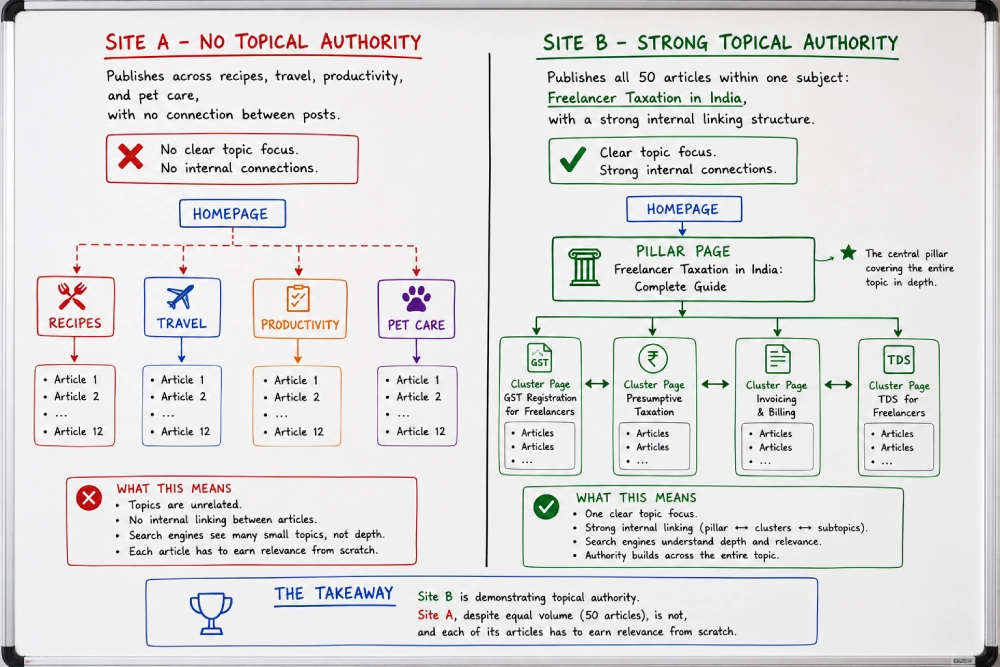
Assume two websites, A and B, each with 50 articles.
- Site A publishes across recipes, travel, productivity, and pet care, with no connection between posts.
- Site B publishes all 50 within one subject, say freelancer taxation in India, with a pillar page linking to cluster pages on GST registration, presumptive taxation, invoicing, and TDS, each linking back and sideways.
Site B is demonstrating topical authority.
Site A, despite equal volume, is not, and each of its articles has to earn relevance from scratch.
Domain Authority vs Topical Authority: Which Matters More?
They answer different questions.
Domain Authority tells you how much backlink-driven weight your whole domain carries, useful for benchmarking.
Topical Authority tells you whether your site has earned the right to be treated as a credible source on a subject, which shapes relevance and depth- the things ranking systems evaluate page by page.
A newer site with narrow but genuinely deep coverage regularly outranks an older, higher-DA site that treats the subject as one article among hundreds of unrelated ones. With a limited content budget, topical depth is usually the higher-leverage investment.
How to Improve Domain Authority: A Practical Framework
Build genuinely useful, linkable content
This doesn’t move DA by itself, but it’s the precondition for everything else, since nobody links to thin content.
Earn authoritative, relevant backlinks
The single largest direct input into DA, DR, and Authority Score alike is
- From sites relevant to your subject, not unrelated directories.
- Editorially earned, not paid or exchanged.
- From diverse referring domains. Ten links from ten different sites beat fifty from one.
Create linkable assets
Original research, data, tools, and templates earn more organic backlinks than standard blog posts, because other publishers cite primary sources.
Use digital PR where it fits
Earning coverage and mentions from credible publications builds both links and the brand recognition behind E-E-A-T’s authoritativeness signal.
Strengthen internal linking
Link from your highest-traffic pages to newer or underperforming ones. Use descriptive anchor text instead of “click here.” Add two or three contextual links per page. Link new posts within a day of publishing.
Fix technical SEO issues
Run a regular broken link audit and fix 404s fast. Redirect or link out orphaned pages. Compress images and enable lazy loading. Clean up redirect chains and slow server response times.
Track outcomes, not just the score
Organic traffic, rankings, and conversions are the real measures. DA is a proxy that can lag behind or run ahead of them.
How to Build Topical Authority: Step by Step
1. Choose one core topic
Narrow enough to dominate, broad enough to sustain dozens of pages. “SEO” is too broad for a new site. “Technical SEO for Shopify stores” works.
2. Map subtopics and search intent
List every subtopic a real expert would expect covered: definitions, comparisons, how-tos, common mistakes. Match format to intent for each.
3. Find content gaps
Compare your map against what’s currently ranking. Look for questions competitors answer shallowly or skip entirely.
4. Build pillar and cluster pages
The pillar gives a full overview and links out to cluster pages that go deep on each subtopic. Each cluster links back and sideways.
5. Connect everything with internal links
Use descriptive, varied anchor text, not the same exact phrase every time.
6. Watch for cannibalisation
If two pages could rank for the same query, they’re competing with each other. Check Search Console for overlapping impressions, then consolidate or differentiate.
7. Decide when a subtopic deserves its own page
It earns a standalone page when it has distinct intent, enough substance to stand alone, and real independent search demand.
8. Measure whether coverage is improving
Track how many keywords the whole cluster ranks for, not just the pillar, and how fast new pages in an established cluster start ranking compared to standalone content elsewhere.
A Worked Example
A Pune-based digital marketing agency wants to become a recognised authority on SEO for the Indian market.
Pillar page: “SEO in India: A Complete Guide,” linking out to every subtopic below.
Domain Authority guide (this article), explaining the DA, DR, and Authority Score landscape, linked from the pillar.
Cluster pages: technical SEO checklist, local SEO for Indian businesses, keyword research for Indian search behaviour, on-page SEO fundamentals, each linking back to the pillar.
Topical Authority page, linked from both the pillar and the content-strategy clusters.
Backlink strategy page, linked from the Domain Authority page and the pillar.
Every page in this structure links to at least two others. A visitor landing on any single page finds a clear path to the rest of the agency’s expertise, and so does a crawler evaluating how comprehensively the domain covers the subject.
Common Mistakes That Interrupt Domain Authority Growth
❌ Chasing the score instead of the underlying signal. Buying links without earning relevance usually stalls rankings even as the number ticks up.
❌ Publishing volume without connection. Fifty unrelated posts build far less authority than fifteen interconnected ones.
❌ Ignoring internal linking. Strong backlinks to an orphaned page waste much of their value.
❌ Treating DA as a go or no-go gate. Content quality and intent match regularly beat raw authority in real SERPs.
❌ No author transparency. Anonymous expert content undercuts E-E-A-T even when it’s accurate.
❌ Letting cannibalisation split your own signals.
❌ Never auditing old content. Outdated stats and dead links quietly erode trust.
Quick diagnostic: if growth has stalled, check:
- Has your referring-domain count grown, or just total link count?
- Are new backlinks coming from relevant sites, or generic ones?
- Do your cluster pages link to each other, or only up to the pillar?
- Are any of your own pages competing for the same keyword?
- Is your most-linked content also your most outdated content?
How Long Does This Take, and How Do You Measure It?
Authority building compounds slowly, then accelerates. A domain in a moderately difficult niche is usually looking at 12 to 24 months of sustained work before both metrics and rankings clearly reflect it. Track:
- Referring domains, growth in unique sites, not just total backlinks
- Keyword rankings across the whole cluster, not just the pillar
- Organic traffic and conversions
- Indexing and ranking speed for new pages in an established cluster
- DA, DR, or Authority Score, as a lagging confirmation, checked last
Myths vs Reality
| Myth | Reality |
|---|---|
| “You need a DA of X to rank for competitive keywords” | Content quality and intent match matter as much as domain authority. |
| “Google uses Domain Authority as a ranking factor” | Google has directly denied this; DA is calculated entirely outside Google. |
| “More backlinks always means higher rankings” | Low-quality links can inflate a score while doing nothing for rankings. |
| “Publishing more automatically builds topical authority“ | Volume without depth and connection dilutes expertise instead of proving it. |
| “DA, DR, and Authority Score are basically the same number” | Each uses different data and formulas; they aren’t interchangeable. |
Where to Start
Don’t open with a link-building campaign. Start by picking one subject you can realistically own, mapping its subtopics against real search intent, and building a small, genuinely interconnected pillar and cluster structure. Backlinks and a rising Domain Authority score tend to follow once you have content worth linking to.
That’s genuinely the work we do every day at Flora Fountain as your trusted SEO company in Ahmedabad: mapping a subject properly, building pillar and cluster content that actually connects, and treating link building as the outcome of good content rather than a separate campaign run alongside it.
If you want a second opinion on where your site’s authority actually stands, we’d genuinely like to talk it through. Get in touch with Team Flora Fountain and let’s map out what your domain and topical authority actually need next.
Frequently Asked Questions

The founder and partner of Flora Fountain, Shefali leads the Content and Technology divisions. A one-time engineer who started her career writing front-end code, she took a detour sometime during her 9 years in New York, studied journalism and started writing prose, poetry and sometimes jokes. She now has 15...