


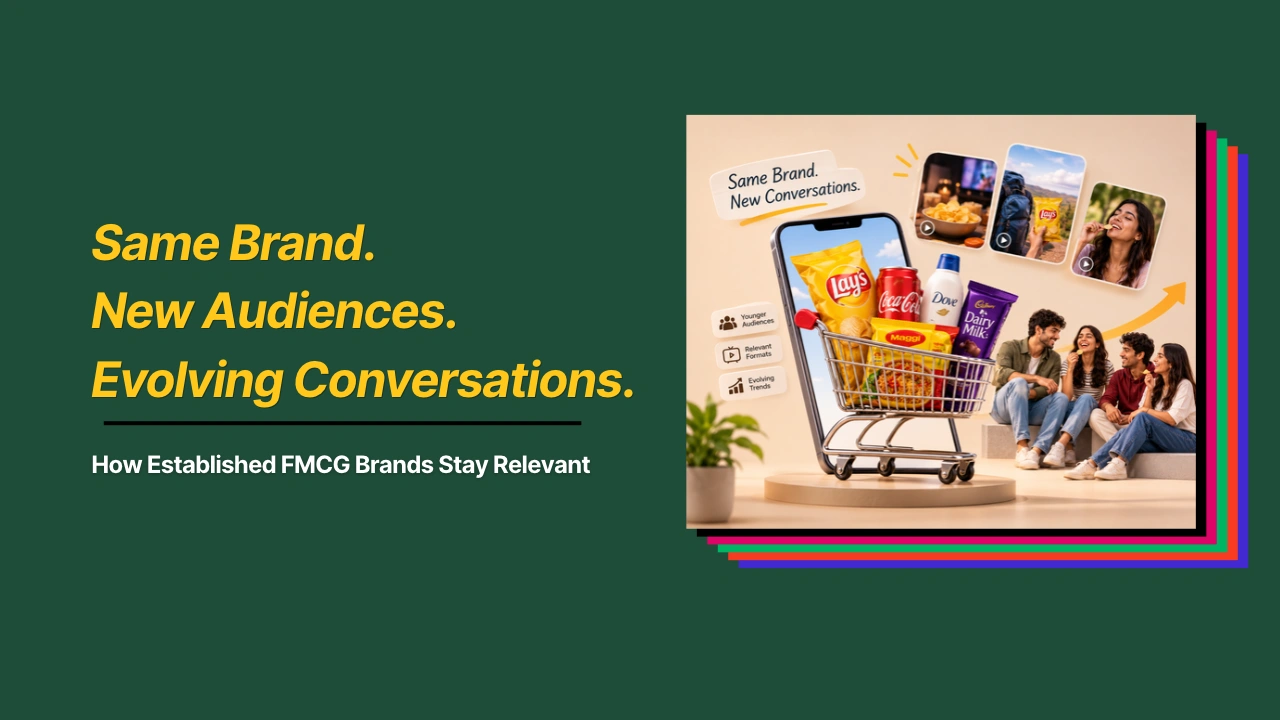
An FMCG brand can have strong retail distribution, established customers and products available across thousands of stores. Yet, when consumers scroll through social media, search for product recommendations or browse a quick-commerce app, the brand still has to earn their attention.
This creates an interesting marketing challenge. Retail availability does not automatically translate into consumer preference, and digital visibility does not guarantee that someone will pick the product from a store shelf.
For established FMCG companies, the opportunity lies in connecting these two parts of the consumer journey.
Digital marketing for FMCG brands should not be planned only around online conversions or the number of people who interact with a campaign. It should also consider how digital communication influences product discovery, brand consideration and purchase decisions across retail channels.
In this article, we’ll explore:
- Why digital marketing and physical retail need to work together.
- How digital campaigns can influence product discovery and brand preference.
- How FMCG brands can connect online communication with retail availability.
- Which digital channels serve different marketing objectives.
- How to measure digital marketing’s contribution to retail demand.
Quick Summary
- Retail makes the product accessible. Digital marketing influences whether consumers notice, consider or look for it.
- Campaigns work best when they follow product availability, regional differences and retail activity.
- Each digital channel needs a clear role. Quick commerce suits some brands and not others.
- Measurement should match the campaign objective, because clicks and views alone do not show retail demand.
Table of Contents
- Why Digital Marketing Should Complement Retail Instead of Competing With It
- What Digital Marketing Can Do Before a Consumer Reaches the Shelf
- How FMCG Brands Can Connect Digital Campaigns With Retail Reality
- Which Digital Channels Can Strengthen Retail Demand?
- How to Measure Digital Marketing Beyond Online Conversions
- Building an FMCG Digital Marketing Strategy Around Business Objectives
- Concluding It For You
- Frequently Asked Questions
Why Digital Marketing Should Complement Retail Instead of Competing With It
For established FMCG brands, physical retail is not simply another sales channel. It is an important part of how products reach consumers and remain accessible across markets.
However, the way consumers discover and evaluate products has expanded beyond the store.
Someone might discover a new beverage through an Instagram Reel, look up its ingredients on Google, see a recommendation from a creator and eventually purchase it from a neighbourhood supermarket. Another consumer might discover the same product while browsing a quick-commerce platform.
These journeys do not follow a single path.
According to IMA India’s March 2026 research on scaling D2C brands, digital discovery and offline expansion can work together as part of an omnichannel growth model. The research focuses on D2C businesses, but the broader channel-planning consideration is relevant to established consumer brands too.
This changes how brands should approach FMCG marketing.
Instead of asking whether digital or retail deserves more attention, marketers need to understand what each channel contributes to the purchase journey.
Retail makes the product accessible. Digital can influence whether consumers notice, recognise, consider or actively look for it.
That does not mean every digital interaction will result in an offline purchase. It means both channels need to be considered when planning how a brand generates and captures demand.
What Digital Marketing Can Do Before a Consumer Reaches the Shelf
A product can be available in a store without being actively considered by shoppers. This is where digital communication can play a useful role.
Rather than treating every campaign as an opportunity to generate immediate sales, FMCG brands can use digital marketing to influence different stages of consumer decision-making.
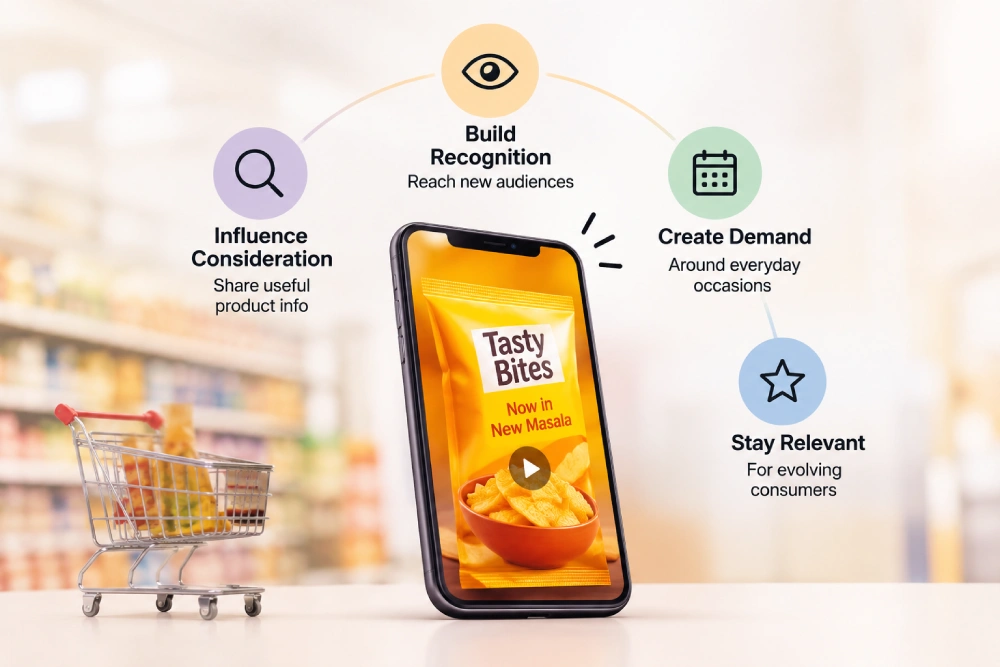
1. Build Product Recognition Beyond Existing Customers
Established FMCG brands often have a familiar customer base. However, familiarity within an existing audience does not guarantee visibility among new consumers or people entering a category.
Digital campaigns can help brands communicate with audiences who may not have encountered their products before.
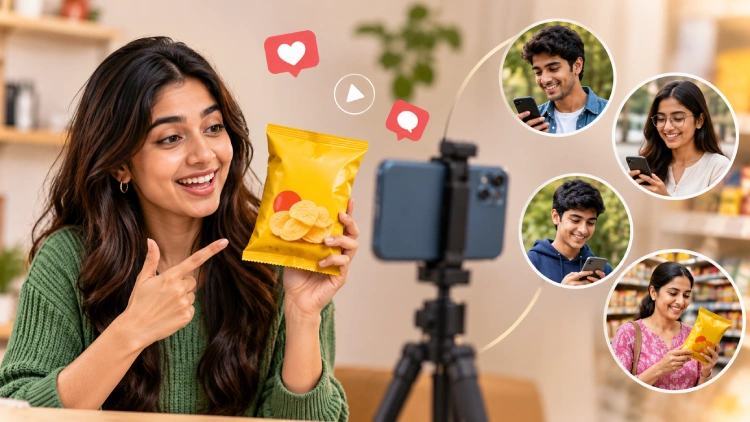
For example, a packaged food brand introducing a new product variant can use short-form videos, product-led content and creator collaborations to explain what makes the variant different.
The objective is not simply to generate views. It is to help the audience recognise the product and understand where it fits into their existing consumption habits.
This becomes particularly relevant when brands expand into new markets, introduce new categories or target younger consumer groups.
2. Influence Product Consideration Through Useful Information
Not every FMCG purchase involves extensive research. However, consumers may still look for information before trying an unfamiliar product.
Ingredients, product benefits, packaging, usage instructions and customer reviews can influence how people evaluate their options.
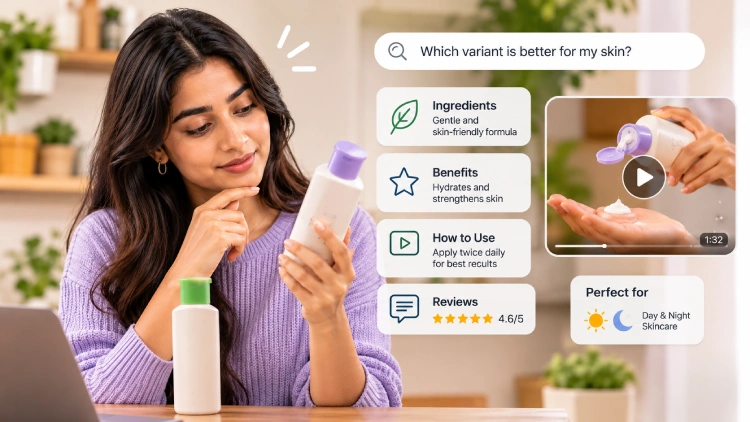
For example, a personal care brand can create educational content explaining the difference between two product formulations. A packaged food company can demonstrate how a product fits into different meal occasions.
Search-friendly product information, explanatory videos and credible creator content can make these details easier to discover.
The important distinction is that content should answer a genuine consumer question rather than repeat product claims without context.
3. Create Demand Around Consumption Occasions
FMCG products are often associated with recurring needs and everyday occasions.
A snack brand can communicate around work breaks, travel or evening consumption. A beverage brand can build campaigns around specific moments when consumers are likely to consider the category.
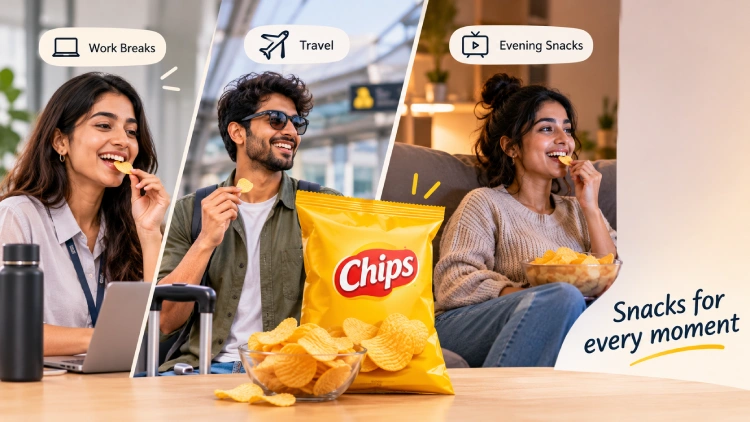
Digital content gives brands opportunities to connect products with these occasions through relevant messaging, creative formats and audience targeting.
However, the communication needs to reflect the actual product and audience. A campaign built around a consumption occasion should give consumers a genuine reason to consider the product rather than manufacture an irrelevant trend.
4. Keep Established Brands Relevant to Changing Audiences
Long-standing FMCG brands may already enjoy strong recognition. Their challenge is to remain relevant as consumer interests, media habits and category expectations change.
Digital platforms provide opportunities to revisit product stories, communicate new developments and engage with different audience groups.
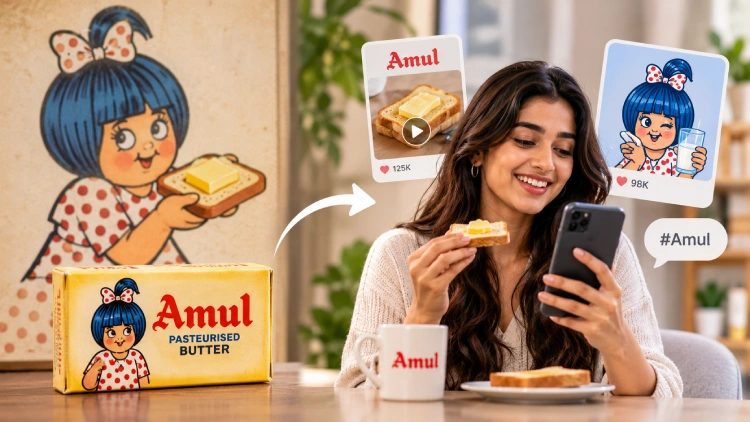
This does not require a brand to abandon the identity that made it recognisable.
Instead, the task is to identify which parts of its communication need to evolve while preserving the associations consumers already have with it.
How FMCG Brands Can Connect Digital Campaigns With Retail Reality
Building digital demand is only one part of the marketing problem. Brands also need to ensure that their campaigns connect with what consumers can actually purchase.
A campaign can generate interest, but if the product is unavailable in the markets being targeted, that interest may not translate into sales.
This is why digital marketing for FMCG companies needs to account for retail operations and market-level differences.
1. Plan Campaigns Around Product Availability
Before launching a campaign, brands should understand where the promoted product is available.
If a product is stocked only in selected cities or retail chains, targeting audiences beyond those markets may create unnecessary demand that the distribution network cannot fulfil.
Campaign planning should therefore consider:
- Markets where the product is currently distributed.
- Retail outlets and platforms where the product is available.
- Stock availability during the campaign period.
- Product variants and pack sizes available in each market.
- Distribution expansion plans, where relevant.
This helps align media spending with the brand’s actual ability to serve the audience.
2. Adapt Campaigns to Regional Market Differences
India is not a single consumer market with uniform buying behaviour.
A product’s relevance, preferred communication style and purchasing context can differ across regions.
For instance, a packaged food brand may need different creative approaches when communicating with audiences in Gujarat, Maharashtra and West Bengal.
Language, cultural context, consumption occasions and local product availability can all influence how a campaign should be planned.
Regional targeting should therefore go beyond translating the same advertisement into different languages.
Brands need to understand which audience segments they want to reach, what makes the product relevant to them and whether the distribution network supports that demand.
3. Coordinate Digital Campaigns With Retail Activities
Digital campaigns can be more useful when they complement activities already happening across retail channels.
Consider an FMCG brand running an in-store promotion across selected supermarket chains.
Its digital communication can introduce the promotion, explain the product offer and direct interested consumers towards participating stores or available online listings.
Similarly, a new product entering a retail market can be supported by digital campaigns that introduce its features and encourage consumers to look for it.
The important part is coordination.
The campaign message, product availability, promotional offer and retail execution should communicate the same proposition.
4. Treat Quick Commerce as an Additional Digital Shelf
Quick-commerce platforms have introduced another environment where FMCG brands compete for consumer attention.
Consumers can browse product categories, compare options and discover products while placing everyday orders.
According to NIQ’s 2026 Commerce Revolution report, Indian shoppers use digital channels for regular top-up purchases, while quick commerce is also expanding into broader grocery and household shopping.
For FMCG brands, this creates opportunities to consider:
- Product visibility within relevant categories.
- Sponsored placements and retail media.
- Product descriptions and images.
- Ratings and reviews.
- Promotional campaigns aligned with actual availability.
However, quick commerce should not automatically become the centre of every FMCG digital marketing strategy.
Its relevance depends on the product category, audience, purchase frequency, distribution and business objectives.
A brand with a strong general trade presence may need a different channel mix from a newer brand relying heavily on online distribution.
Which Digital Channels Can Strengthen Retail Demand?
The effectiveness of digital marketing does not come from using every available platform. It comes from assigning each channel a clear role within the overall marketing strategy.
Here is how different channels can contribute to FMCG brand growth.
Social Media Marketing
Social media gives FMCG brands opportunities to build product recognition, communicate brand personality and maintain an ongoing relationship with consumers.
Short-form videos, product demonstrations, campaign-led content and interactive formats can help brands communicate product relevance.
However, a large following or high engagement does not automatically indicate stronger retail demand.
The content strategy should be connected to what the brand wants consumers to understand, remember or consider.
Influencer and Creator Marketing
Creators can introduce products through formats that fit their existing content and audience interests.
For example, a food creator demonstrating different ways to use a packaged ingredient can make the product relevant to a specific consumption occasion.
A personal care brand may work with creators who can explain product application or demonstrate how a particular product fits into a routine.
The selection should depend on audience relevance, category understanding and the credibility of the content rather than follower count alone.
Search Engine Marketing and SEO
Search becomes relevant when consumers actively look for product information, category comparisons or recommendations.
FMCG brands can strengthen their search presence through product pages, informative content and relevant paid campaigns.
For example, a consumer searching for a particular product category should be able to find useful information about the brand’s offerings, variants and product features.
Search campaigns can also support specific market or product launches where consumer demand is already emerging.
Video Marketing
Video can help FMCG brands communicate product usage, demonstrate features and build familiarity through storytelling.
It can be particularly useful for products that require explanation or have multiple applications.
The format should match the objective. A short video may introduce a product, while a longer demonstration may help explain its usage or differentiating features.
Retail Media and Quick-Commerce Advertising
Retail media provides brands with opportunities to reach consumers within shopping environments.
Sponsored product placements, category promotions and platform-specific campaigns can help improve product visibility when consumers are already browsing for relevant items.
However, brands should evaluate these placements based on their commercial objectives, category competition and the quality of available measurement rather than assuming that visibility guarantees incremental sales.
How to Measure Digital Marketing Beyond Online Conversions
One of the biggest challenges in FMCG marketing is understanding how digital campaigns contribute to purchases that happen across multiple retail channels.
Website traffic, clicks, video views and social media engagement are useful indicators of campaign activity. But they do not independently establish whether a campaign generated additional product sales.
Brands need a measurement approach that connects digital activity with business outcomes wherever reliable data is available.
Here are some important considerations.
1. Measure Brand and Consumer Response
Brand awareness, recall, search interest and consideration can help marketers understand whether campaigns are influencing consumer perceptions.
These metrics are particularly relevant when campaigns focus on introducing a product, strengthening recognition or reaching new audiences.
2. Track Retail and Distribution Performance
Where retailer or distributor data is available, brands can examine:
- Product sales across campaign and non-campaign periods.
- Changes in sales across targeted markets.
- Product availability during campaign periods.
- Retailer-level sales movement.
- Performance across different product variants.
These indicators help marketers understand whether digital activity and retail performance are moving in the same direction.
However, a rise in sales during a campaign does not automatically prove that the campaign caused the increase. Seasonality, pricing, promotions, distribution changes and competitor activity can also influence results.
3. Evaluate Online-to-Offline Campaign Performance
For campaigns designed to generate store visits or retail purchases, brands can explore measurement methods such as location-based experiments, matched-market comparisons and retailer sales analysis.
Google’s geographic experiment approach demonstrates how test and control markets can help evaluate incremental campaign impact rather than relying only on last-click attribution.
The same principle is useful when designing appropriate measurement frameworks for FMCG campaigns, although the exact methodology depends on the available retail data.
4. Connect Marketing Metrics With Business Objectives
A campaign designed to improve product recognition should not be judged using the same criteria as a campaign designed to generate immediate purchases.
Before launching, marketers should establish what success means for that particular activity.
For example:
| Campaign objective | Relevant measurement |
|---|---|
| Build product awareness | Reach, recall and awareness lift |
| Improve product consideration | Search interest, consideration and engagement |
| Support retail promotions | Participating outlet sales and offer redemption |
| Improve product discovery | Product searches, listing visibility and discovery |
| Generate incremental demand | Matched-market sales lift or other suitable incrementality measurement |
This makes reporting more meaningful and helps brands decide where their next marketing investment should go.
Building an FMCG Digital Marketing Strategy Around Business Objectives
There is no single digital marketing formula that works for every FMCG company.
An established food brand with strong retail distribution may have a different marketing problem from a personal care company introducing a new product category.
One may need stronger product recognition among new audiences. Another may need to improve consideration, communicate product differentiation or support distribution expansion.
This is why an effective FMCG marketing strategy should begin with a business problem rather than a predetermined list of platforms.
Before allocating budgets, brands should evaluate:
- The business objective: Is the priority market expansion, product awareness, consumer preference, product trial or repeat purchase?
- The existing market position: How familiar is the brand among its target consumers, and where does it face stronger competition?
- The distribution situation: Where is the product available, and can the existing network support additional demand?
- The consumer opportunity: Which audiences, regions or consumption occasions offer meaningful opportunities?
- The channel mix: Which digital platforms can address the identified problem most effectively?
- The measurement framework: What data will help determine whether the strategy is contributing to the intended business outcome?
This is also where choosing the right digital marketing agency specialising in FMCG becomes important.
An agency should understand the brand’s category, distribution model, consumer audience and existing marketing performance before recommending campaigns.
The objective should not be to add more digital activity to an already crowded marketing calendar. It should be to identify where digital can solve a genuine business problem and how its contribution can be evaluated.
Concluding It For You
For established FMCG brands, digital marketing does not need to compete with physical retail to create value.
Its role is to make products easier to discover, give consumers stronger reasons to consider them and support the demand that retail channels are equipped to fulfil.
But this requires more than running social media campaigns, investing in influencers or increasing advertising budgets. Working with a digital marketing agency for FMCG brand growth can help businesses build strategies that connect digital engagement with actual retail demand.
Brands need to understand their consumers, account for product availability, plan around regional market differences and measure performance against meaningful business objectives.
When digital strategy and retail execution work towards the same goal, marketing becomes more than an exercise in generating online attention. It becomes part of how an FMCG brand builds and captures demand.
Frequently Asked Questions

Vasim Samadji is a partner at Flora Fountain, where he leads the Business and Marketing Strategy divisions. In a world where everyone is used to sugarcoating, his directness is often considered rude. But that shouldn't be a problem if you like the no-nonsense approach. Because he is a seasoned professional...