


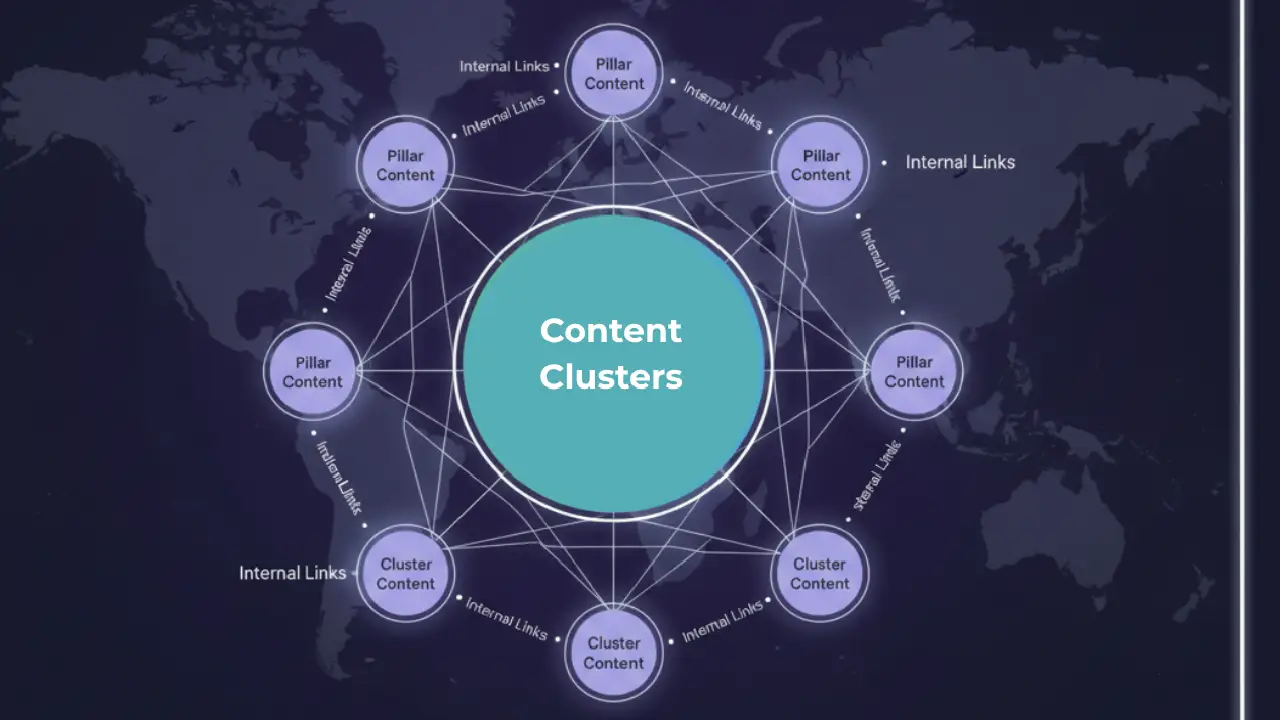
Search engines don’t just look at single pages anymore. Google now rewards sites that show deep, connected knowledge on a topic. It’s about building authority across many related articles, not just chasing keywords.
This shift has made content clusters the cornerstone of modern SEO strategy. But most businesses treat content clusters as a checklist exercise: create a pillar page, write some related articles, add a few internal links and call it done. The result? Mediocre traffic and no real authority building.
If you want real SEO results, you need to go beyond the basics. That means learning how to measure the strength of your internal links, reorganise old content without losing rankings, and build clusters that show real expertise—not just keyword stuffing.
Table of Contents:
- What Are Content Clusters (And Why They Matter Now)
- The Link Flow Map: Calculating Internal Link Equity
- Content Cluster Migration: Reorganising Legacy Content Safely
- The E-Commerce Content Cluster Strategy
- Concluding Thoughts
What Are Content Clusters (And Why They Matter Now)

A content cluster is a strategic content architecture model where a comprehensive pillar page covers a broad topic at a high level, linking to multiple cluster pages that dive deep into specific subtopics. Those cluster pages then link back to the pillar and to each other where contextually relevant.
The traditional SEO approach:
- Create individual blog posts targeting specific keywords
- Ensure minimal strategic connection between content pieces
- Design each page to compete in isolation
The content cluster approach:
- Build a central pillar page establishing topical authority
- Create detailed cluster content addressing specific aspects
- Strategically interlink to demonstrate topic comprehension
Why this matters now:
Google’s algorithm evolution has shifted towards understanding topics holistically rather than matching individual keywords. When you publish comprehensive, interconnected content on a subject, you signal expertise. Google’s systems recognise that your site offers valuable depth on that topic, boosting rankings for all related pages.
User behaviour has changed too. Researchers no longer search for single answers. They explore topics thoroughly, clicking through multiple articles. Content clusters match this natural browsing pattern, keeping users on your site longer.
The competitive landscape has intensified. Single blog posts rarely rank for competitive terms anymore. You need demonstrated authority across the entire topic spectrum.
Anatomy of High-Performing Clusters
- The Pillar Page: Your pillar page covers a broad topic comprehensively (2,500-4,000 words), provides a clear navigation structure and links to 8-15 cluster pages at contextually relevant points. It answers fundamental questions while linking to cluster content for depth.
- Strategic Cluster Content: Each cluster page serves a specific purpose: how-to guides, comparison posts, case studies, conceptual deep-dives or tool reviews. They should be 1,200-2,500 words, link back to the pillar page early, link to 2-4 related cluster pages and target specific long-tail keywords whilst supporting the pillar’s primary keyword.
- Internal Linking Architecture: Pillar pages link to all cluster pages contextually (not just lists at the bottom). Cluster pages link back to pillar pages early and naturally; cluster pages link to related cluster pages where topics genuinely overlap. Anchor text is descriptive and contextual, not keyword-stuffed.
The Link Flow Map: Calculating Internal Link Equity

Understanding how PageRank (or link equity) flows through your content cluster separates advanced SEO practitioners from beginners.
Understanding PageRank Flow
Every page on your site has a certain amount of authority. When that page links to another page on your site, it passes a portion of its authority. The amount passed depends on the authority of the linking page, the number of outbound links on that page (authority is divided amongst them), the position and context of the link and the relevance between linked pages.
Why This Matters for Clusters
If your pillar page has significant authority but links to 30 different cluster pages, each receives relatively little equity. If it links to only 8 highly relevant cluster pages, each receives more. This is why strategic cluster planning matters.
Practical Link Equity Optimisation
Audit your current link distribution:
- Use tools like Screaming Frog or Ahrefs to map all internal links
- Identify which pages have the most authority
- See how many outbound internal links each page has
- Calculate rough equity distribution (page authority ÷ number of outbound links)
Prioritise high-value pathways:
- Ensure your highest-authority pages link to your pillar pages
- Limit pillar page outbound links to only the most important cluster content
- Create “supporting pillars” for sub-topics if your cluster grows beyond 15 pages
Build strategic inter-cluster links:
- Don’t just link cluster → pillar → cluster
- Where genuinely relevant, link cluster → cluster directly
- This creates multiple pathways for equity flow
Most businesses obsess over backlinks whilst ignoring internal link optimisation. Yet strategic internal linking can boost rankings for target pages by 20-40% without any new external links. For a digital marketing agency managing multiple content clusters, this represents significant untapped ranking potential.
Content Cluster Migration: Reorganising Legacy Content Safely
Most businesses already have substantial content libraries. The question isn’t whether to build content clusters from scratch. It’s how to reorganise existing content into clusters without destroying the SEO value you’ve already built.
The Safe Migration Framework
Phase 1: Content Audit and Clustering Identification
Before touching anything, map what you have. Export all existing blog content with current URLs, titles and traffic data. Identify natural topic clusters based on semantic relationships. Determine which pieces could serve as pillar pages (usually your highest-traffic, most comprehensive posts). Identify gaps where new cluster content is needed.
Phase 2: Strategic Consolidation Without Cannibalisation
Often, you’ll find multiple posts covering similar ground. You have two options:
Option A: Merge and Redirect: Combine 3-5 thin posts into one comprehensive cluster page. 301 redirect old URLs to the new consolidated page. Ensure the new page covers all keyword targets from merged posts.
When to use: When posts are genuinely redundant and none has significant individual ranking success.
Option B: Differentiate and Interlink: Keep posts separate, but clarify the unique angle of each. Update content to eliminate redundancy and establish a distinct purpose. Add strategic internal links showing the relationship between posts.
When to use: When multiple posts rank for different long-tail variations or when each has established individual authority.
The Critical Rule: Never redirect high-traffic posts to tangentially related content just to fit your cluster structure. If you can’t make the redirect genuinely valuable, keep pages separate and connect through internal links instead.
Phase 3: Implementing the New Structure
For existing high-authority posts becoming pillar pages: Expand content to cover the topic comprehensively (add 800-1,500 words). Add a clear section structure with a table of contents. Insert contextual links to cluster content throughout. Do NOT change the URL if the post already ranks well.
For existing posts becoming cluster content: Audit to ensure each has a distinct, specific focus. Add an early link back to the pillar page (within the first 200 words). Add links to 2-4 related cluster pages where contextually relevant. Update or keep URLs based on current performance (don’t change ranking URLs).
Phase 4: Filling Content Gaps
Your audit will reveal missing cluster pieces. Prioritise new content based on search volume for uncovered keyword gaps, user questions from support tickets or sales calls, competitor content you don’t have equivalents for and natural subtopics that complete the cluster’s topic coverage.
Phase 5: Monitoring and Iteration
Post-migration, track traffic to pillar and cluster pages, rankings for target keywords (expect 2-4 weeks for stabilisation), internal link click-through rates and engagement metrics (time on site and pages per session should improve).
The Timeline Reality
For a content library of 100+ posts, expect audit and planning (2-3 weeks), content updates and new creation (2-3 months), stabilisation and monitoring (1-2 months). Total: 4-6 months for complete implementation.
A content writing agency in Ahmedabad will anticipate this and ensure clients have realistic timelines and clear expectations about when results will start showing.
The E-Commerce Content Cluster Strategy
E-commerce sites face unique content cluster challenges. Your primary pages are product and category pages, not blog posts. How do you build topical authority when your main content is transactional?
The Pillar Page Approach for E-Commerce
Instead of traditional blog pillar pages, e-commerce clusters use “Best Uses for X Product” or “X Product Category Page” as the pillar, linking to individual product pages (transactional cluster content), buying guides (informational cluster content), comparison posts (commercial investigation cluster content) and use case articles (informational cluster content).
Example: Athletic Shoe Retailer
- Pillar Page:“Running Shoes: Complete Guide” (comprehensive resource covering types, technology, fit, etc.)
- Transactional Cluster Content:Men’s Running Shoes category page, Women’s Running Shoes category page, Trail Running Shoes category page, and individual high-value product pages.
- Informational Cluster Content:“How to Choose Running Shoes for Your Foot Type,” “Running Shoe Technology Explained: Cushioning, Stability, Motion Control,” and “When to Replace Your Running Shoes.”
- Commercial Investigation Cluster Content:“Best Running Shoes for Beginners,” “Trail Running Shoes vs Road Running Shoes: What’s the Difference,” and “Top 10 Running Shoes for Marathon Training.”
The Strategic Value
This cluster captures informational searches early in the buying journey, builds authority for product category keywords, creates natural internal linking to product pages (boosting their rankings) and provides value-added content that reduces bounce rate from paid ads.
Implementation Approach
Identify your highest-value product categories (by revenue and search volume). Build pillar content around each category, covering the topic comprehensively, not just product features. Create informational cluster content answering real customer questions (mine support tickets, reviews and search data). Strategically link from informational content to relevant product pages when contextually appropriate. Measure impact on both organic traffic to informational content AND conversion rates on linked product pages.
The Challenge
E-commerce content clusters require balancing SEO value with commercial intent. Pure informational content builds authority but doesn’t directly drive sales. Product pages drive sales but have limited SEO reach. The cluster model bridges this gap by creating pathways from informational searches to transactional pages.
Concluding Thoughts
Content clusters represent a fundamental shift from isolated content creation to strategic knowledge architecture. They’re not just an SEO tactic. They’re a framework for demonstrating genuine expertise and building topical authority that search engines reward.
The businesses seeing the most significant SEO improvements from content clusters aren’t those following templates blindly. They understand the strategic principles: how to link equity flows through clusters, how to migrate existing content safely without losing rankings and how to apply cluster thinking to their specific business model.
Implementation takes time, planning and ongoing optimisation. But the results are compound. Each new cluster piece strengthens the pillar. Each internal link distributes authority more effectively. Each topic you comprehensively cover establishes your site as an authoritative resource.

The founder and partner of Flora Fountain, Shefali leads the Content and Technology divisions. A one-time engineer who started her career writing front-end code, she took a detour sometime during her 9 years in New York, studied journalism and started writing prose, poetry and sometimes jokes. She now has 15...