


If you have spent any time on Indian tech forums or financial news sites recently, or just in general don’t live under a rock, you have likely seen the panic and the hype surrounding Anthropic’s Claude. Between the launch of powerful new enterprise tools and the sudden shifts in the stock market, Claude is no longer just a ChatGPT alternative. It is a massive economic disruptor.
But for an everyday business owner in Noida or a developer in Bengaluru, is it actually worth the hype? Or is it just another Silicon Valley buzzword?
Let us cut through the noise. Here is a hard, opinion-led look from an AI-driven digital marketing agency at the data, with its use cases laid out.
Table of Contents
- Meet Anthropic and Claude
- Claude in India
- The “SaaSpocalypse”: Why IT Giants Are Terrified of Claude
- Enterprise Scale vs. Individual Affordability
- How can you use Claude in India?
- Conclusion
- FAQs
Meet Anthropic and Claude
Before we dive into the market crash and the productivity data, let us establish exactly who and what we are talking about.
If you have been exclusively using ChatGPT, you might be wondering why an entirely new platform is causing such a stir in the Indian enterprise market.
What is Anthropic?
Anthropic is an AI safety and research company based in San Francisco. It was founded by former senior research executives from OpenAI who left to build a company with a stricter focus on AI safety, steerability, and reliability.
Their overarching philosophy is built around “Constitutional AI“: training models to abide by a strict set of ethical and operational principles, making them far less likely to hallucinate or go off the rails during critical business tasks.
What is Claude?
View this post on Instagram
Claude is Anthropic’s flagship Large Language Model (LLM). If ChatGPT is the loud, consumer-facing conversationalist,
Claude is the highly analytical, slightly more serious enterprise cousin.
What makes Claude so disruptive to traditional workflows?
- The Massive Context Window: The latest frontier models, such as Claude Opus 4.6 and Claude Sonnet 4.6, feature a staggering 1-million token context window. In practical terms, this means you can upload dozens of financial spreadsheets, dense legal textbooks, or entire app codebases into a single prompt. The AI can process and synthesise that massive dataset simultaneously without losing the thread.
- Advanced Agentic Capabilities: With the introduction of tools like Claude Cowork, the AI does not just answer questions; it can be granted autonomy to execute multi-step workflows directly on a user’s computer or within enterprise software ecosystems.
- The “Human” Tone: From a creative perspective, Claude is widely considered to be the most naturally sounding AI on the market. It avoids the repetitive, robotic cadence (“In today’s fast-paced digital world…”) that instantly exposes other models as AI-generated.
Claude in India
Anthropic recently released data that paints a fascinating, almost paradoxical picture of AI adoption in the subcontinent.

India’s Global Standing in AI Adoption
The numbers show massive volume but concentrated access:
- The Volume Leader: India accounts for 5.8% of global Claude.ai consumer use, which places it second only to the United States.
- The Per-Capita Gap: When adjusting for the working-age population, India actually ranks 101st out of 116 countries.
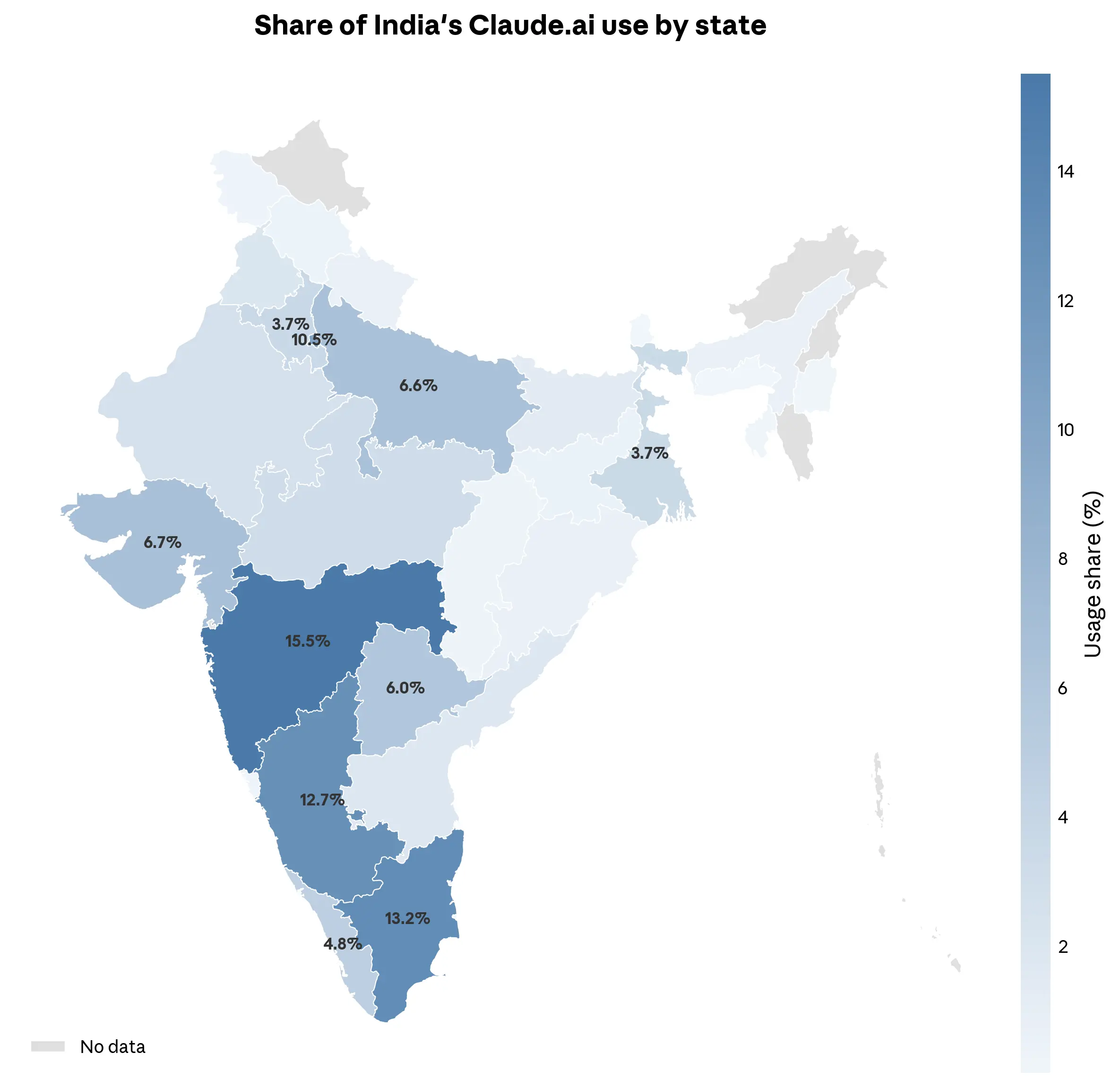
- The Geographic Cluster: Usage is heavily concentrated in just four highly economically active states: Maharashtra, Tamil Nadu, Karnataka, and Delhi. These states account for over half of all Indian Claude activity. (Source: Anthropic)

The 15x Productivity Leap
The people who are using it are seeing insane returns. According to Anthropic’s Economic Index:
- Indian users are taking complex tasks that would normally take 3.8 hours without AI and compressing them down to an average of 14.8 minutes.
- This represents a staggering 15x productivity speedup, which is noticeably higher than the 12x global average.
- A massive 45.2% of these tasks are related to software development and engineering, ranking India first globally in this specific use case.
The “SaaSpocalypse”: Why IT Giants Are Terrified of Claude
While individual users are celebrating their new speed and efficiency, massive corporations are genuinely terrified.
View this post on Instagram
The Financial Fallout
The launch of Claude Cowork, Anthropic’s enterprise-focused AI workspace capable of planning and executing multi-step tasks autonomously, sent shockwaves through the Indian IT services industry.
View this post on Instagram
- The panic peaked on February 3 and 4, 2026, when the Nifty IT index recorded its steepest fall since the Covid-19 era crash.
- Major Indian IT stocks plunged sharply. Infosys dropped about 8%, TCS roughly 7%, and Wipro around 5%.
- In a single day, nearly Rs 2 lakh crore in market value evaporated as investors reacted to these new AI capabilities.
(Source: Forbes India)
The Shift from Effort to Outcome
Why is a single AI release causing such a localised market crash? The answer lies in the fundamental business model of Indian IT.
The $250 billion Indian IT services industry relies heavily on labour-intensive outsourcing, billing Western clients based on “effort” or hours worked.
Claude Cowork threatens to automate the exact categories of work traditionally offshored to India, such as software testing, contract analysis, and data processing.
If AI agents can bypass traditional enterprise platforms and compress work that needed large teams into minutes of output, clients will no longer pay for hours. They will demand outcome-based pricing. This shift threatens to severely compress the profit margins of legacy IT giants. Investment bank Jefferies aptly described this moment as a “SaaSpocalypse”.
Enterprise Scale vs. Individual Affordability
Scaling AI in India requires overcoming two massive hurdles:
infrastructure reliability and individual pricing.
The Infrastructure Solution
Indian enterprises face unique traffic challenges. Events like Diwali shopping surges, tax filing deadlines, and major cricket tournaments cause massive spikes in server load.
To solve this, Amazon Bedrock now offers Anthropic’s Claude Opus 4.6, Claude Sonnet 4.6, and Claude Haiku 4.5 through Global cross-Region inference (CRIS) for customers operating in India.
- Customers using the Mumbai (ap-south-1) and Hyderabad (ap-south-2) regions can now route requests globally during high-traffic periods.
- This allows local applications to handle 3x to 5x normal traffic without performance degradation or throttling errors.
For the enterprise, AWS solves the scaling issue. But for the individual freelancer or SME, the affordability debate rages on across Indian tech forums.
The Claude Pro subscription sits at around $20 (approximately ₹1,650) per month. While this is a trivial expense for a developer in San Francisco, it represents a noticeable monthly overhead for junior talent or bootstrapped startups in Tier-2 Indian cities. However, when you factor in the 15x productivity speedup, treating the subscription as an operational cost rather than a luxury software purchase makes it a mandatory investment for those wanting to stay competitive.
How can you use Claude in India?
How do you actually get that productivity speedup? It depends entirely on your profession. Here is how forward-thinking sectors are leveraging Claude right now.
1. Software Developers and Engineers
Indian professionals are trusting AI to make decisions, displaying a higher willingness to delegate autonomy compared to the global average (3.60 vs 3.38 on a 5-point scale).
- Legacy Code Translation: Developers use Claude to translate massive blocks of code from outdated languages into modern frameworks.
- Autonomous Debugging: Instead of line-by-line checks, engineers give Claude access to their error logs and let the AI autonomously identify and suggest architecture fixes.
- Tackling the Impossible: Data shows that 84.6% of tasks brought to Claude by Indian users could not be easily accomplished by a human alone, proving they are pushing the technology to its absolute limits.
2. Legal and Compliance Teams
The January 30th rollout of Anthropic’s automation plug-ins included a specific tool for legal workflows.
- Massive Document Review: Legal teams are using Claude’s massive context window to upload hundreds of pages of case files, non-disclosure agreements, and compliance documents.
- Risk Identification: They prompt the AI to spot compliance loopholes or contract anomalies in seconds, completely replacing the need for an offshore team of junior paralegals.
3. Writers and Content Creators
Unlike some AI models that produce highly robotic text, Claude (particularly the Sonnet models) is heavily praised for its nuanced, natural tone.
- The Advanced Editor: Writers do not ask Claude to generate articles from scratch. They upload their rough drafts and brand style guides, asking the AI to refine the pacing and punch up the introductions.
- Tone Matching: Creators use it to seamlessly adapt a single piece of content for different platforms, ensuring a LinkedIn post sounds professional while a Twitter thread feels snappy and engaging.
4. Digital Marketing and Branding Agencies
Creative agencies are pivoting away from manual execution and moving towards high-level strategy to justify their retainers.
- Data Synthesis: A premium digital marketing agency uses Claude to synthesise messy customer feedback, survey data, and competitor website copy to identify the core emotional pain points of a target audience.
- Brand Positioning: A top-tier branding agency leverages Claude’s analytical power to build highly accurate buyer personas and map out comprehensive, multi-month SEO content clusters in a fraction of the time it used to take.
Conclusion
Is Claude worth the hype? Absolutely. But it is not a magic wand.
The data clearly shows that Indian professionals who learn how to prompt effectively and delegate autonomy are reaping massive, career-defining productivity gains. While the legacy IT services sector faces a necessary and painful evolution, SMEs, independent creators, and agile agencies have never had more power at their fingertips.
The businesses that survive and thrive in 2026 will not be the ones hiding from AI. They will be the ones who treat tools like Claude as an extension of their own workforce, leveraging the technology to do better work, faster than ever before.
Frequently Asked Questions

The founder and partner of Flora Fountain, Shefali leads the Content and Technology divisions. A one-time engineer who started her career writing front-end code, she took a detour sometime during her 9 years in New York, studied journalism and started writing prose, poetry and sometimes jokes. She now has 15...