

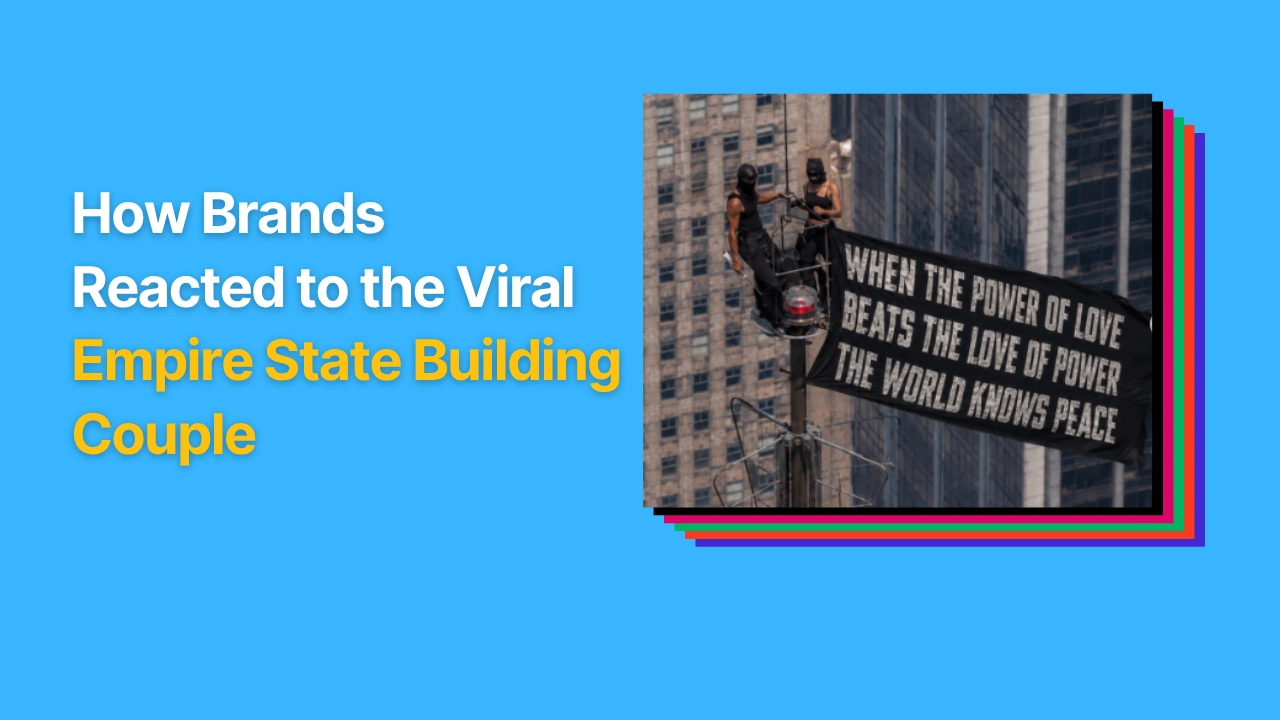
Quick Answer: On 1 July 2026, daredevil couple Angela Nikolau and Ivan Beerkus illegally scaled the Empire State Building, got engaged at 1,454 feet and went viral. Within hours, dozens of global brands, including Duolingo, Tarte Cosmetics and Currys, used the couple’s banner as a meme template, turning a news story into one of the most studied examples of moment marketing and trendjacking in 2026.
On 1 July 2026, Russian rooftoppers Angela Nikolau and Ivan Beerkus entered the Empire State Building as tourists, hid overnight and by noon the next day were perched 1,454 feet above New York City at the tip of the building’s antenna without ropes, without permission and without any apparent fear.
They unfurled a black banner reading “When the power of love beats the love of power, the world knows peace.” Ivan got down on one knee and proposed. Angela said yes. They posted the ring photo to Instagram.
The internet lost its mind. By the time NYPD officers climbed up in harnesses to bring them down, the couple were already global news. They were arrested and charged with burglary and reckless endangerment. They kissed for the cameras outside the court. The banner became a meme. And brands got to work.
Table of Contents
- The Brands That Jumped On It
- Empire State Building
- Duolingo
- Rapido
- Canva
- DoorDash
- Why Moment Marketing Works
- In Conclusion
- FAQs
The Brands That Jumped On It
What did brands do with the Empire State Building viral moment?
View this post on Instagram
Brands used the couple’s black banner as a creative template, swapping the original text for their own on-brand messages and posting within hours of the story breaking. The executions ranged from product showcases to workplace humour, with the best responses sharing one quality: they added something genuinely funny or relevant rather than just inserting a logo.
Empire State Building
View this post on Instagram
The building itself gave the most self-aware response. Its social team recreated Nikolau’s engagement ring photo against the New York City skyline and reminded followers they could enjoy the same breathtaking view from the 86th floor observation deck no illegal climb required. Sharp, fast and completely on-brand. The best trendjacking always comes from the brand closest to the story.
Duolingo
View this post on Instagram
Duolingo Deutschland reimagined Nikolau and Beerkus as the iconic Duo owl, turning the proposal into a German language lesson with vocabulary prompts and translations. Its caption read “If he wanted to, he would” poking fun at the internet’s favourite relationship mantra while staying true to Duolingo’s playful brand voice. Classic Duolingo: funny, fast and completely in character.
Rapido
View this post on Instagram
Rapido jumped on the trend in the most bizarre yet hilarious way possible. They added an Indian taste by adding a Rapido driver on top of the tower with the messaging on the template banner “Ye kya pickup location daal diya hai”, which was like a cherry on top (no pun intended).
Canva
View this post on Instagram
Canva enlarged the couple’s banner and overlaid the words “Make the sign bigger with Canva” directly onto it, highlighting its core design and resizing capability in three seconds flat. It also edited the proposal scene so that Beerkus appeared to be holding up a laptop with the screen reading “Try Canva for free now.” Two product messages. One meme. Zero media spend. A masterclass in viral marketing that made the product the punchline without the post feeling like an ad.
DoorDash
View this post on Instagram
DoorDash recreated its signature delivery drop-off SMS notification, placing a branded DoorDash bag right at the top of the Empire State Building antenna and captioning it: “Your order was dropped off. Please refer to this photo that your Dasher provided to see where it was left.” The format was instantly recognisable to every DoorDash user who has ever received a confusing drop-off photo. No banner edit. No logo slap. Just their own product UI turned into the joke. One of the sharpest moment marketing execution of the entire trend.
Why Moment Marketing Works
What is moment marketing?
Moment marketing is the practice of a brand responding to a current cultural event or viral moment in real time on social media. The goal is to make the brand feel part of an ongoing conversation rather than an interruption to it. It requires speed, a clear brand voice and the creative instinct to know when a moment is worth joining.
Why does moment marketing work?
Moment marketing works because it borrows existing attention rather than generating new attention from scratch. In a world where attention is the scarcest resource in marketing, inserting a relevant brand message into a conversation millions of people are already having delivers reach at a fraction of the cost of paid media.
Here is why it consistently outperforms scheduled content:
It costs almost nothing
Every brand reaction listed above was a single social media post. No production budget. No agency brief. No media spend. The entire value came from timing and creative sharpness. For smaller brands, especially, real-time marketing is one of the few channels where you can compete directly with brands ten times your size.
It borrows existing attention
The Empire State Building story was already the most-discussed event on the internet on 2 July 2026. Every brand that jumped in borrowed that attention rather than trying to generate its own. According to Fast Company, dozens of brands used the banner template within hours of the story breaking.
It signals that your brand is alive
Planned marketing can feel stiff. Brands that respond to the world in real time feel human, switched-on and culturally aware. That perception builds brand relevance in a way that no amount of scheduled content can replicate.
The banner format did half the work
What made this particular moment so brand-friendly was the ready-made meme structure. The banner was a template. Every brand just had to fill in the blank with something funny and relevant. The best newsjacking opportunities come when the viral moment has a clear creative format that brands can borrow and adapt quickly.
Speed is the entire game
As soon as images of the couple and the banner dropped on X and Instagram, brands moved within hours. The brands that waited two days for approvals were posting into a conversation that had already moved on. Brand agility, having the internal processes to move fast, is as important as the creative idea itself.
What separates good moment marketing from bad moment marketing?
Good moment marketing adds something to the conversation a joke, a perspective or a creative twist that is genuinely on-brand. Bad moment marketing simply inserts a product name into a trend without any creative angle. Fast Company described the weaker executions as “brand trend slop.” The brands that worked were the ones with a genuine idea. The ones that flopped were the ones that replaced the banner text with a product name and called it done. Cultural marketing only works when the brand contributes to the conversation rather than crashing it.
In Conclusion
Angela and Ivan climbed the Empire State Building for love. Brands climbed onto the meme for relevance. Some did it brilliantly. Some did it badly. All of them understood the same thing: when the internet has a moment, the brands that show up fast and say something smart get to be part of it for free.
Moment marketing is not a strategy you can fully plan for. But you can build the conditions for it: a brand voice that is clear enough to apply to anything, a team empowered to move fast and the creative instinct to know when a moment is worth jumping on and when it is not.
If you are building those capabilities for your own brand, that is exactly the kind of thinking a good digital marketing agency helps you develop. At Flora Fountain, we help brands stay sharp, stay relevant and show up when it counts. Write to us at hello@florafountain.com.
Frequently Asked Questions
The founder and partner of Flora Fountain, Shefali leads the Content and Technology divisions. A one-time engineer who started her career writing front-end code, she took a detour sometime during her 9 years in New York, studied journalism and started writing prose, poetry and sometimes jokes. She now has 15...