


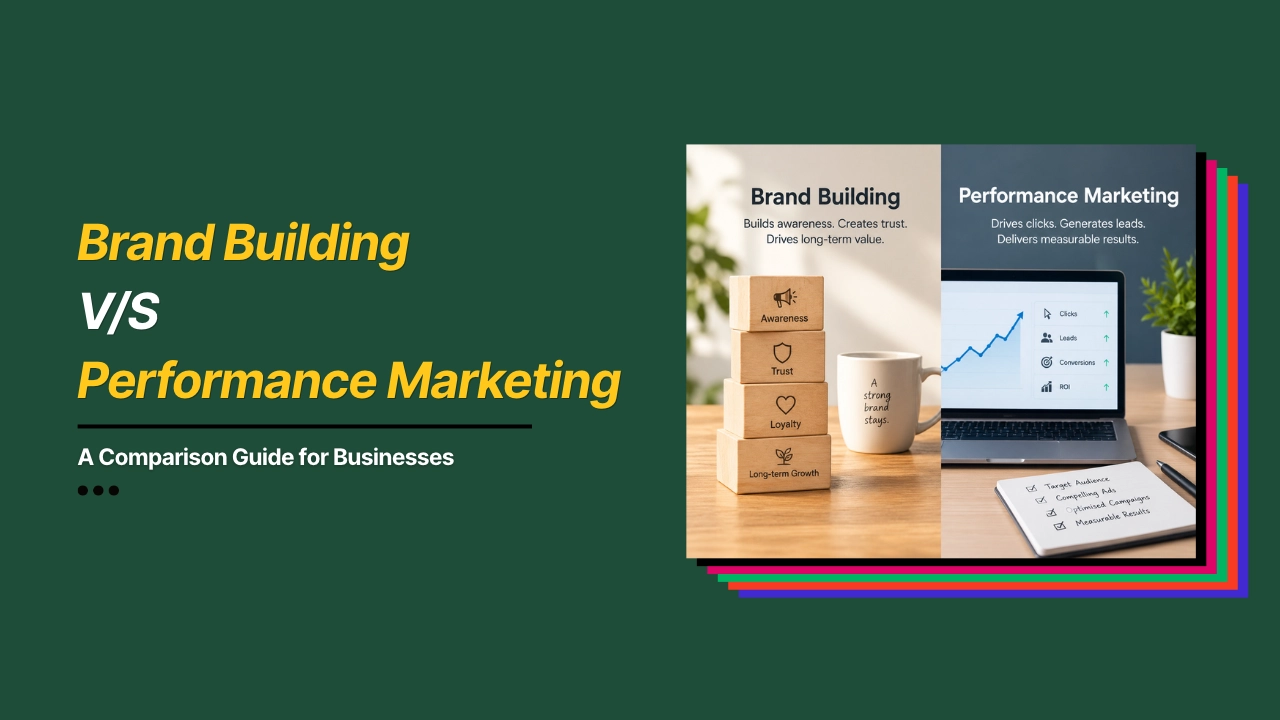
Brand building vs performance marketing comes down to timing. Brand building makes people prefer your business before they need what you sell. Performance marketing gets them to act once they are ready and shows you exactly what each action costs. One creates demand. The other captures it, and your business needs both.
Most business owners treat the two as rivals for the same budget, and that is where the trouble starts. A business that runs only performance marketing pays more every year to reach the same small pool of buyers. A business that runs only brand building gets recognised but rarely gets the call.
This guide shows you what each approach does, where they differ, how to split your budget and which one to lead with.
Quick Summary
- Brand building shapes how buyers see you before they need you. Performance marketing turns ready buyers into measurable leads and sales.
- Awareness and lead generation are different goals. You can have plenty of one and almost none of the other.
- The 60:40 principle is a reference point, not a formula. Your market, buying cycle and budget set your split.
- New businesses usually lead with performance marketing. Businesses facing rising acquisition costs usually need more brand building.
Table of Contents
- Brand Building vs Performance Marketing: What’s the Difference?
- What Is Brand Building and Why Does It Matter?
- How to Build Brand Awareness: 7 Effective Brand Building Strategies
- What Is Performance Marketing and How Does It Work?
- Brand Building vs Performance Marketing: Key Differences
- Why Your Business Needs Both Brand Building and Performance Marketing
- How to Balance Your Brand Building and Performance Marketing Budget
- Which Strategy Should Your Business Prioritise?
- How to Choose the Right Performance Marketing Agency
- Conclusion
- Frequently Asked Questions
Brand Building vs Performance Marketing: What’s the Difference?
Brand building is the long-term work of making your business known, trusted and preferred. Performance marketing is paid, tracked activity built to produce one specific action, such as an enquiry, a purchase or a booking. Brand building decides whether buyers think of you. Performance marketing decides whether they act when they do.
| Brand building | Performance marketing | |
|---|---|---|
| Core job | Makes you the familiar, trusted choice | Turns ready buyers into leads, bookings or sales |
| Question it answers | Why should I choose this business? | What do I do next? |
What Is Brand Building and Why Does It Matter?
Brand building goes far beyond a logo, a colour palette or a tagline. The real work is deciding what your business stands for and making sure buyers remember it. It rests on five things:
- Positioning: the place you hold in a buyer’s mind, such as the jeweller for wedding sets.
- Differentiation: the reason to pick you over an equally capable competitor.
- Recognition and recall: recognition means people know you when they see you. Recall means they name you unprompted.
- Trust: the confidence that you deliver what you promise.
- Customer preference: the point where buyers choose you before they compare alternatives.
Awareness and lead generation are different objectives, and mixing them up wastes budget. Awareness tells you how many people know you exist. Lead generation tells you how many raised a hand this month. Find which gap you have and fund that one. That is also the core of how to build a brand that buyers remember: start with sharp positioning, then make it easy to recall.
How to Build Brand Awareness: 7 Effective Brand Building Strategies
If you want to know how to build brand awareness, these seven brand building strategies show you the order to follow.
1. Define your brand positioning and differentiation
Decide who you serve best and why they should pick you. Write it as one sentence a new salesperson could repeat. Every other strategy depends on it.
2. Understand your audience and their buying behaviour
Find out where your buyers research, who influences them and how long they take to decide. A family buying wedding jewellery follows a different path from a company buying software.
3. Develop consistent brand messaging
Use the same message, tone and visual identity across your website, ads, social profiles and sales conversations. Buyers need repeated exposure before they remember you, and mixed messages reset that progress.
4. Create valuable content and thought leadership
Publish content that answers the questions buyers ask before they buy. Over time that expertise becomes the reason people shortlist you.
5. Build social media visibility
Pick the platforms where your buyers already spend time and post your work, your people and your proof, not only your offers.
6. Invest in SEO, PR and relevant collaborations
SEO puts you in front of buyers researching your topic. PR adds third-party credibility. Collaborations reach audiences that already trust your partner.
7. Build credibility through customer experiences and social proof
Reviews, testimonials and referrals carry more weight than anything you say about yourself. Ask happy customers for reviews and publish real project work.
What Is Performance Marketing and How Does It Work?
Performance marketing is paid marketing built around a specific, measurable action. You decide what counts as a result, track it and move budget toward what works. The action might be an enquiry, a call, a purchase or a booking. These are the pieces:
- Campaign objective: one clear goal per campaign, such as site visit bookings.
- Targeting: reaching people by search intent, location, interests or past visits to your site.
- Paid search and Google Ads: your ad appears when someone searches for what you sell, so intent runs high.
- Meta Ads: Facebook and Instagram ads that reach people by interest and behaviour.
- Retargeting: ads that follow people who already visited your website and bring them back.
- Affiliate marketing: you pay partners only when their referral produces a sale or lead.
- Tracking: code on your site records each completed action. Google’s guide to conversion tracking covers calls, form submissions and offline sales you import later.
- Optimisation: you pause weak ads and move budget to the campaigns with the best cost per result.
Performance marketing earns its place because you can see what every rupee produced. It cannot make people want what you sell. It finds the people who already do.
Brand Building vs Performance Marketing: Key Differences
The brand building vs performance marketing gap shows up in eight places.
| Brand building | Performance marketing | |
|---|---|---|
| Primary objective | Awareness, trust and preference | Leads, sales and bookings |
| Timeframe | Quarters and years | Days or weeks |
| Audience | The whole market, including future buyers | People searching or close to buying |
| Marketing channels | Content, SEO, PR, social media, events, collaborations | Google Ads, Meta Ads, retargeting, affiliates |
| Budget approach | Steady investment judged over time | Flexible spend scaled by cost per result |
| Measurement metrics | Recall, branded search, share of voice, direct traffic | Cost per lead, cost per acquisition, conversion rate, ROAS |
| Customer relationship | Builds familiarity and trust before first contact | Starts the transaction, and what follows the click decides loyalty |
| Long-term business impact | Builds an asset that keeps working after spend slows | Delivers results only while spend runs |
ROAS is return on ad spend, the revenue you earn for every rupee spent on ads. Branded search means people typing your business name into Google.
Why Your Business Needs Both Brand Building and Performance Marketing
Brand building creates the preference. Performance marketing collects the result. Each one performs worse without the other.
Familiarity changes how buyers respond to your ads. When people already know a strong brand, its paid campaigns get a warmer response because the buyer has met you before the ad appears. That is why brand building makes every rupee of paid spend work harder.
Running only paid campaigns carries three risks:
- Your leads stop the day your spend stops.
- Competitors bid in the same auctions, so your cost per lead rises.
- Buyers hold no preference for you, so they compare you on price.
Running only brand building has the opposite problem. Buyers recognise your name, but your website and follow-up never turn that into revenue.
Here is how the split works in three Indian categories. These are illustrative scenarios, not client results.
- Jewellery business: Brand building earns trust in craftsmanship and purity through customer stories and local PR, so families think of your store first. Performance marketing then runs festive offers and retargets people who browsed your collections.
- Real estate developer: Buyers spend months deciding, so brand building focuses on delivery record and buyer testimonials. Performance marketing captures site visit bookings from local searches. Track leads through to bookings, not only form fills.
- FMCG business: Brand building creates recall through consistent packaging and short videos, so shoppers reach for your pack. Performance marketing drives trial and repeat purchase with ads on marketplaces and quick commerce apps.
How to Balance Your Brand Building and Performance Marketing Budget
The 60:40 principle comes from Les Binet and Peter Field’s analysis of the IPA Databank, a library of UK advertising case studies. The analysis covered 996 campaigns across 700 brands and 83 categories and found that very large business effects peaked at about 40% of budget on activation and about 60% on brand building. Campaigns that combined brand and activation channels were also about twice as efficient as those using brand channels alone.
What it proves: a brand-led mix with a smaller share for activation produced the strongest results across a large body of campaigns. Their follow-up research looked at how that balance plays out in different categories.
What it does not prove: a rule for every business. The data measures advertising campaigns, not how a growing business should split a modest monthly budget. Treat 60:40 as a reference point and set your own split from there.
Your split depends on five things:
- Business maturity: a new business needs sales data and cash flow before it can fund long brand campaigns.
- Industry: categories with heavy search demand reward performance marketing sooner.
- Buying cycle: the longer and costlier the decision, the more weight brand building deserves.
- Marketing objectives: a quarterly revenue target and a three-year market position need different mixes.
- Available budget: with a small budget, pick one lead channel and run the other at a low level.
You do not need two separate teams. Brand building can run through content, SEO and reviews at modest cost while paid campaigns capture your best-performing demand. Give every campaign one clear goal, because an ad that tries to build the brand and close the sale at once usually does neither well.
Which Strategy Should Your Business Prioritise?
Use these starting points, then test them against the framework that follows.
- New businesses and startups: Lead with performance marketing to test demand and generate early revenue. Build the brand basics alongside it: clear positioning, a credible website and early reviews.
- Established businesses: Shift weight toward brand building and customer experience to protect your position. Use performance marketing to convert efficiently, not to create demand.
- Businesses facing rising acquisition costs: Look at brand first. Chasing the same shoppers on the same keywords with more spend will not fix your cost. Familiar brands convert more easily.
- Businesses launching new products: Use both in sequence. Brand work introduces the product, because nobody searches for something they do not know exists. Performance marketing then captures the demand that follows.
- Businesses with strong awareness but weak lead generation: Fix conversion first. Audit your offer, website and follow-up speed, then add performance marketing that gives buyers a clear next step.
A four-question decision framework
- Check for existing demand: If buyers already search for what you sell, performance marketing has people to capture. If few do, create the demand first.
- Check whether buyers know you: Low branded search and prospects who have never heard of you point to brand building.
- Check whether your funnel converts: Fix a weak website or slow follow-up before you spend more on either approach.
- Check the length and risk of the decision: The longer and costlier the purchase, the more weight brand building deserves.
If demand exists and your funnel converts but buyers do not know you, add brand weight. If buyers know you but your funnel leaks, fix conversion and then add performance marketing. If demand is thin and decisions are slow, lead with brand building.
How to Choose the Right Performance Marketing Agency
A good performance marketing agency treats paid campaigns as one part of a wider growth system. When you compare performance marketing companies, hold each one to these six standards:
- Strategic understanding: They ask about your margins, sales cycle and customer value before proposing channels.
- Industry experience: They have worked in your category or one with a similar buying cycle.
- Campaign optimisation: They explain how they test creatives, audiences and landing pages.
- Reporting: Reports show cost per lead, cost per acquisition and revenue, not only clicks.
- Conversion tracking: They set up tracking before launch and you own the ad accounts and analytics.
- Alignment with business objectives: They link campaigns to lead quality and sales, and tell you when SEO or a website fix beats more ad spend.
Walk away from any agency that guarantees results or reports only on platform metrics.
Conclusion
Brand building decides whether buyers think of you. Performance marketing decides whether they act. Businesses that run only one pay more for less, so the real decision is which of the two your business is missing right now.
Start with the four checks above and fix the weakest link first. At Flora Fountain, an Ahmedabad-based digital marketing agency established in 2016, we plan brand and performance work as one strategy across SEO, advertising, web development, content marketing and AI search optimisation. Book a consultation and we will show you where your business stands today.
Frequently Asked Questions

Vasim Samadji is a partner at Flora Fountain, where he leads the Business and Marketing Strategy divisions. In a world where everyone is used to sugarcoating, his directness is often considered rude. But that shouldn't be a problem if you like the no-nonsense approach. Because he is a seasoned professional...