


In the high-stakes B2B landscape of 2026, the traditional sales funnel has been replaced by a “Scrutiny Loop.” Buyers are more informed, more cautious, and more averse to professional risk than ever before. Recent data suggests that nearly 70% of the buyer journey now happens in the “Dark Funnel”: through AI research, peer networks, and private communities, long before a lead ever touches your CRM.
For a modern digital marketing agency, this shift changes everything. Branding is no longer a “nice-to-have” creative layer; it is a critical commercial multiplier. This blog deconstructs the anatomy of B2B brand equity and provides a blueprint for becoming the most defensible choice in your market.
Table of Contents
- What Does “Branding” Mean for a B2B Business in 2026?
- How Is B2B Branding Different from B2C or D2C Strategies?
- Why Does Strong Branding Matter So Much in B2B Businesses?
- What Are the Three Essential Pillars of a Modern B2B Brand?
- How Does Your Brand Identity Directly Impact Your Profit?
- The Only Strategy You Require to Build a Strong B2B Brand in 2026
- Conclusion
- FAQs
What Does “Branding” Mean for a B2B Business in 2026?
In 2026, B2B branding is the sum of every signal your business sends into the digital ecosystem. It is not just your logo or your colour palette: it is the predictability of your outcome. A brand is a non-verbal promise that your company will solve a specific problem with a specific level of quality, every single time.
Key Components of B2B Branding in 2026
- Trust Over Selling
Buyers have more choices than ever. Brands must guide, educate, and advise, acting as experts people trust, not just sellers pushing products. - More Human, Less Corporate
B2B messaging will move beyond technical jargon to emotional, value-led stories that feel relatable and purpose-driven. - Strong Digital Experience
With Gen Z and millennials making decisions, brands need smooth, easy-to-use, consumer-like digital experiences at every touchpoint. - Self-Service & Clear Pricing
Buyers want control. Simple self-serve options, clear pricing, and transparency will matter more than heavy sales involvement. - Leaders as Brands
Founders and key professionals must build strong personal brands to build trust and credibility even before people engage with the company. - Data-Driven Stories
AI and analytics will help brands tell the right story to the right client, based on real behaviour and intent, not generic messaging.
For most B2B entities, the brand is synonymous with the company name. It is the “Topical Authority” that ensures when a potential client encounters your content via an AI Overview or a LinkedIn post, they recognise you as a reliable specialist. In a market flooded with AI-generated noise, brands working with a specialised branding agency are the “human anchor” that produces legitimate content narratives.
How Is B2B Branding Different from B2C or D2C Strategies?
View this post on Instagram
The fundamental difference lies in the complexity of the decision. B2C and D2C branding often focus on emotional triggers, lifestyle aspirations, and instant gratification for a single buyer. In contrast, B2B marketing must navigate a committee of stakeholders, each with their own priorities and fears.
| Feature | B2B Branding | B2C / D2C Branding |
|---|---|---|
| Buying Committee | 6 to 10 Stakeholders | Usually 1 Individual |
| Primary Driver | Logic & Risk Mitigation | Emotion & Social Status |
| Sales Cycle | 3 to 18 Months | Instant to 30 Days |
| Relationship | Long-term Partnership | Often Transactional |
B2B branding must provide “Internal Defensibility.” Your brand needs to give your champion within the client company the tools and the confidence to justify their choice to the CFO or the Board of Directors.
Why Does Strong Branding Matter So Much in B2B Businesses?
1. Career Protection and the “Consensus Effect”
B2B decisions in 2026 involve an average of 6 to 10 stakeholders. Each member (from IT to Finance) faces “Professional Risk.” If they back an unknown vendor that fails, their internal credibility is ruined.
- The Safe Choice Bias: A strong brand provides “Internal Air Cover.” If a project hits a snag but the vendor is a recognised authority, the decision-maker is viewed as having made a prudent choice. If the vendor is “unbranded,” the decision-maker is viewed as having been reckless.
- Consensus Builder: A familiar brand name acts as a neutral “third party” that helps disparate departments (who often have conflicting goals) reach an agreement faster.
2. Combating “Loss Aversion” in the Boardroom
Psychologically, the pain of a “bad” B2B purchase is twice as intense as the joy of a “good” one. This is Loss Aversion.
- Proof over Promises: Strong brands use Proof-Based Authority (case studies, original research, and third-party validations) to prove that the “Future State” they promise is attainable.
- The Cost of Inaction: A well-positioned brand shifts the risk from “What if we buy this?” to “What if we don’t act and our competitors do?” By framing the brand as a necessity for resilience, you turn the purchase into a risk-management strategy.
3. Reducing Cognitive Load for Informed Buyers
While 2026 buyers are more informed, they are also more overwhelmed. Over 90% of buyers arrive at the first sales meeting already familiar with the vendor.
- The Familiarity Shortcut: In a high-speed research environment, “Familiarity Trumps Features.” A strong brand acts as a cognitive shortcut, allowing buyers to skip the “basic credibility” phase and move straight into “solution fit.”
- Trust Moat: Brands that have established Topical Authority in the “Dark Funnel” (private Slack groups, peer reviews, AI Overviews) have already won the trust battle before the first official RFP is even issued.
4. Safeguarding Against Operational and Reputational Disasters
For modern procurement teams, brand safety goes beyond the digital space; it includes the Reputational Risk of the entire supply chain.
- The Integrity Signal: A brand that consistently communicates its stance on ethics, sustainability, and data security signals that it is an operationally “clean” partner.
- Crisis Resilience: Trusted brands are more likely to be forgiven for minor service hiccups. A strong brand creates a “buffer of goodwill” that allows for a partnership to endure through market shifts and technical transitions.
View this post on Instagram
A strong brand acts as a pre-validation tool. By establishing yourself as a thought leader through a consistent branding agency strategy, you remove the “Fear of the Unknown.” You aren’t just selling a service: you are selling the peace of mind that comes with a proven track record.
What Are the Three Essential Pillars of a Modern B2B Brand?
To build a resilient B2B brand in 2026, you must focus on three technical and strategic foundations:
- Radical Audience Focus: Move away from “Generic Professionalism.” A strong brand clearly identifies exactly who it is for. This “Anti-Broad” strategy makes your messaging 10x more resonant for your ideal client.
- Outcome-Based Value Propositions: In 2026, buyers don’t care about your features; they care about their “Future State.” Your brand must communicate the specific commercial transformation you deliver.
- Signal Consistency: From your sales decks and website UX to your post-purchase support, every touchpoint must reinforce the same brand promise. Inconsistency is the leading cause of “Trust Decay.”
How Does Your Brand Identity Directly Impact Your Profit?
Branding is a financial strategy, not a creative cost. Strong brand equity has a measurable impact on your balance sheet:
- Lower Customer Acquisition Cost (CAC): Brands with high authority start sales conversations “warm.” Prospects already trust your expertise, which significantly reduces the time and resources needed to close a deal.
- Pricing Power: Data shows that authoritative B2B brands can command a 20% to 30% premium over competitors because they represent a lower perceived risk to the buyer.
Higher Retention (CLV): A strong brand fosters a sense of partnership rather than a vendor-client relationship, leading to higher renewal rates and easier upsells.
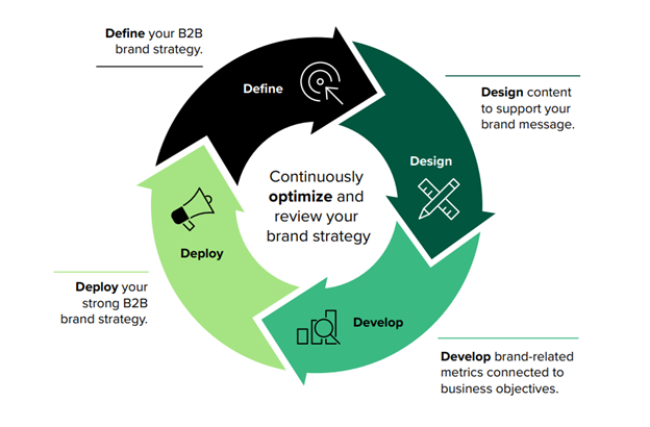
The Only Strategy You Require to Build a Strong B2B Brand in 2026
1. Become a Trusted Authority
Shift from selling to educating. Share expert insights, original thinking, and honest opinions that position your brand as a reliable advisor, not just another vendor.
2. Build a Human Brand Voice
Communicate with empathy and clarity. Focus on values, purpose, and real stories that make your brand relatable, memorable, and emotionally credible to decision-makers.
3. Design Consumer-Grade Digital Experiences
Create seamless, intuitive digital journeys across website, content, and platforms: fast, simple, and user-friendly enough to match modern consumer brand expectations.
4. Enable Self-Serve Decision Making
Empower buyers with clear information, transparent pricing, and easy self-service options, allowing them to research, evaluate, and act without heavy sales dependence.
5. Turn Leadership into Brand Assets
Position founders and leaders as visible thinkers. Personal brands build trust faster and add authenticity, authority, and reach beyond company-only marketing.
6. Use Data to Personalise Stories
Leverage AI and analytics to understand intent. Deliver tailored content and messaging that aligns with buyer behaviour instead of one-size-fits-all campaigns.
7. Stay Consistent, Not Loud
Consistency builds credibility. Maintain a clear brand voice, visual identity, and message across channels rather than chasing trends or short-term attention.
A Premier Digital Marketing agency acts as an external “Brand Champion,” aligning these extensive steps into a single, actionable plan.
Conclusion
Building a strong B2B brand in 2026 is the ultimate act of future-proofing. As AI continues to commoditise information, your brand is the only thing that cannot be replicated. It is the trust you have built with your audience, the consistency of your delivery, and the authority of your voice. When you move up the “Branding Ladder” from a product vendor to a strategic partner, you stop competing on price and start winning on value.
If you are ready to transition from being an “option” to being the “only choice” in your industry, it is time to consult with an expert branding agency that specialises in architecting the trust-moats that B2B brands need to thrive in a high-scrutiny world and help you turn your identity into your most powerful commercial engine.
Frequently Asked Questions

Vasim Samadji is a partner at Flora Fountain, where he leads the Business and Marketing Strategy divisions. In a world where everyone is used to sugarcoating, his directness is often considered rude. But that shouldn't be a problem if you like the no-nonsense approach. Because he is a seasoned professional...