


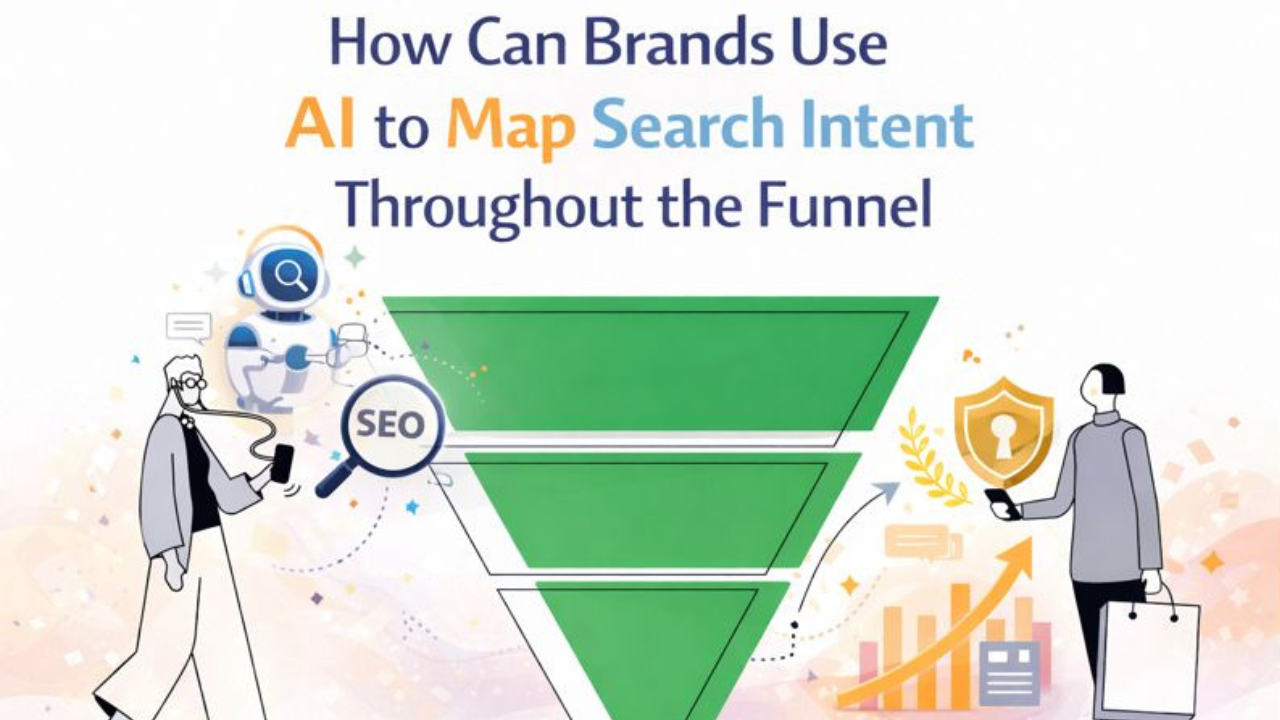
To dominate the SERPs in 2026, we must admit that the traditional “three-bucket” model of search intent (Informational, Navigational, Transactional) is dead. It is too broad, too rigid and too slow. Real user journeys are messy, non-linear loops filled with “micro-intents” that manual keyword research simply cannot catch.
The modern buyer does not move in a straight line from awareness to purchase. They research, compare, retreat, validate and return. In this chaotic ecosystem, AI-Led Intent Mapping is the only way to make sense of the noise.
For a strategic SEO agency, AI is no longer just a content writer. It is a behavioural psychologist. It allows us to move beyond matching keywords to matching minds. This blog explores how brands can leverage AI to decode the human intent behind queries and capture users at every twist and turn of the funnel.
Table of Contents
- Why Traditional Mapping of Search Intent Fails in 2026
- Beyond “Transactional”: How AI Decodes Semantic Intent
- TOFU (Top of Funnel): Predicting “Problem Discovery”
- MOFU (Middle of Funnel): Navigating the “Messy Middle”
- BOFU (Bottom of Funnel): Separating “Window Shoppers” from Buyers
- Steps to Use AI to Map Search Intent in Funnel
- Conclusion
- Frequently Asked Questions
Why Traditional Mapping of Search Intent Fails in 2026
For decades, marketers have relied on manual spreadsheets to map keywords to funnel stages. We assumed that “what is CRM” was Top of Funnel and “buy CRM” was Bottom of Funnel. In 2026, this logic is dangerously simplistic.
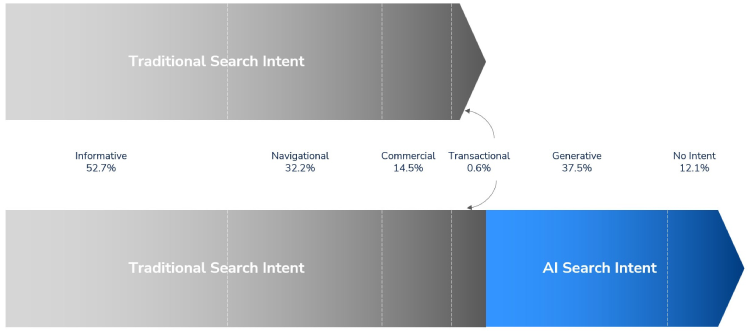
Traditional search intent mapping, often limited to the rigid Informational, Navigational, and Transactional categories, is increasingly failing due to the following reasons:
- Reliance on Static Keywords over Context: Traditional mapping focuses on matching specific words rather than the “why” behind the search. For example, the query “solar panels” could be for research, buying, or financing, but a keyword-only approach often misses this nuance.
- Rise of Conversational and AI Queries: Over 70% of AI search queries do not fit standard categories. Modern users ask complex, 20+ word conversational questions that search engines now interpret through semantic meaning rather than word-for-word matching.
- The Intent-Structure Gap: Even if the intent is correctly identified, traditional models fail if the content structure is poor. Users may bounce if the answer is “buried” under a wall of text, regardless of how well it matches their intent.
- Fractured and Mixed Intent: A single query like “best AI analytics tools” can simultaneously express research, comparison, and purchase intent. Standard mapping struggles to account for these overlapping layers.
- Volume vs. Value Mismatch: High-volume keywords often attract “browsers” rather than “buyers”. Traditional mapping prioritises volume, whereas lower-volume, long-tail keywords frequently drive 3x higher conversion rates.
- Lack of Post-Click Engagement Data: Traditional mapping is often a one-time setup that ignores real-time signals like dwell time and bounce rates, which modern search engines use to determine if a page actually fulfilled the user’s need.
- Ignoring the B2B Buying Dynamic: In B2B, a purchase involves multiple stakeholders (CFOs, technical evaluators, etc.) searching at different stages over months. Traditional models collapse this complexity into a single, static data point
AI changes this by analysing the Search Session, not just the isolated query. It understands that the user who just searched for “enterprise data security” before searching for “CRM features” is a high-value prospect, not a casual browser. The linear funnel has been replaced by a dynamic web of intent.
Beyond “Transactional”: How AI Decodes Semantic Intent
Traditional SEO looks at what was typed. AI looks at why it was typed. Through Natural Language Processing (NLP), AI models can analyse the sentiment, syntax and context of a query to reveal deeper intent layers.
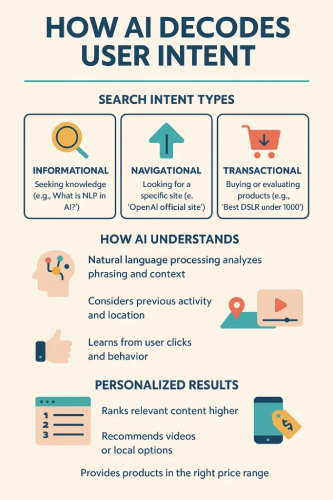
- Sentiment Analysis: Is the user frustrated (“CRM crashing fix”) or aspirational (“best CRM for growth”)?
- Semantic Clustering: AI groups thousands of long-tail keywords into single “Intent Clusters.” It recognises that “cheap software,” “affordable tools” and “budget-friendly apps” are the same semantic request.
This allows a digital marketing agency to target concepts rather than just chasing search volume.
TOFU (Top of Funnel): Predicting “Problem Discovery”
At the top of the funnel, users often do not know the solution; they only know the problem. AI helps you identify these “Problem Unaware” queries before competitors do.
By analysing search patterns on forums, Reddit and social listening tools, AI can predict rising topics. For example, before “remote work software” spikes, AI detects a rise in “productivity dropping at home.”
- The AI Strategy: Use predictive modelling to create content that answers questions users are about to ask. Be the first brand they meet when they start their journey.
MOFU (Middle of Funnel): Navigating the “Messy Middle”
Google calls this the “Messy Middle.” It is where customers explore and evaluate. It is also where most brands lose them.
- Comparison Nuance: A user searching “Brand A vs Brand B” is not always ready to buy. AI can analyse the modifiers used. “Brand A vs Brand B pricing” signals distinct commercial intent, whereas “Brand A vs Brand B history” is purely informational.
- Content Gap Analysis: AI tools can instantly audit your site against top competitors to see which specific comparison questions you are failing to answer.
BOFU (Bottom of Funnel): Separating “Window Shoppers” from Buyers
Not all “buy” keywords are created equal. AI allows for Predictive Lead Scoring based on search behaviour.
- High-Intent Signals: AI identifies patterns like specific SKU searches, bulk pricing queries or shipping time inquiries as “Imminent Conversion” signals.
- Conversion Mapping: Instead of sending all BOFU traffic to a generic home page, AI helps map specific intent clusters to specific landing pages (e.g., sending “enterprise security” queries to a CTO-focused whitepaper rather than a generic signup form).
Steps to Use AI to Map Search Intent in Funnel
Mapping intent manually is impossible at scale. Here is the technical workflow a digital marketing agency uses to automate this process.
| Step | Action | The AI Advantage |
|---|---|---|
| 1. Data Aggregation | Export 12 months of Search Console & Chat log data. | AI processes millions of rows instantly, finding patterns humans miss. |
| 2. N-Gram Analysis | Use AI to break queries into 1, 2, and 3-word strings. | Identifies hidden modifiers (e.g., “for small business”) that define intent. |
| 3. Semantic Clustering | Run data through a clustering tool (like Python/BERT). | Groups 5,000+ keywords into 50 clean “Intent Topics.” |
| 4. SERP Analysis | Use AI to scrape the top 10 results for each cluster. | Determines if Google prefers video, text, or tools for that intent. |
| 5. Content Mapping | Assign existing URLs to clusters. | Identifies “Orphan Intents” where you have no content match. |
Conclusion
The brands that win in 2026 will not be the ones with the most content; they will be the ones with the most relevant content. Relevance is no longer a guessing game. It is a data science discipline.
By using AI to map search intent, you stop shouting at strangers and start answering specific questions for specific people. You move from “Digital Noise” to “Digital Empathy.”
If your current strategy still relies on static spreadsheets and gut instinct, you are likely misinterpreting 50% of your audience. It is time to partner with an SEO agency that speaks the language of the algorithm and uses advanced AI clustering to ensure that every piece of content you create lands exactly where your customer is.
Frequently Asked Questions

The founder and partner of Flora Fountain, Shefali leads the Content and Technology divisions. A one-time engineer who started her career writing front-end code, she took a detour sometime during her 9 years in New York, studied journalism and started writing prose, poetry and sometimes jokes. She now has 15...