


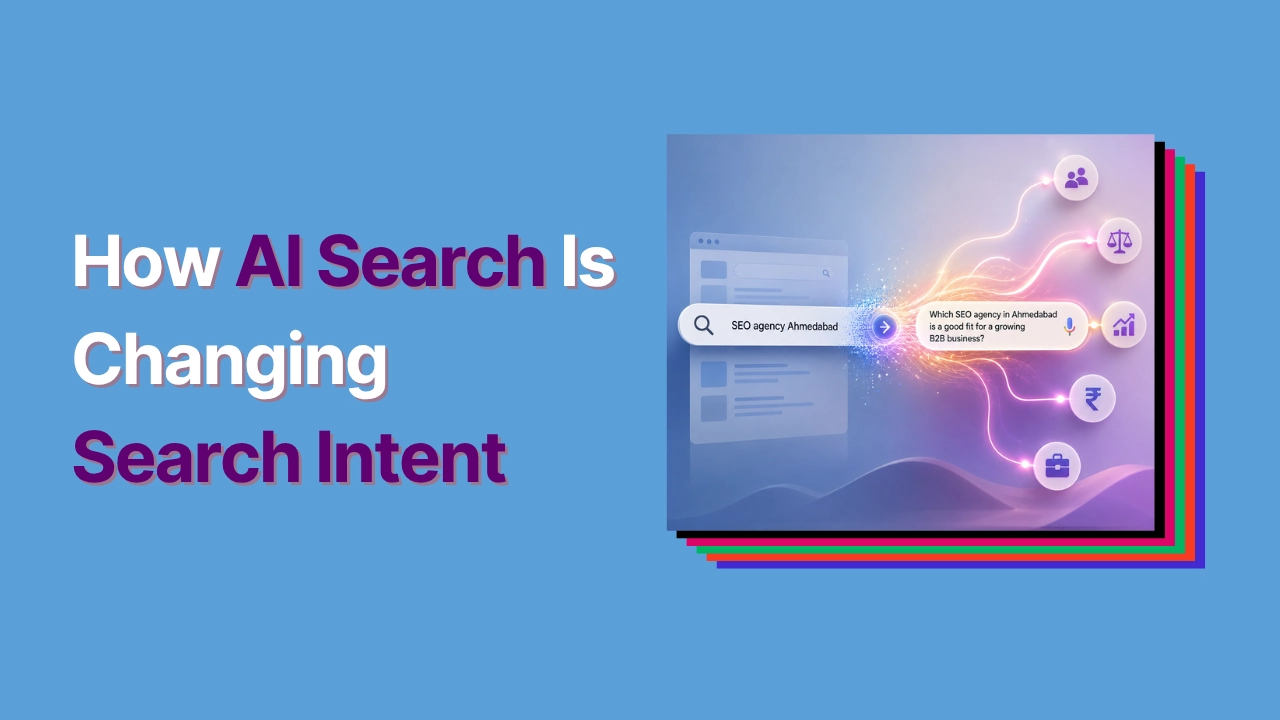
A few years ago, someone looking for marketing help would type “SEO agency Ahmedabad” into Google, scan ten blue links and call three of them.
Today, that same person is more likely to ask something like, “Which SEO agency in Ahmedabad is a good fit for a growing B2B business?” And then follow it up with, “What should I ask before signing a contract?”
The need hasn’t changed. The way people express it has.
That shift, from typing keywords to asking questions, is what this article is actually about. Not what AI is, but how it’s changing what people search for, how they search for it and what that means for anyone trying to stay visible.
Table of Contents
- What Is AI Search?
- Search Intent Is Becoming More Conversational
- From One Search to a Search Journey
- How AI Overviews and AI Mode Change the Results Page
- Search Intent Is Expanding Beyond Keywords
- What Multimodal Search Means for Intent
- What This Means for SEO
- What This Means for AEO and GEO
- How Businesses Should Adapt Their Content Strategy
- Bringing It All Together
- FAQs
What Is AI Search?
AI search is when a search engine uses artificial intelligence to understand what someone is actually asking, pull relevant information from multiple sources and hand back a more synthesised answer instead of a plain list of links.
On Google, this shows up in two ways. AI Overviews sit above the regular results and summarise an answer for questions where Google’s systems judge it genuinely useful. AI Mode goes further, letting people have a full back and forth conversation inside Search, asking follow-up questions the way they would in a chat.
Neither of these has replaced the classic search results page. Most searches still show up as a normal list of links. What’s changed is that a growing share of questions, especially broad or comparison-heavy ones, now get an AI-generated layer on top of that list, or a fully conversational experience instead of it.
Search Intent Is Becoming More Conversational
Go back to that opening example. “SEO agency Ahmedabad” is a short, transactional query. It tells Google what the person wants but almost nothing about why or what they’ll compare before deciding.
“Which SEO agency in Ahmedabad is a good fit for a growing B2B business?” carries far more intent in the same breath. It tells you the business type, the growth stage and the fact that “fit” matters more to this person than a generic ranking promise.
The same pattern shows up for a “digital marketing agency in Ahmedabad“ search. Instead of stopping there, people are increasingly typing or asking things like “how do I compare digital marketing agencies in Ahmedabad?” or “what should a good SEO company in Ahmedabad actually deliver in month one?” People search the way they’d ask a knowledgeable friend, because AI-powered tools can now handle that kind of nuance without losing the thread.
For businesses, this means a page written to answer one narrow keyword is answering a smaller slice of the real question than it used to.
From One Search to a Search Journey
The conversational shift also changes the shape of a search. Instead of running five separate Google searches to research five separate things, people increasingly ask one question, read the response, then ask a follow-up in the same thread. Someone comparing SEO agencies might start broad, move into what to ask before signing a contract, then narrow into pricing or industry experience, all inside one continuous exchange.
Google’s own systems do something similar behind the scenes. Both AI Overviews and AI Mode can use a technique Google calls query fan-out, quietly running several related searches across subtopics to build one response. Google’s own documentation gives the example of someone asking how to fix a weed-covered lawn: behind that single question, the system might also pull in results for the best herbicides, chemical-free removal methods, and weed prevention, before combining what it finds into one answer.
That matters for content strategy. A page built to answer only the literal query is now competing to be useful across a small cluster of related questions, not just the one typed into the box.
How AI Overviews and AI Mode Change the Results Page
It helps to be precise about what each feature actually does, because the two get confused constantly.
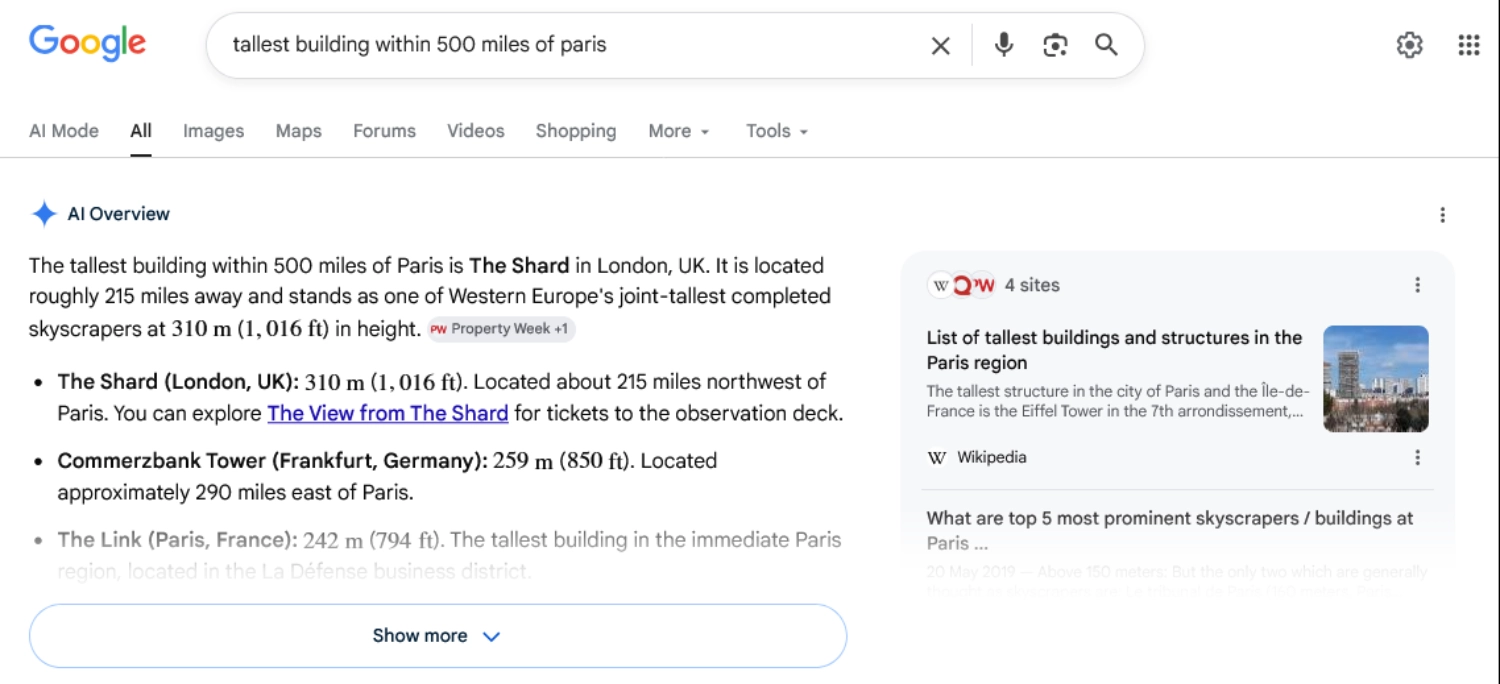
AI Overviews are short, AI-written summaries that appear above the normal results for specific queries. Google has said these are designed to help people get to the gist of a complicated question quickly, then jump off into links to learn more, and that they only appear when Google’s systems judge them genuinely additive to a classic search.
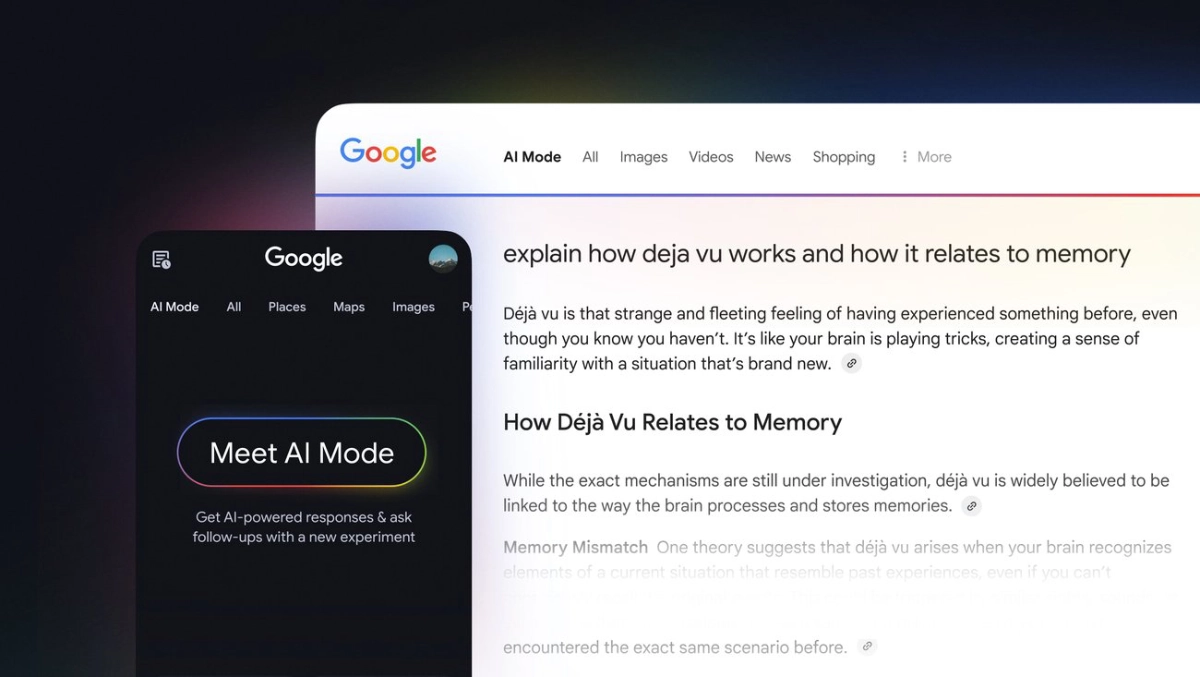
AI Mode is a separate, fuller experience built for exploration, comparison and multi-step reasoning, where a person can ask a nuanced question and keep digging with follow-ups instead of running several separate searches. At Google I/O 2026, Google said AI Mode had passed one billion monthly users within its first year, with query volume more than doubling every quarter, and confirmed it now runs alongside AI Overviews as part of the same broader search experience.
India got AI Mode early. Google launched it in India as a Labs experiment before rolling it out more widely, and noted at launch that early users were asking questions two to three times longer than a typical search, a sign that people trusted the format enough to ask harder, more specific questions straightaway.
For a business, the practical takeaway is this: your page doesn’t just need to rank for a query anymore. It needs to hold up as a source Google is comfortable pulling into a synthesised answer, and it needs to be useful enough that someone still wants to click through and read more.
Search Intent Is Expanding Beyond Keywords
This is probably the most useful shift to actually act on.
The old approach to content planning started and ended with a primary keyword and a handful of secondary ones. That’s no longer where the thinking should stop. A single search intent today sits inside a small web of related ideas:
- Entities: the people, brands, places or concepts involved in the topic
- Subtopics: the smaller questions sitting underneath the main one
- Comparisons: what the reader is likely weighing this against
- Decision stage: whether they’re learning, comparing or ready to buy
- Follow-up questions: what a genuinely curious reader would ask next
Take “SEO company in Ahmedabad” as an example again. The keyword is one line. The real intent behind it spans what a good SEO company should actually deliver, how pricing tends to work locally, how to tell a serious agency from one running cheap link-building and what a first month of work should look like. We’ve written about parts of that ourselves, including what to actually ask an SEO company before signing on.
A single page can’t cover all of that well. But a primary page supported by a few tightly connected pieces, linked to each other with clear, descriptive anchor text, gives both readers and AI systems a fuller picture of what you actually know about the topic.
What Multimodal Search Means for Intent
Search intent isn’t purely typed anymore either. Google has said Lens now handles close to 20 billion visual searches every month, a meaningful share of it tied to shopping.
The practical shift isn’t about image-recognition technology. It’s that a search can now start with a photo or a screenshot, and finish as a typed or spoken question layered on top of it. Someone might photograph a competitor’s storefront and ask what a redesign like that would cost.
For most businesses, this doesn’t demand a separate strategy. It’s a reason to keep image quality, descriptive file names and accurate alt text genuinely serious, since a photo can now be the first half of a search that only finishes as a written question.
What This Means for SEO
Here’s the part worth being precise about, because a lot of AEO advice overstates it. Google’s own guidance is direct: the foundational best practices for SEO remain relevant for AI features, and there are no additional technical requirements to appear in AI Overviews or AI Mode. There’s no separate ranking system to game.
What’s genuinely changed is which parts of good SEO now matter more:
- Intent mapping, not just keyword lists, so a page addresses the real question and the ones next to it
- Topical depth, through a strong primary page supported by genuinely useful related content
- First-hand expertise, since Google’s guidance favours content built on direct experience over content that restates what’s already online
- Clear, direct answers, near the top of a page, so readers and AI systems can both find them fast
- Internal linking, so related pages reinforce each other instead of sitting in isolation
- Crawlability and technical health, since a page must be indexed and eligible for a normal result before it’s eligible for any AI feature
- Trustworthy external references that support claims, not just pad a source list
- Genuine page experience, because none of the above matters if the page is slow or hard to use
None of this is a new ranking system. It’s the same SEO fundamentals, applied with more attention to the questions surrounding a topic instead of just the one keyword sitting at the centre of it.
What This Means for AEO and Generative Engine Optimisation
Answer Engine Optimisation and Generative Engine Optimisation get talked about as if they’re a separate discipline with their own rules. Google has been fairly blunt about this: from Search’s own perspective, optimising for generative AI search is still optimising for the search experience, which is still SEO.
The more useful way to think about it is a change in the underlying question. Traditional SEO asks: how do we make this page relevant for this search query? Modern search strategy asks: how do we make this page useful across the different questions, comparisons and follow-ups that surround the user’s real need?
That reframing is genuinely useful. What isn’t useful is treating AEO as a bag of tricks. Google has pushed back directly on a few of these: you don’t need special AI text files or new markup for AI systems to understand your site, there’s no fixed page length or “chunking” requirement, adding FAQ schema doesn’t guarantee a citation in an AI Overview, and structured data isn’t required for generative AI search, though it’s still worth using for the rest of your SEO.
Where AEO genuinely earns its name is in how content is structured for clarity: answering important questions directly in the first line or two, backing claims with real evidence, covering the related questions a reader would naturally ask next and staying factually consistent across a site instead of contradicting an earlier page. That’s not a hack. It’s just clear writing, done with an AI reader in mind as well as a human one.
How Businesses Should Adapt Their Content Strategy
A few independent studies, including one from Pew Research, have found that people click through to a normal search result far less often when an AI Overview appears on the page than when it doesn’t. That’s not a reason to panic. It’s a reason to be deliberate about where your content effort goes.
A practical framework looks like this:
- Start with the real problem behind the keyword, not the keyword itself.
- Map the follow-up questions a genuinely interested reader would ask next.
- Build one strong primary page, supported by a small cluster of related content that answers the adjacent questions properly, rather than splitting the topic thin across several weak pages.
- Answer the important questions directly, near the top, in plain language, and back significant claims with credible sources.
- Add real expertise and evidence from your own work, not just restated research, and strengthen internal links between the primary page and its supporting content.
- Write for the decision, not just the discovery. Comparison and pricing pages tend to hold their clicks better than pages that only answer a simple factual question.
- Track more than rankings, using Search Console’s generative AI performance data alongside normal traffic and conversions.
None of this replaces good SEO. It’s what good SEO looks like now that a bigger share of searches involve a conversation instead of a single query.
Bringing It All Together
Google is still where most people start looking for answers, and a normal results page still shows up for most queries. What’s changed is what a “search” actually is. It’s less often one query and more often a short conversation, and the businesses that plan their content around that conversation, rather than a single keyword, are the ones staying visible through it.
That’s genuinely the work we do every day as an digital marketing and SEO company in Ahmedabad: mapping the real questions behind a keyword, building content that holds up across a search journey instead of a single query and making sure a brand still gets found and chosen as more of that journey happens inside AI-powered search.
If you’re trying to figure out what any of this means for your own website, we’d genuinely like to talk it through. Get in touch with Team Flora Fountain and let’s look at where your content actually stands.
Frequently Asked Questions

The founder and partner of Flora Fountain, Shefali leads the Content and Technology divisions. A one-time engineer who started her career writing front-end code, she took a detour sometime during her 9 years in New York, studied journalism and started writing prose, poetry and sometimes jokes. She now has 15...