


The fundamental contract of the internet has changed. For two decades, the agreement was simple: users search, Google provides a list of links, and users click to find the answer. In 2026, that contract is void. Search engines have evolved into “Answer Engines.” They no longer just index information; they synthesise it.
This shift from retrieval to generation means that the traditional SEO services model, obsessed with keyword density and backlink volume, is rapidly becoming obsolete. It is being replaced by AI-Led SEO, a discipline focused on Entity Salience, Information Gain, and Generative Engine Optimisation (GEO).
For a forward-thinking digital marketing company, this is not a crisis; it is a correction. It clears the clutter of “copycat content” and rewards brands that possess genuine authority. This blog explores why the old models are failing and how to architect your strategy for the AI era.
Table of Contents
- What Happened to Traditional SEO
- What is AI-Led SEO? (Beyond Just Using ChatGPT)
- The Rise of GEO: Generative Engine Optimisation
- The “Information Gain” Moat: Why Generic Content is Dead
- Traditional vs. AI-Led SEO: A Commercial Comparison
- What Can Brands Do to Adapt to AI SEO?
- Conclusion
- FAQs
What Happened to Traditional SEO
If you have noticed a decline in organic traffic despite maintaining top rankings, you are witnessing the “Zero-Click” reality. AI Overviews (formerly SGE) now occupy the prime real estate at the top of the SERP. These AI-generated snapshots answer the user’s query immediately, removing the need to click through to a website for basic information.
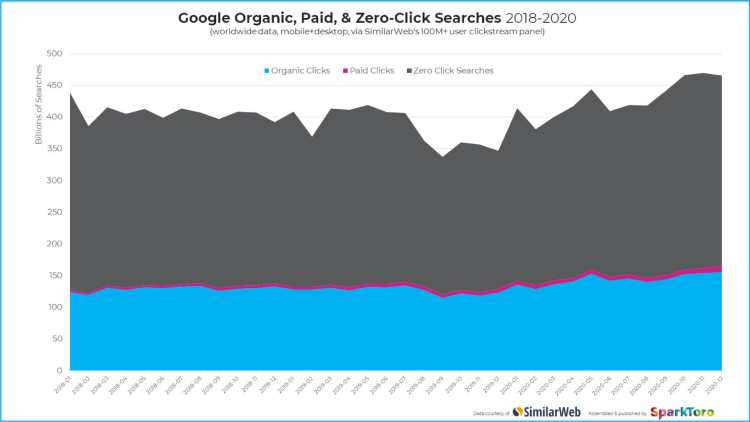
Source: SparkToro
In this new ecosystem, ranking #1 is no longer enough. If your content merely summarises known facts, the AI will scrape it, synthesise it, and serve it to the user without sending you a single visitor. The goal for a premier SEO services providing digital marketing company has shifted from “getting the click” to “being the source.”
What is AI-Led SEO? (Beyond Just Using ChatGPT)
There is a misconception that “AI SEO” simply means using tools like ChatGPT to write blogs. That is incorrect. AI-Led SEO is the strategic process of optimising content so that Large Language Models (LLMs) can understand, trust, and cite your brand.
Key aspects of AI-led SEO:
- Faster execution: AI speeds up repetitive SEO tasks like finding content ideas, creating outlines, and writing meta descriptions.
- Smarter insights: AI scans large amounts of data to spot high-value keywords, search intent patterns, and competitor gaps humans often miss.
- Better content quality: AI helps optimise content to match what users want and what search engines reward, including E-E-A-T signals.
- Stronger technical SEO: AI quickly audits websites, finds errors like broken links, and improves site structure.
- Search behaviour ready: AI helps optimise for how people actually search today. Voice queries, conversational searches, AI Overviews, and chat-based results.
Traditional SEO was about optimising for a crawler (a bot that matches keywords). AI-Led SEO is about optimising for a neural network (a brain that understands context). It prioritises User Intent over keyword volume.
- Old Model: “How many times does the keyword ‘best CRM’ appear?”
New Model: “Does this brand offer the most authoritative, mathematically unique perspective on CRM implementation?”
The Rise of GEO: Generative Engine Optimisation
The technical successor to traditional SEO is Generative Engine Optimisation (GEO). While SEO focuses on ranking blue links, GEO focuses on ensuring your brand is cited in the AI-generated answer.
View this post on Instagram
To win in GEO, your content must be structured for machine readability but written for high-level human authority.
- Citations over Clicks: The new currency of success is the “citation link” within the AI overview.
- Entity Salience: You must establish your brand as a recognised “Entity” in the Knowledge Graph. Google needs to know who you are, not just what you wrote.
The “Information Gain” Moat: Why Generic Content is Dead
Google’s patent on “Information Gain” is the final nail in the coffin for generic content. AI models are trained to penalise redundancy. If your article repeats the same five tips found on every other blog, the AI deems it “low value” and ignores it.
To rank in 2026, your content must provide Information Gain: new data, original research, contrarian opinions, or unique case studies that do not exist elsewhere on the web. A competent digital marketing company will tell you that “being better” is no longer enough; you must be “different.”
Traditional vs. AI-Led SEO: A Commercial Comparison
The metrics of success have shifted. Here is how the two models compare commercially.
| Feature | Traditional SEO | AI-Led SEO |
|---|---|---|
| Primary Goal | Rank for Keywords | Rank for Answers (Entities) |
| Success Metric | Organic Traffic / Rankings | Share of Voice / Citations |
| Content Strategy | Skyscraper Technique (Longer) | Information Gain (Newer) |
| User Journey | Search > Click > Read | Search > Answer > Verify |
| Competition | Anyone with a website | Authoritative Brands only |
What Can Brands Do to Adapt to AI SEO?
Adapting to this shift requires a strategic pivot, not just a tactical tweak. Here is the roadmap for brands in 2026:
- Escape the “Commodity Content” Trap: AI rewards “Information Gain,” not repetition. If an LLM can generate your article in ten seconds, it is already obsolete. Prioritise firsthand experience, proprietary data, and contrarian insights. Do not just report the news: analyse it.
- Optimise for Intent, Not Just Keywords. Stop writing for bots and start writing for humans. AI search has shifted from keyword matching to “Semantic Understanding.” Focus on conversational, long-tail queries and structure your content to answer the specific intent behind the search, not just the search term itself.
- Speak the Language of the Machine (Schema): Structured data is no longer optional. Implement robust Schema markup to help AI systems categorise your content effectively. You need to spoon-feed the Knowledge Graph so it understands exactly who you are and what you offer.
- Adopt an “Answer-First” Architecture: AI models prioritise content that gets to the point. Structure your pages with direct, concise answers at the top (BLUF: Bottom Line Up Front). Clear FAQs and summary tables increase the likelihood of being cited in an AI Overview.
- Monitor Your “Entity Sentiment”: In the GEO era, your brand’s reputation is a ranking factor. Track where and how AI platforms mention your brand. Consistent, positive sentiment across the web signals “Trust” to the algorithm, boosting your authority.
- AI as the Junior, You as the Architect: Use AI tools to generate ideas, organise structures, and improve clarity, but never let it have the final word. AI is excellent at organisation but terrible at nuance. Use it to align with semantic patterns, but ensure the “Human Perspective” remains the core value.
- Combat “Content Decay” Aggressively: AI prioritises the “Now.” Regularly update your core pillars to ensure accuracy and timeliness. A static library is a dying library; keep your information fresh to signal relevance to the engine.
Conclusion
The transition to AI-Led SEO is not a fad; it is the natural evolution of the internet. The brands that cling to the “keyword stuffing” models of the past will see their visibility erode into the “Zero-Click” void. The brands that embrace Information Gain, GEO, and Entity Authority will find themselves in the “Inner Circle” of the AI’s trusted sources.
The future belongs to the experts, not the aggregators. If you are ready to future-proof your visibility and turn your brand into a cited authority, it is time to partner with a digital marketing company that understands the architecture of 2026 and provides top-notch SEO services that are designed to help you dominate the Answer Engine era.
Frequently Asked Questions
The founder and partner of Flora Fountain, Shefali leads the Content and Technology divisions. A one-time engineer who started her career writing front-end code, she took a detour sometime during her 9 years in New York, studied journalism and started writing prose, poetry and sometimes jokes. She now has 15...