


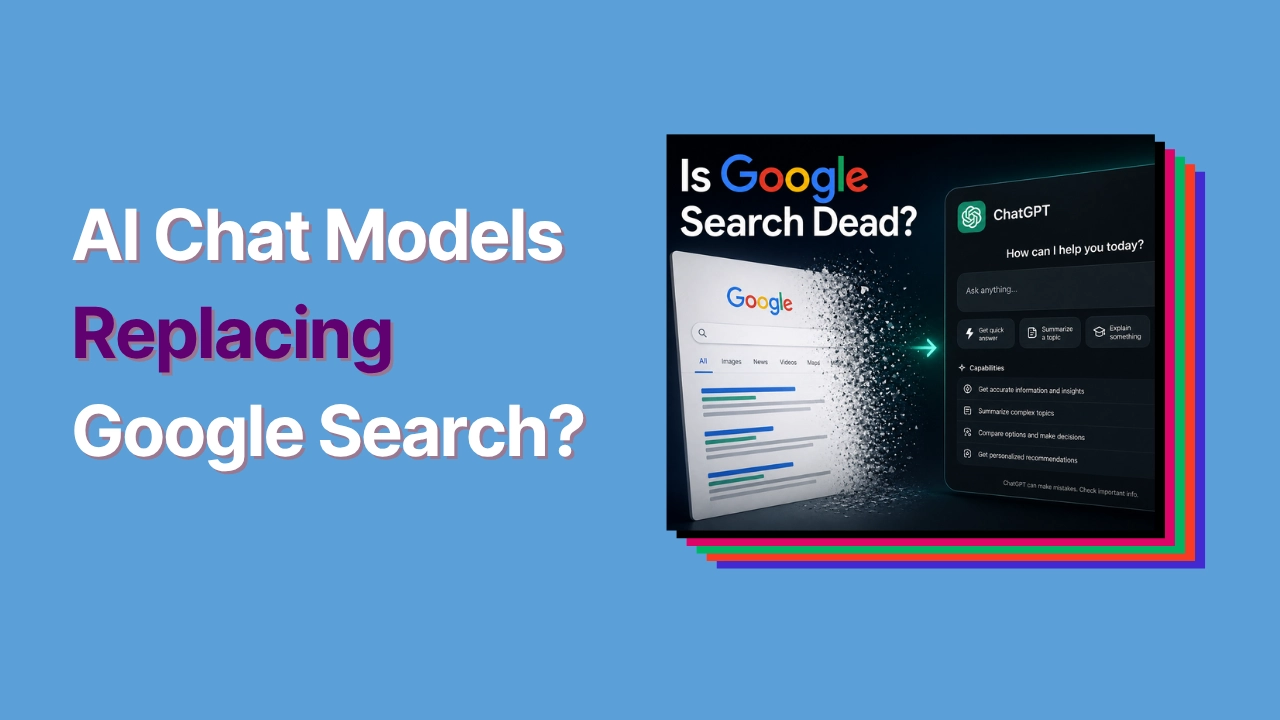
No, AI chat models have not replaced Google Search. But Google has changed a lot in the last year, and that change is probably already affecting your website, even if you haven’t noticed it yet.
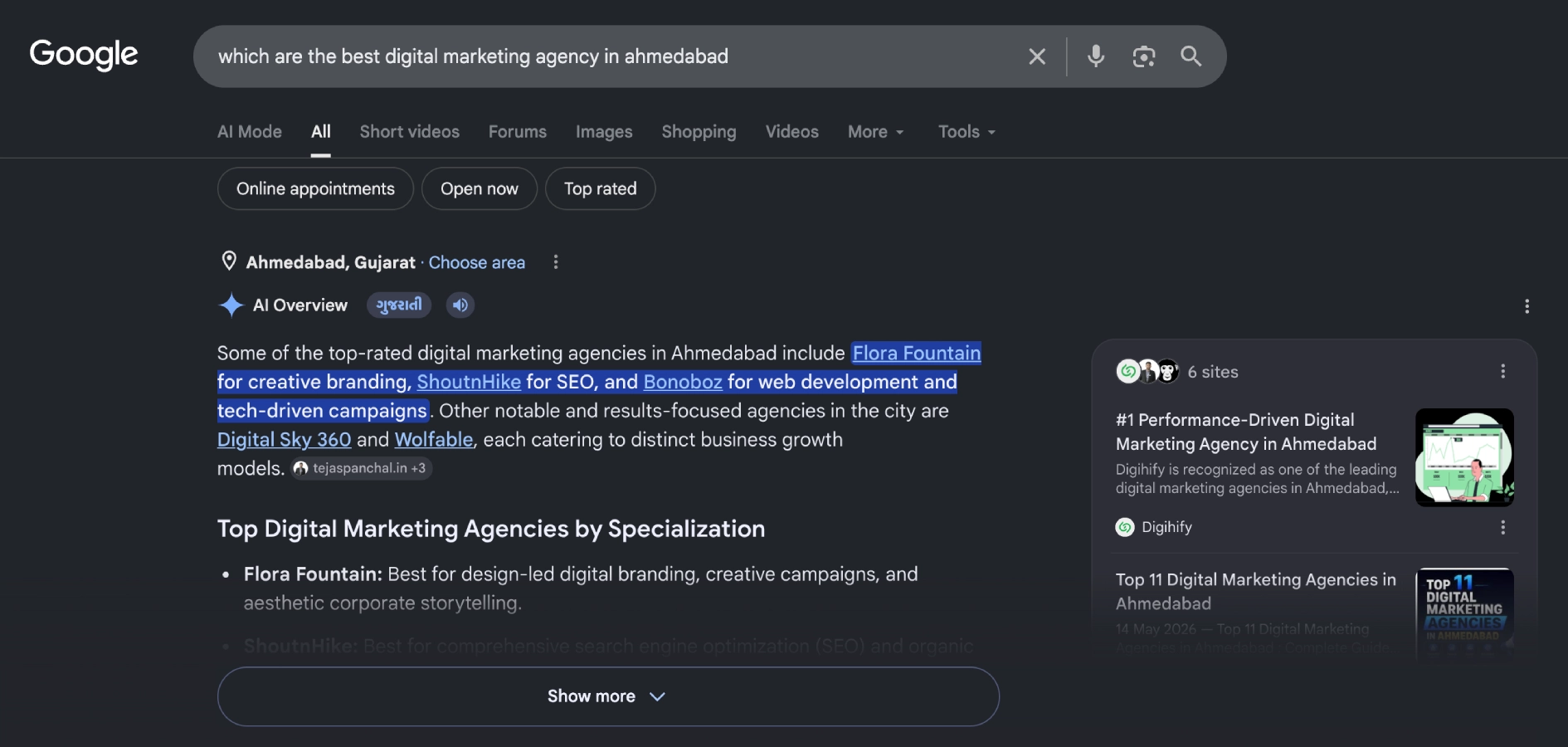
AI Overviews, AI Mode, and tools like ChatGPT now answer a lot of questions directly on the screen, without anyone needing to click through to a website at all. That does not mean Google is dying. It does mean the old rules of SEO, on their own, are no longer enough.
Here’s what’s actually going on, and what it means for your business.
Table of Contents
- What Has Actually Changed
- Is SEO Dead?
- What We’ve Noticed With Our Own Clients
- What This Means for Your Business
- Google Search vs. AI Overviews vs. AI Mode vs. ChatGPT
- Bringing It All Together
- FAQs
What Has Actually Changed
Search used to work in one simple way. You typed a question into Google, got a list of blue links, and clicked one to find your answer.
That is no longer the whole story. Google now writes a short answer directly on the results page for a lot of informational questions, through a feature called AI Overviews. Google has confirmed that AI Overviews are now live in more than 200 countries and over 40 languages, appearing whenever its systems judge them the most helpful response to a query.
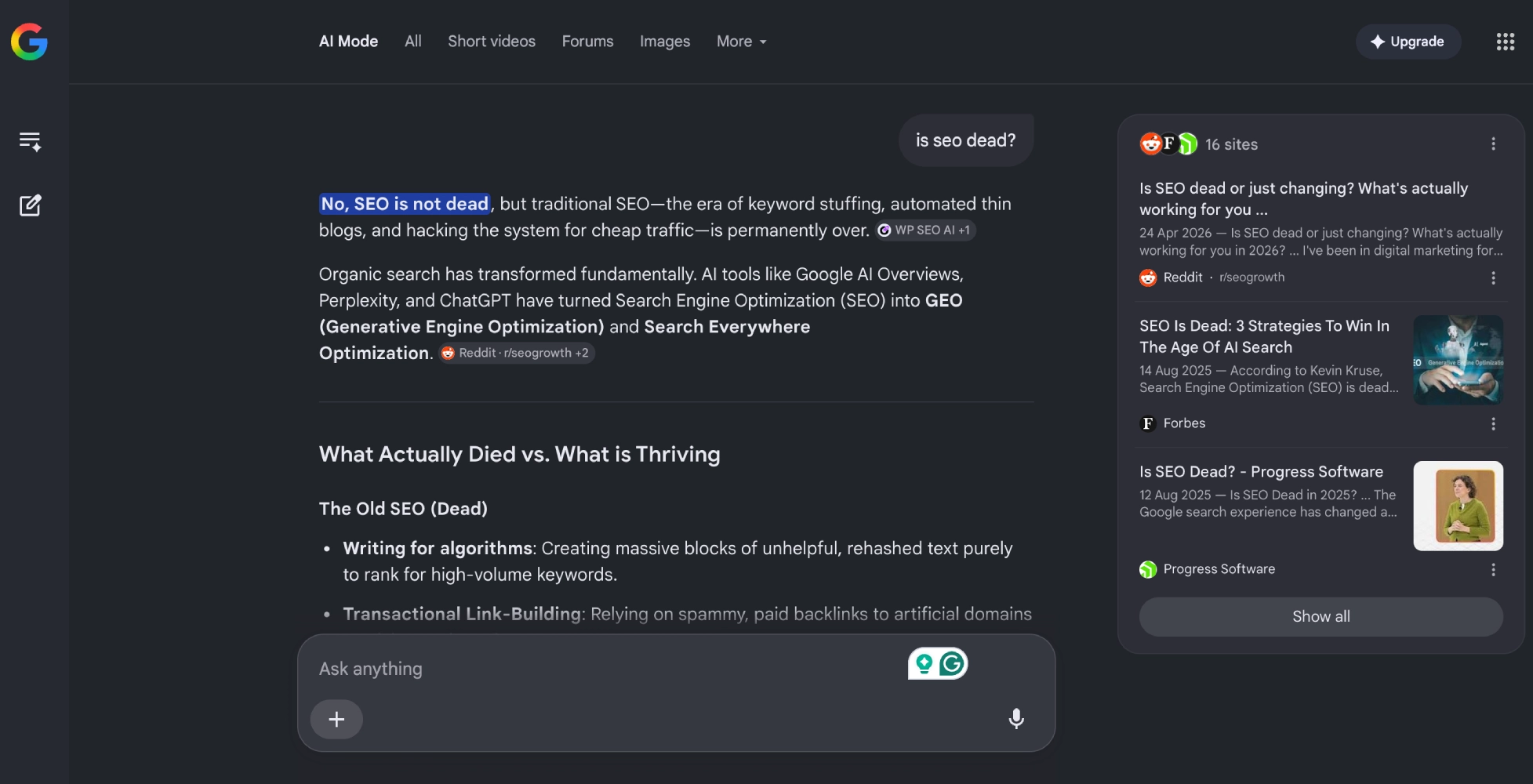
AI Mode goes further, letting people have an actual back-and-forth conversation right inside Google Search. At Google I/O 2026, the company confirmed AI Mode is no longer experimental, rolling out a faster default model and a redesigned search box built around it. On top of that, more people are turning straight to ChatGPT for the kind of question they used to type into Google. OpenAI has confirmed that ChatGPT has crossed 900 million weekly active users, more than double its user base from a year earlier.
None of this has replaced Google. Google is still the starting point for most searches, still controlling roughly 90% of the global search market, and it still sends real traffic to real websites every single day. What has changed is that a growing share of simple, factual questions now get answered on the spot, without a click. A Pew Research Center study found that people click through to a traditional search result in just 8% of visits when an AI Overview appears, compared to 15% of visits when it doesn’t.
Is SEO Dead?
Not because we just saw it on Google AI mode; this is actually factual that SEO is not completely dead.
But it definitely doesn’t work the way it previously used to. The old approach to SEO was only about keywords and links: like choosing the right words, using them in the right places, building enough backlinks, and waiting to rank. Those are still important in 2026, but with that you will also need to know about AEO.
Answer Engine Optimisation (AEO)
Yes, a newer idea has entered the picture, usually called Answer Engine Optimisation, or AEO. Instead of only aiming for a high ranking, AEO is about structuring content so AI tools can read it, trust it and quote it directly. That means clear, well-structured answers, honest sourcing and content that actually says something useful, rather than content built purely to hit a keyword count.
In short, SEO is not disappearing. It is turning into something a bit broader, where being clear and trustworthy is important as much as being technically optimised.
What We’ve Noticed With Our Own Clients
Across the client sites we manage, we’ve started to see a pattern. Purely informational pages, the ones that answer a simple factual question in one or two lines, are the pages most likely to lose a direct click to an AI Overview. Pages built around an actual decision, like comparing options or choosing a service, still tend to get clicked, because that is not something an AI summary can fully answer on someone’s behalf.
That difference matters for how you plan content. A page that only answers “what is X” is more exposed than a page that helps someone choose between real options.
What This Means for Your Business
If your website depends on Google for traffic, here is the honest version of what to do next.
#1 Structure content for both readers and AI
Keep writing SEO content, but stop stopping at the keyword. Structure your pages so an AI tool could summarise them accurately, with clear headings, direct answers near the top and simple language throughout.
#2 Double down on decision-stage pages
Focus extra effort on pages tied to an actual decision, like service pages, comparisons and pricing pages, since these are the pages least likely to be fully replaced by a quick AI summary.
#3 Don’t panic, and don’t stop publishing
Do not panic and do not stop investing in content. Search is changing shape, not disappearing, and the businesses that adapt early are the ones that stay visible either way.
Google Search vs. AI Overviews vs. AI Mode vs. ChatGPT
| Google Search (classic) | AI Overviews | AI Mode | ChatGPT | |
|---|---|---|---|---|
| Format | Ranked list of links | Short AI summary above the links | Full back-and-forth conversation | Full back-and-forth conversation |
| Sends clicks to websites | Yes | Some, but at a lower rate than a standard result page |
Fewer, mostly via citations | Rarely, mostly via citations |
| Best for | Broad research, comparisons | Quick factual questions | Complex, multi-step questions | Open-ended conversation |
| Owned by | OpenAI |
So, is Google search actually going away?
For most businesses, no. Google still sends the majority of organic traffic on the web, and it isn’t losing that position any time soon. What’s shifting is which kind of question still earns a click, and that’s exactly the gap AEO is built to close.
Bringing It All Together
AI has changed how people search, but it has not replaced Google, and it has not made SEO pointless. What it has done is raise the bar. Ranking well is still worth doing, but it is no longer enough on its own. The businesses that also write clear, trustworthy, well-structured content are the ones AI tools will keep quoting, and the ones people will keep clicking through to, however they choose to search.
Frequently Asked Questions

The founder and partner of Flora Fountain, Shefali leads the Content and Technology divisions. A one-time engineer who started her career writing front-end code, she took a detour sometime during her 9 years in New York, studied journalism and started writing prose, poetry and sometimes jokes. She now has 15...