


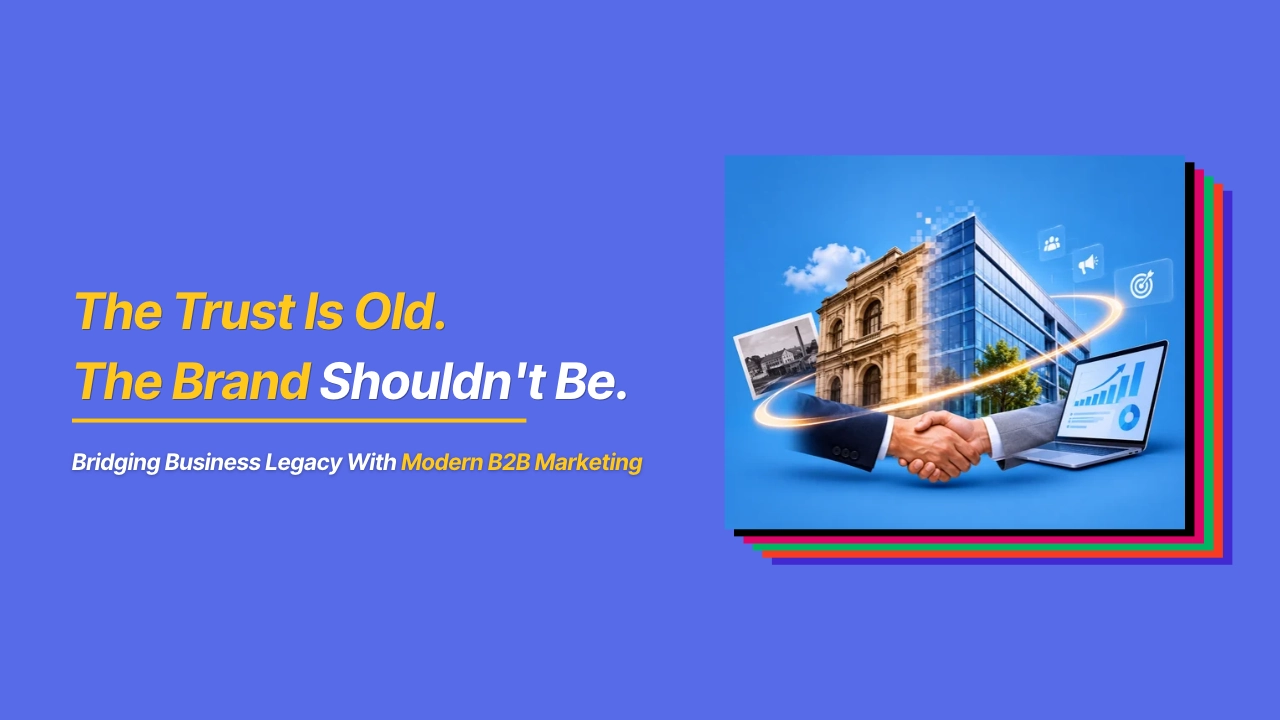
A business with 30 years of experience has something competitors cannot build overnight: customer relationships, industry knowledge and a reputation earned through years of work. However, its digital presence may not reflect the expertise and scale it has developed.
Modernisation is not about abandoning its legacy but communicating its strengths in ways today’s buyers understand. A well-planned B2B marketing strategy, supported by a digital marketing agency in Ahmedabad, can help established businesses connect their experience with modern buyer expectations and strengthen their market presence.
Table of Contents
- Why Established B2B Brands Need To Rethink Their Marketing
- What Is B2B Marketing And What Has Changed?
- Modernise The Brand Message Before Changing Its Identity
- Make Your Digital Presence Reflect Your Actual Business
- Turn Industry Experience Into Visible Brand Authority
- Align Marketing With The People Involved In B2B Decisions
- Build A Modern B2B Marketing Strategy Without Starting Over
- Concluding It For You
- Frequently Asked Questions
Quick Summary
- A legacy brand does not need to abandon its history to become relevant to new buyers.
- Modernisation should begin with positioning and communication, not just a logo or website redesign.
- A strong digital presence should make the company’s capabilities, experience and differentiation easy to understand.
- Technical knowledge and industry experience can become valuable thought leadership when communicated clearly.
- B2B marketing must consider the different people involved in evaluating a business purchase.
- Marketing and sales teams should communicate a consistent brand promise throughout the buyer journey.
Why Established B2B Brands Need To Rethink Their Marketing
Established businesses often have a strong reputation within their existing network. Their customers know the people behind the company, understand its products and have experience working with the business.
However, a potential customer who discovers the company online may not have that context.
They may see an outdated website, unclear service descriptions or communication that does not explain why the company is different from its competitors. The business may have invested in better technology, expanded its capabilities or entered new markets, but its marketing still reflects an earlier version of the company.
This creates a gap between what the business has become and what the market can see.
Modernising the brand helps close that gap.
It does not mean replacing everything that already works. Existing customer relationships, product knowledge, manufacturing experience and industry credibility are assets. The point is to communicate these strengths in a way that makes sense to people who are encountering the brand for the first time.
For a company that has served the same industry for decades, this could mean explaining its technical capabilities more clearly. For a manufacturer entering new markets, it could mean presenting its production expertise and quality processes in a more accessible way.
The right approach depends on what has changed in the business and what its next stage of growth requires.
What Is B2B Marketing And What Has Changed?
B2B marketing, or business-to-business marketing, refers to the activities a company uses to promote its products or services to other businesses rather than directly to individual consumers.
A manufacturer marketing components to distributors, a software company selling to enterprises and an industrial supplier reaching procurement teams are all examples of B2B marketing.
The fundamentals remain the same: understand the audience, communicate value and build a reason for businesses to choose you.
What has changed is how companies discover and evaluate potential partners.
A buyer may come across a supplier through a professional network, search for its capabilities, review its website, compare alternatives and discuss the shortlist with colleagues before contacting its sales team.
The buying decision may also involve people who do not use the product directly but influence the final choice.
The 2025 Edelman-LinkedIn B2B Thought Leadership Impact Report, based on research involving nearly 2,000 global professionals, highlights the influence of these less visible stakeholders. It reports that more than 40% of B2B deals stall due to internal misalignment within buying groups. The report also finds that high-quality thought leadership can help communicate a supplier’s expertise and value to these stakeholders.
For established businesses, this creates an important opportunity. Their experience may already be strong, but it needs to be communicated across the channels where different decision-makers look for information.
Modernise The Brand Message Before Changing Its Identity
One of the first mistakes a business can make when modernising is assuming that the problem starts with its logo, colours or visual identity.
A visual refresh may be necessary, but it cannot solve unclear positioning.
Before changing how the brand looks, understand what it needs to communicate.
Revisit What the Business Wants To Be Known For
An established company may have expanded its product range, developed new capabilities or started serving different customer segments. Its original positioning may no longer describe the full business.
Ask:
- What does the company offer today that it did not offer when it started?
- Which capabilities create the strongest value for customers?
- What does the business want to be recognised for in its industry?
- Which customer segments does it want to reach next?
- What should customers understand about the company before speaking to its sales team?
These questions help distinguish the company’s history from its current market position.
Communicate what has genuinely changed and what remains a strength, without making the business sound like something it is not.
Clarify The Brand Architecture
Some established businesses operate through multiple product lines, divisions or brands. Over time, these identities can overlap, making it difficult for customers to understand which brand does what.
This is a positioning and brand architecture problem, not necessarily a design problem.
A useful example comes from Flora Fountain’s work with the RO components business behind Lexcru, Lexpure and Cruze.
The business had scale and established operations, but its three brand names were being used interchangeably by technicians, dealers and end users. Flora’s team conducted more than 100 technician interviews and spoke with over 30 dealers and distributors before defining distinct roles for each brand.
Lexcru was positioned around manufacturing, OEMs and the core B2B business. Lexpure was developed as the consumer-facing brand, while Cruze received a distinct role for its specialist product line.
The work was not simply about changing logos. It was about giving each brand a clear purpose that its audience could understand.
This is an important lesson for legacy businesses: sometimes the most valuable modernisation is greater clarity about the identity they already have, not a new one.
Make Your Digital Presence Reflect Your Actual Business
A company’s digital presence is often where potential customers begin to understand what it does.
If the website, search results and social media profiles communicate different things, the buyer has to work harder to understand the business.
An experienced digital marketing agency can help established B2B businesses identify gaps in their online presence and build a strategy that communicates their capabilities more effectively. This includes improving search visibility, refining website messaging and creating content that reflects the company’s industry expertise.
Start With The Website
For many B2B companies, the website needs to do more than introduce the business and list its products.
It should help a potential customer answer practical questions:
- What does the company manufacture or provide?
- Which industries and business requirements does it serve?
- What makes its capabilities relevant?
- What quality standards, certifications or processes can it demonstrate?
- How can a potential customer discuss a requirement?
The answers should be specific to the business.
A manufacturer, for example, could explain its production capabilities, material expertise, quality processes and customisation options. A technology provider may need to demonstrate integrations, implementation support and product capabilities.
Avoid broad statements such as “industry-leading solutions” when the website does not explain what makes those solutions different.
Build Search Visibility Around Actual Expertise
A business may have decades of experience but still remain difficult to discover when potential customers search for its products, services or technical capabilities.
Search engine optimisation can help bridge this gap.
Start with the terms customers use when looking for a supplier or researching a business problem. These may include product categories, technical specifications, applications, industry requirements and comparisons between solutions.
The website should then provide useful information around these topics.
For example, a component manufacturer could publish content explaining material differences, product applications, maintenance considerations or factors buyers should evaluate before choosing a supplier.
Blogs published only to keep the website active add little. Content that makes the company’s actual knowledge discoverable does the real work.
Use Social Media With A Clear Business Purpose
Not every B2B company needs to communicate like a consumer brand.
The choice of platform and content format should depend on its audience and objectives. LinkedIn may help a business share industry knowledge and reach professional stakeholders. YouTube may be useful for product demonstrations, factory walkthroughs and technical explanations. Other platforms can support recruitment, brand familiarity or category education when relevant.
The important thing is to give each channel a role.
Flora’s existing guide on Instagram marketing strategies for B2B brands explores how B2B companies can use social platforms without treating them like consumer-facing brands.
Turn Industry Experience Into Visible Brand Authority
An established business has years of experience that can help customers make better decisions. But experience only becomes a marketing advantage when the company communicates it in a useful way.
A long company history is not enough on its own. Buyers need to understand what the business has learned, what it can solve and how its expertise applies to their requirements.
Thought leadership and educational content help here.
Share Knowledge That Helps Buyers Make Decisions
Instead of publishing only company announcements and product updates, create content around the questions customers regularly ask.
Depending on the industry, this could include:
- How to evaluate a supplier for a specific requirement.
- Common technical mistakes buyers should avoid.
- Differences between materials, processes or product specifications.
- How industry standards affect purchasing decisions.
- What businesses should consider before upgrading equipment or systems.
The content should reflect knowledge the company can genuinely support. It should not make broad claims simply to sound authoritative.
Put The People Behind The Expertise In Front
In established businesses, valuable knowledge often sits with founders, senior leaders, engineers, product specialists and sales teams.
Their perspectives can help explain the thinking behind the company’s products and decisions.
This could take the form of:
- Short interviews with technical experts.
- Founder perspectives on changes in the industry.
- Videos explaining how a product or process works.
- Articles answering recurring customer questions.
- Conversations with teams involved in product development or quality.
These formats make the business more understandable without forcing it into an artificial brand personality.
The 2025 LinkedIn-Ipsos B2B Marketing Benchmark also examined the role of video and credible voices in B2B marketing. Its research included marketing leaders across six markets, including India. The findings highlight the role of credibility, video and relevant creators in building buyer confidence.
Align Marketing With The People Involved In B2B Decisions
A B2B company may sell one product, but several people can influence whether a business chooses to buy it.
A technical head may evaluate performance. A procurement team may compare suppliers and commercial terms. A business owner may consider long-term value. The person who eventually uses the product may have different priorities from the person approving the purchase.
Marketing should account for these different perspectives.
Instead of creating one broad message for everyone, identify what each relevant stakeholder needs to understand.
| Audience | What they may want to understand | Useful marketing content |
|---|---|---|
| Business owners and leadership | Business value, reliability and long-term fit | Company capabilities, case studies and strategic insights |
| Procurement teams | Supplier suitability, specifications and commercial clarity | Product information, certifications and comparison guides |
| Technical teams | Performance, applications and implementation | Technical explainers, demonstrations and documentation |
| Distributors and channel partners | Product range, support and business opportunity | Product catalogues, partner information and sales resources |
| End users | Practical benefits, usage and support | Product videos, FAQs and application guides |
The table is a starting point, not a fixed template. The relevant stakeholders will vary by product, industry and buying process.
Once these audiences are understood, the brand can create more useful communication across its website, search content, social media, email and sales material.
Marketing and sales teams should also work with the same positioning. If the website promises one thing and the sales presentation communicates something else, the brand creates unnecessary confusion at an important stage of evaluation.
Build A Modern B2B Marketing Strategy Without Starting Over
Modernising an established business does not require changing every part of its marketing at once.
A better approach is to identify the gaps between the company’s current strengths and how those strengths are represented in the market.
A practical B2B marketing strategy can be organised around five areas:
- Understand the current brand position
Review customer perceptions, competitor communication, existing brand assets and the company’s actual capabilities. Speak to customers, distributors and internal teams where possible. The aim is to identify what the market already recognises and what remains unclear.
- Define the next stage of growth
Decide whether the business wants to reach new industries, enter new markets, strengthen its existing customer relationships, launch new products or improve its visibility among specific decision-makers.
The marketing direction should support this business objective.
- Strengthen the brand foundation
Clarify the positioning, messaging, brand architecture and visual identity where required. Retain the elements that carry genuine recognition and address the parts that create confusion.
- Build a connected digital presence
Bring the website, SEO, content, social media, video and paid campaigns under a consistent communication strategy. Each channel should have a clear role and direct the right audience towards a relevant next step.
- Measure progress against business objectives
Look beyond impressions and follower growth. Track relevant search visibility, qualified enquiries, engagement from target accounts, product or service interest, sales conversations and opportunities influenced by marketing.
The metrics should reflect the business model and sales process. A manufacturer selling through distributors may need different measures from a B2B software company generating direct enquiries.
For companies that need support bringing these activities together, a B2B digital marketing agency should begin with the business problem rather than a fixed list of services. The right mix of strategy, branding, SEO, content, advertising and digital execution depends on what the company needs to achieve.
Concluding It For You
A legacy B2B brand does not have to choose between preserving its reputation and moving with the market.
Its history, relationships and industry knowledge can remain central to its identity. What needs to evolve is how clearly the business communicates those strengths to people who may not have known it for decades.
That evolution starts with understanding the business, clarifying its position and making its capabilities easier to discover and evaluate.
Modernisation lets the market see what the established company has become, without asking it to look like a new one.
Frequently Asked Questions

The founder and partner of Flora Fountain, Shefali leads the Content and Technology divisions. A one-time engineer who started her career writing front-end code, she took a detour sometime during her 9 years in New York, studied journalism and started writing prose, poetry and sometimes jokes. She now has 15...