


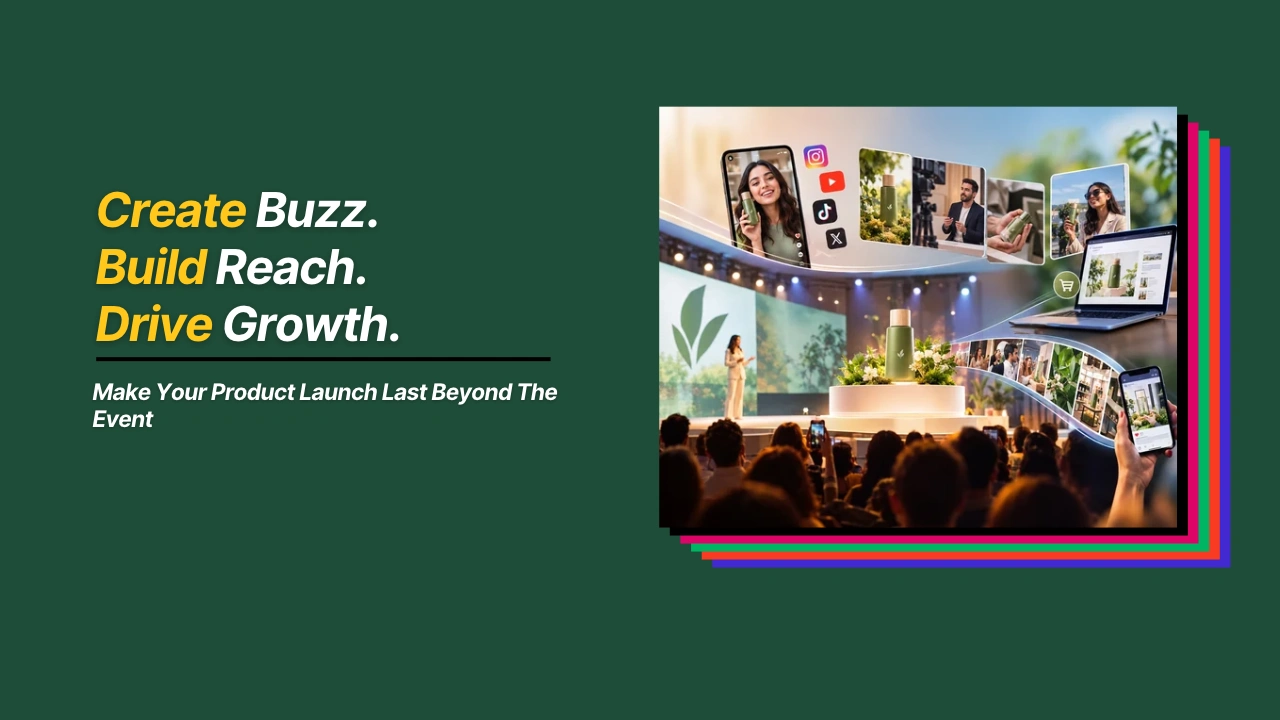
A product launch event can bring the right people into one room. There is a product reveal, a brand presentation, conversations with guests and plenty of photographs. But the story often ends when everyone leaves.
For many brands, the event becomes a collection of photographs, a few social media posts and a press mention. The excitement generated in the room rarely translates into a sustained digital conversation.
That is a missed opportunity.
A launch event should not be treated as the finish line of a marketing campaign. It should be one of its most valuable moments. With the right planning, the event can generate content, introduce the product to new audiences, give people reasons to discuss it and support its journey into the market.
This requires a marketing strategy for a new product launch that connects what happens before the event, what happens during it and what the brand communicates afterwards.
Table of Contents
- Quick Summary
- Why A Product Launch Event Needs A Digital Strategy
- Build The Launch Narrative Before The Event
- Design The Event Around Moments Worth Sharing
- Turn Event Coverage Into A Content System
- Extend The Conversation Through Influencers And Digital Channels
- Measure What Happens After The Launch
- Build A Product Launch Strategy That Continues Beyond The Event
- Concluding It For You
- Frequently Asked Questions
Quick Summary
- A launch event should support the product’s wider marketing objective, not become an isolated activity.
- Pre-launch communication gives the audience context before the product reveal.
- Event planning should account for content capture, audience participation and digital distribution.
- Influencer collaborations work best when the creator, audience and product have a clear connection.
- Post-launch content should answer questions, communicate product value and make the next step clear.
- Reach and engagement matter, but product enquiries, trials, availability and sales are important measures too.
Why A Product Launch Event Needs A Digital Strategy
A launch event creates a concentrated moment of attention. People experience the product, hear the brand’s story and interact with its representatives. But the event itself reaches only the people who attend and those who encounter its coverage.
A digital strategy gives that moment a longer life.
Think about the different audiences a product needs to reach:
- People who attended the event and want to revisit the experience.
- Potential customers who discover the product through social media.
- Retailers, distributors or business partners who want to understand the product.
- Industry publications and creators who may discuss the launch.
- Existing customers who want to know what the brand is introducing.
Each audience needs a different reason to pay attention. A single event announcement cannot address all of them.
A well-planned marketing plan for a new product launch connects these audiences through a consistent product story. The event provides the central moment, while digital channels help communicate that story in formats people can discover and engage with later.
This is also why the launch strategy should not begin with deciding the venue, guest list or stage design. It should begin with the product, its audience and the response the brand wants to create.
Build The Launch Narrative Before The Event
Before planning the event experience, decide what people should understand about the product.
A new product can have several features, benefits and technical details. But the launch communication needs a clear central message. Otherwise, the event may look impressive without giving people a memorable reason to care.
Start with three questions:
- What market or customer need does the product address?
Understand the problem, preference or opportunity behind the product. This helps the brand communicate why the launch matters rather than simply announcing that something new is available.
- What makes this product relevant to its audience?
Identify the strongest differentiator. It could be a product benefit, a new use case, a design decision, a formulation or a different approach to an existing category. The message should be supported by what the product can genuinely deliver.
- What should the audience do after discovering it?
The next step depends on the product and its availability. It could be visiting a website, exploring a product range, requesting a demonstration, finding a nearby retailer, placing an order or speaking to a sales representative.
These answers shape the launch narrative.
For example, if an FMCG brand launches a new snack, the communication should do more than show the packaging. It should explain why the snack is worth trying, who it’s for and where to find it.
This clarity keeps the event presentation, social creatives, influencer briefs and ads aligned, without making every post sound the same.
Design The Event Around Moments Worth Sharing
An event can look impressive in person and still produce very little useful digital content. This usually happens when the experience is designed only for attendees, with content creation considered later.
A stronger approach is to identify the moments that can communicate the product story beyond the venue.
Make The Product Reveal The Main Moment
The reveal should give the audience a clear understanding of what is being launched.
Avoid making the presentation so elaborate that the product becomes secondary. The reveal should communicate its most important qualities through a combination of visuals, demonstration and explanation.
Depending on the category, this could include:
- A live product demonstration.
- A first-look experience for invited guests.
- A presentation explaining the product’s key differentiator.
- A tasting or trial experience for relevant products.
- A conversation with the product team or brand representative.
The format should reflect what the product needs to communicate. A new food product and a new technology product do not need the same kind of launch experience.
Give Attendees A Reason To Participate
People are more likely to create useful content when the event gives them something meaningful to experience.
Instead of relying entirely on a stage presentation, consider interactive product stations, guided demonstrations, sampling areas or opportunities to speak with the people behind the product.
These interactions can create more varied content than a series of photographs showing guests standing beside a backdrop.
Plan Content Capture Before The Event
A content team should know what needs to be captured before the event begins.
Prepare a shot list that covers:
- The venue and event identity.
- The product before and during its reveal.
- Demonstrations and product interactions.
- Key statements from brand representatives.
- Guest reactions and genuine conversations.
- Creator interactions and interviews.
- Short vertical videos suitable for social platforms.
- Wide shots and photographs for media coverage.
Also decide who will capture, review and publish each asset. If the brand wants to share the reveal in real time, the team needs an approved communication plan and a clear process for handling last-minute changes.
Capture the moments that help someone understand why the product matters, not every second of the event.
Turn Event Coverage Into A Content System
The event may last a few hours, but the content it generates can support communication for weeks.
The key is to stop treating event coverage as one large video or a single photo album. Break it into smaller content pieces, each with a distinct purpose.
| Content Format | What It Communicates |
|---|---|
| Launch film | The product reveal and central brand story |
| Short-form videos | Demonstrations, reactions and key event moments |
| Product explainers | Features, benefits and use cases |
| Founder or spokesperson interviews | The thinking behind the product |
| Guest and creator content | Different perspectives on the launch |
| Event photographs | Brand presence, participation and atmosphere |
| FAQs and follow-up posts | Product details, availability and customer questions |
This gives the brand a more useful content library.
For instance, a 30-minute product presentation may contain several short explanations that can become individual videos. A demonstration can become a product explainer. A conversation with the product team can become a short interview. A guest’s genuine reaction can provide another perspective on the experience.
Each asset should have a reason to exist. Repeatedly publishing photographs from the same event may keep the launch visible for a few days, but it does not necessarily give the audience anything new to learn.
The content should also work beyond the original social media post. Product films, interviews and explainers can be adapted for the website, sales presentations, email communication and other relevant brand touchpoints.
At this point, a digital marketing strategy for a new product launch moves beyond a posting schedule. It turns one event into a collection of communication assets that serve different audience needs.
Extend The Conversation Through Influencers And Digital Channels
An event gives the brand a central story. Different digital channels help that story reach people who were not present.
The channel mix should depend on the product, audience and launch objective. A brand does not need to be active everywhere simply because it is launching something new.
Influencer Marketing For Product Launch
Creators can help introduce a product through their own content formats and audience relationships. However, inviting a large number of influencers does not automatically make a launch more effective.
The selection should begin with audience relevance.
Consider:
- Does the creator reach the audience the product is designed for?
- Can they explain or demonstrate the product naturally?
- Does their content style fit the brand’s positioning?
- Is their audience relevant to the product’s price, category and use case?
- Can the collaboration contribute something beyond a launch-day appearance?
A creator who understands the category may be more useful than someone with a much larger but unrelated following.
The content brief should define what the creator needs to communicate without making the collaboration look scripted, and product claims must stay accurate and consistent with the brand’s approved messaging.
In India, brands and creators should also follow the Advertising Standards Council of India’s influencer advertising guidelines. Where a material connection exists, including a gifted product, the content needs a clear, prominent disclosure.
Use Paid Campaigns To Extend Relevant Reach
Organic event coverage may reach existing followers and people who discover the content through sharing. Paid campaigns can help the brand reach additional audiences who match its target market.
The campaign objective should determine the format and audience.
For example:
- Use launch films to introduce the product and its positioning.
- Use product demonstrations to explain its benefits.
- Retarget relevant website visitors or people who engaged with launch content.
- Direct interested audiences to product pages, enquiries or purchase channels.
Do not boost every event post simply because it receives engagement. Prioritise the assets that communicate the product clearly and support the next step in the customer journey.
Give Search And Website Visitors A Clear Destination
Social media may create the first interaction, but people can also search for the product after hearing about it.
Make sure the website or product page is ready before the launch. It should explain what the product is, who it is for, what makes it different and how someone can access it.
For products available through retail, communicate relevant store or distributor information where possible. For products sold online, make the purchase path easy to find.
A launch campaign should not create interest that the brand has no practical way to fulfil.
Measure What Happens After The Launch
A successful event is not necessarily a successful product launch. Attendance, photographs and social media engagement can indicate that the event attracted attention, but they do not establish whether the product is gaining traction in the market.
The brand should measure performance against the objective it defined before the launch.
| Objective | What to Measure |
|---|---|
| Build awareness | Relevant reach, video views, brand searches and media coverage |
| Generate product interest | Product-page visits, enquiries and qualified leads |
| Encourage trial | Sampling requests, product trials or store interactions |
| Support sales | Orders, sales by channel and campaign-attributed conversions |
| Build brand conversation | Relevant mentions, shares, audience questions and creator content |
| Understand audience response | Feedback, recurring questions and product-related sentiment |
The measurement window is also very important.
Some responses appear immediately, while others take time. A product may generate strong launch-week interest but need more communication to convert that interest into trials or purchases.
Review performance at different stages:
- Immediately after the event: Check content performance, audience response, media coverage and enquiries.
- During the following weeks: Review product-page visits, campaign performance, audience questions and lead quality.
- Over the next few months: Assess sales trends, repeat interest, distribution performance and feedback, where the data is available.
Do not try to attribute every sale to the launch event. Look instead at which parts of the campaign contributed to awareness, consideration and action and where the brand needs to adjust its approach.
Build A Product Launch Strategy That Continues Beyond The Event
A launch event should be planned as part of a larger product introduction, not as an independent marketing activity.
That means the brand needs to align its product positioning, audience research, event experience, content production, channel distribution and measurement before the launch date.
A practical way to organise the work is to divide the marketing activities for a new product launch into three connected phases.
Before the event
- Finalise the product proposition and key message.
- Identify the target audience and relevant channels.
- Plan pre-launch communication and audience engagement.
- Prepare the event experience and content shot list.
- Coordinate creators, media and brand representatives.
- Check product availability, website readiness and campaign tracking.
During the event
- Deliver a clear product reveal.
- Capture the moments that communicate its value.
- Give attendees relevant opportunities to experience the product.
- Coordinate live updates and creator content.
- Ensure all product claims and communication remain consistent.
After the event
- Publish the launch film and supporting content.
- Distribute product explainers and interviews.
- Extend relevant creator and media coverage.
- Run paid campaigns around the strongest assets.
- Respond to product questions and direct audiences to the next step.
- Review performance and refine the next phase of communication.
The timeline and budget will vary depending on the category, product readiness, audience and scale of the launch. A new FMCG product entering multiple markets may need a different rollout from a limited product collection or a business-to-business product introduction.
The important thing is to make sure the event has a role in the larger plan.
A digital marketing agency can help bring these moving parts together through campaign strategy, creative development, content production, influencer coordination, advertising and performance analysis. Flora Fountain’s advertising services include product launch campaigns, integrated advertising and event promotion.
Concluding It For You
A product launch event can create attention, but attention alone does not build a lasting product presence.
The real opportunity lies in what the brand does with that moment. A clear product narrative gives the event meaning. A well-designed experience creates content worth sharing. A planned distribution strategy takes that content to relevant audiences. And consistent measurement helps the brand understand whether the launch is contributing to its business objectives.
When these elements work together, the event becomes more than a date on the marketing calendar. It becomes the starting point for a longer brand conversation.
Making the launch event memorable is only half the job. The other half is keeping the product worth talking about after the event is over.
Frequently Asked Questions

The founder and partner of Flora Fountain, Shefali leads the Content and Technology divisions. A one-time engineer who started her career writing front-end code, she took a detour sometime during her 9 years in New York, studied journalism and started writing prose, poetry and sometimes jokes. She now has 15...