


Picture a Monday morning in a sales office. The weekend’s Meta campaign brought in 120 enquiries.
By lunchtime, the team has called every one of them. Forty didn’t pick up. Thirty said they were “just checking”. A few were students working on a project. One was a broker hoping for a favour. Two want to visit on Saturday.
Nobody did anything wrong. The campaign did exactly what it was set up to do, which was get leads. It just wasn’t set up to get the right ones.
If you’ve searched for how to generate real estate leads, you’ve probably found long lists of tactics.
This guide does something simpler. It defines what a high-intent lead actually is, then gives you a five-step framework you can run whether you’re a developer, a broker or a small agency. No jargon, and no list of 50 hacks.
Table of Contents
- What Is a High-Intent Real Estate Lead?
- Why Chasing More Leads Is the Wrong Goal
- Step 1: Write Down What a Hot Lead Looks Like
- Step 2: Go Where Intent Already Exists
- Step 3: Ask for Something That Takes a Little Effort
- Step 4: Reply Like a Human, Within Ten Minutes
- Step 5: Track What Happens After the Lead
- What a Week of This Looks Like
- 3 Mistakes That Fill Your CRM With Junk
- Team Flora Fountain Is Just A Call Away
- FAQs
What Is a High-Intent Real Estate Lead?
A high-intent real estate lead is someone who has shown, by what they ask or do, that they’re close to deciding and that you can actually serve them. They aren’t someone who liked a reel or filled in a form for a gift. They’re someone ready to talk about a particular home, a particular budget and a particular date.
Take two people. The first searches “flats in Ahmedabad”, watches twelve seconds of a walkthrough and leaves a number on a form. The second searches “3 BHK in Shela ready possession”, opens the price sheet, reads the payment plan and messages to ask whether Saturday works for a visit. Both are now rows in your CRM. Only one is likely to buy this quarter.
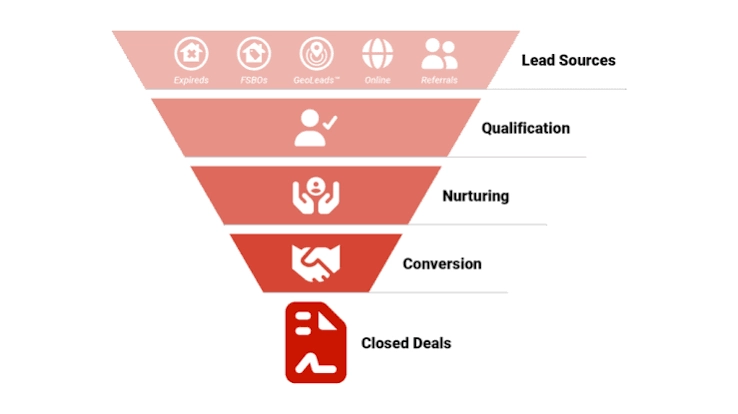
Three signals separate them.
- What they ask: Specific words signal specific intent. Configuration, location, possession status, budget, payment plan, loan. “Flats in Ahmedabad” could mean anything. “3 BHK in Shela ready possession” means they’ve already narrowed it down.
- What they do: Actions that take effort count for more than clicks. Asking for a price sheet, booking a site visit, replying on WhatsApp, coming back to your site a second time, watching a full walkthrough or trying the EMI calculator all say more than a like ever will.
- Who they are: Fit matters as much as interest. Does the budget match what you’re selling? Are they planning to buy in the next few months? Is the decision-maker involved, or at least on the call? And is the money sorted, whether that’s savings or a loan they’ve already explored?
Here’s the difference at a glance.
| High-intent lead | Low-intent lead | |
|---|---|---|
| Search or question | “3 BHK in Shela ready possession price” | “flats in Ahmedabad” |
| Action | Asks for a price sheet, payment plan or visit | Likes a post, downloads a brochure, enters a contest |
| Timeline | Within the next few months | “Sometime”, “just looking” |
| Budget | Knows a range and it matches | No idea, or far below your prices |
| Reply to your message | Answers within hours | Silent, or “who is this?” |
Why Chasing More Leads Is the Wrong Goal
Every lead costs more than the ad that found it.
Someone has to call, follow up and explain the project. A site visit eats a sales executive’s afternoon and a family’s Saturday. Wasted calls aren’t free. They’re just invisible on the ad dashboard.
The market makes it worse. Ahmedabad sold 9,581 homes in the first half of 2026, while 11,077 launched in the same period. More supply than buyers means more projects fighting over the same families, and less room to waste time on people who were never going to book.
And the platforms will happily give you junk. Ad systems are very good at finding the cheapest people to fill in a form. Ask for leads, and you get leads. If you want buyers, you have to ask for something else, and tell the system what a good outcome looks like.
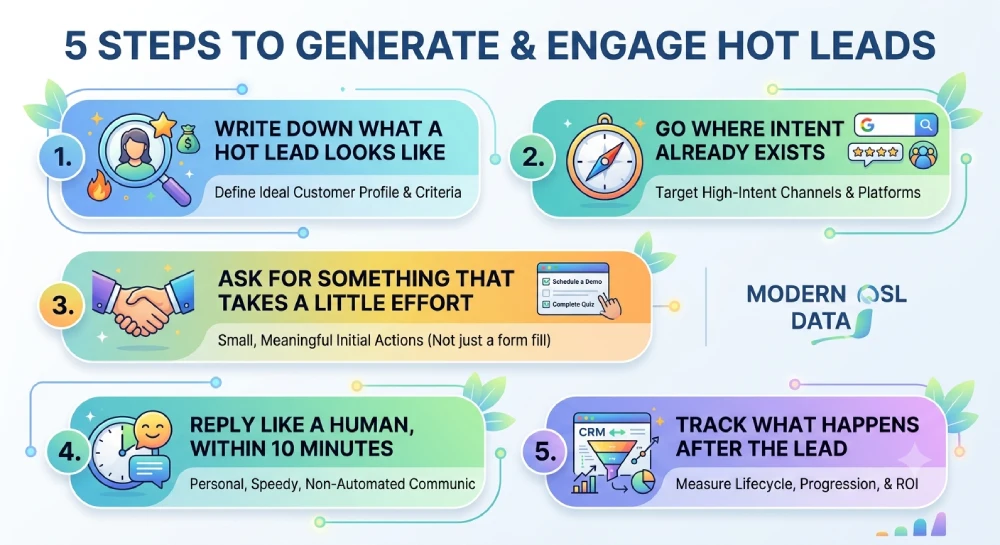
That’s real estate lead generation built around quality instead of volume. Five steps, in order:
- Write down what a hot lead looks like.
- Go where intent already exists.
- Ask for something that takes a little effort.
- Reply like a human, within ten minutes.
- Track what happens after the lead.
Step 1: Write Down What a Hot Lead Looks Like
Before you spend a rupee, get your sales and marketing people into a room and agree on one thing: what counts as a good lead. If marketing counts every form fill and sales only counts site visits, you’ll argue about it forever, and the ad account will keep chasing whatever it was told to chase.
Use five questions. Put them on one page and pin it where the sales team sits.
- Does the budget fit the homes you’re selling?
- Are they planning to buy within about three months?
- Are they looking for the configuration and location you have?
- Is the decision-maker involved?
- Is the money clear, whether that’s savings or loan eligibility?
Then sort every lead into one of three buckets. This is our rule of thumb, not an industry standard, so adjust it to your project.
| Bucket | What it looks like | What you do |
|---|---|---|
| Hot | Budget fits, buying within three months, asked for a price, plan or visit | Call within minutes. Book a visit within the week |
| Warm | Budget roughly fits, three to twelve months out, still comparing | Send useful updates. Invite them to visit when they’re ready |
| Cold | No budget, “just looking”, or not your buyer | Reply politely. Add to a monthly update list. Don’t chase |
Step 2: Go Where Intent Already Exists
Not all lead sources are equal. Some put you in front of people who are already looking for what you sell. Others put you in front of people who were scrolling past. Here’s how we’d rank them, based on our own judgement rather than a study, so test it against your own numbers.
| Source | Typical intent | How to use it |
|---|---|---|
| Past buyers and channel partners | Highest | After handover, ask every happy buyer for two introductions. Keep partners updated on prices and availability |
| Google Search for specific queries | High | Bid on searches like “3 BHK in Shela ready possession”. Add negative keywords such as rent, PG and jobs if you don’t sell them |
| Property portals | Medium to high | Enquiries are often shared with other developers, so speed decides who wins |
| Facebook and Instagram ads | Medium | People weren’t searching, so qualify them. Click-to-WhatsApp ads work well for this |
| Content, social posts and events | Low, straight away | They build trust and recall. Don’t judge them on leads alone |
Start at the top and work down. Don’t spend on the bottom rows until the top ones are producing.
Step 3: Ask for Something That Takes a Little Effort
A free gold coin draws a crowd. A request for a price sheet for a specific 3 BHK draws buyers. The offer you put in front of people decides which of the two you get.
So ask for something a serious buyer wants and a casual browser can’t be bothered with. A Saturday site visit. The price and payment plan for one configuration. A quick home loan eligibility check. Then build the form and page around it.
Keep the form short, but not too short. Name, number and the configuration they want, plus one question that tells you about timing, such as “When are you planning to buy?” with options from “within three months” to “just exploring”.
Check the lead form settings on Meta, too. There’s a choice between “More volume” and “Higher intent”. The first fills in details automatically and submits in a couple of taps. The second adds a review screen where the person confirms their details before sending. You’ll get fewer leads and each will cost more, but fewer of them will be accidental taps. Judge it on cost per site visit, not cost per lead.
The landing page has one job. Show the project, a starting price, the payment plan and a WhatsApp button. Showing a starting price scares off a few people. Good. They were never going to book, and now they’ve saved your team a call.
One compliance point, which also happens to be a trust point. Since mid-June 2025, GujRERA Order 108 has required every advertisement for a registered project to carry the RERA registration number, the GujRERA website and the QR code from the registration certificate. GujRERA has also said projects must be registered before any marketing or bookings, and it has cracked down on pre-registration booking campaigns. A buyer who scans that QR code and sees a live registration trusts you faster. Make the block easy to find.
Step 4: Reply Like a Human, Within Ten Minutes
You can run a perfect campaign and lose every lead by answering a day later.
In 2011, Harvard Business Review audited 2,241 US companies by sending each a test enquiry. The average reply took 42 hours and 23% never replied at all. In a separate analysis of 1.25 million leads at 42 companies, firms that tried to reach a lead within an hour were nearly seven times as likely to have a meaningful conversation with the decision-maker as firms that tried even an hour later, and more than sixty times as likely as firms that waited a day or more (Harvard Business Review, 2011).
So set a rule. Ten minutes is a good target. One hour is the limit.
Make the first message short, personal and useful. Something like this:
“Hi Rakesh, this is Neha from [Project name]. Thanks for asking about the 3 BHK in Shela. So I can send you the right details, are you looking to move in the next few months or planning further ahead? And is your budget somewhere around ₹80 lakh to ₹1 crore?”
Notice what it does. It names the person and the home. It asks two questions that sort hot from warm. It doesn’t dump a twelve-page brochure on someone who hasn’t said hello yet.
A few habits that help:
- Give every lead an owner the moment it arrives, so two people don’t call and nobody follows up.
- If a lead asks for a visit, phone them. Don’t just message.
- For enquiries that arrive late at night, send an auto-reply that promises a time, such as “We’ll message you by 9am”, and then keep that promise.
- If you can’t reply quickly, spend less on ads. It’s the cheapest fix in this whole guide.
Step 5: Track What Happens After the Lead
Most dashboards stop at the form. The money is made, or lost, after it.
Give every lead a status in your CRM or even a simple sheet: New, Contacted, Qualified, Site Visit Done, Negotiation, Booked or Lost. And when a lead is lost, write down why. Budget, location, timing, bought elsewhere. After a month, those reasons will tell you more about your ads and your pricing than any report.
Then look at three numbers every week:
Lead-to-site-visit rate, by source. Cost per site visit. Cost per booking.
Now close the loop. Ad platforms can only chase what they’re told about. Google Ads lets you send back “qualified lead” and “converted lead” events from your CRM, so bidding learns from real outcomes and not from form fills (Google Ads Help). Meta has a conversion leads option that does something similar, learning from what happens to leads after they submit, once your CRM events are sent back through the Conversions API. Both take some setup. It’s fiddly, and it’s the kind of job a Performance Marketing agency in Ahmedabad should do for you rather than leave on your to-do list.
What a Week of This Looks Like
It doesn’t need to take over your life. A simple rhythm is enough.
Monday: review last week’s leads against your one-page checklist. Which sources sent hot leads and which sent noise?
Tuesday: fix the ads. Add negative keywords, pause what sent junk and put more behind what sent visits.
Wednesday: ask for referrals. Two past buyers, two channel partners.
Thursday: follow up warm leads with something useful, such as a construction update, a new floor plan or a possession date.
Friday: confirm weekend site visits. For most families, that’s when they can come.
Weekend: run the visits. Record what happened, including why people said no.
3 Mistakes That Fill Your CRM With Junk
- Judging campaigns by cost per lead. A cheap lead that never answers is the most expensive one you’ll buy. Judge by cost per site visit and cost per booking.
- Letting the form do all the qualifying. A form can filter out the careless. It can’t tell you whether someone is serious. Only a quick, friendly conversation does that, which is why Step 4 matters as much as Step 3.
- Giving up after one missed call. People are busy. Try again at a different time of day, then send a WhatsApp message. Two or three attempts before you move someone to the monthly list is fair. Some families are also waiting for an auspicious date to book, so a quiet lead isn’t always a lost one.
Team Flora Fountain Is Just A Call Away
Getting high-intent leads isn’t about one clever ad. It comes from the definition, the offer, the speed of reply and the feedback loop all working together, and that’s a lot to run alongside selling homes.
If you’d like help setting it up, Flora Fountain is a Digital marketing agency in Ahmedabad that can plan the campaigns, build the landing pages and wire up the tracking, so your sales team spends its time on buyers and not on noise. Our Performance Marketing agency team works on exactly that closed loop between ads, leads and outcomes. Get in touch with our expert team today!
Frequently Asked Questions

Vasim Samadji is a partner at Flora Fountain, where he leads the Business and Marketing Strategy divisions. In a world where everyone is used to sugarcoating, his directness is often considered rude. But that shouldn't be a problem if you like the no-nonsense approach. Because he is a seasoned professional...