


When a national corporate builder enters a growing city, local developers often worry. Big players bring massive ad budgets, Bollywood brand ambassadors, and full-page newspaper spreads that seem impossible to beat.
Yet local builders continue to win bookings. The challenge is clear: How does real estate marketing differ between corporate giants and regional builders, and how can local players compete?
The answer comes down to brand scale versus local precision. Corporate brands sell institutional trust and standardised amenities, while regional developers win through micro-location targeting, practical carpet areas, and visible construction progress.
This guide explores how both players spend their budgets, why local marketing works, and what regional builders can learn from corporate strategies.
Real estate marketing strategies cannot simply be copied across cities. National brands sell institutional trust to out-of-town buyers, while regional builders focus on everyday livability for people who know the city street by street. Understanding this difference helps you spend every rupee more effectively.
Table of Contents
- How Big Corporate Brands Actually Spend Their Money
- Why Local Builders Still Win on Ground Realities
- The Split in Social Media and Performance Ad Campaigns
- Pragmatic Lessons Local Builders Should Borrow from Corporate Playbooks
- Conclusion
- Frequently Asked Questions
How Big Corporate Brands Actually Spend Their Money
National developers work with a distinct playbook. When a publicly listed developer or a multi-city corporate house buys land in a new market, they cannot rely on personal promoter reputations. Nobody in the city knows their uncle, and nobody has seen their older projects down the road.
Their marketing teams have to manufacture trust through sheer institutional weight.
| Area of Focus | National Conglomerates | Regional Family Firms |
|---|---|---|
| Primary Trust Anchor | Public listing & corporate balance | Past deliveries in the pin code |
| Creative Direction | Aspirational luxury & golf courses | Carpet layout & room sizes |
| Channel Partner Model | Institutional corporate brokers | Grassroots independent agents |
| Campaign Geography | Pan-India metros & Gulf NRIs | 7-to-10 km radius of project |
Corporate brands invest heavily in high-visibility real estate advertising months before site work begins. They buy prime highway hoardings, sponsor business news segments, and run gloss-finish print campaigns in national papers.
This approach serves a clear commercial purpose: it works on buyers who want safety above everything else.
If an engineer living in Singapore or an executive moving from Bengaluru wants an apartment, they will happily pay a 15% price premium to buy from an institutional name. They do not know which local builder builds reliable slab structures, so the corporate logo acts as an insurance policy against stalled construction.
Why Local Builders Still Win on Ground Realities
National campaigns look impressive from thirty thousand feet, but real estate decisions happen at street level.
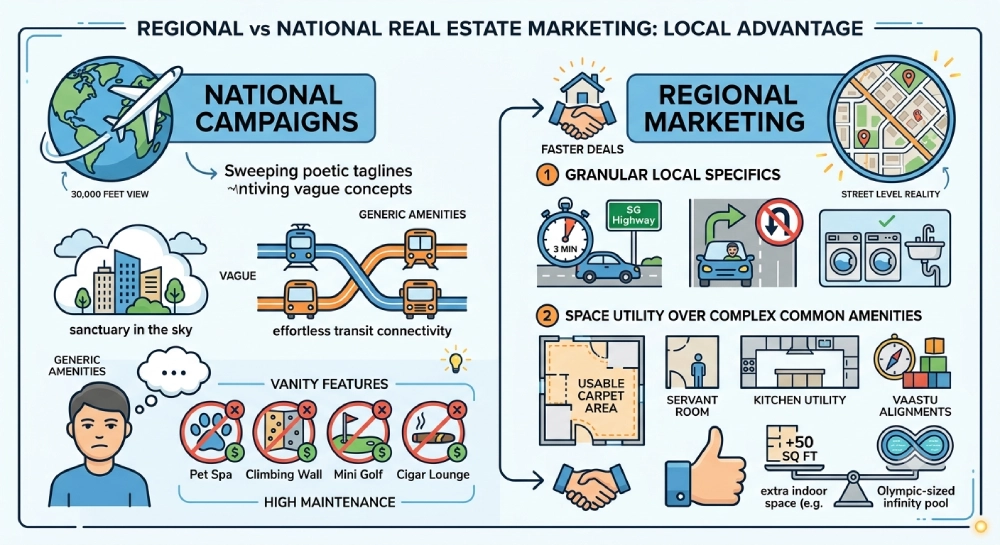
A homebuyer moving five kilometres across the same city does not care about an architectural design award won in Singapore. They care about everyday logistics.
This is where regional real estate marketing has a natural advantage that national budgets struggle to beat:
1. Granular Local Specifics
National campaigns love sweeping, poetic taglines about “sanctuaries in the sky” and “effortless transit connectivity.”
Local buyers find that vague. A regional builder talks about real landmarks:
- “Three minutes from the SG Highway underpass.”
- “Direct service lane entry so your driver does not have to make a U-turn.”
- “Dry balcony engineered specifically for two washing machines and a large utility sink.”
When an ad speaks to the exact friction points of living in that specific suburb, it cuts through far quicker than another picture of a model smiling on a generic balcony.
2. Space Utility Over Complex Common Amenities
Corporate township projects often allocate substantial land to vanity features: pet spas, climbing walls, miniature golf putting greens, and cigar lounges. These look stunning on glossy sales brochures.
Local buyers, especially self-employed business owners and joint families, see these as recurring maintenance bills for spaces they will barely use.
Regional builders usually design with ruthless spatial efficiency. Their marketing puts usable carpet area, separate servant rooms, wide kitchen utility sections, and Vaastu alignments front and centre. They know that in local markets, an extra fifty square feet inside the master bedroom closes a deal faster than an Olympic-sized infinity pool on the terrace.
The Split in Social Media and Performance Ad Campaigns
Look at the Meta ad library for a corporate township versus an independent residential tower, and the strategic divide becomes obvious.
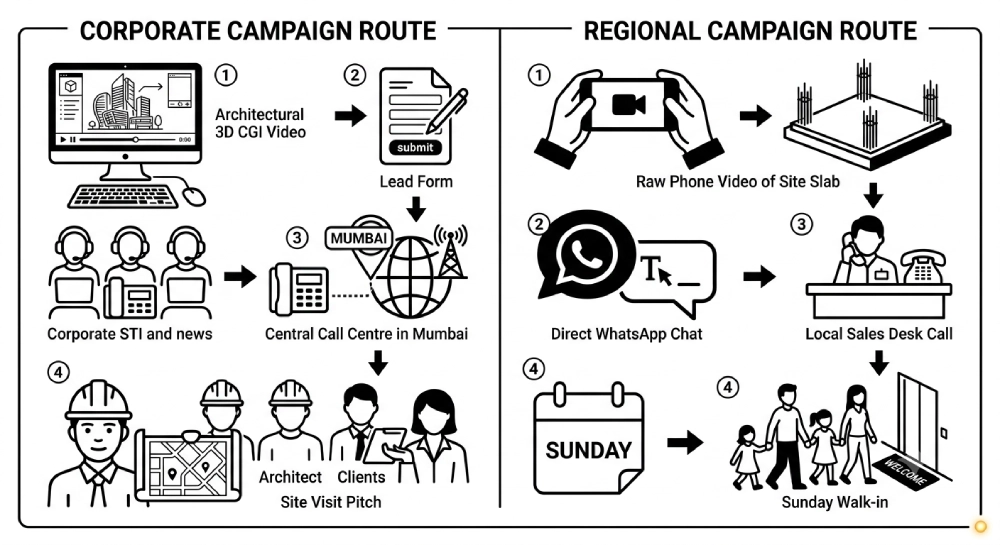
How Corporate Teams Run Ads
National players treat real estate social media marketing as an extension of their corporate public relations. You will see cinematic 3D render walkthroughs, drone flyovers set to ambient cinematic music, sustainability reports, and green building badges.
When you submit a contact form on one of their ads, your phone number enters an enterprise CRM. A call centre agent based in Mumbai or Gurgaon rings you twenty minutes later, confirms your budget against a scripted questionnaire, and schedules a formal appointment.
It feels organised, but it often lacks immediate warmth.
What Actually Works for Regional Projects
A regional firm trying to copy that corporate template usually burns through cash with little to show for it.
The most effective real estate marketing ideas for independent projects are intentionally straightforward:
- Short, vertical phone clips showing the actual concrete pour on the fourth-floor slab, with the site engineer talking directly to the camera.
- Side-by-side blueprint graphics comparing super built-up area with actual usable carpet area.
- Clear videos showing morning traffic flow on the main approach road so buyers can judge access for themselves.
When a regional project drops the staged stock footage and shows genuine site progress, local buyers pay attention. It proves the builder has the working capital to keep the mixers running.
Pragmatic Lessons Local Builders Should Borrow from Corporate Playbooks
Regional developers hold the local advantage, but they often lose high-ticket deals because their customer handling falls apart between the initial enquiry and the site visit.
Here are four specific operational habits local firms should borrow from corporate developers to lift their booking rates:
- Stop Sending Ugly, Low-Resolution PDFs on WhatsApp: A corporate firm hands you a beautifully typeset, legible digital brochure with clear floor plans and legible dimensions. Local builders often forward grainy, badly photographed brochures via WhatsApp that make a ₹2 crore flat look cheap before the buyer even steps foot on site. Clean up your digital collateral.
- Speed Up the Response Time on Inbound Leads: When an ad produces an enquiry on a Saturday evening, a corporate system assigns it immediately. In many local sales offices, that enquiry sits in an unread spreadsheet until Tuesday morning because the team was busy with weekend walk-ins. By Tuesday, that buyer has already booked a visit with a competitor down the street.
- Be Upfront with Approvals and Timelines: Put the RERA registration number, title clearance details, and approved bank finance lists right on the first page of the project website. Forcing buyers to dig through government portals to verify your land title creates unnecessary doubt.
- Train Sales Staff to Listen Instead of Monologuing: Corporate sales teams are trained to ask questions first. Walk into an average regional site lounge, and the sales rep will immediately spend fifteen minutes reciting the brochure verbatim. Train your floor team to ask two simple questions first: “Where do you currently live?” and “What is the single biggest problem with your current home?”
Pulling off this type of performance requires sharp positioning and consistent digital execution. If you want to build high-converting campaigns that speak the real language of your buyers, working with an experienced real estate marketing agency helps turn online interest into crowded site offices.
Conclusion
Big corporate developers will continue buying land banks across growing cities. They have deep pockets, institutional backing, and access to capital markets that single-city builders cannot match.
That does not mean they automatically own the market.
Real estate remains an intensely personal, physical purchase. When local builders stop trying to mimic corporate jargon and instead lean into their true advantages—honest carpet layouts, micro-locality knowledge, and genuine accountability—they win the trust of local families every single time.
For builders looking to build serious momentum in Gujarat’s fastest-growing corridors, partnering with a grounded digital marketing agency in Ahmedabad ensures your marketing budget works as hard as your construction crew.
Frequently Asked Questions

Vasim Samadji is a partner at Flora Fountain, where he leads the Business and Marketing Strategy divisions. In a world where everyone is used to sugarcoating, his directness is often considered rude. But that shouldn't be a problem if you like the no-nonsense approach. Because he is a seasoned professional...