
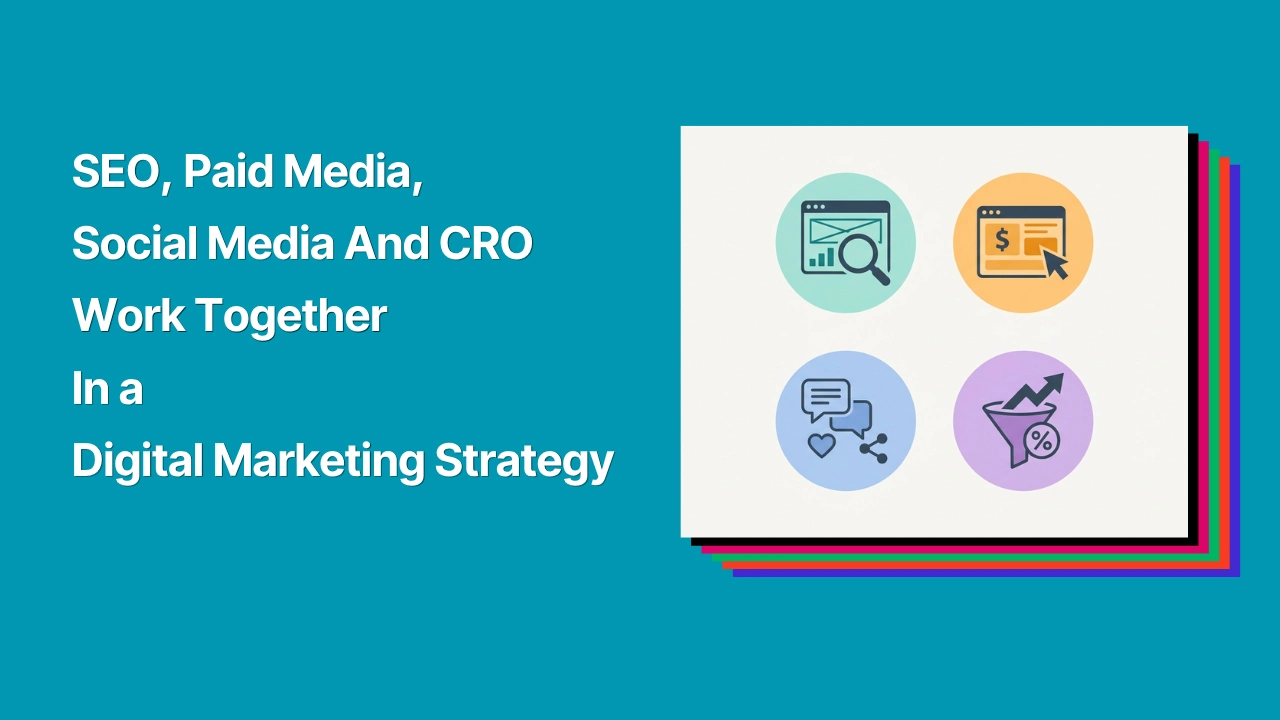
Most businesses treat SEO, paid media, social media and CRO as four separate budget lines, often run by different people, sometimes by different agencies, rarely talking to each other. That’s usually where the returns start leaking out.
Each of these channels is genuinely good at one specific job. SEO builds visibility that compounds over years. Paid media, or SEM, buys immediate visibility the moment you need it. Social media builds trust and distribution outside the search engine entirely. CRO decides whether any of the traffic the first three channels bring in actually turns into revenue.
Run alone, each one hits a ceiling fairly quickly. Run together, each one makes the others measurably more efficient. This article breaks down exactly how that works, what the data behind it actually shows, and how a business in Ahmedabad can build these four channels into one connected strategy rather than four disconnected campaigns.
Table of Contents
- What Each Channel Actually Does in a Digital Marketing Strategy
- Google Ads vs SEO: Why This Shouldn’t Be an Either/Or Question
- How SEO and Paid Media Reinforce Each Other
- How Social Media Strengthens SEO and Paid Campaigns
- Why CRO Is the Multiplier Behind Every Channel
- How Data Should Flow Between All Four Channels
- What Happens When Channels Are Run in Isolation?
- Building a Unified Performance Marketing Strategy
- The Right Sequence Depends on Your Growth Stage
- Conclusion
- FAQs
What Each Channel Actually Does in a Digital Marketing Strategy
Each channel has a clear role in your digital marketing strategy. SEO helps people find you through search, while paid media drives targeted reach and traffic. Social media builds awareness and trust, and CRO turns more website visits into enquiries or sales. Knowing these roles helps you use your budget effectively
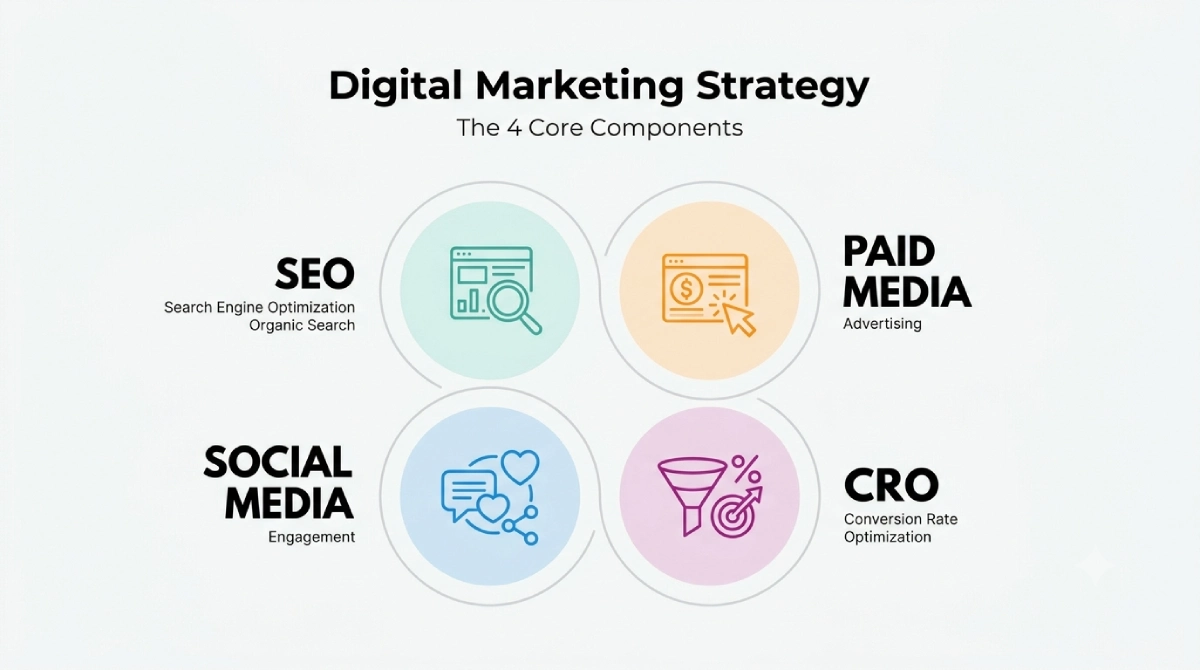
SEO builds compounding, long-term visibility. Organic rankings take months to establish, but once earned, they keep generating traffic without an ongoing per-click cost, which is exactly what makes SEO an asset rather than a rental.
Paid media, or SEM, buys immediate, controllable visibility. It’s the fastest way to appear in front of people actively searching, and the only one of the four where you can predict cost and volume with real precision, at the cost of that visibility disappearing the moment spend stops.
Social media builds trust and distribution outside the search engine entirely. It reaches people before they’ve started actively searching, and it’s where a business’s personality and proof of credibility live in a way a search results page can’t fully capture.
CRO decides what happens once someone actually arrives. It doesn’t generate traffic at all; it determines what percentage of the traffic the other three channels bring in actually converts into a lead, a sale or a booking.
None of these four roles substitutes for another. A business that excels at SEO but has poor CRO generates traffic that quietly leaks away. A business running expensive SEM with no organic presence is renting every single customer with no equity building underneath it.
Google Ads vs SEO: Why This Shouldn’t Be an Either/Or Question
This is one of the most common questions a business asks when planning budget, and it’s usually the wrong question to ask in isolation. If you’re still getting to grips with the organic side, our guide on what SEO is and how it works is a good place to start before comparing it with paid search.
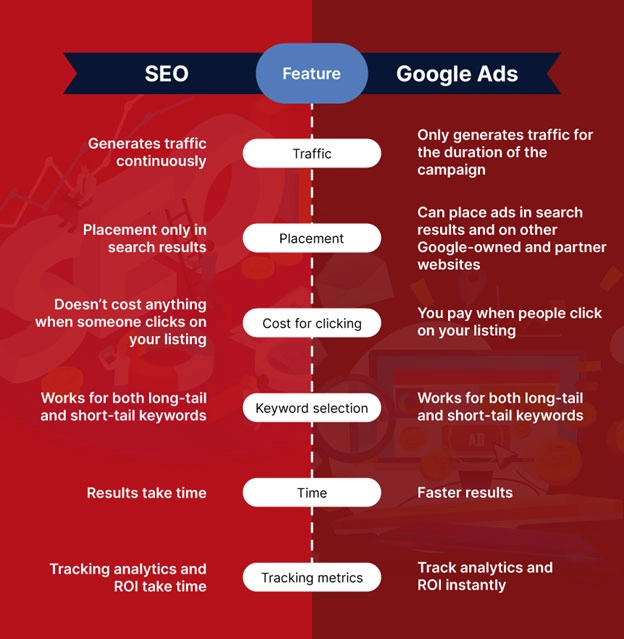
A study published by NYU Stern researchers Yang and Ghose analysed the relationship between organic and sponsored search listings and found that click-through rates, conversion rates and revenue were all significantly higher when both a paid and an organic listing appeared together for the same search, compared to when only one appeared alone.
Appearing in both spots doesn’t just add two separate results; it measurably lifts the performance of each one individually.
There’s a practical reason behind this too. A business appearing in both the paid ad and the organic listing for the same search looks more established and trustworthy to the person searching, simply by taking up more of the page with a consistent message.
The honest, practical answer to Google Ads vs SEO isn’t picking a side. It’s recognising that SEO earns you a durable position over time, while google ppc marketing lets you occupy space immediately while that organic position is still being built. The two working together outperform either alone.
How SEO and Paid Media Reinforce Each Other
Beyond simply appearing together on the same results page, SEO and paid media actively improve each other’s performance in a few specific, practical ways.
Paid search data reveals which keywords actually convert, in real time, long before organic content built around them would have enough traffic to tell you the same thing. This turns SEM into a fast, cheap testing ground for SEO’s much longer-term content investment.
SEO reduces the pressure on paid budgets over time. As organic rankings for a keyword strengthen, the same keyword in a paid campaign often needs a lower bid to maintain a strong position, since Google’s own quality scoring rewards a site with strong overall relevance signals.
A strong SEO and CRO foundation improves paid Quality Scores directly. Google’s ad auction rewards landing pages that are fast, relevant and well-structured, all things a serious SEO and CRO programme is already optimising for independently.
This is precisely why an experienced SEO agency in Ahmedabad won’t be handing off keyword and content decisions without ever checking what the paid campaigns running alongside them are already learning; the two are meant to inform each other, not operate on separate calendars.
Why Must SEO, CRO & Paid Media Work Together in an AI-Driven Funnel?
The customer journey is no longer a straight line from search to click to website. AI Overviews and AI assistants now answer many questions directly on the results page, and Contentsquare’s 2026 benchmark findings point to AI Overviews reducing search clicks, while AI-referred traffic is closing the conversion gap with traditional sources. In simple terms: fewer clicks are coming through, and the ones that do arrive tend to be better informed. That raises the stakes on every channel in the funnel.
Here’s how each one adapts:
- SEO earns visibility inside AI answers. Clear page structure, direct answers to real questions, FAQs, genuine expertise and a consistent brand presence make your content easier for search engines and AI tools to understand, summarise and surface.
- Paid media protects your position when organic space shrinks. When an AI summary pushes organic listings further down the page, a well-targeted ad on high-intent searches keeps your business visible at the moment of decision.
- CRO makes every scarce click count. With fewer visits to go around, a landing page that answers the visitor’s question quickly, builds trust and makes the next step obvious matters far more than it did when traffic was plentiful.
- Social and brand activity feeds all three. The more people recognise and search for your business by name, the more likely you are to be chosen once they’ve done their research, whether that research happened in a search result, an AI chat or a social feed.
Run in isolation, each channel only covers one stage of this funnel. Run together, they cover discovery, consideration and conversion, even when part of that journey happens before the visitor ever reaches your website.
How Social Media Strengthens SEO and Paid Campaigns
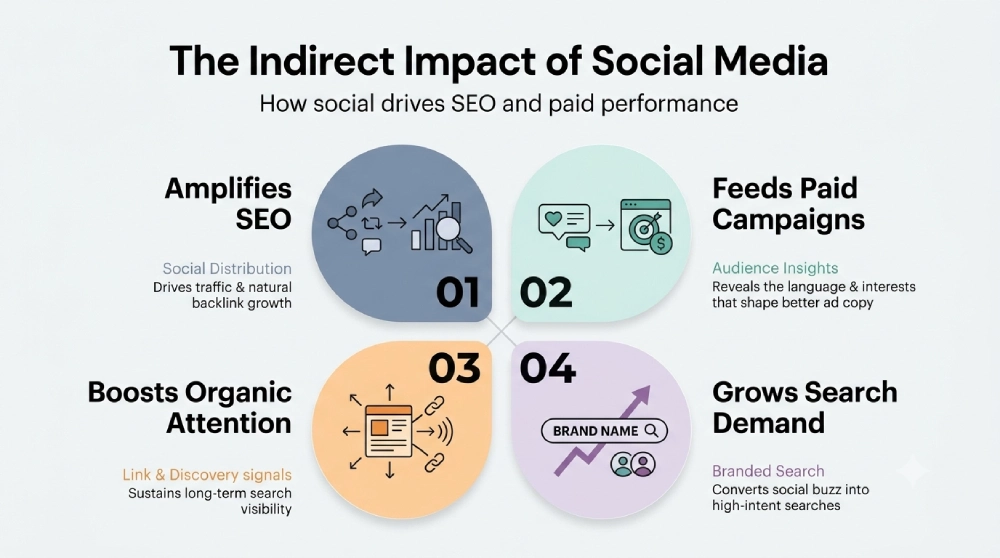
Social media rarely shows up as a direct ranking factor, but its indirect contribution to both SEO and paid performance is significant and often underestimated.
Social distribution drives the kind of traffic and engagement signals that support content discovery. A piece of content that gets shared and discussed generates exactly the kind of real-world attention and linking behaviour that supports its organic performance over time.
Social platforms are where audience research for paid campaigns often gets built cheaply. Comments, shares and engagement patterns on social content reveal language, objections and interests that can directly inform both ad copy and landing page messaging.
Branded search volume, meaning people searching for a business by name, is one of the more reliable signals that social and content activity is translating into genuine interest, and it’s a metric that’s simple to track directly in Search Console.
Why CRO Is the Multiplier Behind Every Channel
CRO is the channel that makes every other channel’s spend go further, and it’s usually the most underinvested of the four.
The scale of the opportunity is larger than most businesses assume. Contentsquare’s 2026 Digital Experience Benchmark Report, drawing on data from 46 billion web sessions, found the global average website conversion rate sits at just 2.35% across industries. That means, on average, roughly 97 or 98 out of every 100 visitors a business works hard to attract through SEO, SEM and social leave without taking any action at all.
Improving conversion rate has a compounding effect that improving traffic volume alone doesn’t. Doubling a conversion rate effectively halves the cost of acquiring each customer, without spending a single additional rupee on traffic acquisition through any of the other three channels.
CRO also closes the loop on measurement. Without a clear view of what’s actually converting on the website itself, it’s very difficult to know whether SEO, SEM or social is genuinely working, or simply generating traffic that looks good in a dashboard without producing revenue.
Source: Contentsquare, 2026 Digital Experience Benchmark Report
How Data Should Flow Between All Four Channels
The businesses that get real compounding value from these four channels aren’t the ones spending the most. They’re the ones who’ve built a simple, working loop where each channel feeds the next with real data.
Paid search keyword data flows into the SEO content calendar, prioritising topics already proven to convert rather than guessing.
SEO’s top-performing organic pages become the priority list for CRO testing, since that’s where the existing traffic volume makes a test statistically meaningful fastest.
Social engagement and comment data flows into both ad creative and landing page messaging, since it reveals the actual language real customers use.
CRO’s conversion data flows back into paid campaigns, informing which audiences and keywords should get more budget based on what’s actually converting on-site, not just what’s generating clicks.
This loop doesn’t require expensive software to start. It requires one person, or one agency, with visibility across all four channels and the discipline to actually close the loop every month rather than reporting on each channel separately.
What Happens When Channels Are Run in Isolation?
Traffic without conversion
A business investing heavily in SEO, SEM and social without a matching CRO effort tends to see a familiar pattern: growing traffic, growing ad spend, and a conversion rate that never improves, because nobody is actually working on what happens once a visitor lands on the site. The three channels bringing people in get all the attention, while the one channel deciding whether any of it turns into revenue gets none.
Rising costs with no compounding asset
The opposite failure looks different. A business running only paid media, without any SEO or social investment underneath it, sees costs climb every year as competition for the same keywords increases, with nothing built up that reduces that dependency over time. The moment spend pauses, so does every bit of visibility, because nothing was ever built that persists without ongoing payment.
The strongest position sits between these two failure modes: enough investment across all three visibility channels that paid media isn’t fighting alone, and enough CRO discipline that the traffic being generated doesn’t go to waste.
Building a Unified Performance Marketing Strategy
A practical framework, in order:
- Audit what each channel is currently doing independently. Most businesses are surprised to find their SEO, SEM and social teams are targeting completely different keywords and audiences without realising it.
- Identify the highest-value keywords across both paid and organic. Look for terms with strong commercial intent where a business can reasonably compete in both spaces.
- Align messaging across channels. A person seeing an ad, then a social post, then an organic result from the same business should see one consistent message, not three different pitches.
- Build the CRO layer before scaling traffic further. There’s little point increasing SEO, SEM or social investment into a website that’s already leaking most of the traffic it currently gets.
- Set up cross-channel reporting from day one. Track how channels influence each other, not just how each one performs in isolation.
- Review and reallocate monthly, not annually. The loop described earlier only works if the data actually gets acted on regularly, not filed away in a quarterly report nobody revisits.
The Right Sequence Depends on Your Growth Stage
There’s no fixed budget split that fits every business, but the right sequence tends to shift predictably as a business matures.
New businesses with little existing visibility usually need to lean on paid media early, since SEO and social both take months to build meaningful traction, while beginning SEO and content investment in parallel rather than waiting until paid media “proves” the market first.
Growing businesses that have validated their offer typically see the strongest returns from investing in SEO and social alongside their existing paid spend, since this is the stage where compounding organic growth starts reducing dependency on paid budgets.
Established businesses with strong organic visibility and brand recognition can often maintain a leaner paid media budget, using it primarily to defend branded search terms and support specific campaigns, while CRO work continues squeezing more value from already-strong traffic.
The right question for any business isn’t “how much should we spend on each channel.” It’s “which of these four channels is currently the weakest link in the system,” since that’s almost always where the next unit of budget produces the most improvement.
Conclusion
Getting these four channels to actually reinforce each other takes more than running all four at once; it takes someone watching how they interact and adjusting the connections between them every month, not just reporting on each one separately.
This is exactly the kind of integrated thinking a considered performance marketing agency in Ahmedabad should bring to campaign planning, connecting SEO, paid media, social and CRO into a single strategy rather than four unrelated line items with four separate dashboards.
If you’re trying to work out which of these four channels is your business’s current weak link, our digital marketing services go into more detail on how we approach that diagnosis for different categories. Get in touch with Flora Fountain today!
Frequently Asked Questions
It depends on how quickly you need results and how much existing visibility your business already has. Google Ads produces faster, more predictable results and suits a business that needs leads immediately. SEO takes longer to show results but builds a durable asset that keeps generating traffic without an ongoing per-click cost.
Most businesses benefit from starting both in parallel, using paid media for immediate visibility while SEO content is being built, rather than treating it as a strict either-or decision.
The founder and partner of Flora Fountain, Shefali leads the Content and Technology divisions. A one-time engineer who started her career writing front-end code, she took a detour sometime during her 9 years in New York, studied journalism and started writing prose, poetry and sometimes jokes. She now has 15...