


Google began rolling out the Google September 2026 spam update at 9:15 am Pacific on 24 September, which was 9:45 pm in India. If your traffic dropped, you do not need a policy lecture. You need to know what to check first and what to leave alone.
Google has not said which spam tactics this update targets, so nobody can name the exact trigger. This guide sticks to the documented Google spam policies and a short diagnostic order.
Quick Summary
- Google began the update on 24 September 2026 and says it may take up to two weeks to complete.
- Google has not said which spam tactics it targets, so confirm your drop started on or after 24 September and check the Manual Actions report before you change anything.
- Use the table to match the pattern of your drop to a likely spam-policy issue. Fix security problems first, then anything a manual action names, then the affected page group only.
- Do not delete content in bulk, remove AI-assisted content by default or disavow every unfamiliar backlink.
- Recovery has no fixed timeline and Google guarantees no result.
Table of Contents
- What Google Has Confirmed
- Did the Update Actually Cause Your Drop?
- Match What You See To The Likely Cause
- What To Fix First
- What Not To Do After A Spam Update
- How Long Does Recovery Take?
- Still Unsure What Caused The Drop?
- FAQs
What Google Has Confirmed
The Search Status Dashboard logged the start at 09:15 PDT on 24 September. Google says the update applies globally to all languages and may take up to two weeks to complete, so it could run until around 8 October.
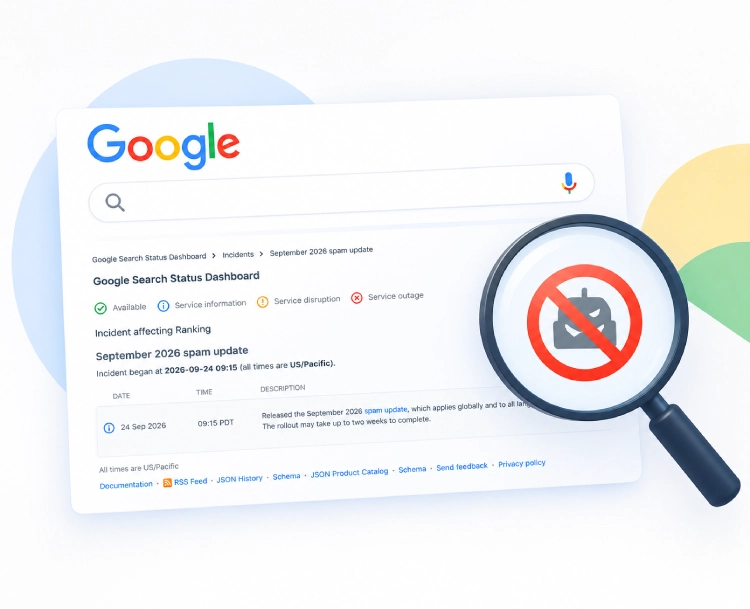
As of 30 September, the dashboard shows no completion entry. It is Google’s fourth spam update this year. Google says sites that see a change should review its spam policies, because sites that violate them may rank lower or not appear at all.
Did the Update Actually Cause Your Drop?
Run this 3-step check before you change anything:
- Check the date: Set Search Console to the last 16 months, as Google’s traffic drop guide suggests, to rule out seasonality. Your drop should start on or after 24 September. Also compare clicks, not just impressions, because PPC Land reported that Google added multimodal search traffic to the Performance report on 24 September. That can create a reporting jump that is not a ranking change.
- Open the Manual Actions report: The Manual Actions report shows whether a human reviewer flagged your site. If it is empty, your drop is an algorithmic change, not a manual penalty. A ranking drop alone does not mean you were penalised.
- Sort your Pages table by clicks difference: See whether the whole site fell or only one section.
If the drop began before 24 September or hit every page equally, look at technical, security and seasonal causes first.
Match What You See To The Likely Cause
| What you see | Possible spam-policy issue | What to check | What to do |
|---|---|---|---|
| Blog or one content section dropped | Scaled or thin content | Pages published in bulk, near-duplicates, unreviewed AI or machine-translated text. Google defines scaled content abuse as many pages made mainly to manipulate rankings, “no matter how it’s created”. | Improve, merge or exclude the weak pages. |
| Location or service pages dropped | Doorway-style pages | Swap the city name. If nothing else needs changing, the page is a template. Do all pages lead to one form? | Add real local substance or consolidate. A page with genuine local context for Ahmedabad businesses is legitimate. |
| Text copied or lightly rewritten from other sites | Scraping | Search distinctive sentences in quotation marks. | Rewrite with original value or remove. |
| Unknown pages in Google or odd redirects | Hacked content or cloaking | Security Issues report, Page indexing report, click your own result on a phone. | Clean up and patch the vulnerability. |
| A partner or third-party section on your domain | Site reputation abuse | Unrelated topics, no named author or editorial oversight. | Bring it under editorial control or remove it. |
| Backlink spike or sold links | Link spam | Paid links without rel="sponsored" or nofollow, sitewide footer links. |
Qualify the links and audit first. |
What To Fix First
Fix security problems first, then anything a manual action names, then the affected page group only. Change one thing at a time and note the date, so you can tell what worked. If you cannot find the cause, a structured SEO audit beats guessing, because random changes destroy the evidence.
What Not To Do After A Spam Update
- Don’t delete hundreds of articles. Find the pattern first.
- Don’t remove AI-assisted content just because AI was involved.
- Don’t disavow every unfamiliar backlink. Google says the disavow tool is advanced and most sites do not need it.
- Don’t publish more pages to compensate or stuff keywords into pages that lost visibility.
How Long Does Recovery Take?
There is no fixed timeline. If you are wondering how to recover from a Google spam update, start with a correct diagnosis. Google says improvement may follow if its systems learn over a period of months that your site complies with its spam policies. It also says some changes take days while others take months, and that no result is guaranteed. Wait until the rollout ends before you judge your data.
Still Unsure What Caused The Drop?
If your website’s visibility changed after the September 2026 spam update and you are not sure where the problem lies, a one-to-one conversation with Flora Fountain’s SEO team can help you identify the areas worth investigating and decide the next steps. As a digital marketing agency in Ahmedabad, we start with Search Console evidence and your page templates before we recommend any change. We cannot promise a recovery, but we can help you find the root cause and avoid changes that make things worse.
Frequently Asked Questions

The founder and partner of Flora Fountain, Shefali leads the Content and Technology divisions. A one-time engineer who started her career writing front-end code, she took a detour sometime during her 9 years in New York, studied journalism and started writing prose, poetry and sometimes jokes. She now has 15...