


Almost every business owner in Ahmedabad reaches the same moment.
Leads have slowed, a competitor is suddenly everywhere online, or a festive season is approaching, and the instinct is the same: increase the ad budget.
It feels like the obvious move. It’s usually the wrong first move.
More ad spend without a strategy underneath it doesn’t fix a weak funnel, unclear positioning or an offer that isn’t converting. It just makes those problems more expensive, faster. A bigger budget amplifies whatever is already happening, good or bad; it doesn’t correct direction on its own.
This article breaks down why a digital marketing strategy has to come before a bigger ad budget, how this plays out differently across Ahmedabad’s business categories, from real estate to D2C to professional services, and what a practical strategy framework actually looks like before your next rupee goes into a campaign.
Table of Contents
- What Does a Digital Marketing Strategy Actually Mean? A Quick Definition
- Why Increasing Ad Budget Without a Strategy Backfires: 5 Reasons
- How This Plays Out Across Ahmedabad’s Business Categories: 6 Examples
- What Happens When You Scale Spend Without Strategy? 2 Common Outcomes
- What Should a Digital Marketing Strategy Framework Actually Include? 6 Components
- How to Build a Marketing Strategy Plan Before Your Next Campaign: 7 Steps
- How Do You Know You’re Actually Ready to Increase Ad Budget? 5 Signs
- What Should You Measure Before and After Increasing Budget?
- Strategy and Ad Spend Should Move Together, Not One Before the Other
- Team Flora Fountain Is Just A Call Away
- FAQ
What Does a Digital Marketing Strategy Actually Mean? A Quick Definition
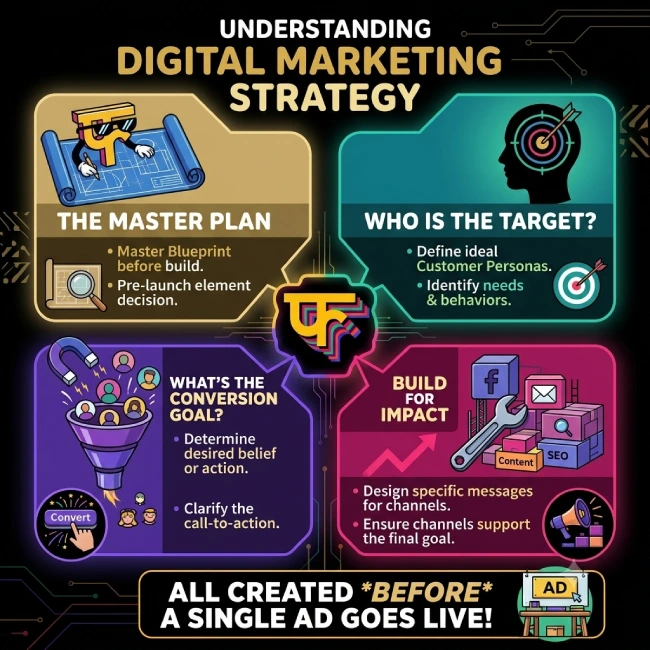
A digital marketing strategy is the underlying plan that decides who you’re trying to reach, what you want them to believe or do, and which channels and messages are actually built to achieve that, before a single ad goes live.
An advertising campaign or a marketing campaign, on the other hand, is the execution of that plan on a specific platform, over a specific period, toward a specific outcome. A campaign without a strategy behind it is just spend with no direction. It might still generate some results, but nobody can explain why it worked or reliably repeat it.
The distinction matters more than it sounds. A strategy tells you which campaigns are even worth running. A campaign, run without one, is a guess dressed up as a plan.
Why Increasing Ad Budget Without a Strategy Backfires
A bigger budget doesn’t fix an unclear strategy; it just exposes it faster and at greater cost. A few specific reasons this backfires so consistently:
It amplifies existing weaknesses. If your landing page doesn’t convert at ₹50,000 a month in spend, it won’t convert any better at ₹2,00,000; it will just burn through more budget, proving the same point.
It reaches the wrong audience faster. Without a clear strategy defining who you’re actually trying to reach and why, more budget usually means more reach to people who were never going to buy, not more qualified leads.
It raises costs without raising quality. Platforms reward relevance. A campaign built on guesswork tends to see rising cost per click and cost per lead as it scales, because the algorithm has no strong signal to optimise toward.
It creates pressure to spend reactively. Once a bigger budget is committed, there’s pressure to deploy it quickly, which usually means less testing, less refinement and more repetition of whatever was already running.
It makes failure more expensive to diagnose. A ₹20,000 campaign that underperforms is a cheap lesson. A ₹2,00,000 campaign that underperforms for the same underlying reason is an expensive one, and often harder to unwind once stakeholders have expectations tied to it.
There’s a well-documented pattern behind this too.
CoSchedule’s 2022 Trend Report on Marketing Strategy found that marketers with a documented strategy were 414% more likely to report success than those without one. The budget was never the differentiator. The plan underneath it was.
How This Plays Out Across Ahmedabad’s Business Categories: 6 Examples
The specific risk of scaling spend without strategy looks different depending on what a business sells and how its customers actually decide to buy.
-
Real estate: A high-consideration category where buyers compare projects over months. Increasing lead generation ad spend without a clear differentiation strategy usually just means paying more to compete on the same generic promises as every other listing in the same price band.
-
D2C and FMCG brands: These depend on repeat purchase. Scaling ad spend without a retention or brand strategy in place tends to produce an expensive stream of one-time buyers rather than a growing base of repeat customers.
-
Education: Admissions decisions involve parents researching for weeks. A bigger ad budget during admission season without a reputation-building strategy already in place is competing purely on visibility, not trust, in a category where trust is usually what closes the decision.
-
Healthcare and wellness: Trust and credibility drive the decision more than any single ad. Increasing spend without first building credibility signals, reviews, doctor profiles, patient outcomes, tends to produce clicks that don’t convert into bookings.
-
Hospitality: Guests choose based on reputation and how a property makes them feel about an experience they haven’t had yet. Ad spend can drive bookings during a push, but without a brand and reputation strategy behind it, occupancy tends to fall right back once the spend pauses.
-
Professional and B2B services: Buying cycles are long and most of the addressable market isn’t actively shopping at any given time.
In many B2B categories, only around 5% of potential buyers are in-market at any given moment (Ehrenberg-Bass Institute, LinkedIn B2B Institute).
Spending more to chase that same 5% harder, without a strategy to stay visible to the other 95% until they’re ready, usually just drives up cost per lead within an already small pool.
Across every one of these, the pattern is consistent. A bigger budget can only work as hard as the strategy behind it allows.
What Happens When You Scale Spend Without Strategy? 2 Common Outcomes
Rising costs with flattening returns
The most common pattern is a business that sees strong early results from a modest budget, then increases spend expecting proportional growth, only to watch cost per lead and cost per acquisition climb instead. Without a strategy refining who’s being targeted and why, more budget mostly means paying more to reach the same limited pool of ready buyers, or worse, a much larger pool of unready ones.
Internal pressure without a clear diagnosis
The second pattern is less visible but just as damaging. When a bigger budget doesn’t produce proportionally better results, the instinct is often to blame the platform, the creative or the agency, rather than the missing strategy underneath all three. This usually leads to campaign-hopping, changing platforms or agencies every few months, without ever addressing the actual gap, which is a clear plan for who the business is trying to reach and why they should choose it.
The businesses that avoid both patterns aren’t the ones with the biggest budgets. They’re the ones that got the strategy right before scaling spend into it.
What Should a Digital Marketing Strategy Framework Actually Include? 6 Components
A working digital marketing strategy framework should answer six questions clearly enough that anyone on the team could explain the plan without you in the room:
- Who is the actual target audience, described specifically enough to guide real decisions, not a vague “everyone who might buy.”
- What is the core message or positioning, the reason this business should be chosen over an equally capable competitor.
- Which channels make sense for this audience and this buying cycle, rather than every channel a competitor happens to be using.
- What does the customer journey look like, from first awareness through to conversion and repeat purchase.
- What will success actually be measured against, defined before the campaign starts, not after the results come in.
- What is the realistic budget and timeline needed to see those results, given the category’s actual buying cycle.
A strategy missing any one of these six tends to produce campaigns that look busy without producing a clear, repeatable outcome.
How to Build a Marketing Strategy Plan Before Your Next Campaign: 7 Steps
A practical sequence, in order:
- Audit what’s already happening: Look honestly at current traffic, conversion rates and existing campaign data before assuming more budget is the fix.
- Define the specific objective: More revenue this quarter, more qualified leads, or long-term brand visibility are different goals requiring different plans.
- Clarify who you’re actually targeting: Get specific about the audience, their buying cycle and what influences their decision.
- Sharpen the positioning: Decide what makes this business the obvious choice, not just an available option.
- Choose channels based on the audience, not habit: The platform a competitor uses isn’t automatically the right one for your buyer.
- Set the budget to match the strategy, not the other way around: The plan should determine what’s needed, not the other way round.
- Build in a measurement plan from day one: Decide upfront what you’ll track and how often you’ll review it, so results can actually inform the next decision.
This isn’t a one-time document. It’s a plan that should be revisited as results come in and as the business’s situation changes.
How Do You Know You’re Actually Ready to Increase Ad Budget? 5 Signs
A bigger budget tends to be a good decision when:
The current campaign is already converting at a healthy, predictable rate, and the limiting factor is genuinely reach, not quality.
There’s a clear, tested message and creative that’s already performing, not something still being figured out in real time.
The website or landing page has a proven conversion path that can handle more traffic without leaking it.
The sales or response process can actually handle more leads without response times slipping.
There’s a measurement system already in place to track whether the increased spend is producing proportional results, not just more activity.
If most of these aren’t true yet, the honest next step usually isn’t a bigger budget. It’s a clearer strategy.
What Should You Measure Before and After Increasing Budget?
Before increasing spend, a business should already have a clear read on: current cost per lead and cost per acquisition, conversion rate by channel, and which audience segments are actually converting versus just clicking.
After increasing spend, the same metrics need to be tracked proportionally, not just in absolute terms. A 5x increase in budget that produces only a 2x increase in qualified leads is a signal that the extra spend is reaching a weaker audience, not a stronger one.
Google’s own research into full-funnel marketing supports this. Campaigns built on a clear strategy connecting upper-funnel awareness with lower-funnel conversion consistently outperform single-stage campaigns on business outcomes, because each stage is measured and strengthens the one that follows (Think with Google). A budget increase without that connected strategy rarely produces the same compounding effect.
Strategy and Ad Spend Should Move Together, Not One Before the Other
None of this means a business should delay advertising until a perfect strategy document exists. Strategy and spend should move together, refined as real data comes in, not treated as a one-time step that has to be finished before anything else happens.
What matters is the order of operations. A small, well-targeted budget guided by a clear strategy will almost always outperform a large budget guided by guesswork, and it does so at a fraction of the cost of finding that out the expensive way.
The businesses that scale ad spend successfully in Ahmedabad, across real estate, D2C, healthcare or professional services, aren’t the ones with the biggest budgets. They’re the ones who built the strategy first and let the budget follow proven results, rather than hoping the budget would create them.
Team Flora Fountain Is Just A Call Away
Getting the sequence right, strategy before spend, takes an honest look at what’s actually happening in your current campaigns, not just a bigger number in next month’s ad account.
This is exactly the kind of thinking a considered digital marketing agency in Ahmedabad should bring to the table before recommending a bigger budget, starting with what’s already working and why, rather than simply scaling what’s already there.
If you’re trying to work out whether your business needs a clearer strategy before its next campaign, our digital marketing services go into more detail on how we build that foundation for different categories. Get in touch with our expert team today!
Frequently Asked Questions
Increasing ad budget without a clear strategy tends to amplify whatever is already happening, both good and bad. If your current campaign has an unclear audience, weak positioning or a leaking conversion path, more budget usually means paying more to expose the same problems faster, rather than fixing them.
The better first step is understanding why current results look the way they do, then scaling the parts that are actually working.
A marketing strategy is the underlying plan: who you're targeting, what you want them to believe, and which channels are suited to reach them. A marketing campaign or advertising campaign is the execution of that plan on a specific platform over a specific period.
A campaign without a strategy behind it can still run, but nobody can reliably explain why it worked or repeat it with confidence.
A few signs suggest a business is ready:
Current campaigns are already converting at a predictable, healthy rate. The limiting factor is genuinely reach, not creative or targeting quality. The website or landing page can handle more traffic without losing conversions. The sales or response process can handle more leads without slowing down. There's already a system in place to measure whether results scale proportionally with spend
If most of these aren't true yet, building a clearer strategy is usually a better next step than a bigger budget.
A working framework should clearly define six things: the specific target audience, the core positioning or message, the right channels for that audience, the customer journey from awareness to conversion, how success will be measured, and a realistic budget and timeline based on the category's actual buying cycle.
Missing any of these usually results in campaigns that generate activity without a clear, repeatable outcome.
It applies at any budget level. A small business spending ₹20,000 a month benefits from the same clarity as one spending ₹2,00,000, since the core problem, spending without a clear plan, doesn't require a large budget to become expensive. In fact, smaller budgets often have even less room for guesswork, since there's less margin to absorb an underperforming campaign while it gets figured out.

Vasim Samadji is a partner at Flora Fountain, where he leads the Business and Marketing Strategy divisions. In a world where everyone is used to sugarcoating, his directness is often considered rude. But that shouldn't be a problem if you like the no-nonsense approach. Because he is a seasoned professional...