


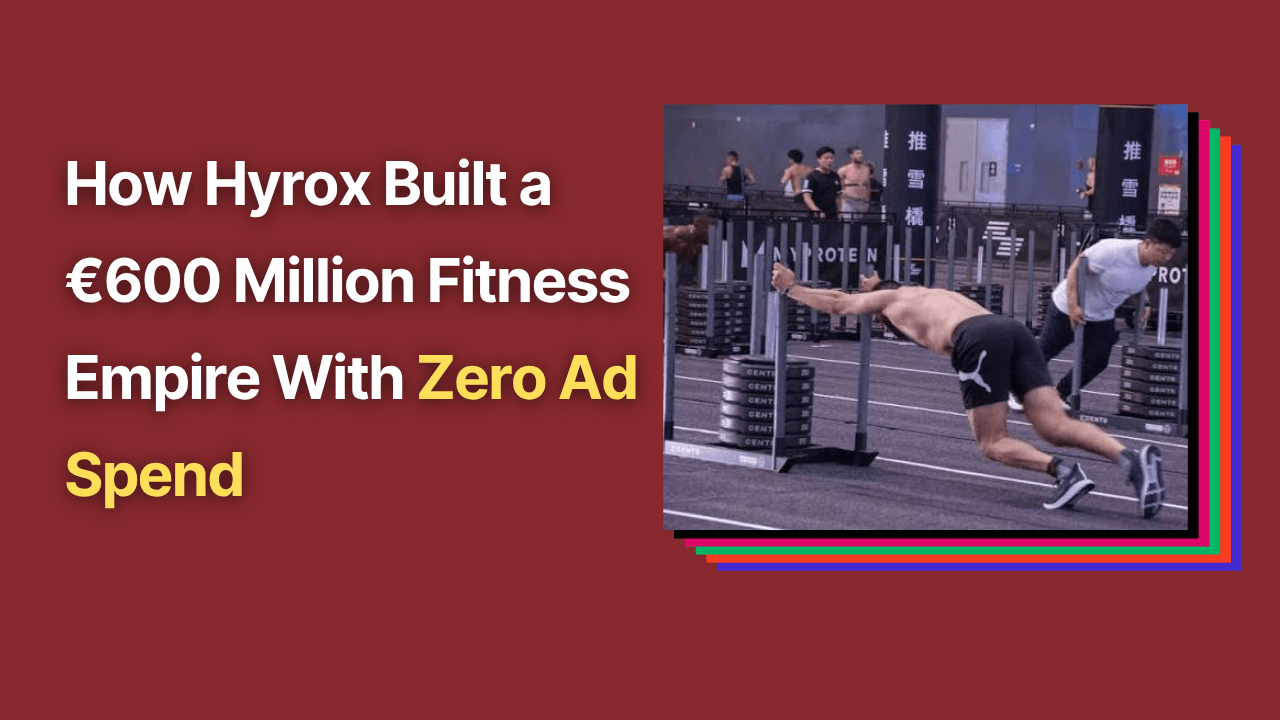
Most fitness brands spend somewhere between $100 and $300 to acquire a single paying customer through digital advertising.
Hyrox went from 650 competitors at a single Hamburg event in 2017 to over 1.4 million participants and roughly €135 million in revenue, with zero ad spend to acquire customers.
But how?
Hyrox grew by turning its product into its distribution. Instead of running ads to consumers, it licensed its brand to gyms, which then market ‘race training’ to their own members; standardised its race format so every finish time became a shareable, comparable number; and capped entries per city so events sell out and create urgency without paid promotion.
This blog analyses what it takes for a sporting event to become one of the most highly valued athlete-centric brands, from the viewpoint of an experienced branding agency that has seen many such brands come and go from the industry
Table of Contents
- What is Hyrox and what is its business model?
- How does Hyrox actually make money?
- Pillar 1: How did Hyrox turn gyms into its sales force?
- Pillar 2: Why did standardising the race format change everything?
- Pillar 3: How does Hyrox get athletes to market it for free?
- Pillar 4: How does scarcity drive registrations without ads?
- Hyrox vs CrossFit: why did one scale faster?
- What’s the honest risk in this model?
- What can other brands actually learn from this?
- In Conclusion
- FAQs
What is Hyrox and what is its business model?

Hyrox is a standardised fitness race combining eight 1km runs with eight identical functional fitness stations, and its business model matters because it reached roughly €135 million in revenue by making its product the distribution channel rather than buying customers through advertising.
The format itself is deliberately simple: run 1km, complete a station, repeat eight times. The stations are the same in every city, in the same order, on the same equipment. A competitor in London runs the same race as a competitor in Singapore.
That sounds like an operational detail. It’s actually the entire strategic foundation, and the rest of this teardown explains why.
The scale it has reached is genuinely unusual for a business this young:
- Grew from 650 competitors at one event in 2017 to over 1.4 million participants across 100+ events in 30+ countries
- Revenue climbed from around €40 million in 2023 to roughly €135 million in 2025
- Reported 2025 EBITDA of around €30 million, implying a margin near 20%, which most consumer fitness businesses never approach
(Source)
How does Hyrox actually make money?
View this post on Instagram
Hyrox generates revenue through four main streams: race entry fees, gym affiliate licensing, sponsorship deals, and merchandise, with race entries forming the largest share.
| Revenue stream | How it works |
|---|---|
| Race entries | Participants pay to compete; capped per event, often selling out in advance |
| Affiliate licensing | Gyms pay roughly $1,500 a year per site to become official Training Clubs |
| Sponsorship | Partners including Puma, Red Bull, Amazfit and BYD pay for association and category exclusivity |
| Merchandise | Branded apparel and equipment sold to a highly engaged participant base |
What makes this mix commercially interesting is how little fixed cost sits underneath it. Hyrox doesn’t own gyms, doesn’t carry property costs, and doesn’t employ the coaches who train its athletes. It runs events in existing venues and licenses its brand to facilities other people already pay for.
Co-founder Moritz Fürste has described the original production brief as creating an event that costs €200,000 but looks like it costs €2,000,000. That instinct, maximum perceived value at controlled cost, runs through the whole business.
Pillar 1: How did Hyrox turn gyms into its sales force?
Hyrox licenses its brand to gyms as official Training Clubs for roughly $1,500 a year, and those gyms then market Hyrox training to their own existing members, effectively outsourcing customer acquisition to thousands of businesses who pay for the privilege.
This inverts the normal economics of consumer fitness entirely. A typical brand pays a platform to reach a consumer. Hyrox gets paid by a gym, and that gym then does the reaching.
The reason gyms sign up is genuinely rational on their side:
- The licence appears in the official Hyrox gym finder, which race-prep athletes actively search when choosing where to train
- It’s a licence, not a franchise, so gyms keep full ownership and pay no royalties on their own revenue
- The Training Club tier has no minimum floor space or equipment quota, so almost any gym qualifies
- A single new member joining specifically for Hyrox training can cover the entire annual licence fee
Hyrox365 now reports 15,000 Training Clubs globally. Each one is a local marketing outpost with a commercial incentive to fill race spots, none of which appears as an acquisition cost on Hyrox’s own books.
The honest caveat worth noting: that licence is currently priced low precisely because Hyrox needs the volume. As the business matures under new ownership, whether those terms hold is a genuinely open question for gym owners.
Pillar 2: Why did standardising the race format change everything?
Standardising the course turned a workout into a measurable, comparable benchmark, which created global leaderboards, personal records and a reason to come back and race again, none of which is possible when every event is different.
Before Hyrox, functional fitness had a structural problem. You couldn’t meaningfully compare a workout completed in one gym to one completed in another, because the workouts weren’t the same. There was no shared yardstick.
Fixing the format solved this in a way that unlocked several things at once:
- A personal record worth chasing. If the race is identical everywhere, your time means something, and beating it becomes a goal that pulls you back to another event
- A global leaderboard. Times become comparable across cities and countries, creating genuine competitive context for amateur athletes
- A trainable target. Gyms can build structured programming against a fixed, known format, which is exactly what makes the affiliate model work
- A shareable number. Your finish time is a specific, legible piece of content, which matters enormously for the next pillar
This is classic value innovation. Hyrox didn’t invent any of the individual exercises. It standardised an existing activity and, in doing so, created a category that didn’t exist before.
Pillar 3: How does Hyrox get athletes to market it for free?
Every finisher leaves with a time, a bib number and official finish-line photography, all of which get posted to social media, turning hundreds of thousands of participants into an organic marketing channel that costs Hyrox nothing.
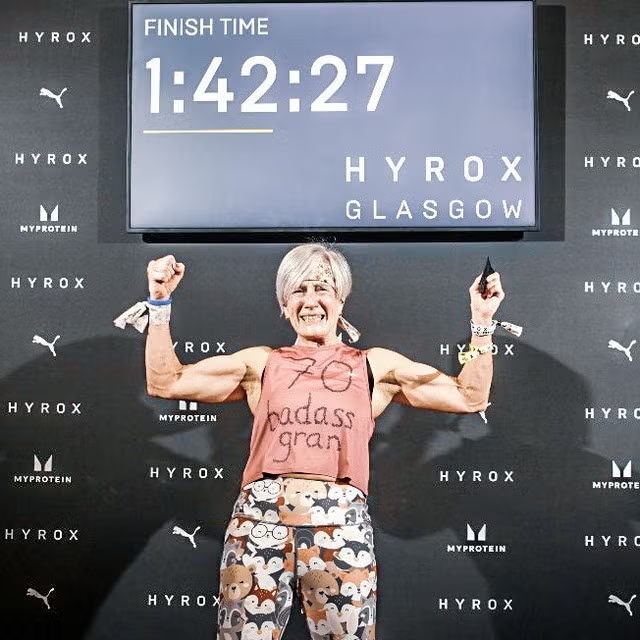
The psychology here is worth understanding properly, because it’s more deliberate than it looks.
Hyrox sells achievement rather than prize money. For the overwhelming majority of participants, there’s no financial reward for competing. What they get instead is a verified, comparable result and the social proof that comes with it. That turns out to be more motivating, and far more shareable, than a cash prize would be for the same audience.
The mechanics that make this work:
- The time is the content. A finish time is specific, comparable and inherently postable in a way that “I went to the gym” never is
- The finish line is designed to be photographed. Production value creates imagery participants actually want to share
- Training becomes content too. The preparation cycle generates weeks of posts before the race itself, extending organic reach well beyond event day
- Every post is implicit endorsement. It isn’t an ad, it’s a person you know doing something difficult, which is considerably more persuasive
A participant who finishes and posts their time is, functionally, an unpaid distribution channel. At the scale Hyrox now operates, that’s a marketing engine most brands couldn’t buy.
Pillar 4: How does scarcity drive registrations without ads?
Hyrox caps entries per event based on venue capacity, which causes races to sell out well in advance and creates genuine urgency to register early, removing the need to advertise for late sign-ups.
This is the least discussed pillar and one of the more commercially elegant. When something sells out reliably, three things happen without any paid promotion:
- Registering early becomes the rational choice, pulling demand forward
- Selling out becomes its own social proof, signalling that the event is worth attending
- The brand never appears to be chasing customers, which protects its positioning
There’s an important distinction here though, and it’s worth being precise about it. Hyrox’s scarcity is largely structural rather than manufactured. A venue holds what it holds. The brand didn’t invent artificial limits so much as it declined to compromise the format to squeeze more people in, then let the resulting constraint do the marketing work.
Recent expansion tells you how real the demand pressure is. Events in Japan and mainland China have extended to four-day formats to accommodate more participants, and a New York event drew 50,000 participants across eight days.
Hyrox vs CrossFit: why did one scale faster?
Hyrox scaled faster than CrossFit largely because its format is standardised, accessible to average fitness levels, and licensed cheaply without franchise obligations, lowering the barrier for both gyms and participants.
| Hyrox | CrossFit | |
|---|---|---|
| Format | Fixed and identical worldwide | Varies daily by workout and gym |
| Comparability | Global leaderboard, direct PR tracking | Difficult to compare across gyms |
| Barrier to entry | Accessible to recreational fitness levels | Often requires technical skill development |
| Gym affiliation | Licence, no equipment minimum at entry tier | Affiliate model with more requirements |
| Primary appeal | Finishing a benchmark race | Community and daily training culture |
The comparison deserves fairness rather than a winner declared. CrossFit built the functional fitness culture Hyrox now benefits from, and its community model has produced loyalty Hyrox is still earning. But CrossFit’s greatest strength, infinite variety, is precisely what made global comparison impossible, and comparison is what Hyrox monetised.
What’s the honest risk in this model?
The main risk is that Hyrox’s growth depends on an affiliate network priced below its strategic value, and new institutional investors will eventually need to find growth levers, one of which is repricing that licence.
A few genuine pressure points worth naming rather than glossing over:
- Licence repricing. At a €600 million valuation, someone has to build a growth case. More races, higher entry fees and more sponsorship are three options that don’t touch gym owners. Raising affiliate fees is the fourth, and the one that does
- Category competition. Hyrox created a category, which means competitors can now enter it. A standardised format is, by definition, replicable
- Participation ceiling. Growth so far has come from geographic expansion and repeat participation. Both have limits, and the 2026 projections are ambitious
- Dependence on organic reach. A marketing engine built on participant sharing works brilliantly while the brand is culturally ascendant. It’s less reliable if enthusiasm cools
None of this undermines what’s been built. It just means the zero-acquisition-cost model is a strategy with conditions, not a permanent advantage.
What can other brands actually learn from this?
The transferable lesson isn’t to copy the race format; it’s to build distribution into the product itself so that using the product generates the marketing, rather than treating marketing as a separate budget line.
Four things genuinely transfer across categories:
- Make the outcome measurable and shareable. Hyrox’s finish time is content. Most products have an equivalent: a result, a score, a before-and-after, that customers would share if you made it legible enough
- Turn partners into distribution. If another business already has your customers and a reason to want them engaged, a licence can be more effective than an ad campaign, and they may pay you for it
- Standardise to create comparison. Comparability creates competition, and competition creates repeat purchase. Variety feels generous but often prevents this entirely
- Let constraint do marketing work. Selling out is a stronger signal than any campaign claiming demand exists
The uncomfortable version of this lesson for most businesses: if your product doesn’t generate any organic advocacy, paid acquisition isn’t a growth strategy; it’s life support. The budget is compensating for something the product isn’t doing.
In Conclusion
Hyrox didn’t win by outspending anyone. It won by designing a product where participation and promotion are the same activity, then letting thousands of gyms and hundreds of thousands of athletes carry the message for reasons of their own.
That’s a harder thing to build than an ad campaign, and a considerably more durable one. The businesses that grow this way aren’t the ones with the largest budgets; they’re the ones that asked what would make someone talk about this, and then built the answer into the product itself.
If you’re trying to work out where your own brand’s organic advocacy could come from, rather than defaulting to a bigger ad budget, Flora Fountain works as a branding agency for exactly this kind of strategic thinking. Drop us a line at hello@florafountain.com and let’s look at what your product could be doing that your ads are currently paying for.
Frequently Asked Questions

The founder and partner of Flora Fountain, Shefali leads the Content and Technology divisions. A one-time engineer who started her career writing front-end code, she took a detour sometime during her 9 years in New York, studied journalism and started writing prose, poetry and sometimes jokes. She now has 15...