

Wake up performance marketing folks, ChatGPT Ads is a reality now.
No, it has not changed its name to Ch-adGPT now. Shocking.
Open AI is creating a new horizon for paid ads now. Instead of typing a few keywords, users explain their needs, compare options and ask follow-up questions within a conversation.
OpenAI first announced plans to test advertising in ChatGPT in January 2026, with testing beginning in the US shortly after. In August 2026, ChatGPT Ads began rolling out in India, followed by advertiser access through OpenAI’s Ads Manager.
Unlike traditional search ads, targeting is built around conversation context, user intent, campaign settings and advertiser-provided signals, rather than relying only on exact keywords.
Pricing is auction-based, with support for models such as CPC and CPM. In India, advertisers can currently start campaigns with daily budgets from around ₹725.
This guide explains how ChatGPT Ads work, what they cost, how targeting works and whether your business should test them.
Table of Contents
- What Are ChatGPT Ads?
- Who Actually Sees Ads on ChatGPT?
- How Much Do ChatGPT Ads Cost?
- How to Set Up Your ChatGPT Ads Manager Account
- How Targeting Works Without Keywords
- Ad Formats: Static Ads vs Product Ads
- Privacy & Brand Safety on ChatGPT
- How to Improve Performance on OpenAI Ads
- Should Your Business Advertise on ChatGPT?
- Conclusion
- FAQs
What Are ChatGPT Ads?
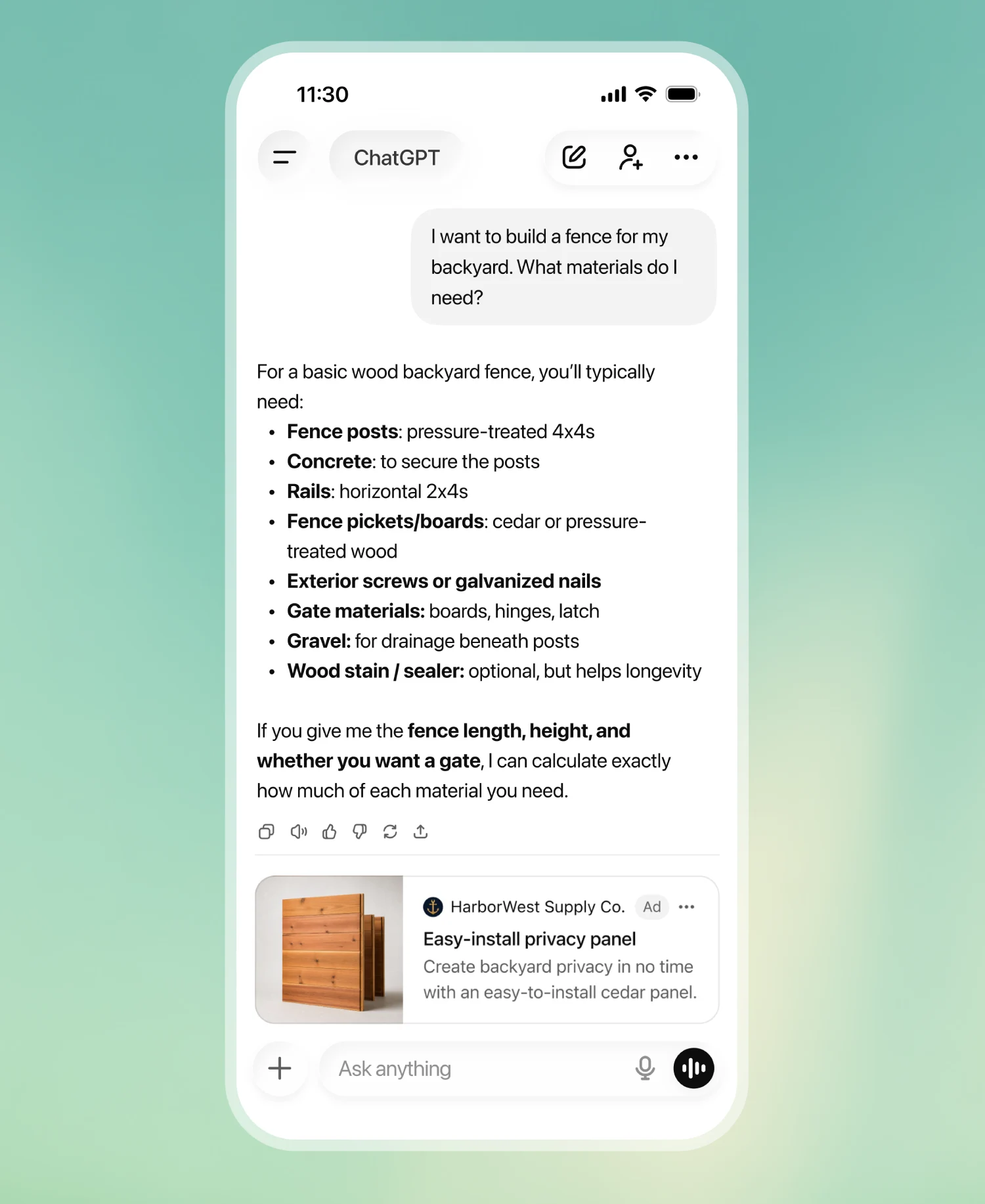
ChatGPT Ads are sponsored placements inside ChatGPT conversations shown below the model’s response, carrying a “Sponsored” label and linking to the advertisers’ landing page, similar to a shopping result under a Google search.
What started as a pilot has since opened into a full self-serve platform. Any business, not just enterprise brands with six-figure budgets, can now create an account and run a campaign.
The idea: people don’t scroll ChatGPT the way they scroll Instagram; they ask it something because they’re trying to make a decision. OpenAI is betting that makes ChatGPT a high-intent moment worth advertising in, not unlike search but conversational.
Ads do not change what ChatGPT says; the ad appears separately. The model’s output stays independent of who paid. For marketers, you’re buying visibility at the point someone is thinking through a purchase, not attention on a feed.
Who Actually Sees Ads on ChatGPT?
View this post on Instagram
Not every ChatGPT user sees ads. Ads currently show to logged-in adult users (18+) on the Go tiers. Pro, Business, Enterprise and Education subscribers won’t see your ad; free and low-cost users fund the platform partly through ads while paying subscribers stay ad-free. Targeting currently covers India, US, UK, Canada, Australia, Japan, New Zealand and South Korea, with regions expected over time.
This audience skews price-sensitive about subscriptions but still active. If your ideal customer is more likely to use a tool than a paid one, this fits. If your product depends on power users who’ve upgraded, a meaningful chunk of your audience is excluded.
Before building a campaign, check OpenAI’s advertising policies. Adult content, alcohol, tobacco and gambling are restricted. Rules around financial services and legal ads are still evolving.
How Much Do ChatGPT Ads Cost?
This is where things changed dramatically.
When OpenAI Ads first piloted in 2026, minimum spend sat around ₹1.6 crore (approx. $200,000) with CPMs near ₹5,000 (approx. $60), pricing out everyone except large enterprise brands. The self-serve rollout changed that.
Today you can run a campaign with a budget as low as ₹725 a day. Average cost-per-click ranges from ₹150 to ₹400, depending on industry. Set your max CPC below ₹250 and the platform warns the ad may not deliver, a fixed threshold regardless of targeting or creative quality.
View this post on Instagram
You can bid for Clicks, Reach or Conversions. Clicks and Conversions charge per click (with Conversions optimising toward a bid cap once tracking is set up); Reach charges per thousand impressions.
Placement runs through a relevance-weighted second-price auction, familiar if you’ve run Google Ads or Meta. The bigger shift isn’t price; it’s accessibility: a small business in a Tier 2 city can now test this channel without an enterprise media budget.
How to Set Up Your ChatGPT Ads Manager Account
View this post on Instagram
Getting set up is fairly straightforward. Here is the process step by step:
- Create your ChatGPT Ads Manager account
Start by setting up an account in OpenAI’s advertising dashboard. Keep your business name, website URL, Business Tax ID or local equivalent, square favicon, payment method and industry category ready. - Complete the onboarding details
You will be asked to confirm your billing country, currency, time zone and whether the account belongs to an individual or a business. - Set up account ownership correctly
If you are working with an agency, the client should create and own the Ads Manager account. Agencies can then be added as users, rather than creating the account on the client’s behalf. - Complete verification
OpenAI may review the business and billing information before the account becomes fully active. Verification can take anywhere from around a day to a couple of weeks. - Build your first campaign
ChatGPT Ads Manager follows a simple structure: Campaign → Ad Group → Ad. At campaign level, you set the objective, budget, locations and dates. Ad Groups control bids and context hints. At Ad level, you add the headline, description and creative.
How Targeting Works Without Keywords
If you’re coming from Google or Meta, this is the adjustment: there are no keywords, demographic filters or in-market audience lists. Instead, OpenAI Ads targeting runs on context hints in a text box at the ad group level where you describe the conversations or topics where your product might be relevant.
OpenAI’s guidance is loose by design: describe what you sell and who it’s for, in language. These hints guide matching. Aren’t exact-match rules like keywords.
Early testing suggests a list of short phrases similar to search keywords tends to trigger more impressions than long conversational sentences, likely because the matching model is still maturing.
Geography and first-party audience data (customer emails or phone numbers uploaded in bulk) round out your remaining levers. First-party audiences require a minimum of 25,000 matched users, out of reach for advertisers for now. The honest takeaway: this rewards testing over assumption.
Ad Formats: Static Ads vs Product Ads
OpenAI Ads currently come in two formats.
Static ads are the option: a headline (50 characters max), a description (100 characters max), a square image (PNG or JPG) and a destination URL appearing below the response with a sponsored label.
Product ads pull from a submitted product feed to Google Merchant Centre, built for e-commerce catalogues. OpenAI recently added pricing and star ratings to the product card.
Both formats follow the auction logic. A single offer fits ads; a full catalogue fits product feeds. With no keyword to reinforce relevance, your headline and description carry weight.
Privacy & Brand Safety on ChatGPT
OpenAI has been consistent on one principle: it doesn’t use personal data to target ads based on conversation context. Advertisers never see the underlying conversation, only aggregated performance data.
This cuts both ways. It simplifies compliance under GDPR and CCPA since no personal data is collected for targeting. It also limits you: no retargeting, no lookalike audiences, no frequency capping.
Conversations can shift topic unpredictably within a session, so OpenAI applies real-time content analysis to suppress ads during flagged exchanges. This tooling is newer than Google’s or Meta’s. If brand safety matters for your category, ask OpenAI’s support team before committing meaningful budget.
How to Improve Performance on OpenAI Ads
Because this platform doesn’t hand you Google’s or Meta’s usual levers, performance comes down to what you can control:
- Test context hint formats. Run keyword-style phrases and longer conversational descriptions separately, then compare delivery and CTR.
- Keep copy tight. With 50-character headlines and 100-character descriptions, lead with the problem you solve.
- Bid above the delivery threshold. Max CPCs below ₹250 often won’t serve.
- Track conversions from day one. Install OpenAI’s pixel before launch, not after.
- Use UTM parameters everywhere. Native reporting is limited and segmented by country, so validate results in GA4 separately.
- Benchmark on acquisition cost, not click cost. A cheaper click that converts poorly isn’t actually cheaper.
Should Your Business Advertise on ChatGPT?
The honest answer: probably worth testing with expectations and a small budget.
OpenAI Ads are still young. Reporting is limited, targeting is unconventional and best practices are being written in real time rather than established over years like Google’s. That’s a reason to treat it as a test channel, not a one for now.
Businesses most likely to see value: B2B SaaS, ecommerce brands with a strong product feed and service businesses where one high-value conversion covers a higher CPC. Businesses that should wait: those relying on retargeting, low-margin products where a ₹150–400 CPC doesn’t pencil out and anyone needing detailed reporting to justify spend internally.
Given the low daily minimum, the smartest approach is a small test: pick one product, run it for a few weeks, track it, and decide from your own numbers.
Conclusion
OpenAI Ads represent a different advertising moment, built around conversation rather than scrolling and interruption. The shift from a ₹1.6-crore pilot to a ₹2,000-a-day self-serve platform means this is no longer reserved for enterprise brands with deep pockets.
That said, it’s still early. Using context hints instead of keywords for targeting takes some getting used to and the reporting isn’t as detailed as what you get from Google or Meta. That doesn’t mean it’s not worth trying. It just means you should go in with a test budget, not your entire ad spend.
At Flora Fountain, we look at every ad platform with one question in mind: does it actually help the business grow? Not just because it’s new. If you’re thinking about trying OpenAI Ads as part of your strategy, An AI-enabled Performance Marketing agency can help you test it the right way, alongside the channels that are already working for you. Reach out to the Flora Fountain team today.
Frequently Asked Questions

Vasim Samadji is a partner at Flora Fountain, where he leads the Business and Marketing Strategy divisions. In a world where everyone is used to sugarcoating, his directness is often considered rude. But that shouldn't be a problem if you like the no-nonsense approach. Because he is a seasoned professional...