


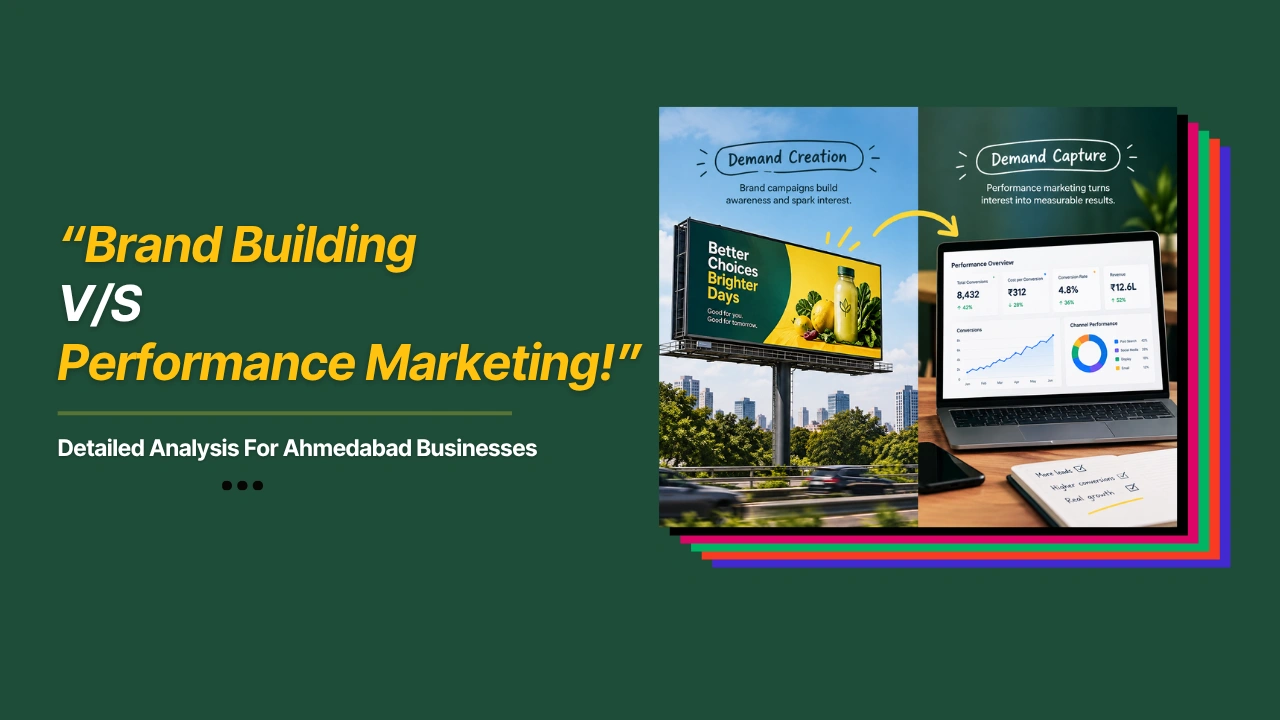
Most marketing conversations in India’s growing business hubs, Ahmedabad included, eventually arrive at the same tension: should the budget go toward building the brand, or toward campaigns that generate leads and sales this month?
It is usually framed as a choice. It shouldn’t be.
Brand marketing and performance marketing solve two different business problems. One creates demand that doesn’t exist yet. The other captures demand that already exists. A business that only does one of these will eventually hit a ceiling: either it runs out of new customers to acquire, or it builds awareness that never converts into revenue.
This article breaks down what each approach actually does, when to lean on which and how a business in Ahmedabad, across categories from real estate to D2C to professional services, can decide its own balance rather than copying a generic ratio from somewhere else.
Table of Contents
- Brand Building vs Performance Marketing: What’s the Difference?
- Why Ahmedabad Businesses Need Both Brand Building and Performance Marketing: 6 Reasons
- When Should You Prioritise Performance Marketing? 5 Signs to Look For
- When Should You Prioritise Brand Building? 5 Signs Your Business Is Ready
- What Happens When You Focus on Only One? 2 Common Marketing Problems
- How Brand and Performance Marketing Reinforce Each Other: 4 Ways They Work Together
- How to Build a Brand and Performance Marketing Strategy: 7 Steps to Follow
- How Should You Measure Brand and Performance Together? 10 Metrics to Track
- A Practical Example: How an Ahmedabad Brand Can Balance Both
- The Right Balance Depends on Your Growth Stage: 3 Stages to Consider
- Brand Building and Performance Marketing Should Work as One System: 2 Sides of Growth
- Team Flora Fountain Is Just a Call Away
- Frequently Asked Questions
Brand Building vs Performance Marketing: What’s the Difference?
Brand marketing is the work of shaping how people think and feel about a business before they need what it sells. It builds recognition, trust and a mental shortcut that makes a business the obvious choice when a need eventually arises.
Performance marketing is the work of converting an existing need into an action, such as a click, an enquiry or a purchase, and measuring that action directly.
The clearest way to see the difference is side by side.
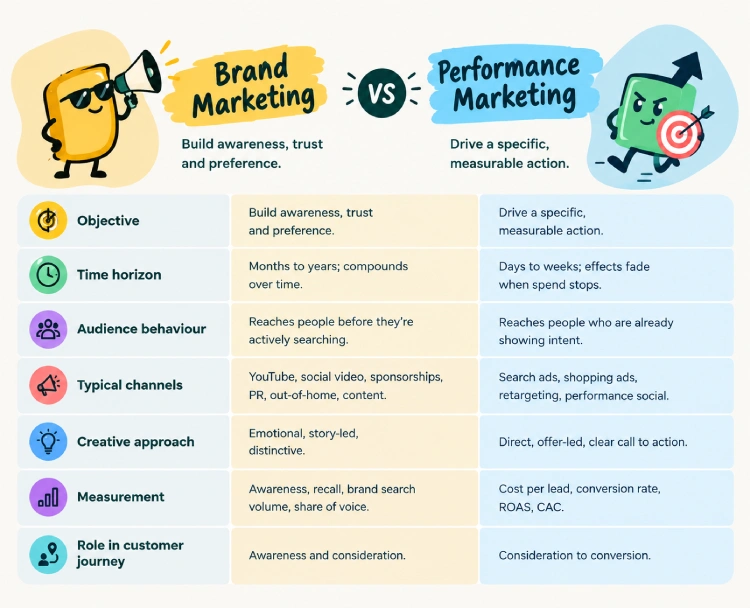
Neither approach is “better.” They sit at different points in the marketing funnel and answer different questions. Brand marketing answers “why should this business matter to me?” Performance marketing answers “what do I do right now?”
Why Ahmedabad Businesses Need Both Brand Building and Performance Marketing: 6 Reasons
The right mix depends heavily on what a business sells and how long people take to decide to buy it.
Consider a few categories active in Ahmedabad’s market, each with a different buying cycle:
- Real estate: A high-consideration purchase where buyers can spend months researching, comparing projects, and visiting properties before deciding. A project that only runs lead generation ads is competing primarily on price and urgency, with no strong reason for a buyer to prefer it over a similar listing.
- Jewellery: A category built on trust, craftsmanship and occasion, where a customer decides which brand to walk into long before they decide what to buy. Performance ads can drive festive footfall, but they rarely build the loyalty that keeps someone coming back for the next wedding purchase.
- Hospitality: Guests choose based on reputation, reviews and how a property makes them feel about an experience they haven’t had yet. That’s brand territory. But occupancy still needs booking engine campaigns that convert search intent into confirmed rooms.
- FMCG and D2C: These depend on repeat purchase and habit formation. Performance marketing can drive a first sale, but customer lifetime value is built by brand associations that bring the customer back without an ad prompting them.
- B2B and professional services: Buying cycles are long, decision makers are few and most of the addressable market isn’t actively shopping at any given moment. A well-known analysis by the Ehrenberg-Bass Institute for Marketing Science found that in many B2B categories, only a small share of potential buyers are actively in-market at any given time, while the rest will buy later, once they’re ready. That’s exactly why staying visible to that larger, not-yet-buying audience matters (Ehrenberg-Bass Institute, Marketing Science).
- Education: Parents and students research for weeks or months, comparing reputation and outcomes, before a single enquiry form is filled. Admission season lead ads work far better when the institution already has a reputation to lean on.
Across every one of these, the pattern repeats. Performance marketing works best when there is already demand to capture. Where the buying decision is slow, emotional or trust-dependent, that demand has to be built first, and that is brand marketing’s job.
When Should You Prioritise Performance Marketing? 5 Signs to Look For
Performance marketing deserves the larger share of budget and attention when:
- The category already has clear, searchable demand and people are actively looking for the product or service.
- The buying cycle is short and the decision is relatively low risk.
- The business needs measurable, near-term results to fund growth, such as a new business, a seasonal push or a specific revenue target.
- There’s a conversion path that’s ready to receive traffic, such as a working website, a responsive sales team and a fast enquiry-to-response cycle.
- The goal is lead generation or direct customer acquisition at a defined cost.
A new D2C brand launching in Ahmedabad with a working product and a functioning website, for instance, often needs performance marketing early to generate cash flow and real customer data. That data later informs brand positioning.
When Should You Prioritise Brand Building? 5 Signs Your Business Is Ready
Brand building deserves more weight when:
- The category has low or no active search demand, and the challenge is that people don’t yet know they have the problem the business solves.
- The purchase is high consideration, high ticket or infrequent, such as real estate, education, premium jewellery or enterprise B2B services.
- The business is entering a competitive, commoditised category and needs a reason to be chosen beyond price.
- Trust, credibility or reputation materially affects the buying decision, as in healthcare, finance, legal or home services.
- The business is trying to reduce its long-term dependence on paid acquisition and build direct, unpaid demand, including branded search, where people search for the business by name instead of a generic category term.
A jewellery brand trying to compete with well-established names on trust and heritage cannot performance market its way into that trust. It has to be built.
What Happens When You Focus on Only One? 2 Common Marketing Problems
1) Performance without brand
A business that runs performance marketing without any brand investment tends to see a familiar pattern: strong early results that get progressively more expensive to repeat.
Cost per lead and cost per acquisition rise over time because the campaigns are always fighting for the same small pool of people who are already searching, with no new demand being created underneath.
The moment the ad spend pauses, so does the pipeline. There is no residual awareness carrying the business forward. This is often described in marketing effectiveness research as advertising that “harvests” demand without ever “sowing” it. A business that only harvests eventually runs out of crop.
2) Brand without a path to conversion
The opposite failure looks different but is equally damaging. A business builds awareness and goodwill; people recognise the name, but nothing is set up to convert that recognition into action. There’s no clear offer, no responsive lead capture and no conversion optimisation on the website to meet the demand once it’s created. The brand becomes well liked but commercially underused: awareness without a business outcome.
The strongest position sits between these two failure modes. Enough brand investment that performance marketing isn’t fighting an uphill battle for attention, and enough performance discipline that brand awareness doesn’t go to waste.
How Brand and Performance Marketing Reinforce Each Other: 4 Ways They Work Together
The relationship between the two isn’t linear. It’s a loop.
Brand building creates awareness, which shapes consideration, which becomes demand. Performance marketing then captures that demand at the moment of intent. Conversions generate data on who is actually buying and why, and that data sharpens brand positioning and messaging, which creates more efficient future demand.
Practically, this shows up in a few consistent ways:
- Search data from performance campaigns often reveals what language customers actually use, which can reshape brand messaging.
- A recognisable brand tends to see lower cost per click and higher click-through rates in performance channels, because ad platforms and people alike respond to familiarity.
- Branded search volume, meaning people searching for the business by name, is one of the more reliable signals that brand investment is translating into real interest, and it’s a metric performance teams can track directly.
- Google’s own full-funnel research points in the same direction. Campaigns that combine upper-funnel brand activity with mid- and lower-funnel performance activity consistently outperform single-stage campaigns on business outcomes, because each stage strengthens the ones that follow (Think with Google).
This is the core argument worth internalising. Performance marketing gets more efficient when brand marketing has done its job, and brand marketing becomes accountable when performance marketing measures its effect.
How to Build a Brand and Performance Marketing Strategy: 7 Steps to Follow
A practical framework, in order:
- Define the business objective: Revenue this quarter, market share over three years or category leadership are different goals that call for different mixes.
- Understand existing demand: Look at search volume, enquiry patterns and competitor activity to see how much demand already exists to be captured.
- Clarify the brand position: What does the business stand for and why should a customer choose it over an equally capable competitor?
- Build demand where it’s missing: Invest in awareness and content where the category or the business itself isn’t yet known or considered.
- Capture demand where it exists: Run performance campaigns against people who are already searching, comparing or ready to act.
- Measure both sides on their own terms, not with a single shared KPI.
- Feed performance insights back into brand strategy: Messaging, audience segments and positioning should evolve based on what performance data reveals about real customers.
This isn’t a one-time plan. It’s a cycle that a business should revisit as its market position, competition and growth stage change.
How Should You Measure Brand and Performance Together? 10 Metrics to Track
One of the more common strategic mistakes is trying to judge every marketing activity by the same yardstick, usually a performance metric like ROAS or cost per lead.
That works for performance marketing. It doesn’t work for brand marketing, because brand activity isn’t designed to convert in the same session or even the same month.
A more useful approach separates the two.
Brand metrics, designed to track awareness and preference over time:
- Brand awareness and recall, measured through surveys or brand lift studies
- Share of voice relative to competitors
- Branded search volume growth
- Direct traffic and repeat visits
- Social following and engagement quality, not just volume
Performance metrics, designed to track conversion efficiency:
- Cost per lead and cost per acquisition
- Conversion rate by channel and campaign
- Return on ad spend (ROAS)
- Lead-to-sale conversion rate
- Customer lifetime value relative to acquisition cost
Neither list works alone. Impressions without any conversion signal can be vanity, but treating ROAS as the only metric that matters ignores the demand-building activity that made those conversions cheaper in the first place. The honest answer is that some marketing activity should be judged on immediate return, and some should be judged on trend, such as awareness moving up, branded search growing or repeat customers increasing over quarters, not days.
A Practical Example: How an Ahmedabad Brand Can Balance Both
Take a hypothetical mid-sized home interiors brand in Ahmedabad, competing in a category with several established local players and a few national D2C entrants.
Running performance campaigns alone, such as search ads for “modular kitchen Ahmedabad” or “interior designer near me,” puts the brand into a bidding war for a small pool of people who are already searching, competing mostly on price and speed of response. Costs climb every festive season as competitors bid up the same keywords.
A combined approach looks different. The brand invests in project showcase content, before-and-after transformations and design-led social content that builds a recognisable point of view, say a focus on space-efficient design for smaller apartments, a genuinely common Ahmedabad housing pattern. This content doesn’t ask for a lead. It builds familiarity and a reason to prefer this brand’s aesthetic over a competitor’s.
Alongside this, performance campaigns run continuously to capture people actively searching or retargeting website visitors who viewed a portfolio page. Because the brand content has already built some recognition, the performance campaigns see better engagement and lower cost per lead than a cold audience would. The sales team also finds that leads arriving through brand-aware channels ask fewer basic questions and take less convincing, since the groundwork has already been laid.
Over two to three quarters, the business tracks both: is branded search growing, and is cost per qualified lead trending down. Both moving in the right direction is the signal that the balance is working, not either metric alone.
The Right Balance Depends on Your Growth Stage: 3 Stages to Consider
There’s no single ratio that fits every business, and any number applied without context is a guess. That said, marketing effectiveness research does offer a useful reference point, not a rule to copy blindly.
The most cited work in this space, Les Binet and Peter Field’s long term analysis of UK advertising effectiveness data, found that campaigns splitting spend roughly 60 percent toward brand building and 40 percent toward activation tended to produce the strongest long run results, though Binet himself is clear that the ratio should flex by category, business situation and competitive context rather than be applied as a fixed formula (Marketing Week).
What matters more than adopting that exact split is understanding how the balance tends to shift with a business’s growth stage:
- New brands with little to no awareness usually need to lean harder into performance marketing early, for cash flow, for customer data and to prove the offer works, while beginning modest brand-building investment in parallel rather than waiting until the business “can afford it.”
- Growing brands that have found product-market fit typically benefit from increasing brand investment, because performance channels alone start showing diminishing returns as they saturate the pool of people already searching.
- Established brands with strong awareness and a healthy share of branded search can often sustain a heavier brand-building weight, using performance marketing primarily to maintain efficient conversion rather than to create demand from scratch.
The right question for any Ahmedabad business isn’t “what percentage should I spend on brand?” It’s “how much of my current demand is being created versus captured, and does that match where my business actually is?”
Brand Building and Performance Marketing Should Work as One System: 2 Sides of Growth
The distinction between brand and performance marketing is useful for planning and measurement. It’s less useful as a strategic choice, because in practice the two aren’t competing priorities. They’re stages of the same system.
Brand creates demand. Performance captures demand.
A business that only captures will run out of demand to capture. A business that only creates will struggle to turn interest into revenue. The businesses that grow sustainably, in Ahmedabad or anywhere else, are the ones that treat both as part of one connected strategy rather than separate campaigns run by separate teams with separate goals.
Team Flora Fountain Is Just a Call Away
Getting that balance right takes an honest look at buying cycles, category dynamics and growth stage, which is a big part of what a considered digital marketing strategy actually involves, beyond simply running ads.
This is the kind of integrated thinking that agencies like Flora Fountain bring to campaign planning, connecting brand and performance work into a single strategy rather than treating them as unrelated line items.
If you’re figuring out where your own business sits on this spectrum, our digital marketing services go into more detail on how we approach that balance for different categories. Get in touch with our expert team today!
Frequently Asked Questions
Brand marketing focuses on building awareness, trust and preference so people are more likely to choose your business when they are ready to buy. Performance marketing focuses on converting existing demand into measurable actions such as clicks, enquiries, leads or purchases.
The key difference is their role in the customer journey: brand marketing creates demand, while performance marketing captures demand. They work best together rather than as competing approaches.
There is no fixed answer because the right balance depends on your business, buying cycle, existing demand and growth stage.
- Prioritise performance marketing when people are actively searching for your product or service, the buying cycle is relatively short and you need measurable results in the near term.
- Prioritise brand marketing when the purchase is high-consideration, trust plays a major role or there is little existing demand to capture.
- Use both when you need to create future demand while also converting people who are ready to buy today.
The right question is not simply how much to spend on each. It is how much of your current demand needs to be created versus captured.
Yes, especially when a business operates in a category with strong existing demand and people are actively searching for what it sells. Performance marketing can generate leads or sales without significant brand investment in the short term.
The limitation is that performance campaigns primarily capture existing demand. Over time, acquisition can become more expensive if the business is continually competing for the same pool of customers without creating new demand. For categories such as real estate, premium jewellery, education and B2B services, brand building can be particularly important because customers often take longer to decide and rely heavily on trust and reputation.
Brand marketing builds awareness and consideration, creating demand that performance marketing can later capture. Performance campaigns then generate data about customer behaviour, search patterns and conversion, which can feed back into the brand strategy.
In practice, the relationship works as a loop:
- Brand marketing builds awareness and preference.
- Performance marketing captures existing intent and drives action.
- Performance data reveals what customers respond to.
- Brand strategy uses those insights to improve messaging and positioning.
This makes both approaches more effective than treating them as completely separate marketing activities.
The two should not be judged using exactly the same metrics because they have different objectives.
For brand marketing, track metrics such as:
- Brand awareness and recall
- Share of voice
- Branded search growth
- Direct traffic and repeat visits
- Quality of social engagement
For performance marketing, focus on:
- Cost per lead and cost per acquisition
- Conversion rate
- Return on ad spend (ROAS)
- Lead-to-sale conversion rate
- Customer lifetime value relative to acquisition cost
Looking at both sets of metrics gives a more complete picture of whether your marketing is creating demand as well as converting it.

Vasim Samadji is a partner at Flora Fountain, where he leads the Business and Marketing Strategy divisions. In a world where everyone is used to sugarcoating, his directness is often considered rude. But that shouldn't be a problem if you like the no-nonsense approach. Because he is a seasoned professional...