


Likes are easy to see. Sales are harder to trace.
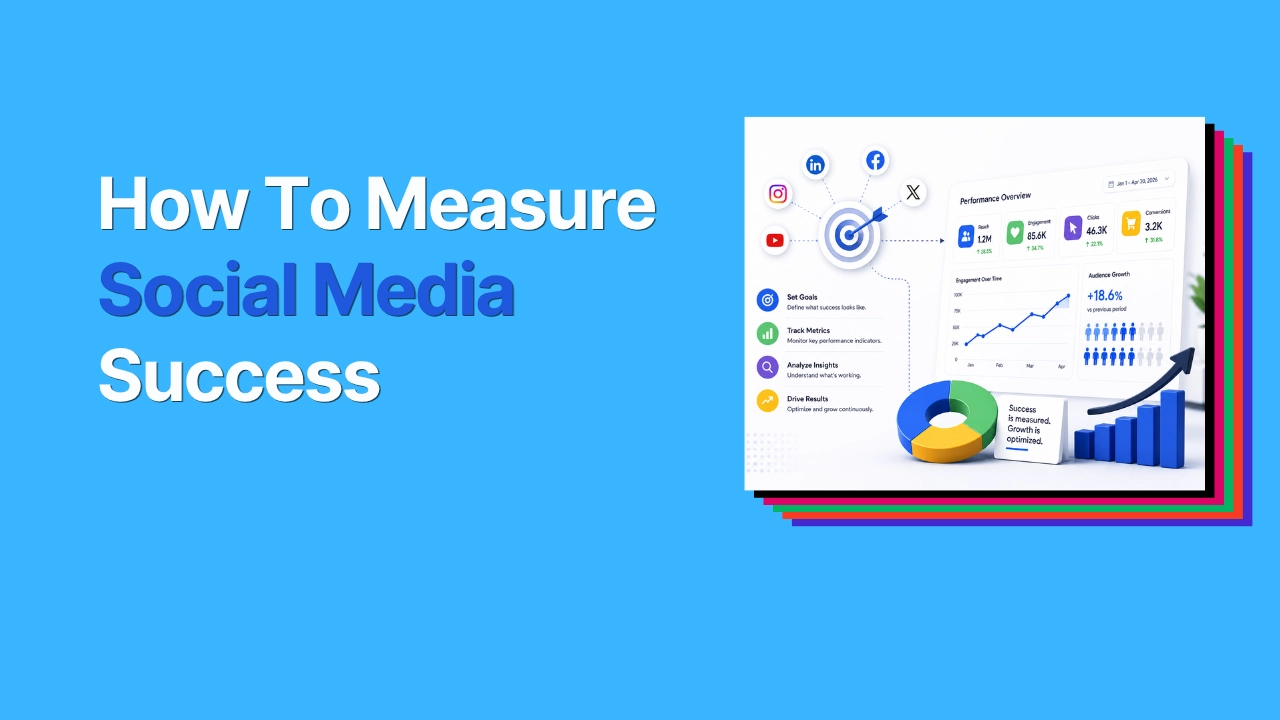
So, how to measure social media marketing success? Start by connecting your social media goals to business outcomes, then track the metrics that show whether those goals are being met.
A post with 100,000 views may look impressive. Yet, if it reaches the wrong audience and generates no useful action, it may not be a successful business result. Likewise, a post with fewer views can be more valuable when it attracts the right people, brings qualified traffic or generates leads.
This is why measuring social media success should go beyond likes and follower counts.
Table of Contents
- Quick Answer
- Why Social Media Success Is Difficult to Measure
- Start With Your Social Media Marketing Goals
- The Most Important Social Media Success Metrics
- How to Measure Social Media Success by Goal
- Organic vs Paid Social Media Metrics
- How to Build a Successful Social Media Strategy Around Data
- How AI in Social Media Marketing Is Changing Measurement
- Common Social Media Measurement Mistakes
- When Should You Work With a Social Media Marketing Agency?
- Final Thoughts
- FAQs
Quick Answer
Social media marketing success is measured by comparing your social media results against clearly defined business goals.
The most useful social media success metrics usually include:
- Reach and impressions for awareness
- Engagement rate for audience response
- Click-through rate for interest and traffic
- Leads and conversions for business impact
- Cost per lead or acquisition for paid campaigns
- Revenue and return on investment for commercial outcomes
- Follower growth and audience quality for long-term community building
There is no single metric that defines success. The right measurement framework depends on what you are trying to achieve.
Why Social Media Success Is Difficult to Measure
Social media creates a large amount of data.
You can see views, likes, comments, shares, saves, clicks, followers, profile visits and many other numbers. The difficulty is deciding which numbers actually matter to your business.
Most measurement frameworks put web traffic, impressions, lead generation, engagement and revenue at the centre of social performance reporting, precisely because these are the numbers that connect back to business outcomes rather than sitting on a platform dashboard.
A metric is useful only when it helps answer a business question.
For example:
Question: Is our content reaching more potential customers?
Metric: Reach
Question: Are people responding to our content?
Metric: Engagement rate
Question: Is social media bringing people to our website?
Metric: Social referral traffic
Question: Is social generating business?
Metric: Leads, sales or revenue
That small shift in thinking can make your reporting much more useful.
Start With Your Social Media Marketing Goals
Before choosing metrics, define the outcome you want from your social media marketing strategy.
Your goals could include:
| Goal | Useful Metrics |
|---|---|
| Brand awareness | Reach, impressions, video views |
| Audience engagement | Engagement rate, comments, shares, saves |
| Website traffic | Link clicks, CTR, sessions from social |
| Lead generation | Leads, conversion rate, cost per lead |
| Sales | Purchases, revenue, customer acquisition cost |
| Community building | Follower growth, comments, replies, returning viewers |
| Customer service | Response time, response rate, resolved queries |
The biggest mistake is starting with the platform dashboard and then deciding what your goal must have been.
A better approach is the opposite.
Goal → KPI → Content → Measurement → Optimisation
This creates a much stronger system for deciding what to publish next.
The Most Important Social Media Success Metrics
You do not need to track every number available.
You need the numbers that explain whether your strategy is working.
1. Reach
Reach tells you how many unique people saw your content.
It is particularly useful when the objective is awareness.
However, high reach does not automatically mean high-quality exposure. You should also look at who you reached and whether those people match your intended audience.
2. Impressions
Impressions show how many times content was displayed.
One person can create multiple impressions. Therefore, impressions and reach should not be treated as the same thing.
This distinction matters when you are comparing campaigns or platforms, because different social networks can define and calculate impressions in slightly different ways.
3. Engagement Rate
Engagement tells you whether people are actually responding to your content.
Depending on the platform, this can include reactions, likes, comments, shares, saves and clicks.
A useful basic formula is:
Engagement Rate = Total Engagements ÷ Reach or Impressions × 100
The denominator should be kept consistent within your reporting so that comparisons remain meaningful.
Do not look only at the number of likes. A thoughtful comment or share may tell you much more about audience interest.
4. Click-Through Rate
Click-through rate, or CTR, helps you understand whether people are taking the next step after seeing your content.
CTR = Clicks ÷ Impressions × 100
This is useful when your social media objective is to drive traffic to a landing page, article, product page or enquiry form.
5. Follower Growth
Follower growth can show whether your audience is expanding.
Yet, follower count alone is a weak measure of success.
A smaller but relevant audience can be more valuable than a very large audience with little interest in what you offer.
LinkedIn’s Page analytics, for example, separates follower information from content performance, visitor data and search appearances. This helps marketers understand not just how many people follow a Page but also how those audiences interact with it.
6. Leads and Conversions
This is where social media measurement becomes much more connected to business performance.
Track actions such as:
- Form submissions
- Enquiries
- Calls
- Product purchases
- Demo requests
- App downloads
- Sign-ups
A campaign that produces fewer clicks but more qualified leads may be much stronger than a campaign that produces large amounts of low-value traffic.
7. Cost Per Lead or Acquisition
For paid campaigns, cost matters.
Cost Per Lead = Total Campaign Spend ÷ Leads Generated
You can also use customer acquisition cost when you have reliable customer and revenue data.
This is especially important for businesses using social media marketing services as part of a wider performance strategy.
How to Measure Social Media Success by Goal
There is no universal definition of success.
Your measurement model should change based on your objective.
1. If Your Goal Is Brand Awareness
Track:
Reach + Impressions + Video Views + Audience Quality
For awareness campaigns, it is reasonable to care about how many relevant people you reached.
2026 industry data actually points the other way for many marketers: PhotoShelter’s State of Social Media Marketing report found brand awareness sliding down the priority list, from 76% of marketers naming it their top goal to just 22%, with engagement (63%) now the leading priority. That shift makes awareness measurement easy to deprioritise, but it is still worth taking seriously for brands with longer buying cycles, where visibility now pays off later.
2. If Your Goal Is Engagement
Track:
Engagement Rate + Shares + Comments + Saves + Replies
Do not just ask, “How many people liked this?”
Ask:
Did this content make people respond, discuss or share?
That is often a better signal of genuine interest.
Buffer’s 2026 analysis of more than 52 million posts across 10 platforms also shows why engagement needs to be evaluated through real platform data rather than assumptions about what should work.
3. If Your Goal Is Website Traffic
Track:
Link Clicks + CTR + Sessions + Landing Page Behaviour
A useful next step is to connect social traffic with website analytics.
Otherwise, you may know that people clicked without knowing what they did afterwards.
4. If Your Goal Is Lead Generation
Track:
Leads + Conversion Rate + Cost Per Lead + Lead Quality
Lead volume should not be your only KPI.
Ten poor leads may be less valuable than three qualified prospects.
5. If Your Goal Is Revenue
Track:
Purchases + Revenue + Customer Acquisition Cost + Return on Investment
This is usually the most commercially important measurement layer.
Social media may support the customer journey without being the final touchpoint. Therefore, attribution should be interpreted carefully rather than treated as perfect proof of causation.
This is a distinction more platforms are building tools around: helping marketers separate what marketing actually caused from what attribution systems simply claim.
Key rule: Do not confuse attribution with causation.
Organic vs Paid Social Media Metrics
Organic and paid social should not always be judged in exactly the same way.
Organic Social
Focus more heavily on:
Reach, engagement rate, shares, saves, follower growth, profile visits, website traffic and community response.
The main question is:
Are we building attention and trust with the right audience?
Paid Social
Focus more heavily on:
Spend, CPM, CTR, CPC, conversions, cost per lead, cost per acquisition and revenue.
The main question becomes:
Is our paid investment producing an outcome that justifies the cost?
A campaign can also have a low CPM yet still perform badly if the traffic is poor or the conversion rate is weak.
How to Build a Successful Social Media Strategy Around Data
A successful strategy should not end when the report is delivered.
The report should tell you what to do next.
A useful process is:
- Set the goal
Decide what the campaign needs to achieve.
- Select the KPI
Choose the smallest useful set of metrics.
- Establish a baseline
Look at your recent performance before setting a target.
- Publish and measure
Give the content enough time and data to produce meaningful signals.
- Identify patterns
Look for common themes across strong and weak posts.
- Test and optimise
Change one major variable at a time where possible.
- Repeat
Measurement should be an ongoing cycle rather than a one-time activity.
Comparing your results against appropriate industry benchmarks, rather than judging every number in isolation, is standard practice for telling a genuine shift apart from normal variation.
Tip: Your own historical performance is often one of the most useful benchmarks because it reflects your audience, content style and business context.
How AI in Social Media Marketing Is Changing Measurement
AI in social media marketing is changing more than content creation.
It is also changing how teams analyse large amounts of content and audience data.
A September 2025 survey by MiQ and Censuswide found that social media management was the single most-cited AI use case among marketers worldwide, reported by 40% of respondents.
AI can help marketers:
- Spot patterns across large datasets
- Group comments by topic
- Identify strong-performing content themes
- Speed up reporting
- Compare content formats
- Generate ideas for new tests
Yet, AI should support judgement rather than replace it.
A dashboard may tell you that one post performed better. It cannot always tell you why that happened or whether the result can be repeated.
Human interpretation remains important.
Common Social Media Measurement Mistakes
👉Measuring Everything
More metrics do not automatically mean better reporting.
Too many numbers can hide the important ones.
👉Focusing Only on Vanity Metrics
Followers, likes and views have value.
They simply should not be treated as proof of business success on their own.
👉Comparing Platforms Without Context
Instagram, LinkedIn, YouTube, Facebook and TikTok have different audiences, formats and measurement systems.
Compare like with like.
👉Judging Content Too Quickly
A post may need time to gain reach or generate meaningful traffic.
Avoid making major strategic decisions from very small samples.
👉Ignoring Business Outcomes
This is perhaps the biggest mistake.
A social report should eventually answer: What did our social media activity achieve for the business?
When Should You Work With a Social Media Marketing Agency?
Managing social media becomes more complex as your goals grow.
You may need strategy, creative development, content production, influencer campaigns, paid advertising, analytics and optimisation at the same time.
This is where a social media marketing agency can bring structure.
At Flora Fountain, we approach social media as more than a content calendar. We connect creative thinking with audience insights, platform data and business goals.
For businesses looking for social media marketing services in Ahmedabad or a social media marketing agency in Ahmedabad, the right partner should be able to explain not just what was posted but why it was posted, what it achieved and what should happen next.
That distinction matters when comparing a best social media marketing agency with a team that simply produces content.
Final Thoughts
Social media success is not one number.
It is the relationship between your goals, your audience, your content and your business outcomes.
Start with what you want to achieve. Then choose the metrics that prove progress towards that goal.
Reach can show visibility. Engagement can show interest. Clicks can show intent. Leads and sales can show commercial impact.
Your measurement framework should evolve as your social media marketing strategy evolves.
At Flora Fountain, we believe good social media marketing should create more than attention. It should create a measurable reason for that attention to matter.
That is the difference between simply being active on social media and using social media strategically.
Need a social media strategy in Ahmedabad built around measurable business goals? Talk to Team Flora about our strategic social media marketing services.
Frequently Asked Questions

Vasim Samadji is a partner at Flora Fountain, where he leads the Business and Marketing Strategy divisions. In a world where everyone is used to sugarcoating, his directness is often considered rude. But that shouldn't be a problem if you like the no-nonsense approach. Because he is a seasoned professional...