


You can spend ₹50,000 on Google Ads and generate ₹2,00,000 in revenue. On paper, that looks like a successful campaign. But is it actually profitable?
That depends on your margins, costs and business model. This is why ROAS in Google Ads is useful, but should never be viewed as the only number that matters.
ROAS tells you how much conversion value your ads generated for the money you spent. It helps you understand advertising efficiency and compare campaign performance. A higher number can be good, but there is no universal ROAS target that works for every business.
Quick Answer
ROAS in Google Ads is the conversion value generated from advertising divided by advertising cost.
ROAS = Conversion value ÷ Ad spend
- ROAS of 2 = ₹2 in conversion value for every ₹1 spent
- ROAS of 4 = ₹4 in conversion value for every ₹1 spent
- ROAS of 5 = ₹5 in conversion value for every ₹1 spent
A higher ROAS is not automatically better. The right target depends on margins, operating costs, customer value and business goals.
Table of Contents
- What Is ROAS in Google Ads?
- How to Calculate ROAS in Google Ads?
- What Is a Good ROAS for Google Ads?
- What Is Target ROAS in Google Ads?
- How Does Target ROAS Work?
- How to Choose a Target ROAS
- How to Improve ROAS in Google Ads
- ROAS vs ROI: What Is the Difference?
- Common ROAS in Google Ads Mistakes
- Final Thoughts
- Faqs
What Is ROAS in Google Ads?
The meaning of ROAS in Google Ads (aka Return on Ad Spend) is the measure of how much conversion value you generate compared with the amount spent on advertising.
In Google Ads, the conversion value/cost metric helps advertisers understand the value generated compared with advertising cost.
For example, if you spend ₹10,000 on ads and generate ₹40,000 in tracked conversion value, your ROAS is 4.
ROAS is not the same as ROI or CPA:
- ROAS measures conversion value compared with ad spend.
- ROI can consider the broader costs and returns involved in the business.
- CPA measures how much you paid for each conversion.
A strong ROAS does not automatically mean strong profit. Product costs, fulfilment, salaries, discounts and other expenses still matter.
Let’s Make It Simpler
A ROAS number becomes easier to understand when you look at what it represents.
| ROAS | Meaning |
|---|---|
| 1 | ₹1 in conversion value for every ₹1 spent |
| 2 | ₹2 returned for every ₹1 spent |
| 3 | ₹3 returned for every ₹1 spent |
| 4 | ₹4 returned for every ₹1 spent |
| 5 | ₹5 returned for every ₹1 spent |
A ROAS above 1 does not automatically mean a campaign is profitable.
Imagine an ecommerce business sells a ₹1,000 product. If the product, shipping, fulfilment, payment and operating costs total ₹800, a campaign generating ₹1 in revenue for every ₹1 spent on ads would clearly not work.
This is why the ROAS number must be viewed alongside actual business economics.
How to Calculate ROAS in Google Ads?
The formula is straightforward:
ROAS = Conversion value ÷ Ad spend
Example 1
₹1,00,000 conversion value ÷ ₹25,000 ad spend = 4 ROAS
That means you generated ₹4 in attributed conversion value for every ₹1 spent on advertising.
Example 2
₹1,50,000 conversion value ÷ ₹50,000 ad spend = 3 ROAS
That means every ₹1 spent generated ₹3 in conversion value.
ROAS can also be shown as a percentage:
ROAS of 4 = 400%
The important thing is not to confuse this with profit margin. A 400% ROAS means ₹4 in tracked conversion value for every ₹1 spent. It does not mean ₹4 in profit.
What Is a Good ROAS for Google Ads?
There is no universal answer to what is a good ROAS for Google Ads.
A business with high margins may be comfortable operating at a lower ROAS. A business with thin margins may need a much higher return before advertising becomes profitable.
Your target should consider:
- Gross or contribution margin
- Customer lifetime value
- Average order value
- Operating costs
- Business model
- Campaign objective
For example, a business acquiring customers who make repeat purchases may accept a lower first-purchase ROAS than a business that relies on one-time transactions.
This is where context matters. Chasing an arbitrary target because another company considers 4 ROAS or 5 ROAS successful can lead to poor decisions.
The better question is: What ROAS does this business need to support its actual goals and economics?
What Is Target ROAS in Google Ads?
Google Ads Target ROAS is a Smart Bidding strategy that aims to maximise conversion value while working towards a specific return on ad spend target.
Google’s current Smart Bidding documentation explains that, starting in June 2026, the previous label “Maximize conversion value with a Target ROAS” is changing to “Target ROAS”, while the underlying bidding behaviour remains the same.
Target ROAS sits within Google’s value-based bidding approach, which is designed for situations where different conversions have different values.
For example, 10 conversions are not necessarily equal. One customer may generate ₹500 in value while another generates ₹10,000. In this situation, optimising only for conversion volume can hide an important difference.
Target ROAS allows Google Ads to use conversion value as part of the bidding objective.
How Does Target ROAS Work?
Target ROAS works by using your reported conversion values to help Google estimate the potential value of a conversion and adjust bids accordingly.
Google’s Smart Bidding system uses auction-time bidding to optimise bids for conversions or conversion value. Its bidding systems can also evaluate contextual signals during individual auctions.
For Target ROAS specifically, Google’s bidding guidance explains that the system uses predicted conversion value and contextual auction-time signals when setting bids.
Suppose your Target ROAS is 400%.
Google Ads will try to generate an average of approximately ₹4 in conversion value for every ₹1 spent over time. Individual conversions may perform above or below that target.
This is why accurate conversion tracking matters.
Google’s guidance on conversion values makes an important point here. The values you report help Google measure business impact and identify higher-value conversions. If those values do not reasonably reflect what different conversions are worth, optimisation becomes less useful.
How to Choose a Target ROAS
Do not choose a target randomly.
Start by reviewing:
- Historical conversion value and cost
- Your actual business margins
- Customer value
- Campaign goals
- Whether the conversion values being tracked are reliable
Google’s value-based bidding guidance recommends reviewing historical ROAS performance when setting a target. Its guidance specifically suggests using historical performance as a benchmark rather than starting with an arbitrary number.
Google’s Smart Bidding performance guidance also states that your target ROAS should generally be at or below historical ROAS performance when determining an initial target.
That does not mean you should copy a number blindly.
Your historical ROAS may not reflect your ideal business target. Perhaps margins have changed. Perhaps you are intentionally investing more aggressively in customer acquisition. Historical performance should be a starting point, not the entire decision.
Also, avoid changing targets constantly. If every short-term fluctuation leads to a new bidding target, it becomes difficult to understand what is actually affecting performance.
How to Improve ROAS in Google Ads
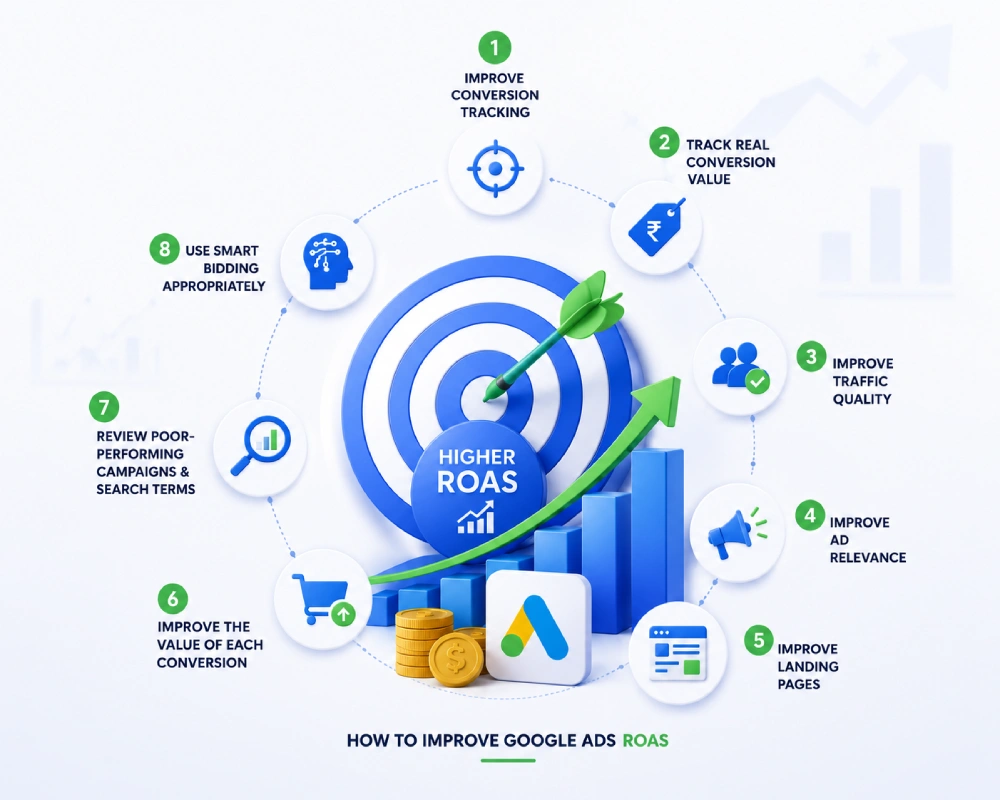
Improving ROAS is not always about reducing bids. Often, the bigger opportunity is improving the quality of traffic, conversion tracking or conversion value.
1. Improve conversion tracking
Start with the data.
If purchases, leads or other important actions are not being tracked properly, your ROAS calculations can be misleading.
Google’s conversion value measurement guidance explains that assigning values to conversions helps advertisers measure the total business value generated by campaigns, not simply the number of conversions.
Make sure your conversion setup reflects the actions that actually matter to the business.
2. Track real conversion value
Not every conversion has the same value.
If a ₹500 purchase and a ₹20,000 purchase are treated as equal, your optimisation data loses useful information.
Where appropriate, use conversion values that better reflect what each transaction or customer means to the business. This is particularly important when using value-based bidding strategies such as Target ROAS.
3. Improve traffic quality
More traffic is not automatically better.
Review search intent, search queries, targeting and audiences. Remove wasted spend where it clearly does not contribute to meaningful conversion value.
For businesses looking for performance marketing services in Ahmedabad, this is why campaign analysis should go beyond clicks and impressions. The real question is whether the traffic is producing valuable outcomes.
4. Improve ad relevance
Your ad should match what the user is actually searching for.
Better alignment between the search query, ad message and landing page can improve the quality of visitors arriving on the site.
If you are also reviewing your wider campaign structure, the broader Flora Fountain digital marketing services approach can provide useful context around how paid campaigns fit into the overall marketing strategy.
5. Improve landing pages
Google Ads can bring the right person to your website. The landing page still has to do its job.
Keep the page clear. Make the offer easy to understand. Remove unnecessary friction and give users a clear next step.
Flora Fountain’s Performance Marketing service also focuses on areas closely connected to ROAS, including PPC, conversion rate optimisation and landing page optimisation.
6. Improve the value of each conversion
Sometimes the best way to improve ROAS is not only to reduce advertising cost.
You may be able to improve:
- Average order value
- Product bundles
- Upsells
- Cross-sells
- Customer lifetime value
More value from the same quality of traffic can improve the economics of the campaign.
7. Review poor-performing campaigns and search terms
Do not optimise only around clicks.
Look at cost alongside conversion value. Some campaigns may generate plenty of traffic but contribute very little business value.
This is where a performance marketing agency in Ahmedabad should focus on the relationship between spend and outcomes rather than simply reporting activity.
8. Use Smart Bidding appropriately
Target ROAS can be useful when you have reliable conversion values and your goal is to optimise for value at a specific efficiency target.
Google’s bid strategy guidance recommends choosing a bidding strategy based on the actual business goal. If your priority is conversion volume rather than differences in conversion value, another bidding strategy may be more appropriate.
The goal is not to use Smart Bidding simply because it is automated. The goal is to use the strategy that best matches what you are actually trying to achieve.
ROAS vs ROI: What Is the Difference?
ROAS measures return relative to advertising spend.
ROI measures return relative to the broader investment or costs being considered.
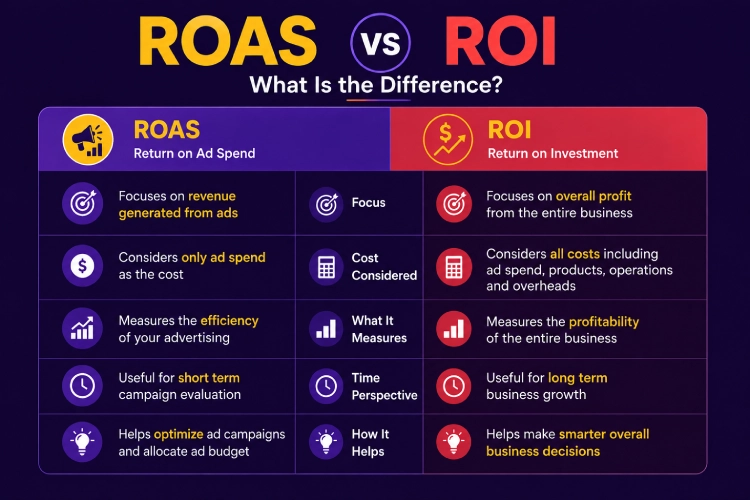
A campaign can show a strong ROAS while the business itself remains unprofitable after product costs, salaries, shipping, technology and other expenses.
This does not make ROAS unimportant. It simply means it should be viewed as an advertising efficiency metric, not a complete profitability report.
Common ROAS Mistakes
Some of the most common mistakes include:
- Treating ROAS as profit
- Chasing an unrealistic ROAS target
- Using incorrect conversion values
- Ignoring customer lifetime value
- Optimising for conversion volume when conversion values differ significantly
- Judging performance too quickly
- Comparing ROAS across businesses without considering margins and business models
The number is useful. The interpretation matters just as much.
Final Thoughts
ROAS in Google Ads is useful because it gives you a simple way to understand how efficiently advertising spend is generating conversion value. But the number only becomes meaningful when you connect it with margins, tracking, customer value and campaign goals.
At Flora Fountain, we see ROAS as an important performance measure, not the only one. Strong campaigns need reliable data, relevant traffic and a clear understanding of what each conversion is actually worth.
If you’re unsure whether your ROAS in Google Ads is healthy, start by looking beyond the number. Check your conversion values, margins, tracking and campaign goals together. Businesses looking for performance marketing services in Ahmedabad need that broader view if they want advertising decisions to support real business growth.
As a performance marketing agency in Ahmedabad, Flora Fountain looks beyond ad clicks and considers the wider conversion journey. Our Performance Marketing services bring together PPC, landing page optimisation, CRO and other areas that directly affect how efficiently advertising spend performs. Get in touch with the Flora Fountain team today.
Frequently Asked Questions

Vasim Samadji is a partner at Flora Fountain, where he leads the Business and Marketing Strategy divisions. In a world where everyone is used to sugarcoating, his directness is often considered rude. But that shouldn't be a problem if you like the no-nonsense approach. Because he is a seasoned professional...