


Every founder eventually asks the same question.
Should the budget go into building the brand, or into ads that sell right now? Most answers dodge it with “it depends.” The real answer is more useful than that: brand building and sales activation aren’t rivals competing for the same budget; they’re a dual-engine system, and running one without the other is why so many campaigns quietly stop working.
Here’s the pattern behind that failure. A business pours its entire budget into direct-response ads because that’s where the immediate revenue is. It works, for a while. Then costs per click creep up, ad fatigue sets in, and returns start sliding, not because the ads got worse, but because the audience being targeted has no prior familiarity with or trust in the brand.
This isn’t a hunch. It’s one of the most rigorously tested findings in modern marketing effectiveness research, and this piece breaks down exactly what it means for how you should actually split your budget.
In short: brand awareness campaigns build future demand while sales campaigns capture existing demand, and marketing effectiveness research spanning 996 case studies found that brands allocating roughly 60% of spend to brand building and 40% to activation achieve stronger long-term growth than those that lean heavily into either one.
Table of Contents
- What’s the Real Difference Between Brand Awareness and Sales Campaigns?
- What Does a Brand Awareness Campaign Actually Do for a Business?
- What Does a Direct Sales Campaign Actually Do, and Where Does It Fail?
- Brand Awareness vs Sales Campaigns: The Full Comparison
- What Is the 60/40 Rule, and Is It Actually a Fixed Formula?
- Which Budget Split Should Your Brand Actually Use?
- In Conclusion
- FAQs
What’s the Real Difference Between Brand Awareness and Sales Campaigns?
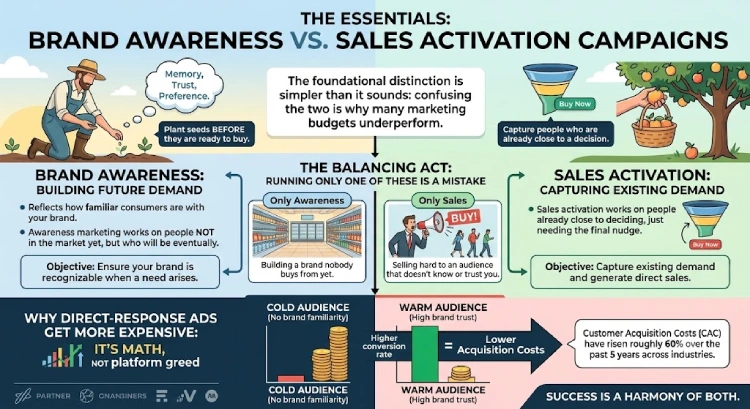
Brand awareness campaigns build future demand by creating memory, trust and preference before a customer is ready to buy, while sales campaigns capture existing demand from people already close to a purchase decision, and confusing the two is why so many marketing budgets underperform.
This is the foundational distinction in any brand awareness vs sales campaigns decision, and it’s simpler than most marketing conversations make it sound:
- Awareness marketing works on people who aren’t in the market yet, but will be eventually
- Sales activation works on people who are already close to deciding, and just need the final nudge
- Running only one of these means either building a brand nobody buys from yet, or selling hard to an audience that doesn’t know or trust you
The reason direct-response ads get more expensive over time isn’t platform greed, it’s math. Customer acquisition costs have risen roughly 60% over the past five years across industries, and a cold audience with no brand familiarity converts at a lower rate than a warm one, which pushes acquisition costs up further still.
What Does a Brand Awareness Campaign Actually Do for a Business?
A brand awareness campaign builds long-term memory structures, trust and emotional resonance so a brand is already top-of-mind by the time a buyer actually enters the market, functioning as a compounding investment rather than a transaction.
The most common mistake here is expecting an awareness campaign to behave like a sales campaign. It won’t, and shouldn’t, because it’s measured differently:
- Reach and impressions, how many people actually saw the message
- Video completion rate, whether the story held attention long enough to land
- Brand lift, measurable shifts in recall, favourability or purchase intent
- Organic search volume and share of voice, both strong signals that awareness is translating into genuine interest
This is where a good Advertising agency earns its value, not by running more ads, but by crafting the visual narratives, brand identity and campaign hooks memorable enough to survive being seen once in a crowded feed and still be recalled weeks later when the buyer is finally ready.
What Does a Direct Sales Campaign Actually Do, and Where Does It Fail?
A direct sales campaign is built to drive immediate, trackable action, a purchase, a form fill, a booking, and it fails specifically when it’s aimed at a completely cold audience that has no prior trust in the brand, since conversion rates on cold traffic are consistently lower.
Performance campaigns are measured on entirely different, much more immediate metrics:
- Cost per acquisition (CPA), what it actually costs to win one customer or lead
- Return on ad spend (ROAS), revenue generated per unit of ad spend
- Conversion rate (CVR), the percentage of people who take the desired action
- Click-through rate (CTR), how many people engage with the ad at all
This is precisely why a sales campaign vs brand campaign comparison matters before you spend a rupee. Pushing a hard sales offer at an audience with zero brand familiarity is expensive by design; you’re paying to build trust and close the sale in the same ad, instead of letting brand work do the trust-building earlier and more cheaply. An experienced Digital marketing Agency solves this by building tight retargeting funnels and testing creative against audiences that already have some familiarity with the brand, rather than only ever targeting cold traffic.
Brand Awareness vs Sales Campaigns: The Full Comparison
The core difference in any performance marketing vs brand marketing comparison comes down to timeline and objective: brand campaigns build recall and trust over the medium to long term, while sales campaigns drive an immediate, trackable action from an audience already close to buying.
| Feature | Brand Awareness Campaigns | Direct Sales Campaigns |
|---|---|---|
| Primary Objective | Build recall, trust, and preference | Drive immediate sales, leads, or actions |
| Target Audience | Broad market, largely out-of-market buyers | High-intent, in-market buyers |
| Timeline to ROI | Medium to long-term, compounding | Short-term, immediate |
| Core Message | Emotional, story-driven, value-focused | Direct offer, urgency, clear call-to-action |
| Key Metric | Organic reach, brand lift, ad recall | Cost per sale, ROAS, conversion rate |
This is exactly the kind of comparison a Social media advertising agency should be running before setting any campaign live, since the creative, targeting and even the platform choice usually need to differ between the two rather than being handled by one blended campaign trying to do both jobs at once.
What Is the 60/40 Rule, and Is It Actually a Fixed Formula?
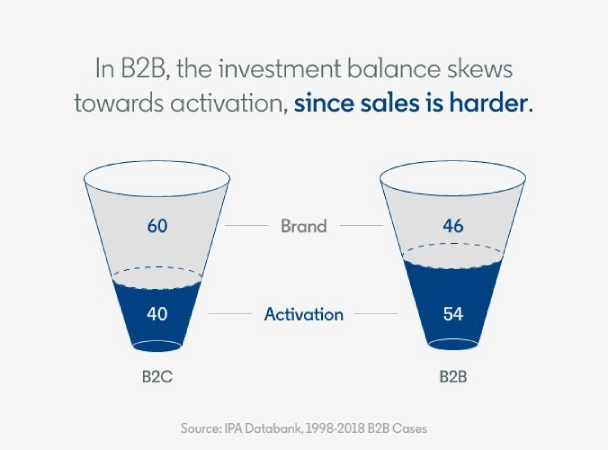
The 60/40 rule, based on Les Binet and Peter Field’s analysis of nearly 1,000 IPA Effectiveness Awards case studies, found that brands allocating roughly 60% of spend to brand building and 40% to activation achieved the strongest long-term profit growth, though the researchers themselves have been clear it’s an average, not a fixed formula.
This distinction matters more than most summaries of the research admit. The 60:40 split isn’t a rule to apply blindly to every brand:
- Financial services and other high-consideration categories often skew closer to 70:30 or even 80:20 in favour of brand
- Newer brands entering a market typically need a heavier brand-building weighting before performance spend can even work efficiently
- Established brands with strong existing recall can sometimes shift closer to 50:50 or lean slightly more into activation without losing ground
A skilled Performance marketing agency treats 60/40 as a starting benchmark to test and adjust against actual results, brand lift data and conversion trends, not a number to set once and leave alone.
Which Budget Split Should Your Brand Actually Use?
The right brand-to-sales budget split depends on business stage: new brands typically need closer to 70% awareness and 30% sales, established brands scaling growth tend to perform best near the classic 60:40 split, and short seasonal promotions can justify shifting as far as 80% toward sales activation.
Three practical scenarios, rather than one formula for every business:
Scenario A: New brand launch or market entry. Roughly 70% awareness, 30% sales. Focus heavily on introducing the brand narrative and building retargeting audiences before scaling conversion budgets, since there’s little existing demand to capture yet.
Scenario B: Established brand scaling growth. Roughly 60% brand, 40% sales, the classic Binet and Field ratio. Maintain top-of-funnel reach to keep warming new prospects while running conversion campaigns against existing demand.
Scenario C: Seasonal promotions or flash sales. Roughly 20% awareness, 80% sales. Temporarily shift almost entirely to direct response to capitalise on high-intent shopping windows like festive sales or end-of-season clearance, since the goal here is short-term volume, not long-term recall.
Getting this shift right, and shifting back afterwards, is exactly the kind of Paid advertising management work that separates a campaign that spikes and disappears from one that compounds into lasting brand equity.
In Conclusion
Brand awareness builds the fire. Sales campaigns strike the match. Neither one on its own gets you very far; a fire with no fuel burns out fast, and fuel with no spark never lights at all. The businesses that scale sustainably are the ones that stop treating this as a binary choice and start treating it as a single, deliberately balanced system.
If your current budget is entirely performance-led, the fix usually isn’t to abandon what’s working; it’s to start feeding it with brand equity so the same ad spend converts more cheaply over time, instead of getting more expensive every quarter.
Struggling to balance performance with brand growth? As a Digital marketing agency, we build full-funnel advertising strategies that capture sales today while securing your market position for tomorrow. Drop us a line at hello@florafountain.com and let’s map out the right split for where your brand actually is.
Frequently Asked Questions

Vasim Samadji is a partner at Flora Fountain, where he leads the Business and Marketing Strategy divisions. In a world where everyone is used to sugarcoating, his directness is often considered rude. But that shouldn't be a problem if you like the no-nonsense approach. Because he is a seasoned professional...