


Five days ago, an AI startup that most people outside the developer world had never heard of became a unicorn. Emergent Labs closed a $130 million Series C at a $1.5 billion valuation, five times what it was worth just six months earlier, roughly thirteen months after the company was founded.
That speed only makes sense once you understand what Emergent Labs actually replaced. Traditional software development meant hiring engineers, running sprint cycles and waiting months before an idea became something a customer could touch. Emergent Labs compressed that entire process into a plain-language description and a few minutes of waiting.
This case study breaks down how a platform built on natural language prompts went from a Y Combinator batch to a $1.5 billion valuation, and what the strategy behind it means for anyone building or marketing high-growth tech.
In short: Emergent Labs is a “vibe coding” platform where autonomous AI agents turn plain-language descriptions into production-ready software, reaching $120 million in annual recurring revenue and a $1.5 billion valuation within roughly thirteen months of its founding.
Fast facts
| Company | Emergent Labs Inc. (Emergent) |
|---|---|
| Founders | Mukund Jha (CEO) and Madhav Jha (CTO) |
| Founded | 2025, out of Y Combinator |
| Headquarters | San Francisco, with a large engineering base in Bengaluru |
| Latest funding | $130 million Series C, July 2026, led by Creaegis |
| Valuation | $1.5 billion, up from $300 million six months earlier |
| Total funding raised | Approximately $230 million |
| Current ARR | $120 million, with 200,000 paying customers |
| Apps built on the platform | Over 12 million since public launch |
| Backend | MongoDB Atlas |
Table of Contents
- What is Emergent Labs?
- Who are the founders of Emergent Labs?
- What does “vibe coding” actually mean for software development?
- How does Emergent Labs handle complex backend infrastructure?
- How much does Emergent Labs cost compared to its competitors?
- What is the valuation of Emergent Labs in 2026, and how did it get there?
- What does this mean for enterprise teams and non-technical builders?
- What can other tech and SaaS brands learn from Emergent Labs?
- In Conclusion
- FAQs
What is Emergent Labs?
Emergent Labs is an AI-powered “vibe coding” platform that turns plain-language descriptions into production-ready web and mobile applications, and it reached unicorn status on 15 July 2026 after a $130 million Series C valued the company at $1.5 billion.
View this post on Instagram
The Emergent Labs AI app builder solves a problem every founder with a good idea and no engineering team has faced: building software has always required capital, time and talent that most people simply don’t have. Emergent Labs’ pitch is that none of those three should be a prerequisite for shipping real, working software.
The scale of adoption is what makes this genuinely different from a typical AI hype cycle:
- Over 12 million applications have been built on the platform since its public launch
- The company now counts 200,000 paying customers and between 1.5 and 2 million monthly active users
- Annual recurring revenue has grown from $100,000 to $120 million in roughly a year
That trajectory places Emergent Labs among a small handful of AI companies, alongside Replit and Cursor, that have gone from a Y Combinator launch to a multi-billion dollar valuation inside two years.
Who are the founders of Emergent Labs?
View this post on Instagram
The twin brother duo, Mukund and Madhav Jha, founded Emergent Labs after recognising that the biggest barrier between a good business idea and a working product was not the idea itself, but the cost and scarcity of skilled engineering talent needed to build it.
Their backgrounds gave them an unusually direct view of that bottleneck from two different angles.
- Mukund Jha spent time at Google before becoming co-founder and CTO of Dunzo, one of India’s pioneering quick-commerce platforms, where he saw firsthand how execution speed decided which businesses actually survived
- Madhav Jha holds a PhD in Theoretical Computer Science from Penn State University, was a postdoctoral fellow at Sandia National Laboratories, and was a founding member of the research team that built Amazon SageMaker
That combination, one brother who understood the operational cost of slow engineering and one who understood how to build serious machine learning infrastructure, is what let them design an “engineering team in the cloud” rather than just another AI coding assistant. Emergent Labs launched publicly in 2025 out of Y Combinator’s 2024 batch.
What does “vibe coding” actually mean for software development?
View this post on Instagram
Vibe coding is a software development approach where a user describes what they want in plain language, and autonomous AI agents handle the planning, building, testing and deployment of the application without the user writing any code.
Vibe coding software development works through a coordinated system of specialised agents rather than a single model doing everything at once:
| Agent | Role |
|---|---|
| Planning Agent | Translates the user’s description into structured project requirements. |
| Frontend Agent | Designs and builds the user interface. |
| Backend Agent | Creates APIs, business logic, and data architecture. |
| Testing Agent | Identifies bugs and checks application reliability. |
| Deployment Agent | Publishes the finished application with managed hosting. |
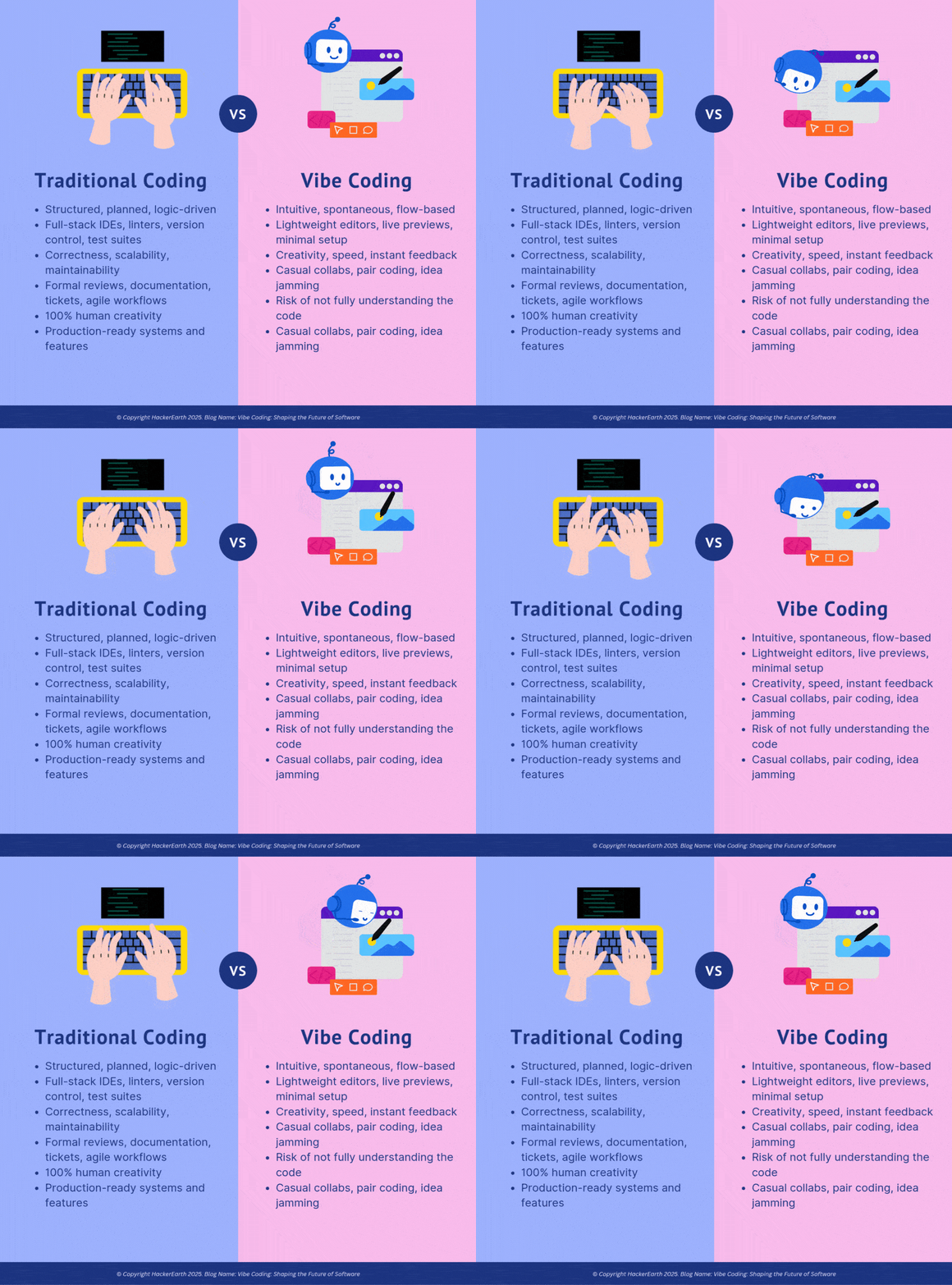
This is a meaningful step beyond tools like GitHub Copilot, which suggest individual lines or functions inside an existing codebase. Emergent Labs’ autonomous engineering agents operate at the level of an entire application, spinning up a full-stack project, testing it and deploying it, something that even a full-stack web development and design agency would appreciate.
How does Emergent Labs handle complex backend infrastructure?
Emergent Labs runs on MongoDB Atlas rather than a traditional relational database because its flexible document structure lets AI agents dynamically adapt schemas as an application grows, something rigid, table-based systems struggle to do at the same speed.
This is a genuinely technical decision with a real business payoff. Most complex backend integration problems in AI-generated software show up when an application’s data needs change mid-build, and a fixed schema forces a rebuild rather than an adjustment.
The numbers here are a useful proof point for anyone sceptical that AI-generated code can be genuinely production-grade:
- Most other vibe-coding platforms support applications of up to 10,000 to 15,000 lines of code before running into limitations
- Emergent Labs’ median application runs to around 35,000 lines of code
- Some of the platform’s more complex applications have reached as much as 300,000 lines of code, all still supported on MongoDB Atlas
This is what separates a dynamic schema architecture from a demo trick. An AI tool that can only produce a simple prototype is a novelty. One that can support an application with 300,000 lines of working code is a genuine alternative to hiring a development team.
How much does Emergent Labs cost compared to its competitors?
Emergent Labs uses a credit-based subscription model starting with a free plan, then a Standard plan at $20 a month, rising to $200 a month for its Pro tier, placing it broadly in line with rivals like Replit and Cursor at the entry level but notably more expensive at the top end.
Nearly every vibe coding tool now uses some version of credits rather than a flat monthly fee, which makes the headline price only part of the real cost. Here’s how the main players compare at a glance.
| Platform | Free plan | Entry paid tier | Higher tier | Pricing model |
|---|---|---|---|---|
| Emergent Labs | Yes, 10 monthly credits | Standard, $20/month (100 credits) | Pro, $200/month (750 credits) | Credit-based |
| Replit | Yes, Starter | Core, $20/month | Pro, $100/month (up to 15 collaborators) | Credit-based |
| Cursor | Yes, Hobby | Pro, $20/month | Ultra, $200/month | Credit-based |
| Lovable | Limited free tier | Pro, around $25/month | Same tier, unlimited users on one subscription | Message-based |
A few things worth noting for anyone budgeting this out:
- Emergent Labs’ entry price matches Replit and Cursor almost exactly at $20 a month, which suggests the category has settled on that figure as the expected starting point for serious use
- Emergent Labs’ Pro tier at $200 a month mirrors Cursor’s Ultra plan, both sit well above Replit’s $100 team-oriented tier and Lovable’s flat $25 unlimited-user plan
- Because these are credit-based systems, actual monthly spend can run higher than the headline price once heavier projects, debugging cycles and top-up credits are factored in, a pattern that shows up across every platform in this table, not just Emergent Labs
For a business evaluating zero-code monetisation through one of these platforms, the entry-level cost is rarely the deciding factor. What matters more is how many credits a real project actually consumes, which is where Emergent Labs’ higher line-of-code ceiling can offset its higher top-tier price for genuinely complex builds.
What is the valuation of Emergent Labs in 2026, and how did it get there?
Emergent Labs is valued at $1.5 billion as of its July 2026 Series C, a fivefold jump from the $300 million valuation it held just six months earlier at its Series B.
The funding trajectory itself tells the growth story better than almost any other metric available:
| Date | Amount | Valuation |
|---|---|---|
| September 2025 | $23 million | Not disclosed |
| January 2026 | $70 million | $300 million |
| July 2026 | $130 million | $1.5 billion |
This is exactly the kind of milestone search covered under Emergent Labs funding Series C, and the underlying revenue supports the valuation rather than just riding investor enthusiasm. At $1.5 billion against roughly $120 million in annual recurring revenue, the company is trading at around 12.5 times revenue, a multiple that only holds up if growth and retention stay strong as larger, better-funded competitors like Replit and Cursor push further into the same market.
What does this mean for enterprise teams and non-technical builders?
Emergent Labs’ growth signals that non-technical teams inside larger organisations can now build and deploy operational software independently, without routing every request through an already overstretched internal IT department.
This is where the company’s ambitions have started reaching beyond individual founders and small businesses. More than half of Emergent Labs’ customers now use the platform to build software that’s genuinely critical to running their business, not just prototypes or internal experiments.
- The company recently launched a feature called Wingman, which uses autonomous agents to handle operational tasks like customer follow-ups and scheduling, moving beyond app-building into actual business process automation
- Real customer examples include a founder in India who used the platform to build both a partner portal for nutritionists and a full ERP system covering inventory, manufacturing, finance, tax and compliance
- These points toward genuine enterprise software governance questions that larger organisations will need to work through: who approves an application a marketing manager builds themselves, and how is it maintained once that person moves teams
For enterprise buyers evaluating options in this category, Emergent Labs is increasingly positioning itself as one of the best natural language processing app creators for teams that need working software fast and don’t have a developer to spare, rather than as a tool aimed at professional engineers.
What can other tech and SaaS brands learn from Emergent Labs?
A few lessons here transfer well beyond AI coding tools specifically:
- Name the bottleneck precisely before you build the solution. Emergent Labs didn’t just build “an AI coding tool,” it targeted the exact moment good ideas die on a whiteboard
- Let your funding story do marketing work. Publishing clear, honest growth numbers at each stage, from $100,000 to $120 million in ARR, builds more credibility than any campaign could
- Treat infrastructure decisions as a marketing asset. The MongoDB Atlas story isn’t just a technical footnote; it’s proof that the product can handle real complexity, and it’s worth telling that story loudly
- Expand the product surface as the market matures. Wingman shows that a company doesn’t have to stay confined to its original pitch once it earns enough trust to expand
In Conclusion
Emergent Labs’ rise isn’t really about coding at all. It’s about a company that identified exactly where good ideas were dying, built the infrastructure to remove that barrier and then let its growth numbers speak louder than any positioning statement could.
For any founder or brand watching this space, the takeaway isn’t to copy vibe coding specifically, it’s to find the one bottleneck in your own category that’s quietly stopping good ideas from becoming real products, and build your entire narrative around removing it.
If you’re building a hyper-growth SaaS startup and need a strategy that can keep pace with numbers moving this fast, that’s exactly the kind of work an AI-led Digital Marketing Agency like Flora Fountain does for founders and marketing teams navigating high-growth tech. Drop us a line at hello@florafountain.com and let’s talk about your next milestone.
Frequently Asked Questions

The founder and partner of Flora Fountain, Shefali leads the Content and Technology divisions. A one-time engineer who started her career writing front-end code, she took a detour sometime during her 9 years in New York, studied journalism and started writing prose, poetry and sometimes jokes. She now has 15...