


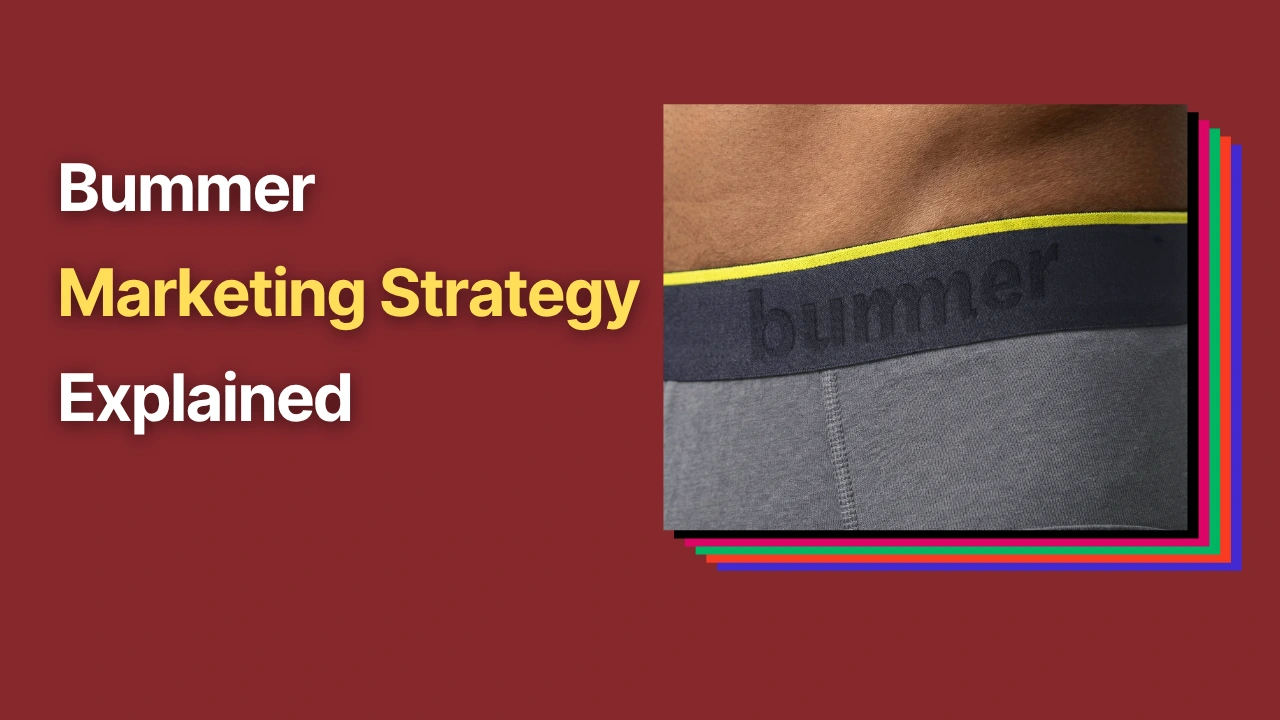
Underwear in India was a category nobody wanted to think about, let alone talk about. It sat in the same aisle as socks and handkerchiefs, beige, forgettable and purely functional. Every brand on the shelf was selling the same white cotton promise and calling it a day.
Bummer looked at that shelf and asked a different question. What if underwear could be fun? What if a category built on silence could actually have a voice, and a loud one at that? That single reframe is the seed of everything that follows in this breakdown.
This isn’t another retelling of the Shark Tank pitch. It’s a look at the actual marketing decisions behind Bummer’s rise, the ones a brand owner or marketer can actually learn from.
In short: Bummer’s marketing strategy repositions innerwear from a functional necessity into a fashion and identity statement, using bold brand design, humour-led social content, packaging as an unboxing-worthy channel and tonally matched micro-influencers to build a loyal Gen Z and millennial following.
Fast facts
| Brand | Bummer |
|---|---|
| Category | D2C innerwear and loungewear, India |
| Founded | 2020 |
| Founder | Sulay Lavsi |
| Signature Material | MicroModal fabric from beechwood trees |
| Core Audience | Gen Z and millennial consumers in India |
| Positioning | Fun, sustainable innerwear built around identity rather than function. |
Table of Contents
- What Gap Did Bummer Actually Spot in Indian Innerwear?
- How Did Bummer Build a Brand Identity Nobody Could Ignore?
- Is the Packaging Doing More Marketing Than the Ads?
- Who Does Bummer Actually Work With, and Why Does It Work?
- What Makes Bummer’s Social Voice Different in a Crowded D2C Category?
- Where Does Bummer’s Strategy Actually Fall Short?
- What Can Other Brands Steal From Bummer’s Playbook?
- In Conclusion
- FAQs
What Gap Did Bummer Actually Spot in Indian Innerwear?
Bummer spotted a positioning gap rather than a product gap. While legacy innerwear brands competed on comfort, durability and price, none offered identity or self-expression, so Bummer built the category’s first brand around personality instead of function.
View this post on Instagram
Founder Sulay Lavsi picked up a pair of underwear on a trip abroad and noticed something India’s own market had missed. Underwear could look good, feel good and say something about the person wearing it. Back home, the category was dominated by a handful of legacy players, all fighting over the same function-first pitch: comfort, durability, price.
Nobody was fighting over identity. That was the opening.
Bummer’s approach is a textbook example of challenger brand strategy. Instead of competing on the same terms as the incumbents, it changed what the category was supposed to be about:
- Category disruption: repositioning underwear from a functional necessity to a fashion and self-expression choice
- Sustainable fashion marketing: using MicroModal fabric derived from beechwood trees as both a product story and a values story
- A refusal to be embarrassed about the product category, which itself became a marketing angle
| Legacy Innerwear Brands | Bummer |
|---|---|
| Function-first messaging | Identity-first messaging |
| Muted, safe colours | Bold prints and colours |
| Product treated as private | Product treated as a personality statement |
| Traditional retail-first | D2C brand strategy built for e-commerce first |
The gap wasn’t fabric or fit. It was permission. Bummer gave a young, digitally native audience permission to care about their underwear the way they cared about their sneakers.
How Did Bummer Build a Brand Identity Nobody Could Ignore?
Bummer built its brand identity through three deliberate decisions: a self-deprecating, memorable name, a bold and colourful visual language, and a humour-first tone of voice used consistently across the product and its marketing.
View this post on Instagram
A bold brand identity doesn’t happen by accident. Three decisions do most of the heavy lifting for Bummer.
- The name itself. Calling an underwear brand “Bummer” is a wink, not an accident. It’s self-deprecating, a little cheeky and instantly memorable, which matters enormously in a category people don’t naturally want to discuss out loud.
- The visual language. Loud prints, saturated colours and playful patterns run through everything from the product to the packaging to the app. This isn’t decoration. It’s brand positioning made visible, a constant signal that this is not your father’s underwear drawer.
- The voice. Humour sits at the centre of every piece of copy Bummer puts out, from product names to captions. It reads like a friend teasing you, not a company selling to you.
Put together, these choices do something most legacy brands in the category never bothered to attempt. They give the product a personality strong enough to survive without discounts or fine print.
Is the Packaging Doing More Marketing Than the Ads?
Yes. Bummer treats its packaging as a marketing channel rather than pure protection, using bold, photogenic boxes to turn the unboxing moment into free, shareable brand content.
This is the part most case studies on Bummer skip entirely, and it’s arguably one of the smartest levers in the whole strategy.
Packaging as marketing works differently for Bummer than it does for most fashion brands, because the product itself is usually hidden from view until the moment of unboxing. That moment becomes the brand’s best shot at a first impression.
A few things Bummer gets right here:
- Bright, branded boxes that photograph well, encouraging organic unboxing content on social media
- Consistency between the packaging aesthetic and the product prints, so the brand feels designed end to end rather than assembled
- Sustainability cues built into materials, reinforcing the eco-conscious positioning without needing a separate campaign to explain it
For a category where word-of-mouth and repeat purchase matter enormously, a box that people want to photograph and share is doing double duty. It’s protecting the product and pitching the brand at the same time, at zero incremental media cost.
Who Does Bummer Actually Work With, and Why Does It Work?
Bummer works mainly with micro- and mid-tier creators like Harshit Arora and Utkarsh Soni, whose casual, humorous tone already matches its own brand voice, prioritising trust and tonal fit over sheer follower count.
Influencer marketing for Bummer isn’t about chasing the biggest follower count in the room. The brand leans heavily on creators who already talk casually and humorously to Gen Z and millennial audiences, people whose feeds already feel like a group chat rather than a billboard.
This matters for three reasons:
- The product category benefits from creators who can make an awkward topic feel normal and funny rather than clinical
- Micro and mid-tier creators tend to have tighter, more trusting relationships with their audience than mega-influencers, which suits a brand trying to build community-led growth rather than one-off reach
- Consistent tone across creator content and owned social means the brand voice never feels diluted, no matter who’s posting it
The result isn’t a roster of celebrity faces. It’s a loose, ongoing community of voices who all sound like they could plausibly be friends with the brand, which is precisely the point.
What Makes Bummer’s Social Voice Different in a Crowded D2C Category?
Bummer’s social voice stands out by leaning into humour and home-grown cultural references, rather than the muted, minimalist aesthetic most Indian D2C fashion brands default to.
View this post on Instagram
Indian D2C fashion is saturated with brands chasing the same aesthetic playbook: pastel palettes, minimalist copy, and aspirational lifestyle shots. Bummer goes the opposite direction, and that contrast is doing a lot of the work as a piece of Gen Z marketing.
Its social media branding leans on:
- Humour as the default tone rather than an occasional flourish
- Cultural references and memes that speak fluently to Indian Gen Z rather than translated global trends
- A willingness to be a little crude, a little cheeky, in a category that usually plays it safe
This is where cultural marketing earns its keep. Bummer’s content doesn’t feel imported from a global playbook and localised. It feels like it was written by someone who actually spends time in Indian meme culture, which is a very different thing.
The content marketing strategy behind this isn’t complicated on paper. It’s just executed with more nerve than most competitors are willing to risk.
Where Does Bummer’s Strategy Actually Fall Short?
Bummer’s main limitations are a narrow tonal register that struggles with serious topics, a naturally low-frequency repeat-purchase category, and the risk of diluting its edge as it scales into more conservative offline markets.
No strategy is without cracks, and pretending otherwise does nobody any favours.
Reliance on a narrow tonal register. Humour-first branding works brilliantly for acquisition and social buzz, but it can limit how the brand talks about anything more serious, whether that’s a genuine quality issue or a broader category conversation like body positivity or inclusivity.
Category ceiling on repeat frequency. Underwear is not a high-frequency repeat category the way, say, snacks or skincare are. Bummer has had to lean on retention tactics such as post-purchase automation and bundling to keep repeat revenue healthy, which suggests the brand voice alone isn’t enough to drive loyalty.
Scaling tension. A voice built on being cheeky and irreverent online can get diluted the moment a brand tries to scale into more conservative offline retail formats or Tier 2 and Tier 3 markets with different cultural sensitivities. Balancing that expansion without losing the edge that built the brand is a genuinely hard problem, not a solved one.
None of this undoes what Bummer has built. It just means the playbook has edges, and any brand copying it should know where those edges are.
What Can Other Brands Steal From Bummer’s Playbook?
Brands can copy four things from Bummer: find the emotional gap in the category, treat packaging as a media channel, build a voice strong enough to work without a logo attached, and pick creators for tonal fit over reach.
You don’t need to sell underwear to learn from this. Here’s what transfers to almost any category:
- Find the emotional gap in your category, not just the functional one. Bummer won by giving people permission to feel differently about a mundane product, not by making a better product on paper
- Treat packaging as a media channel, not an afterthought. If your unboxing moment isn’t worth photographing, you’re leaving free marketing on the table
- Build a voice distinct enough to survive without your logo attached. If your captions could belong to any competitor, they’re not doing their job
- Pick creators for tonal fit over follower count, especially in categories that need trust more than reach
If your internal team doesn’t have the bandwidth to execute this consistently across content, ads and creator partnerships, that’s exactly the gap a digital marketing agency is built to close, bringing structure to what can otherwise become a scattered, inconsistent effort.
In Conclusion
Bummer’s rise isn’t really a story about underwear. It’s a story about a brand that refused to accept the tone its category had settled for, and backed that decision consistently across product, packaging, creators and content until the market had no choice but to notice.
The lesson for any brand owner reading this isn’t to copy the jokes or the colour palette. It’s to find your own version of the gap Bummer found, the place where your category has gone quiet and safe, and to build a voice loud enough to fill it properly.
If you’re trying to figure out where that gap sits for your own brand, Flora Fountain works as a branding agency for exactly this kind of problem, helping brands find and build the identity their category is missing. Drop us a line at hello@florafountain.com and we’ll help you work it out.
Frequently Asked Questions

Vasim Samadji is a partner at Flora Fountain, where he leads the Business and Marketing Strategy divisions. In a world where everyone is used to sugarcoating, his directness is often considered rude. But that shouldn't be a problem if you like the no-nonsense approach. Because he is a seasoned professional...