


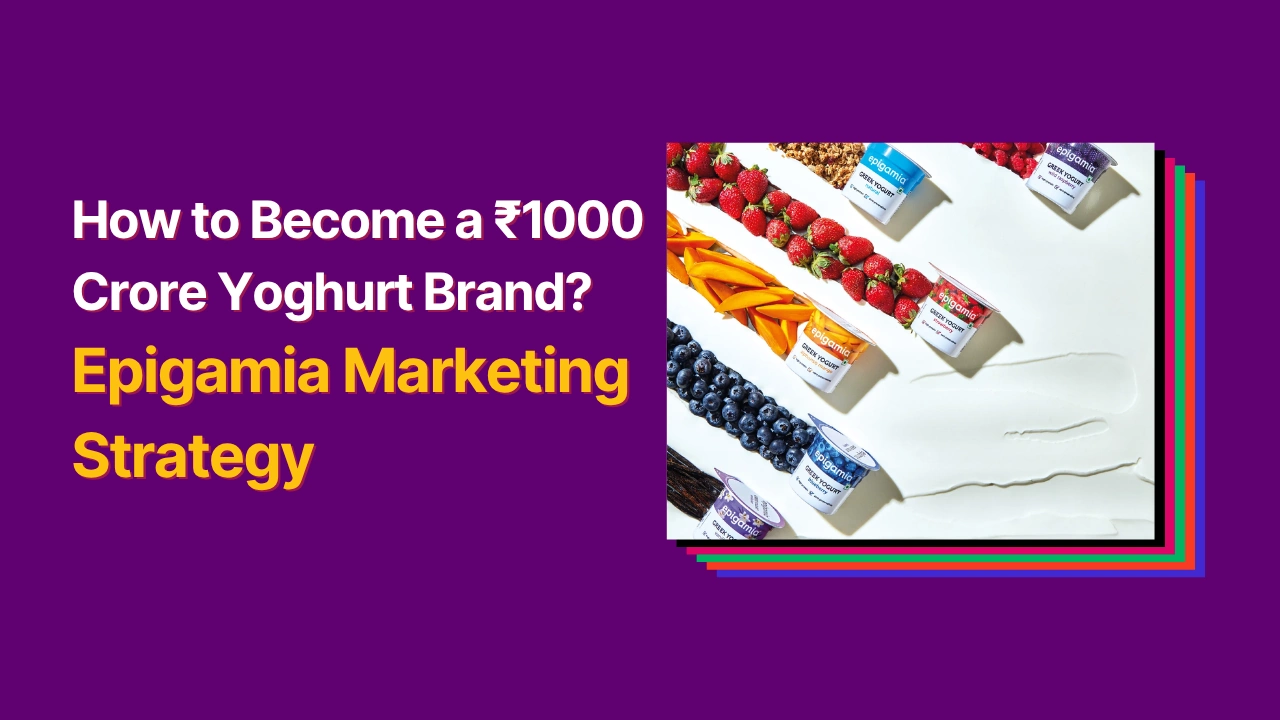
India is the world’s largest producer of milk. Yet for decades, the dairy aisle looked the same.
Amul. Mother Dairy. Nestle. The same white packaging. The same functional messaging. The same assumption that dairy is a commodity, not a brand.
Then in 2015, a Wharton graduate named Rohan Mirchandani walked into that aisle and saw something nobody else had bothered to act on. Indians were eating more yoghurt than ever. But nobody was selling them a yoghurt brand worth caring about.
What followed is one of the most interesting FMCG brand-building stories in modern India. The creation of Epigamia.
Table of Contents
- What Gap Did Epigamia Actually Spot?
- How Do You Make Yoghurt Cool?
- Can Packaging Be Your Best Salesperson?
- Deepika Padukone as the Brand Ambassador of Epigamia
- Teach First. Sell Later.
- Epigamia’s Distribution Strategy
- How Quick Commerce Changed Everything
- What Does ₹1000 Crore Actually Mean?
- What Can Your Brand Steal From This?
- In Conclusion
- FAQs
What Gap Did Epigamia Actually Spot?
The opportunity was hiding in plain sight.
India’s dairy market was valued at over ₹18,975 billion in 2024 and is growing.
Greek yoghurt, a high-protein, low-sugar format hugely popular in the West, did not exist as a branded product in India at all. And the health-conscious urban millennial, someone who was already paying a premium for gym memberships, clean eating and international food experiences, had no dairy product designed specifically for them.
View this post on Instagram
Every existing dairy brand was talking to everyone. Nobody was talking to this person.
Rohan Mirchandani, Ganesh Krishnan and Uday Thakkar founded Drums Food International in 2015 and launched Epigamia as India’s first branded Greek Yoghurt. But the real insight was not just the product. It was the positioning. They were not entering the dairy category. They were creating a new one: premium functional dairy for the modern Indian consumer.
That distinction, entering a market by creating a category rather than competing in an existing one, is the foundation on which everything else was built.
How Do You Make Yoghurt Cool?
In a category dominated by brands that communicated utility, Epigamia chose to communicate identity.
The brand was not positioned around “good source of calcium” or “digestive health.” It was positioned around a lifestyle: healthy, modern, aspirational and unapologetically Indian in its flavours while feeling international in its format.
The tagline “Your Happy Balance” communicated something specific. Not extreme fitness. Not guilt-free indulgence. Balance. That word did a lot of strategic work. It spoke to the urban millennial who was trying to eat better without becoming obsessive about it, a far larger audience than hardcore fitness enthusiasts.
Epigamia also made a deliberate choice to market the product as a mid-meal snack rather than just a breakfast item or a cooking ingredient. This was a category expansion move disguised as a positioning decision. By occupying the snacking occasion, they were competing with chips and biscuits, not just other dairy products. That dramatically widened their potential market.
The brand positioning was simple: health does not have to be boring, clinical or self-denying. It can be delicious, colourful and something you actually look forward to.
Can Packaging Be Your Best Salesperson?
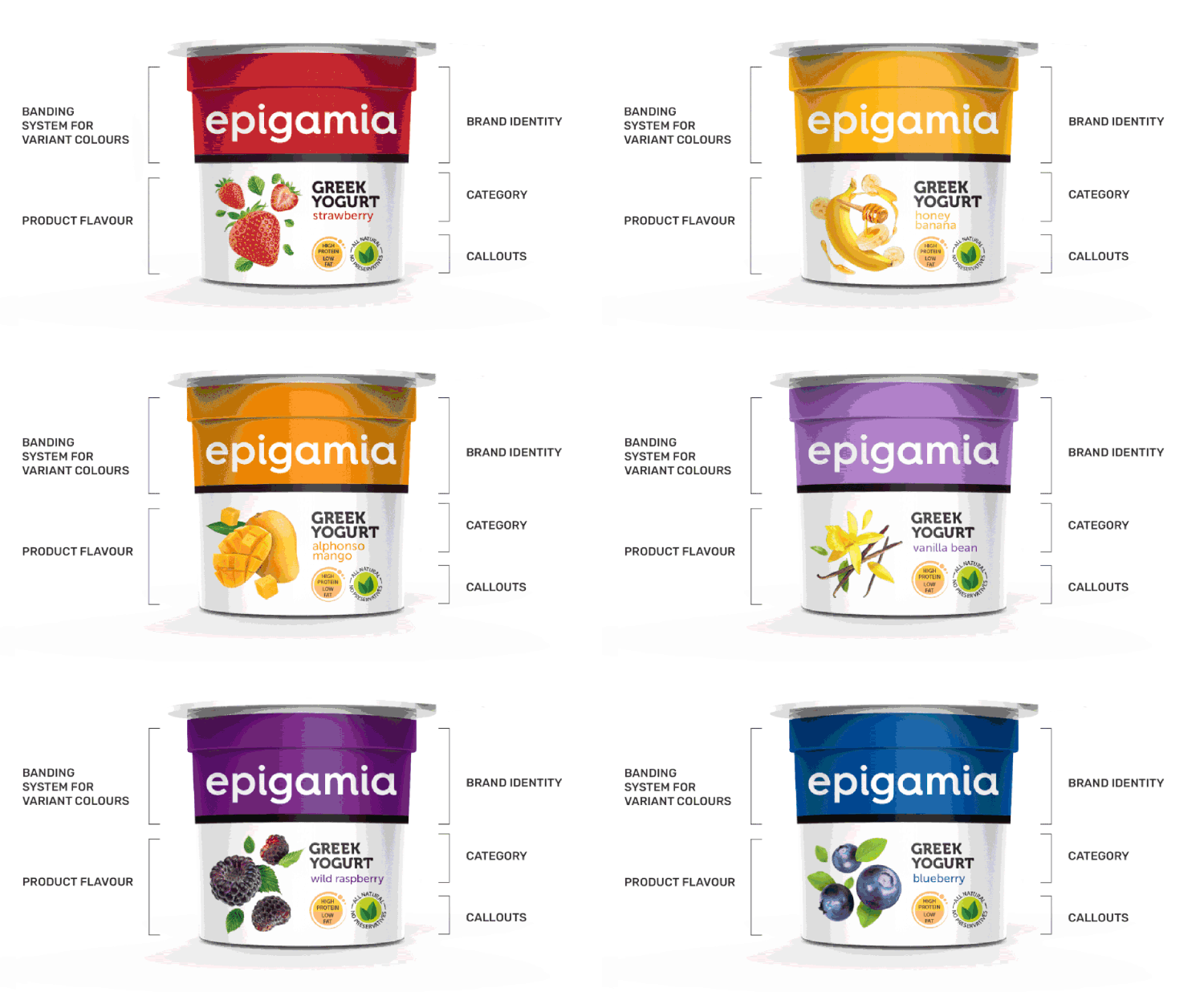
In Epigamia’s case, the answer is yes, and it was entirely by design.
The dairy aisle in 2015 was visually dominated by white and blue. Clinical. Functional. Forgettable. Epigamia walked in with something that looked like it belonged in a Scandinavian design store.
Every design decision was deliberate:
- Vibrant colour-coded packaging, each flavour had its own bold colour identity, making the range instantly navigable and visually exciting on a refrigerated shelf
- Transparent tubs letting consumers see the product before buying, a signal of honesty and quality confidence that no competitor was making
- Minimal typography, clean and modern, communicating premium without being cold or unapproachable
- Compact and portable format designed for the office desk and the gym bag, not just the kitchen shelf
This approach to packaging design achieved something that most FMCG brands spend lakhs of advertising money trying to do: it communicated the brand’s entire personality before a single word was read.
When Epigamia entered premium modern trade outlets like Foodhall and Nature’s Basket, the packaging made the brand look like it belonged there. It created an aspirational premium perception before the consumer had even tasted the product.
As brand strategy expert Harish Bijoor noted, Epigamia is a classic case of marketing done right a hardworking product paired with great packaging and a brand endorser with skin in the game. The packaging was the first of those three pillars.
Deepika Padukone as the Brand Ambassador of Epigamia
Most celebrity endorsement deals in India follow the same template. A brand pays a celebrity a large fee to appear in a campaign. The celebrity shows up on a billboard. Awareness goes up temporarily. The campaign ends. Everyone moves on.
View this post on Instagram
The Deepika Padukone partnership was structurally different and that difference is what made it work.
Deepika did not just endorse Epigamia. She invested in it through her strategic initiative arm, KA Enterprises LLP, as part of the extended Series C funding round. She became a brand ambassador and a stakeholder simultaneously.
This changed the entire nature of the association. When Deepika appeared in the #YourHappyBalance campaign for Epigamia’s smoothie range, audiences knew she had money in the business. That meant she was not just being paid to say she liked it. She had a reason to actually believe in it.
Why did this matter so much?
Deepika’s public persona at the time was built around exactly what Epigamia stood for: discipline, wellness, balance and a willingness to talk honestly about mental and physical health. The brand alignment was not manufactured. It was genuine. And audiences can tell the difference.
The investment-plus-endorsement structure also generated earned media that a standard celebrity campaign would not. The story of an A-list actress investing in a yoghurt startup was covered extensively by financial and entertainment press alike, delivering reach that no paid media budget could have replicated.
This is celebrity brand partnerships done with strategic intelligence rather than just chequebook marketing.
Teach First. Sell Later.
View this post on Instagram
Epigamia’s content marketing strategy was not built around product promotion. It was built around education. In a market where most consumers had never eaten Greek yoghurt before, the first job was not to sell it. It was to teach people what to do with it.
Their Instagram and digital content were filled with:
- yoghurt bowl recipes and meal prep ideas
- Smoothie tutorials using Epigamia products
- Collaborations with nutritionists explaining the protein benefits of Greek yoghurt
- Fitness coaches showing how to use it as a pre- or post-workout snack
- Food bloggers and chefs are creating recipes that naturally feature the product
The brand’s own marketing team described it clearly: “Content isn’t an ad for us. It’s how we enter the customer’s kitchen.”
This approach did several things simultaneously. It educated a market that had never bought the product before. It demonstrated versatility, showing that Greek yoghurt was not just a breakfast item but an ingredient for dozens of occasions. And it built an influencer marketing network of credible, category-relevant voices rather than generic celebrities.
The result was a 20% increase in consumer engagement through content partnerships alone. More importantly, it built a habit. Consumers who learned to cook with Epigamia became loyal repeat buyers, not one-time trialists.
The lesson: if your product is new to your market, your marketing budget is better spent on education than on awareness advertising.
Epigamia’s Distribution Strategy
View this post on Instagram
Epigamia’s distribution strategy is one of the most deliberately sequenced in recent Indian FMCG history and most analyses of the brand skip over it entirely.
When Epigamia launched, it did not try to be everywhere. It chose to be in very specific places first: Foodhall, Nature’s Basket, Modern Bazaar and premium supermarkets in metro cities. Not Big Bazaar. Not kirana stores. Not everywhere.
This was not a supply constraint. It was a strategy.
By seeding the product in premium modern trade outlets first, Epigamia built aspirational credibility before it built distribution scale. When a consumer saw Epigamia next to imported cheeses and organic produce at Foodhall, they immediately understood what kind of product it was. The shelf placement communicated positioning more efficiently than any ad could.
Once that premium credibility was established offline, the brand used it to drive online adoption. Consumers who had discovered and trusted Epigamia at Foodhall were far more willing to subscribe to it on BigBasket or reorder it on Amazon Fresh.
This offline-to-online flywheel worked because trust was built first in a physical environment where the brand had full control over context, and then leveraged digitally, where repeat purchase was more convenient.
How Quick Commerce Changed Everything
If the offline-to-online flywheel was Epigamia’s distribution story up to 2020, quick commerce is the chapter that defines its growth from 2022 onwards.
Platforms like Zepto, Blinkit and Swiggy Instamart fundamentally changed the economics of selling perishable FMCG products. For a cold-chain brand like Epigamia, the traditional challenge was always logistics: how do you get a refrigerated product to a consumer quickly enough for it to feel like an impulse purchase rather than a planned one?
Quick commerce solved that problem. A consumer craving a healthy snack at 11 am could now have Epigamia delivered in 10 minutes. That changed the purchase occasion entirely.
By 2024, quick commerce and D2C channels together contributed approximately 25 to 30% of Epigamia’s total sales. The brand used its D2C website not just as a sales channel but as a testing platform, launching new flavours digitally first to gauge demand before committing to national retail distribution.
This D2C strategy created a feedback loop that traditional FMCG brands simply cannot replicate at the same speed. Epigamia could launch a seasonal flavour like Alphonso Mango on its own website and Zepto simultaneously, read real-time sales data within days and decide whether to scale it into modern trade within weeks rather than months.
The company also expanded into ambient milkshakes and high-protein beverages in 2024, specifically to reduce cold-chain dependency and improve gross margins, since ambient SKUs cost approximately 20 to 30% less per unit to distribute than refrigerated lines.
What Does ₹1000 Crore Actually Mean?
Let us be precise about the number because most content around Epigamia conflates revenue and valuation.
Epigamia’s valuation was approximately $150 million, or roughly ₹1,250 crore, as of December 2023. This is the investor-assessed value of the business, not its annual revenue.
It is a ₹1000 crore valuation business with a credible path to that revenue scale.
What makes the valuation justified is not just current revenue but the strategic assets the brand has built:
- A premium brand positioning that commands 20% higher pricing than competitors
- A loyal urban millennial consumer base with high repeat purchase rates
- A distribution infrastructure spanning 20,000+ retail outlets with a target of 50,000
- A quick commerce presence that is growing faster than traditional trade
- A product innovation pipeline backed by proprietary probiotic research and IoT-monitored cold chain logistics
Together, these assets represent something harder for competitors to replicate than any individual product or campaign.
What Can Your Brand Steal From This?
Epigamia’s playbook is not exclusive to dairy brands or D2C startups. These principles transfer across categories.
Create a category instead of entering one
Epigamia did not compete with Amul. It created the branded Greek yoghurt category in India and owned it before anyone else arrived. If your market is crowded, the question is not how to compete better. It is whether there is a segment nobody is serving at all.
Let your packaging do the first pitch
In any environment where your product sits next to competitors, a shelf, an app listing, a marketplace, your visual identity is your first salesperson. Epigamia’s packaging communicated premium positioning before a single marketing rupee was spent. Invest in design like it is a performance marketing channel because it is.
Make your brand ambassador a believer, not just a borrower
The Deepika deal worked because she invested. Find endorsers whose public identity aligns with your brand’s values and, wherever possible, structure deals that give them genuine skin in the game. Audiences are increasingly good at detecting the difference between paid advocacy and genuine belief.
Teach the market before you sell to it
If you are introducing a new product or a new category, your content budget is better spent on education than on awareness. Epigamia’s recipe content and nutritionist partnerships built a loyal base of consumers who understood the product deeply before they were ever sold to directly.
Sequence your distribution deliberately
Go premium first. Build credibility in the right contexts before chasing scale. The shelf you are on tells consumers what kind of brand you are. Being in the right 100 stores is worth more early on than being in the wrong 10,000.
This kind of strategic thinking is what a good branding agency brings to a brand-building conversation, not just creative executions but the sequencing logic behind them.
In Conclusion
Epigamia did not become a ₹1000 crore brand by outspending Amul or out-distributing Nestlé. It became one by being sharper, more deliberate and more consistent than anyone else in its chosen lane.
The brand spotted a real gap. It is designed for the right consumer. It built trust in the right places first. It educated before it advertised. And it used every new distribution channel, from premium modern trade to quick commerce, as a strategic lever rather than just a sales channel.
For any brand trying to build something meaningful in a crowded market, Epigamia’s story is one of the clearest recent examples of what focused, intelligent brand strategy can achieve.
If you are working on finding your own version of that clarity, that is exactly the kind of thinking a digital marketing agency like Flora Fountain helps you develop. From positioning to content to distribution strategy, we help brands build with intention. Write to us at hello@florafountain.com.
Frequently Asked Questions

The founder and partner of Flora Fountain, Shefali leads the Content and Technology divisions. A one-time engineer who started her career writing front-end code, she took a detour sometime during her 9 years in New York, studied journalism and started writing prose, poetry and sometimes jokes. She now has 15...