


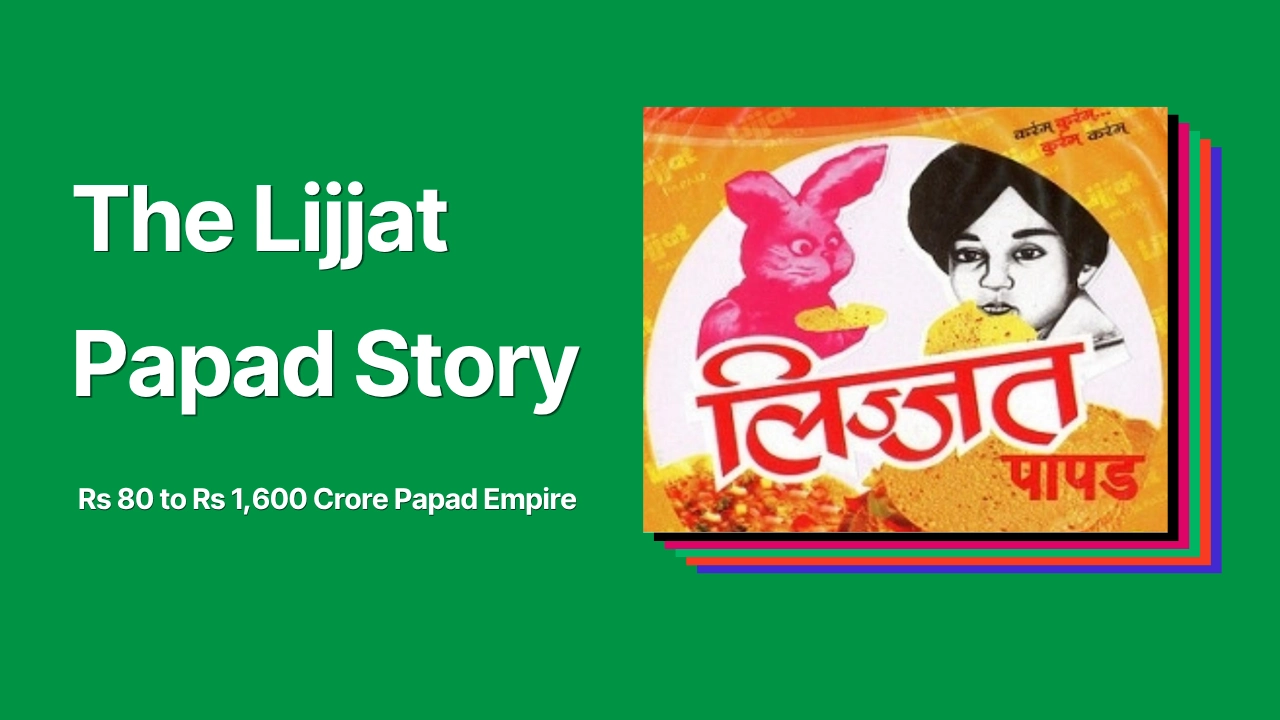
Name 5 papad brands in India. Okay, Try 3.For most of us, the list stops at one name.
Because for us, that one name is enough.
Imagine this. Seven women. One terrace. Rs 80 is the entire starting budget.
No investors. No MBA degrees. No marketing strategy decks. Not even a business plan written on paper. Just seven Gujarati homemakers in Mumbai who knew how to make a really good papad, and decided that skill was enough to build something on.
Started in 1959 with a seed capital of only Rs 80, Lijjat Papad had an annual turnover of more than Rs 1,600 crore by 2019.
It provides employment to 45,000 women across the country and is considered one of the most remarkable entrepreneurial initiatives by women identified with female empowerment in India.
This is not just an inspiring story. It is one of the greatest branding and business case studies India has ever produced. And somehow, it never ends up in the textbooks. And as the leading digital marketing agency in Ahmedabad, we think it is our job to propagate this success story to every household.
Table of Contents
- Who Founded Lijjat Papad and How It All Started
- The Numbers That Tell the Story
- The Marketing Strategy of Lijjat Papad
- The Bunny That Built a Brand
- What Lijjat Got Right That Most Brands Get Wrong
- Lijjat Today and What the Future Looks Like
- Conclusion
- FAQs
Who Founded Lijjat Papad and How It All Started
To understand Lijjat, you have to understand the India of 1959.
India was a fairly underdeveloped country. Literacy was considered a luxury, and women’s literacy was not even considered important. Only a fraction of women in India could actually read and write. On top of that, women were not allowed to work outside the home, and their families’ earnings were not enough to afford a decent standard of living.
Against that backdrop, seven women sat together and decided to do something about it.
View this post on Instagram
The Seven Founders
The seven women were Jaswantiben Jamnadas Popat, Parvatiben Ramdas Thodani, Ujamben Narandas Kundalia, Banuben N. Tanna, Laguben Amritlal Gokani, Jayaben V. Vithalani, and Diwaliben Lukka. They lived in Lohana Niwas, a group of buildings in Girgaum, a thickly populated area of South Mumbai. (Source)
They wanted to earn a livelihood without leaving their homes. The skill they had was cooking. The product they chose was papad.
The First Day
They borrowed Rs 80 from Chhaganlal Karamsi Parekh, a social worker, bought the necessary ingredients, and on 15 March 1959, gathered on the terrace of their building. The result of that first session was 4 packets of papads, which they started selling to a known merchant in Bhuleshwar. (Source)
On the first day of business, the women earned eight aanas by selling one kilogram of papad.
Where the Name Came From
In 1962, the name Lijjat, which means “tasty” in Gujarati, was chosen by the group in a contest held for the purpose. The prize money for the winning entry was Rs 5. The full name became Shri Mahila Griha Udyog Lijjat Papad, which translates to “Women Home Industry Tasty Papad.”
Simple. Honest. Exactly what it was.
Jaswantiben Jamnadas Popat, one of the original seven founders, was later honoured with the Padma Shri in 2021 by the Government of India for her contributions to trade and industry.
The Numbers That Tell the Story
Numbers do not lie. And Lijjat’s numbers are genuinely extraordinary.
| Year | Milestone |
|---|---|
| 1959 | Founded with Rs 80 seed capital. 4 packets of papad on day one. |
| 1959 to 1960 | First year annual sales: Rs 6,196 |
| 1962 to 1963 | Annual sales reach Rs 1,82,000 |
| 1968 | First branch outside Maharashtra opens in Vadodara, Gujarat |
| 1975 onwards | Exports begin to the UK, USA, and Singapore |
| 2019 | Annual turnover crosses Rs 1,600 crore |
| Today | 83 branches, 17 states, 25 plus countries, 45,000 sister members |
Due to standardisation in the papad-making process, 4.8 billion papads made by 45,000 Lijjat sisters all over India have a similar taste.
Think about what that means. 45,000 women working from their homes across 17 states, using the same recipe, producing the same taste, every single day. No factory. No centralised production line. Just an extraordinary system of trust and quality control built entirely by women.
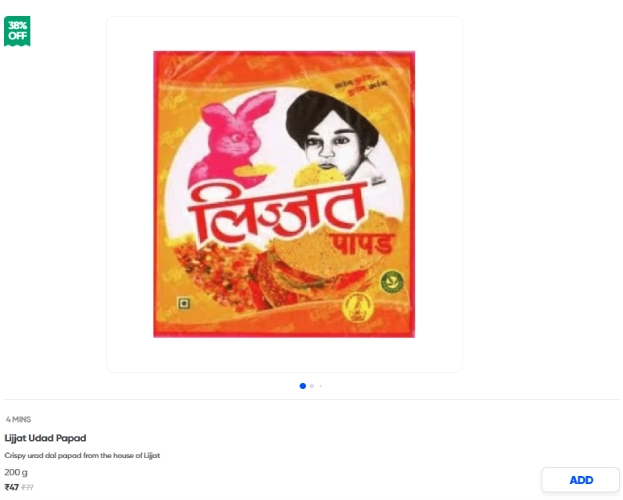
Today, Lijjat Papad is available across India both offline and online. You can find it at your local kirana store, in supermarkets, and on platforms like Amazon, Blinkit, BigBasket, and Zepto. Prices for a 200g pack typically start at around Rs 40, while a 1 kg pack of Lijjat Papad is priced between Rs 180 and Rs 220, depending on the variety and platform.
The Marketing Strategy of Lijjat Papad
For the first twenty years of its existence, Lijjat did not run a single advertisement.
No television commercials. No newspaper ads. No posters. No campaigns. The only thing spreading the brand was the quality of the product and the word of mouth of people who had tried it.
Before 1980, Lijjat believed that the best promotion was through word of mouth. The cooperative focused on the quality of the product rather than spending huge amounts on ads.
And it worked. By the 1970s, they were exporting internationally. All of this happened without a single rupee spent on advertising.
The Quality Control System
Maintaining consistent taste across 45,000 home kitchens spread across 17 states is, frankly, one of the most impressive operational achievements in Indian business history.
Here is how they did it:
- Every papad goes through a grade check before it is accepted.
- Supervisors conduct surprise visits to homes to check hygiene and process.
- Only approved, standardised ingredients are distributed centrally.
- Any papad that does not meet the standard is rejected. Broken papads are distributed among neighbours rather than sold.
- The dough itself is prepared centrally, so every batch starts from the same base.
The result is that a Lijjat papad bought in Ahmedabad tastes the same as one bought in Chennai or Kolkata. In a country as diverse as India, that kind of standardisation without a factory is remarkable.
The Bunny That Built a Brand
By the late 1970s, Lijjat’s success had created an unexpected problem.
Their success had made way for fraudsters to sell fake Lijjat papads in the market. To counter the menace, the company felt it was perhaps time to go big on branding.
They needed something that would make the real Lijjat instantly recognisable on a shelf full of imitations. What they got was one of the most iconic mascots in Indian advertising history.
Enter the Bunny

Ramdas Padhye with his bunny puppet
The brainchild of Ramdas Padhye, a ventriloquist and puppeteer, the Karram Kurram jingle and the pink bunny character were created around 1978 to 1979.
Padhye hosted a puppet show on Doordarshan that had become very popular. When someone from Lijjat’s marketing team contacted him for an advertisement, he introduced his bunny character as a mascot for the brand.
Initially, Lijjat had reservations. “Why would a rabbit eat papad?” was the question.
A few days later, Padhye hauled a big bunny muppet to the Lijjat office. The large anthropomorphic rabbit with white fur, beady eyes, and buck teeth wore a satin green bow over a black vest. Only after seeing the ventriloquist’s creation did the Lijjat executives agree
Why It Worked
The rabbit had no logical connection to papad. And that was precisely the point.
Lijjat is an example of the role of an irrelevant brand element in building a recognisable and meaningful brand. The unique concept of puppetry, the emotional connection of family, and a distinctive soundtrack made the Lijjat Papad television commercial unique.
The jingle, “Karram Kurram Kurram Karram, chai coffee ke sang khaiye,” became one of the most recalled brand sounds in Indian television history. The rabbit’s distinctive laugh, “Eh he he,” became part of Indian pop culture. Generations of children grew up scared of, confused by, and utterly fascinated by the Lijjat bunny.
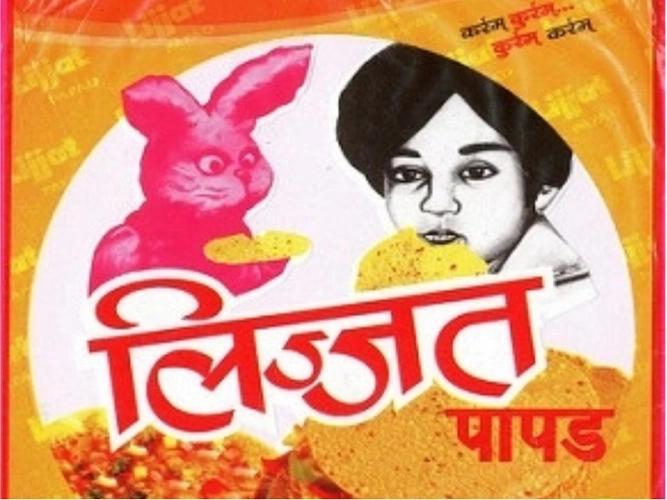
The mascot was eventually added to the packaging itself, sitting right next to the original “Babla” illustration, where it remains to this day.
For a branding agency that knows the power of mascots, the Lijjat rabbit is a masterclass. You do not need a mascot to make logical sense. You need it to be memorable. And the bunny was unforgettable.
What Lijjat Got Right That Most Brands Get Wrong
Lijjat did not have a marketing strategy. They had something better: a set of deeply held beliefs that naturally produced great marketing.
Here is what they got right that most modern brands, with all their tools and budgets, continue to get wrong.
If you strip away the nostalgia, Lijjat Papad’s growth strategy boils down to four brutal realities that most modern startups ignore:
- Product Before Ads: Today, founders launch Instagram pages before they even finalise their product. Lijjat spent decades perfecting the actual papad before spending a single rupee on advertising.
- Real Community, Not Slack Channels: Lijjat did not pay influencers to promote them. By making 45,000 women actual co-owners, they built an army of fiercely loyal brand advocates who genuinely cared about the product’s survival.
- The Uncopyable Story: You can copy a competitor’s logo or pricing, but you cannot fake the story of seven women turning ₹80 into an empire. That undeniable authenticity is their strongest defence against corporate giants.
- Stubborn Consistency: While modern D2C brands rebrand every two years to chase the latest internet trend, Lijjat has not changed its recipe or core values in sixty years. In a chaotic market, consistency is the ultimate competitive advantage.
A genuine digital marketing agency will tell you the hard truth: you cannot shortcut this process. You cannot buy a 60-year legacy with a month of Meta Ads. You have to build the foundation first. But once you build a product this undeniable, scaling the story becomes effortless.
Lijjat Today and What the Future Looks Like
Lijjat is not stuck in the past. It has expanded carefully, staying true to its roots while moving with the times.
Where Lijjat Is Today
- 83 branches and 27 divisions across 16 to 17 states in India
- Exports to 25 plus countries, including the USA, UK, France, Germany, Japan, Australia, and South Africa
- Products beyond papad include masala, wheat atta, khakhra, chapati, detergent powder, and liquid soap
- Available on all major e-commerce platforms, including Amazon, Blinkit, Zepto, and BigBasket
The Challenge Ahead
In today’s digital age, Lijjat Papad faces the challenge of staying relevant to younger consumers.
Lijjat Papad’s relatively weak social media presence is a deliberate outcome of its unique, grassroots business model, which prioritises women’s empowerment and traditional word-of-mouth marketing over modern, digital advertising.
As a prominent digital marketing agency, we suggest that a stronger social media presence could help bridge the gap between new-age consumers and Lijjat Papad, allowing the brand to connect with a wider audience and showcase its rich heritage.
Conclusion
Lijjat Papad is proof that the fundamentals of great business have not changed in 65 years.
Make something genuinely good. Treat the people who make it with dignity and fairness. Stay consistent. Let the product speak first. And tell a true story.
Their goal was never to make more money. It was always to empower women and their families. Money was only ever the fuel to scale their impact, not the sole purpose of their existence.
That clarity of purpose is, ultimately, what the Lijjat story is about. And it is the reason that 65 years later, in a market full of well-funded, professionally managed competitors, the papad that seven women made on a Mumbai terrace is still the one people reach for.
Frequently Asked Questions

Vasim Samadji is a partner at Flora Fountain, where he leads the Business and Marketing Strategy divisions. In a world where everyone is used to sugarcoating, his directness is often considered rude. But that shouldn't be a problem if you like the no-nonsense approach. Because he is a seasoned professional...