


Every advertising agency in the world knows how to pitch.
They employ charismatic sales directors, build stunning slide decks, and showcase cherry-picked case studies that promise exponential growth. Pitching is their primary skill.
However, as a founder, Chief Marketing Officer, or marketing director, you are not buying a pitch. You are buying execution.
As an experienced advertising agency, we believe the digital advertising landscape has become more complex than ever. With the rise of AI-generated content, opaque programmatic media buying, and tightened data privacy laws, choosing the wrong partner does not just mean flatlining sales. It means exposing your company to legal liabilities, wasted ad spend, and compromised brand equity.
Before you hire an advertising agency, you must ask the right questions.
Here is the ultimate interrogation guide with 13 essential questions, which are categorised into four critical phases: Strategy, Team, Measurement, and Contract Legalities.
Table of Contents
- Why Is a Strict Investigation Before Hiring an Advertising Agency Mandatory?
- Phase 1: Strategy and Business Alignment
- Phase 2: The Team and Execution Reality
- Phase 3: Measurement, Transparency, and AI
- Phase 4: The 2026 Advertising Agency Contract Checklist
- 5 Massive Red Flags That Should End the Meeting
- Conclusion
- FAQ’s
Why Is a Strict Investigation Before Hiring an Advertising Agency Mandatory?
The cost of a bad agency relationship goes far beyond their monthly retainer fee.
The true cost is the opportunity cost. If you spend six months locked into a bad ad agency contract, you have lost six months of market share to your competitors.
To prevent this, you must control the interview process.
Do not let them guide you through their standard presentation. Interrupt them. Ask for specific examples. Demand transparency.
Here are the 13 questions that will separate the true revenue partners from the generic vendors.
Phase 1: Strategy and Business Alignment
A great agency does not just run ads. They act as an extension of your board of directors, aligning their tactical execution with your high-level financial goals.
1. How do you connect tactical ads to our broader business strategy?
Why you must ask this: Many agencies operate in a vacuum. They care about getting a low Cost Per Click, but they do not understand how that click impacts your profit margins or supply chain logistics.
The Answer You Want: Look for an agency that asks you about your
- Customer Lifetime Value
- Your gross margins
- Your sales cycle length
They should explain how their advertising strategy shifts depending on whether your current business goal is aggressive market penetration or profitable customer retention.
2. Can you walk us through a campaign that failed and what you learned?
Why you must ask this: In digital marketing, failure is inevitable. Algorithms change, competitors launch aggressive offers, and consumer behaviour shifts.
The Answer You Want: You want absolute honesty. If they claim they have never had a campaign fail, they are either lying or they have never taken a meaningful creative risk. A mature advertising agency will happily dissect a past failure, explain the diagnostic process they used to identify the root cause, and detail the exact pivot that eventually turned the campaign around.
3. How do you approach audience research specifically for the Indian market?
Why you must ask this: When reviewing the questions to ask an advertising agency before signing the contract in India, the local context is paramount.
View this post on Instagram
India is not a single market. It is a continent of diverse languages, purchasing behaviours, and cultural nuances.
The Answer You Want: The agency must demonstrate how it navigates “Hinglish” search intents, the dominance of WhatsApp as a conversion tool, and the vast behavioural differences between Tier 1 metropolitan buyers and emerging Tier 2 or Tier 3 audiences.
They should rely on localised sentiment analysis, not just broad demographic targeting.
Phase 2: The Team and Execution Reality
The people who pitch your account are rarely the people who manage it. You need to know exactly who has their hands on your budget.
4. Who will actually manage our account day to day?
Why you must ask this: This is the classic “Bait and Switch.” The agency CEO and Senior Strategist dazzle you in the boardroom, but the moment the ink dries on the contract, your account is handed over to a junior intern who is fresh out of university.
The Answer You Want: Demand to meet the actual Account Manager and Media Buyer who will be running your campaigns before you sign.
Assess their seniority and their specific experience in your industry.
5. What is your client-to-strategist ratio?
Why you must ask this: Burnout destroys ad performance.
If a single media buyer is managing 25 different client accounts, they do not have the time to proactively optimise your campaigns.
They are merely logging in to check if the ads are broken.
The Answer You Want: A healthy ratio for a performance-focused agency is typically one strategist to every five or six accounts.
This ensures they have the mental bandwidth to run A/B tests, analyse data anomalies, and suggest proactive creative shifts.
6. Do you produce creatives in-house or use outsourced freelancers?
Why you must ask this: The biggest bottleneck in modern advertising agencies is creative fatigue.
Ads burn out quickly, and you need a constant stream of high-quality video and image assets. If an agency outsources its design work to offshore freelancers, the turnaround times will be sluggish, and the brand consistency will suffer.
The Answer You Want: You want an all-in-house advertising agency with a dedicated, creative studio where the copywriters, designers, and media buyers sit in the same room and share immediate feedback on what visual hooks are currently driving conversions.
Phase 3: Measurement, Transparency, and AI
Data is easily manipulated. An agency can make a failing campaign look successful by highlighting the wrong metrics. You need to establish exactly how success is measured.
7. Which specific agency KPIs do you track to measure success?
Why you must ask this: Weak agencies hide behind metrics like
- Impressions
- Reach
- Engagement Rate
These metrics look impressive on a Pitch deck, but they do not pay your payroll.
The Answer You Want: The agency KPIs contract should explicitly focus on bottom-line business metrics.
Look for an obsession with
- Return on Ad Spend
- Customer Acquisition Cost
- Lead to Close Ratio.
They should be willing to tie their performance reviews directly to these financial indicators.
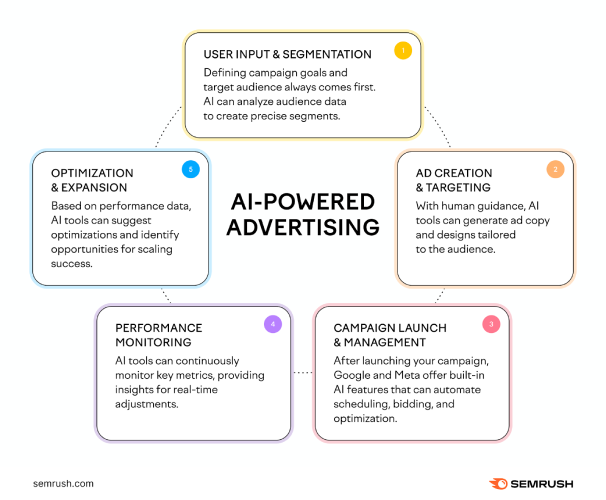
8. How do you balance AI ad automation with human oversight?
Why you must ask this: In 2026, advertising platforms like Google and Meta rely heavily on black-box AI algorithms (such as Performance Max or Advantage+).
Source: Semrush
Lazy agencies simply hand your budget over to the AI and let it run on autopilot. You’re not paying for AI services, are you?
The Answer You Want: The agency should view AI as a tool, not a replacement for strategy.
They should explain how they feed the AI with high-quality first-party data, how they set strict negative keyword guardrails to prevent budget wastage, and how human oversight ensures the AI does not bid on irrelevant or brand-damaging placements.
9. Can we see a live sample of your client’s reporting dashboard?
Why you must ask this: A static, end-of-month PDF report is outdated. By the time you read it, the data is 30 days old, and the budget is already spent.
The Answer You Want: Top-tier agencies provide clients with 24/7 access to live, interactive dashboards (built on tools like Looker Studio or Tableau). You should be able to log in on a Tuesday morning and see exactly how much was spent on Monday and what revenue it generated.
Phase 4: The 2026 Advertising Agency Contract Checklist
This is the most critical phase. The contract is where vague promises meet legal reality. Give your legal and finance teams this specific advertising agency contract checklist to ensure you are fully protected.
10. How is your retainer fee broken down versus media spend?
Why you must ask this: Media buying transparency is a massive issue in the advertising industry.
Some agencies act as “principals” rather than “agents.” They buy ad inventory in bulk at a steep discount and resell it to you at a premium without disclosing the markup.
The Answer You Want: You require absolute clarity. The retainer fee breakdown must explicitly separate the agency’s management fee from the actual media spend paid to the platforms.
Furthermore, the contract must state that any Annual Volume Bonuses or undisclosed rebates the agency receives from media vendors using your budget will be returned to you pro rata.
11. Who legally owns the ad accounts, historical data, and creative assets?
Why you must ask this: A common hostage tactic used by unethical agencies is to create Google Ads or Meta Business Manager accounts in the agency’s name. If you decide to fire them, they refuse to hand over the accounts. You lose years of valuable pixel data and algorithmic learning.
The Answer You Want: The contract must state unconditionally that your company is the sole owner of all ad accounts, analytics properties, custom audiences, and creative files.
The agency should only be granted “Admin” or “Partner” access, which you can revoke at any time.
12. What are the specific termination clauses and exit handover protocols?
Why you must ask this: Many agencies try to lock clients into 12-month non-cancellable contracts. If their performance drops in month three, you are trapped paying them for another nine months.
The Answer You Want: A fair and transparent advertising agency usually includes a termination clause that requires a 30-day or 60-day notice period.
Crucially, the contract must include an “Exit Handover Protocol.” This legally obligates the agency to spend their final 30 days packaging all data, pausing active campaigns safely, and training your internal team or new agency on the historical account structure.
13. Do we have explicit financial audit rights written into the advertising contract?
Why you must ask this: Trust is good, but verification is better. In programmatic digital advertising, supply chain opacity can hide hidden fees levied by demand-side platforms and ad exchanges.
The Answer You Want: Your legal team must insert comprehensive audit rights in advertising contract clauses.
This grants you the right to hire an independent, third-party financial compliance auditor to review the agency’s trading records, third-party invoices, and media supply chain contracts. If the agency refuses an audit clause, it is a massive red flag.
5 Massive Red Flags That Should End the Meeting
If you hear any of these statements during your commercial investigation, politely pack up your notes and walk away.
- “We guarantee a 5x ROAS in the first 30 days.” Nobody can guarantee specific returns in an auction-based digital ecosystem. They are lying to win your signature.
- “Our pricing includes media spend, but we cannot show you the exact split.” This means they are masking a massive profit margin by buying cheap, low-quality inventory and pocketing the difference.
- “We require a 12-month lock-in to see true results.” While SEO takes time, paid advertising shows directional data within weeks. Confidence does not require handcuffs.
- “We use a secret, proprietary targeting algorithm.” There are no secret algorithms. Everyone uses the same machine learning tools provided by Google, Meta, and LinkedIn. “Proprietary algorithm” is usually code for “We will not tell you what we are doing.”
- “We do not share raw data access; we only provide summary reports.” If an agency denies you administrative access to your own data, they are hiding severe inefficiencies or manipulated numbers.
Conclusion
Hiring an advertising agency is akin to taking on a new business partner. You are trusting them with your brand reputation, your cash flow, and your future growth.
Do not be afraid to make agencies uncomfortable during the pitch process. The best agencies welcome rigorous vetting because it eliminates their mediocre competition.
If you are ready to stop guessing and start growing, it is time to partner with an advertising agency that operates with radical transparency, builds custom strategies rather than templates, and gladly signs contracts that protect your data ownership.
Frequently Asked Questions

The founder and partner of Flora Fountain, Shefali leads the Content and Technology divisions. A one-time engineer who started her career writing front-end code, she took a detour sometime during her 9 years in New York, studied journalism and started writing prose, poetry and sometimes jokes. She now has 15...