


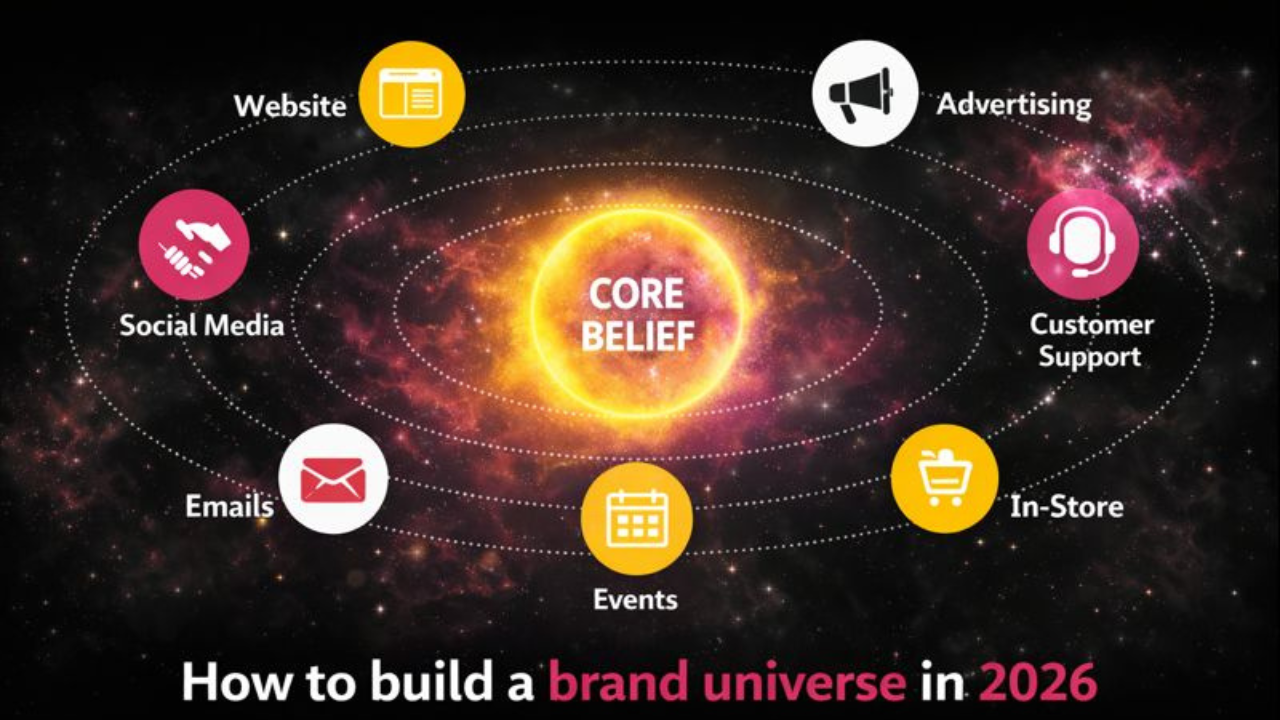
In the old world of marketing (circa 2020), the goal was simple: get the customer from Point A (Awareness) to Point B (Purchase). We called it a “Funnel.” We pushed them down a slide, took their money at the bottom, and sent them an email receipt.
In 2026, the Funnel is dead. The linear path no longer exists. Today, consumers are not looking for a transaction; they are looking for a Destination. They want to enter a world that aligns with their identity, hang out there, meet like-minded people, and thenmaybebuy a souvenir.
This is the era of the Brand Universe. It is a shift from “Brand Storytelling” (me talking to you) to “Worldbuilding” (us living in a story together). For a forward-thinking branding agency, the job is no longer just to design a logo; it is to architect a reality.
Table of Contents
- Why Worldbuilding Is the New Marketing
- What Exactly Is a Brand Universe? (The 4 Pillars)
- Step-by-Step: How to Architect Your Brand Universe
- Case Studies: Brands That Built Worlds, Not Just Ads
- Conclusion
- Frequently Asked Questions
Why Worldbuilding Is the New Marketing
Why the shift? Two reasons: Noise and AI. Generative AI has flooded the internet with “perfect” but soulless content. To stand out, you cannot just have better graphics; you need deeper Lore.
Why Worldbuilding is Replacing Traditional Marketing
- From Passive to Participatory: Traditional marketing is “didactic” (telling you what to think), whereas worldbuilding is “co-authored”. Brands like Lego and Disney invite fans to create their own paths within the world, turning passive audiences into active “fandoms”.
- Escapism as a Service: In a saturated and unstable landscape, consumers crave meaningful immersion. Brands that offer a “world” provide a sense of belonging and an imaginative escape that a single product cannot.
- The “Attention Economy” Solution: With consumers spending 7+ hours daily on content, a cohesive world makes every touchpoint, from a TikTok to a pop-up shop, part of a larger, rewarding narrative. This creates “compound returns” because each interaction reinforces the whole world.
- Lore Over Features: Instead of competing on price or convenience (relative positioning), brands use “lore”, like the founder’s military background for BPN supplements, to create deep emotional investments that price-matching competitors can’t touch
Think of Red Bull. They don’t just sell energy drinks. They own a universe of extreme sports, F1 teams, breakdancing competitions, and music studios. The can of soda is just a ticket to enter that world.
What Exactly Is a Brand Universe? (The 4 Pillars)
A Brand Universe is a holistic ecosystem where your brand’s values, aesthetics, and content create a cohesive “reality.” It stands on four pillars:
1. The Lore (Narrative)
This is your backstory and belief system. It is not “founded in 2015.” It is why you exist.
- Example: Nike’s lore isn’t about shoes; it’s about the “Hero’s Journey” of the athlete. Every ad adds a chapter to that myth.
2. The Atmosphere (Sensory)
If your brand were a physical place, what would it smell like? What is the lighting? What is the soundtrack?
- Example: Liquid Death feels like a heavy metal dive bar. Their fonts, colours, and tone of voice consistently reinforce this “Dungeon & Dragons meet Punk Rock” atmosphere across every channel.
3. The Rituals (Behaviour)
What do your citizens do? A universe needs customs.
- Example: Jeep owners wave at each other. Lego fans share “MOCs” (My Own Creations). These are shared rituals that prove membership to the tribe.
4. The Artefacts (Product)
In a Brand Universe, your product is not just a commodity; it is an artifact. It is a physical totem that proves you have visited the world.
- Example: Buying a Supreme brick isn’t about construction; it’s about owning a piece of the Supreme culture.
Step-by-Step: How to Architect Your Brand Universe
You don’t need a Red Bull budget to build a world. You need a brand storytelling strategy that is consistent.
Step 1: Define Your “Gravity”
What is the central truth that holds your world together? This is your “North Star.”
- Action: Don’t say “We sell software.” Say “We believe work should not be drudgery” (Slack). Your gravity attracts the right people and repels the wrong ones.
Step 2: Map Your “Portals”
Stop thinking of Instagram, LinkedIn, and your Website as “channels.” Think of them as Portals into your universe.
- The Website: The Library / HQ (Deep knowledge).
- Instagram: The Window Display (Vibes and aesthetics).
- Newsletter: The Town Hall (Insider updates for citizens). Flora Tip: Ensure the “Atmosphere” is consistent. If your Instagram is funny but your website is corporate, you have broken the immersion.
Step 3: Enable “Multiplayer Mode”
A universe with only one person is lonely. You must invite your customers to build with you.
- Action: Encourage User Generated Content (UGC) not as a “contest,” but as “canon.” When a fan creates art for your brand, feature it as part of the official lore.
Case Studies: Brands That Built Worlds, Not Just Ads
Liquid Death: The Entertainment Universe
They realised that water is boring. So, they built a universe of absurdity. They made horror movies, released heavy metal albums with lyrics from hate comments, and sold “souls” instead of subscriptions. They didn’t market a product; they entertained a culture.
Lego: The Creative Universe
Lego is the master of worldbuilding. Their “System in Play” means a brick from 1980 fits a brick from 2026. They expanded this into movies, theme parks, and video games. They don’t sell plastic; they sell the toolset for imagination.
Conclusion
In 2026, the brands that win will be the ones that feel like places. If you want to stop competing on price and start competing on meaning, you need to stop selling and start building. Invite your customers into a story where they are the main character, and your product is the magical item that helps them win.
Ready to architect your world? At Flora Fountain, we help brands move beyond logos and into legends. Let’s build your universe.
Frequently Asked Questions

Vasim Samadji is a partner at Flora Fountain, where he leads the Business and Marketing Strategy divisions. In a world where everyone is used to sugarcoating, his directness is often considered rude. But that shouldn't be a problem if you like the no-nonsense approach. Because he is a seasoned professional...