


The B2B marketing funnel gets mentioned constantly. It’s one of the most familiar terms in marketing, but does that really mean everyone understands what it is or how to create one?
Most B2B funnels are built on a foundation of dry logic and technical specifications. But in 2026, logic is the baseline: storytelling is the differentiator. While your competitors are busy shouting about features, the most successful brands are using narrative arcs to guide their prospects through a journey of transformation.
As a strategic digital marketing agency, we have seen that B2B buyers are not just looking for a tool; they are looking for a great story. By overlaying “storytelling” tactics onto your marketing funnel, you can turn a cold lead into a loyal advocate. Whether you are a startup or an established firm, the first step is moving from a “pitch-first” to a “story-first” mindset.
Table of Contents
- What is Storytelling in a B2B Marketing Funnel?
- Why Should You Use Storytelling in the B2B Marketing Funnel
- The Three Stages of a Traditional B2B Marketing Funnel
- TOFU: The “Call to Adventure” (Awareness)
- MOFU: The “Road of Trials” (Consideration)
- BOFU: The “Ultimate Boon” (Conversion)
- Post-Funnel: The “Return with the Elixir” (Advocacy)
- Conclusion
- FAQs
What is Storytelling in a B2B Marketing Funnel?
In 2026, B2B storytelling is the art of moving beyond “Once upon a time” to a structured framework of Problem, Solution, and Transformation.
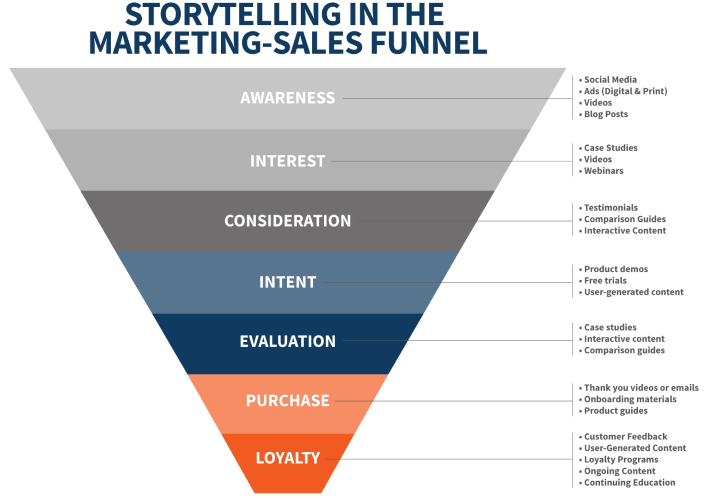
B2B storytelling uses stories to make complex business solutions easier to understand and more engaging. Instead of just talking about product features, it focuses on the customer’s challenges and successes, making the customer the hero and the brand the guide. This builds trust and helps drive better decisions
Historically, B2B marketing was about “selling to a building.” Today, we are selling to committees of humans who are exhausted by AI-generated noise.
Storytelling is the ultimate tool for cutting through this clutter because it provides what machines cannot: authentic context.
For a leading digital marketing agency, storytelling isn’t just about the words on a page; it is about the “Information Gain” you provide. When you share a unique brand narrative or a proprietary case study, you are giving search engines original data to index. In 2026, your story is your most valuable technical asset, ensuring your brand isn’t just a vendor, but a recognised entity in the global knowledge graph.
Why Should You Use Storytelling in the B2B Marketing Funnel
Why do we insist on stories in a world of data? Because 95% of purchase decisions are subconscious, even in the high-stakes world of B2B. While a buyer might justify a purchase with a spreadsheet, they choose the vendor based on trust. Stories trigger the release of oxytocin in the brain, which builds the “Trust Moat” your brand needs to survive long sales cycles.
Storytelling is the “secret sauce” that bridges the gap between a cold transaction and a lasting partnership. While logic justifies a purchase, emotion and trust drive the decision
As a strategic branding agency, we focus on the “Narrative Transportation” effect. When a prospect reads a well-crafted story, they mentally simulate the experience of using your product.
This reduces their perceived risk and increases their “Confidence Score” in your brand. By using storytelling at every stage of the funnel, you aren’t just giving them information; you are giving them a vision of their own future success.
The Difference between Marketing and Sales Funnel
The Marketing Funnel is about Demand Generation: it casts a wide net to capture interest and nurture it until a prospect is “sales-ready.”
Conversely, the Sales Funnel is about Deal Execution: it takes that nurtured lead and moves them through a high-touch, decision-based process to finalise the transaction.
| Feature | Marketing Funnel | Sales Funnel |
|---|---|---|
| Primary Goal | Awareness & Interest | Intent & Conversion |
| Stage Focus | Top and Middle (TOFU/MOFU) | Bottom (BOFU) |
| Metrics | Impressions, CTR, Leads (MQLs) | Proposals, Win Rate, Revenue (SQLs) |
| Ownership | Creative & Content Teams | Sales & Account Managers |
| Psychology | “Why do I need this solution?” | “Why should I buy from you?” |
The Three Stages of a Traditional B2B Marketing Funnel
Building a marketing funnel helps you understand how businesses make buying decisions. When you clearly identify your target customers’ pain points and what drives them, you can design a funnel that guides them smoothly toward a purchase.
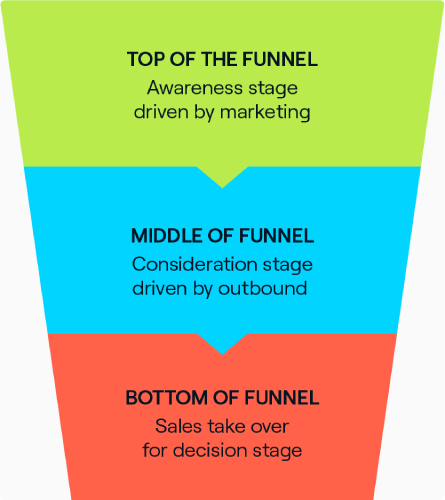
The three stages of a B2B marketing funnel are:
- Top of the Funnel (TOFU)
- Middle of the Funnel (MOFU)
- Bottom of the Funnel (BOFU)
TOFU: The “Call to Adventure” (Awareness)
The Top of the Funnel (TOFU) is where your story begins. In the “Hero’s Journey” framework, this is the Call to Adventure. Your prospect is the Hero, and they are currently facing a “Villain”, a recurring business struggle, a manual process, or a lack of growth. Your job is not to talk about your product yet, but to identify the Villain so clearly that the Hero feels seen.
To capture attention in 2026, your TOFU content must use “Scroll-Stopping” hooks that promise a resolution to this conflict.
- Identify the Conflict: Use educational videos or blogs to highlight the pain points of the status quo.
- Establish the Stakes: What happens if the Hero doesn’t act?
- Provide the Spark: Offer a new perspective that makes the Hero realise a solution is possible.
MOFU: The “Road of Trials” (Consideration)
The Middle of the Funnel (MOFU) is the “Road of Trials.” Your prospect knows they have a problem, and they are now evaluating their options. This is where most funnels fail because they pivot too quickly to “Sales Mode.” Instead, this is where you introduce your brand as the Mentor, the wise guide (like Gandalf or Obi-Wan) who provides the Hero with the knowledge and tools they need to succeed.
In this stage, any expert digital marketing agency will tell you that Case Studies should be treated as “Success Epics.” Don’t just list results; tell the story of the struggle, the pivot, and the eventual victory. This makes your data relatable and your brand indispensable.
BOFU: The “Ultimate Boon” (Conversion)
The Bottom of the Funnel (BOFU) is the “Ultimate Boon.” This is the moment where the Hero finally achieves the goal. Your product or service is the Magic Sword that allows them to defeat the Villain once and for all. At this stage, storytelling is used to remove the final friction of the purchase.
Use testimonials and demos to show the Hero exactly what life looks like after the transformation.
- Proof of Transformation: “Before we used Flora, our leads were cold; now, our pipeline is overflowing.”
- The ROI Chapter: Turn your pricing and technical specs into a narrative of efficiency.
- The Final Obstacle: Use “Risk-Reversal” stories to address any lingering doubts the Hero might have.
The B2B Storytelling Matrix
| Funnel Stage | Story Element | Content Format |
|---|---|---|
| TOFU | The Conflict | Viral Hooks, Educational Guides |
| MOFU | The Mentor | Case Studies (Success Epics), Webinars |
| BOFU | The Magic Sword | Product Demos, ROI Calculators |
Post-Funnel: The “Return with the Elixir” (Advocacy)
In 2026, the funnel doesn’t end at the sale. The final stage is the “Return with the Elixir,” where the Hero returns to their community to share their success. This is where storytelling turns a customer into an advocate. Happy customers become the protagonists of your next round of TOFU content, creating a self-sustaining narrative flywheel.
As a premier branding agency, we help our clients build communities where these stories can thrive. By providing a platform for your customers to share their wins, you aren’t just keeping them as clients; you are turning them into the primary authors of your brand’s future. Advocacy is the ultimate proof that your story wasn’t just marketing; it was a promise kept.
Conclusion
Building a strong B2B marketing funnel in 2026 requires a shift in perspective. You are not just building a process; you are crafting a journey. By positioning your customer as the Hero and your brand as the Guide, you create a narrative that is both technically sound for AI engines and emotionally resonant for human buyers.
The future of B2B belongs to the brands that can tell the best stories. If you are ready to transform your funnel from a series of facts into a compelling epic, it is time to partner with a strategic digital marketing agency. Let’s stop pitching and start guiding.
Frequently Asked Questions

Vasim Samadji is a partner at Flora Fountain, where he leads the Business and Marketing Strategy divisions. In a world where everyone is used to sugarcoating, his directness is often considered rude. But that shouldn't be a problem if you like the no-nonsense approach. Because he is a seasoned professional...