


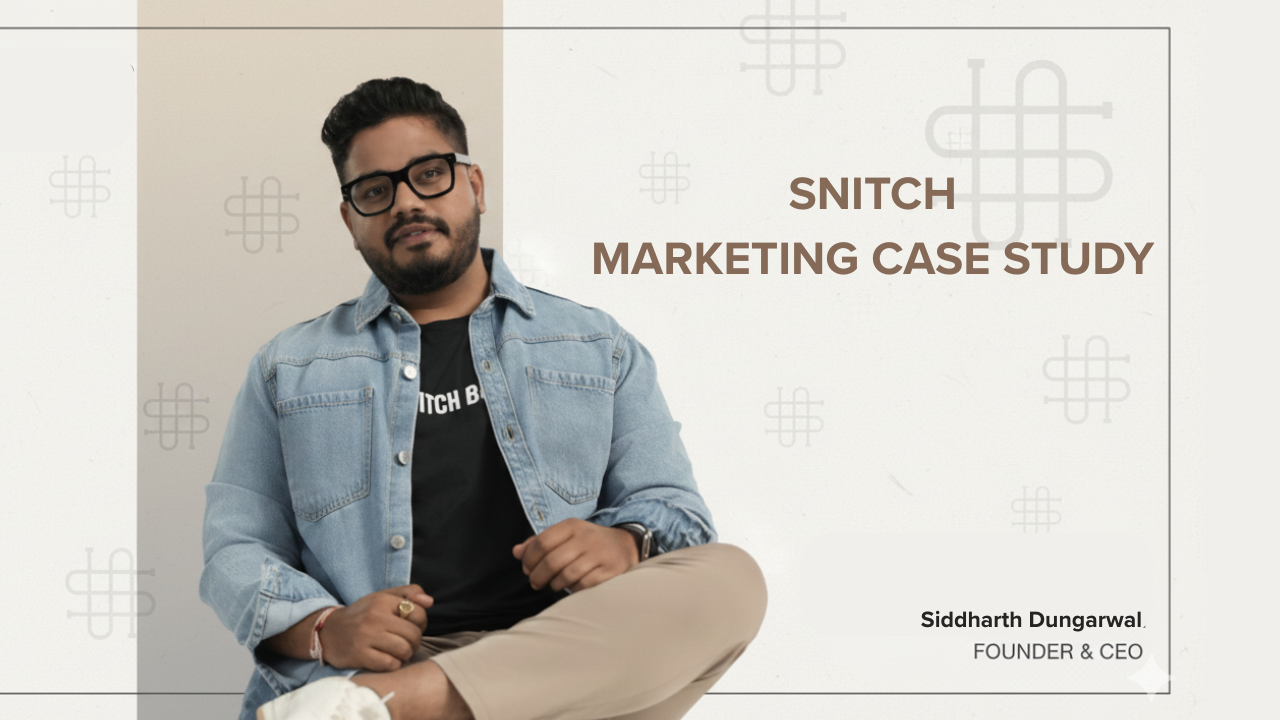
In 2021, Snitch was a relatively unknown men’s fashion brand generating ₹11 crore in annual revenue. By 2025, they crossed ₹520 crore with 51 profitable stores, an all-shark deal from Shark Tank India and a ₹2,500 crore valuation after raising ₹340 crore in Series B funding.
That’s 47x revenue growth in four years. In an industry dominated by global giants like Zara and H&M, and challenged by established Indian players, Snitch didn’t just survive. They redefined how fast fashion operates in India through speed, community building and relentless customer obsession.
For any brand that wants to build a strong D2C customer base in collaboration with a top digital marketing agency, studying D2C success stories, Snitch offers masterclass lessons in agile marketing, influencer strategies and omnichannel execution. Let’s examine how founder Siddharth Dungarwal built India’s fastest-growing menswear disruptor.
Table of Contents:
- The origins
- The Shark Tank India moment that changed everything
- The complete marketing strategy breakdown
- Influencer and creator economy dominance
- Social media mastery and community building
- Sales tactics and retention strategies
- What businesses can learn from Snitch
- Conclusion
- FAQs
The origins
Siddharth Dungarwal wasn’t new to fashion when he founded Snitch in 2020. His father ran Mr & Mr, a B2B men’s shirt manufacturing business that Siddharth joined after completing his B.Com. He learned manufacturing, understood fabric sourcing and built relationships with suppliers across India.
But B2B manufacturing had limitations. Margins were thin, brand control was minimal and growth depended on wholesale partnerships. Siddharth saw an opportunity in D2C, especially in men’s fashion, which lagged significantly behind women’s apparel in terms of variety and experimentation.
When COVID-19 hit in 2020, the B2B model collapsed as retail partners shuttered stores. Rather than waiting for recovery, Siddharth made a decisive pivot. He launched Snitch as a D2C digital-first brand targeting Gen Z and millennial men seeking experimental, affordable yet luxury fashion.
View this post on Instagram
The initial product range was modest, just 30 styles. But the approach was radical: 100% Made in India, 2-week design-to-shelf cycle versus industry standard of 3-6 months and direct customer relationships without intermediaries. Snitch positioned itself as “Made in India, Modern Style” for young men who wanted variety beyond the typical black t-shirt and jeans.
The Shark Tank India moment that changed everything
In February 2023, Siddharth appeared on Shark Tank India Season 2 seeking ₹1.5 crore for 0.5% equity, valuing Snitch at ₹300 crore. His pitch was compelling: the brand shipped 2,000+ orders daily, attracted 50,000 daily website visitors, had 5 lakh app downloads and generated ₹9.3 crore monthly revenue whilst remaining bootstrapped with 5% EBITDA margins.
What happened next became Shark Tank India history. All five sharks (Anupam Mittal, Aman Gupta, Namita Thapar, Peyush Bansal and Vineeta Singh) made a collective offer: ₹1.5 crore for 1.5% equity (0.3% each) at ₹100 crore valuation.
Siddharth accepted without hesitation. He’d made it clear from the beginning that he wanted all five sharks or none, valuing their collective expertise over valuation maximisation. Each shark brought different strengths: Anupam’s consumer internet experience, Aman’s youth marketing insights, Namita’s health and wellness perspective, Peyush’s retail operations knowledge and Vineeta’s beauty and personal care expertise.
The Shark Tank appearance delivered immediate benefits beyond capital. National television exposure introduced Snitch to millions of potential customers. The all-shark deal provided credibility with investors, partners and customers. Anupam Mittal even collaborated on “King of Bling”, a limited-edition collection featuring blingy shirts and vibrant patterns specifically designed with his input.
View this post on Instagram
The complete marketing strategy breakdown
Snitch’s marketing approach revolves around speed, community and customer centricity rather than traditional advertising spend.
Speed obsession
Snitch operates on 2-week design-to-shelf cycles compared to the industry standard of 3-6 months. This speed enables them to capture trends whilst they’re hot, responding to social media fashion movements in real-time. When a style goes viral on Instagram, Snitch can have similar designs available within days, not quarters.
Customer centricity
Snitch invested heavily in technology to personalise customer experience. Their AI style recommender analyses browsing behaviour, purchase history and style preferences to suggest relevant products. This increases conversion rates whilst reducing decision fatigue.
The Snitch X loyalty programme rewards repeat purchases, referrals and engagement. Members receive early access to new drops, exclusive discounts and personalised recommendations. This programme has delivered 10% retention uplift whilst providing valuable customer behaviour data.
Community building
The #SnitchIt campaign transformed customers into brand ambassadors. User-generated content showcasing how customers style Snitch products floods Instagram daily. The brand features customer photos on its feed, creating aspirational peer validation that advertising cannot replicate.
With 400,000+ Instagram followers, Snitch maintains an engaged community through behind-the-scenes content, styling tips and interactive polls. Rather than broadcasting product promotions, they create conversations about fashion, style and self-expression.
Influencer and creator economy dominance
Whilst traditional fashion brands spend crores on celebrity endorsements, Snitch built its influence strategy around nano and micro-influencers through the Snitch Squad programme.
View this post on Instagram
The economics are compelling. A single mega-celebrity post might cost ₹5 lakh and reach millions with low engagement. The same budget deployed across hundreds of nano-influencers (1,000-10,000 followers) and micro-influencers (10,000-100,000 followers) generates dozens of authentic content pieces with much higher engagement rates.
These creators produce real-world styling content showing how Snitch fits into everyday wardrobes. Their followers trust recommendations because they’re peers, not paid celebrities. The content feels genuine rather than staged, which resonates with Gen Z audiences sceptical of traditional advertising.
View this post on Instagram
Snitch automated influencer management through site banners and email outreach, creating frictionless processes for creators to join the programme. Influencers receive free products, commission on sales generated through their links and featured placement on Snitch’s social channels.
Social media mastery and community building
Snitch treats social media as their primary discovery and engagement channel rather than just a promotional tool. Instagram serve as a digital storefront where customers browse, discover and connect with the brand daily.
Their content strategy emphasises style inspiration over product promotion. Reels showcase different ways to wear pieces, mixing and matching items for various occasions. How-to videos teach styling techniques. Trend-jacking content positions Snitch as culturally aware and relevant.
View this post on Instagram
The #SwitchToSnitch (The first campaign they ever launched) challenges encourage customers to share transformation content, showing their style evolution after discovering Snitch. These challenges generate viral moments whilst demonstrating product impact in authentic contexts.
View this post on Instagram
User-generated content dominates their feed, with customer photos and videos featuring prominently. This approach serves multiple purposes: it provides endless fresh content, makes customers feel valued, shows products in real-world contexts and creates aspirational peer validation.
Working with a digital marketing agency that understands creator economy dynamics and platform-specific content strategies has been crucial to Snitch’s social media success. Generic social media management doesn’t work in fast fashion. Platform-native, trend-responsive content creation requires specialist expertise.
Sales tactics and retention strategies
Snitch employs sophisticated retention mechanics that keep customers returning rather than treating each purchase as a one-time transaction.
Automated cart recovery through WhatsApp and SMS captures 15-20% of abandoned carts, a critical metric for e-commerce profitability. Personalised messages remind customers about items left behind, often including limited-time discount codes to drive conversion.
Flash sales create urgency whilst clearing inventory. Birthday sales offer 50% discounts on new drops. Black Friday campaigns have become annual events, with 2025 delivering 5 lakh units sold in 3 days (116 units per minute) at 4x year-over-year growth, with 90% of sales through owned channels.
(Source: BW Retail World)
View this post on Instagram
Half of Snitch’s customers are repeat purchasers, demonstrating strong retention. Real-time inventory visibility and customer feedback loops ensure popular items restock quickly whilst slow movers get discounted and cleared efficiently.
Buy now, pay later integration through BharatX (branded as SnitchPay) removes purchase barriers for price-sensitive customers. Three instalment options with zero interest increase average order value whilst maintaining accessibility.
What businesses can learn from Snitch
Snitch’s journey offers actionable insights for businesses across categories.
- Speed as a Competitive Advantage:In trend-driven categories, responding faster than competitors creates differentiation that budget alone cannot overcome. Investing in processes and relationships that enable rapid iteration is more effective than relying on perfect planning.
- Influencer Economics Over Celebrity Endorsements:Hundreds of nano and micro-influencers generate more authentic content and deliver better ROI than expensive celebrity partnerships. Working with a branding agency in Ahmedabad that understands creator economy dynamics enables the creation of systematic and scalable influencer programmes.
- Community as a Sustainable Moat:User-generated content, customer advocacy and engaged communities create competitive advantages that competitors cannot simply buy. Community building should be treated as a long-term marketing strategy rather than a short-term promotional tactic.
- Omnichannel Is the Present:Pure digital and pure retail models both face limitations. A strategic blend of digital efficiency with physical touchpoints delivers a superior customer experience while improving overall unit economics.
- Retention Over Acquisition:As customer acquisition costs continue to rise, customer lifetime value becomes a critical driver of profitability. Loyalty programmes, personalisation and automated retention mechanisms should receive equal focus and investment as acquisition channels.
- Unit Economics Drive Sustainability:Growth without profitable unit economics only delays failure. Sustainable scaling requires reducing customer acquisition cost, increasing lifetime value and achieving a positive contribution margin before aggressive expansion.
- Operational Excellence Backs Marketing Promises:Marketing creates expectations, but operations deliver reality. Snitch’s two-week cycle promise depends on strong manufacturing partnerships, efficient inventory systems and reliable logistics. Strategic alignment between marketing and operations is essential.
- Authenticity Resonates with Gen Z:Gen Z audiences detect inauthenticity instantly and respond by disengaging. Genuine community engagement, transparent communication about challenges and a real customer focus build trust that traditional advertising cannot manufacture.
Conclusion
Snitch’s journey from a $1.3 million (₹11 crore) bootstrapped startup to a $62 million (₹520 crore) omnichannel enterprise, now valued at $300 million (₹2,500 crore), offers a powerful lesson: D2C dominance demands more than funding. It requires an obsession with speed, genuine community building, unwavering customer centricity, and operational excellence working in perfect alignment.
Their marketing model prioritizes influencer partnerships over expensive celebrity endorsements, authentic user-generated content over glossy campaigns, and leveraging owned channels rather than over-reliance on paid advertising. This sustainable approach is a definitive blueprint for success in the creator economy. While the Shark Tank deal provided significant acceleration and validation, the core of their foundation was built on tireless execution well before television exposure. Snitch proves that Indian D2C brands can achieve global competitiveness by crafting India-first strategies and executing them with world-class discipline. This is the new standard for marketing evolution.
Ready to Scale Your Brand?
Are you a D2C brand based in Ahmedabad looking to achieve a similar category disruption? To navigate the competitive digital landscape and execute your vision with world-class discipline, partner with an experienced Branding agency in Ahmedabad that understands the local pulse and the global standard of growth.
FAQs

Vasim Samadji is a partner at Flora Fountain, where he leads the Business and Marketing Strategy divisions. In a world where everyone is used to sugarcoating, his directness is often considered rude. But that shouldn't be a problem if you like the no-nonsense approach. Because he is a seasoned professional...