


A decade ago, buying your favourite snack meant a small ritual: a walk to the store, browsing aisles, maybe chatting with the shopkeeper and leaving with a familiar brand memory. Today, that entire journey fits inside a 10-minute delivery window. Quick commerce has changed not just how fast we buy, but how little we feel while buying. Everything is efficient, instant and forgettable.
And that’s where the problem and the possibility begin. For food and beverage brands, quick commerce is a whole new stage where the only physical connection between brand and buyer is the packaging itself. When speed kills storytelling, packaging has the power to bring it back to slow down the experience, spark curiosity and make the brand memorable again.
Table of Contents:
- The new rules of brand experience
- Why quick commerce has created a branding vacuum
- Blinkit’s bag: A masterclass in emotional branding
- Turning speed into storytelling
- The design thinking behind interactive packaging
- Why this matters for F&B brands specifically
- Before you redesign your packaging, keep this in mind
- The opportunity ahead
- Frequently Asked Questions
The new rules of brand experience
Blinkit, Zepto and Swiggy Instamart have spoiled us. We no longer plan purchases; we impulse-tap. Most of us aren’t walking through shelves anymore. Hence, the brand’s biggest storyteller, its packaging, is now hidden behind an app tile until it lands at someone’s door.
That means the unboxing moment, earlier reserved for premium or D2C brands, is now the only real-world moment your brand has. For many F&B brands, that’s the last five seconds before the packet is opened and forgotten.
The question is: what happens in those five seconds?
That’s where packaging design, long treated as functional or aesthetic, suddenly becomes a strategic weapon.
Why quick commerce has created a branding vacuum
In traditional retail, a consumer spends an average of 7 seconds deciding on a product on the shelf. During that time, packaging design, colours, claims and shape all worked together to build recall. In quick commerce, that moment doesn’t exist.
Today, shoppers see one product image and a delivery ETA. Their decision is driven by convenience, not curiosity. So, when the product finally arrives, there’s no emotional residue, no brand story left behind. It’s efficient, but empty.
Quick commerce has inadvertently created a branding vacuum. The brand’s digital presence belongs to the platform; the marketing moment belongs to the algorithm. The only asset a brand truly owns is its packaging.
And that’s where the game begins.
Blinkit’s bag: A masterclass in emotional branding
Let’s look at Blinkit. Their delivery bags are simple yet quirky, which makes them already memorable in India’s visual clutter. But what really stands out is how those bags have evolved into something people reuse, doodle on, paint over or turn into art.
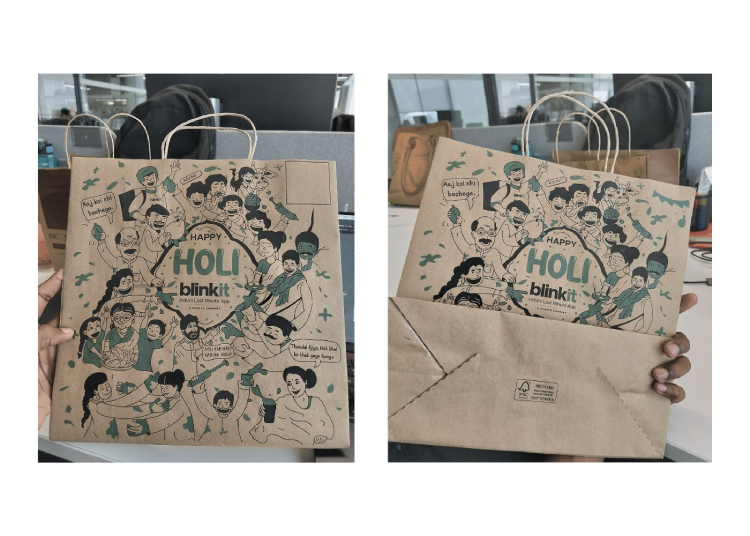
Himanshu Kumar’s Holi Special Doodles on Grocery Bags of Blinkit
Blinkit designed something that invited interaction. The result? Free user-generated content flooding social media, people posting painted bags, DIY crafts and even tote transformations.
View this post on Instagram
What Blinkit achieved was memory. The kind of recall that survives long after the product is consumed. And Blinkit didn’t stop. Its packaging changes as the festival arrives to give the customers a new feel, a new experience altogether. Isn’t that something all F&B brands take inspiration from?
Could your cookie box, milk carton or snack pouch spark the same kind of engagement?
The Psychological Impact on Consumers Due to Such Packaging
Humans remember what they interact with. When we touch, twist, tear, reuse or even laugh at packaging, it anchors itself in memory.
It’s the same reason why a cereal box maze or a cut-out token worked so well in our childhood. That sense of ownership and play created emotion and emotion drives recall.
When brands add small, thoughtful elements that invite users to do something colour, fold, scan, share or collect, they’re not just adding design; they’re building connection.
That’s why Blinkit’s bag worked. That’s why Kellogg’s Chocos boxes with little mazes or cut-and-play games work. They make you spend time with the brand. In quick commerce, time is currency.
Turning speed into storytelling
Quick commerce brands have trained consumers to expect instant gratification. But that doesn’t mean storytelling has to slow down it just needs to adapt.
Think of packaging as a micro-storyboard. You have five seconds and one surface to say something worth remembering. That something could be:
- A fun interactive design (a doodle area, maze or trivia puzzle).
- A QR code leading to a short video or AR experience.
- A witty message that surprises at unboxing (E.g. Congrats, you found this message before your snack disappeared).
- Or even a small reusable element, a box that folds into something useful, a label that becomes a sticker or packaging that transforms post-use.
It’s about giving consumers a reason to engage. Because in quick commerce, you don’t need a big storytelling window. You just need a sticky moment.
View this post on Instagram
The design thinking behind interactive packaging
Design thinking teaches us that good design solves human problems. In the age of instant commerce, the problem isn’t awareness; it’s attachment.
Consumers are buying the same brands more frequently but feeling less connected to them. Packaging that encourages engagement can help rebuild that bridge.
Here’s how design thinking can guide it:
- Empathise: Understand the delivery journey. What does the consumer see, feel and do when they receive your product in under 10 minutes?
- Define: What emotion do you want to trigger? Joy, nostalgia, curiosity, laughter, surprise?
- Ideate: Think small. The best ideas aren’t expensive overhauls, they’re clever details. A tear-off recipe card. A fun QR playlist. A collectable doodle panel.
- Prototype: Test your idea in small batches. Limited-edition packaging is a great playground.
- Test & Amplify: Watch how people react online. Encourage UGC subtly. The feedback loop will shape your next design.
Why this matters for F&B brands specifically
F&B is one of the fastest-moving categories on quick commerce platforms. Products are bought, consumed and forgotten faster than ever. But it’s also the category with the most sensory potential.
A beverage brand can trigger playfulness. A snack brand can evoke nostalgia. A breakfast brand can bring back morning rituals. Packaging can become a silent storyteller for each of these.
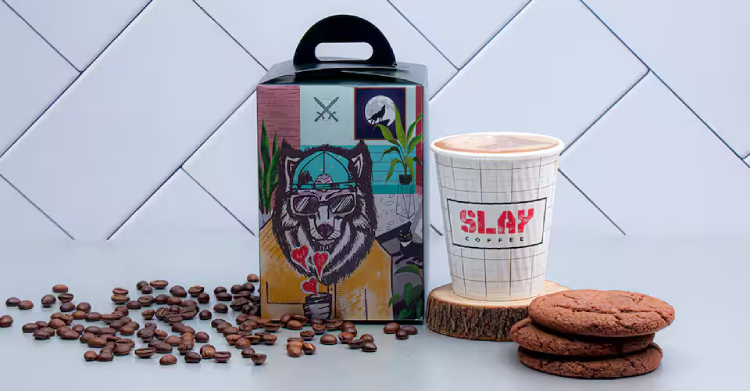
More importantly, F&B brands have repeat customers. So, if your packaging delivers a small delight or memory every single time, you’re building cumulative loyalty and not just awareness.
The key is to think of packaging as media. It’s not a wrapper. It’s a billboard in someone’s kitchen, a moment in their routine, a touchpoint on their dining table.
Before you redesign your packaging, keep this in mind
Before diving into interactive packaging, here are three strategic filters every brand manager should consider:
- Authenticity over aesthetics: Don’t add games or QR codes for the sake of being “cool.” Every element should align with your brand story. If your brand stands for mindfulness, design packaging that calms, not clutters.
- Simplicity wins: Consumers engage more with ideas that are effortless. One clean, clever interaction works better than complex mechanics that demand effort.
- Scalability matters: Test interactive packaging in limited runs. See how your audience responds before scaling it across SKUs. Quick commerce audiences are diverse — what delights one segment might confuse another.
When done right, packaging can become your most cost-effective media channel. When done wrong, it can confuse or distract. The trick lies in balancing creativity with clarity.
The opportunity ahead
We’re living in an age where speed has replaced experience and yet, connection is what consumers crave most. Quick commerce has made everything instant purchases, deliveries and even gratification, but it has also made everything fleeting. That’s why packaging can no longer just protect the product; it has to protect the brand memory.
This is the space where smart F&B brands will win, not by being louder, but by being stickier. Interactive packaging can make consumers pause, smile or share, even in a world that runs on swipes. Think of it as designing a small, meaningful moment that breaks the autopilot mode of consumption.
So maybe the question isn’t whether you should redesign your packaging for the quick commerce era. The real question is: Can your packaging still tell a story when you’re no longer on the shelf?
If the answer is no, it might be time to rethink your design strategy.
As a branding agency, we help F&B brands design digital-first, memorable experiences that stay with consumers long after the order is delivered. If you’re exploring how to make your packaging your next storytelling tool, we’d love to help you bring that vision alive.
Frequently Asked Questions

The founder and partner of Flora Fountain, Shefali leads the Content and Technology divisions. A one-time engineer who started her career writing front-end code, she took a detour sometime during her 9 years in New York, studied journalism and started writing prose, poetry and sometimes jokes. She now has 15...